

What if a family limited partnership is less about finding a tax shortcut and more about deciding who will manage family assets, and how? If you’re considering a family limited partnership Uxbridge MA families may use for business succession or estate planning, it’s natural to wonder whether it can help without giving up too much control or creating avoidable family conflict.
Those concerns matter. An FLP assigns different roles to general and limited partners, and its practical value depends on how the partnership is structured and managed. It isn’t automatically the right fit for every family or a simple answer to liability, tax, or inheritance questions. Understanding the responsibilities, costs of administration, and decision-making arrangements can help you weigh the trade-offs.
This article explains how an FLP works in Massachusetts, what to consider about control, family dynamics, taxes, liability, and recordkeeping, and how it compares with options such as trusts and LLCs. You’ll also find practical questions to consider as you assess whether this structure supports your family’s goals and long-term plans in Worcester County, including Uxbridge, or Middlesex County.
Key Takeaways
- An FLP is a legal partnership structure, not an automatic tax or asset-protection solution; its value depends on your family’s goals and circumstances.
- Consider how partner roles, asset choices, documents, and ongoing administration will affect family decision-making.
- Compare a family limited partnership Uxbridge MA families may consider with an LLC, trust, or will. Each serves a different purpose.
- Use a practical checklist to weigh potential benefits against recordkeeping demands and the possibility of family disagreements.
- Gather asset records, business documents, existing plans, and family goals to make a discussion about your options more focused.
What is a Family Limited Partnership in Uxbridge, MA?
A family limited partnership (FLP) is a legal partnership in which family members hold different roles in managing and owning partnership interests. Families may use one to organize certain assets under a shared structure or to plan who will manage a family business over time. The idea can sound straightforward, but creating an FLP doesn’t automatically produce tax savings, protect assets, or prevent disputes. Its effect depends on the assets involved, the documents, and how the partners operate the partnership.
A general partner manages the partnership and makes decisions within the authority set by its governing documents and applicable law; limited partners hold partnership interests and generally have a less active management role. That distinction is a starting point, not a promise of absolute protection from liability or a complete description of anyone’s rights. The Family Limited Partnership overview explains common structures and uses, but Massachusetts-specific consequences depend on the details of the arrangement.
How do general partners and limited partners differ?
General partners typically handle day-to-day management, such as overseeing partnership affairs and making decisions allowed by the partnership agreement. Limited partners generally hold an ownership interest without taking the lead in ordinary management. Their role may still include rights set out in the documents and law. The agreement and applicable law determine authority, responsibilities, and the consequences of particular actions, so labels alone don’t settle every question.
For a family, these roles raise practical questions: Who should make management decisions? How will other partners receive information? What happens if a general partner can no longer serve, or family members disagree? Deciding how to handle these situations early can make expectations clearer. It also helps reveal whether the family is comfortable separating management authority from ownership interests.
Why might a Uxbridge family consider an FLP?
A family with a closely held business or other shared assets may want a clearer framework for managing them and planning future leadership. For example, relatives involved in a business might explore how management could continue as responsibilities change over time. An FLP can provide a structure for those conversations, but it won’t resolve disagreements on its own or guarantee a particular succession or tax outcome.
Whether a family limited partnership Uxbridge MA is worth exploring depends on what the family owns, what it hopes to accomplish, and how much decision-making control it wants to retain. Start by clarifying the family’s aims before choosing a structure:
- Assets: Which family assets or business interests are being considered, and are they appropriate for a partnership structure?
- Goals: Is the priority coordinated management, succession planning, or another estate-planning objective?
- Control: Who would manage the partnership, and how would the family handle changes or disagreement?
An FLP is one possible part of a broader estate and business succession plan, not a fit for every family, property, or business. Compare its responsibilities with the family’s goals to see whether it supports continuity or adds complexity without enough practical value.
How a Family Limited Partnership Is Structured Under Massachusetts Law
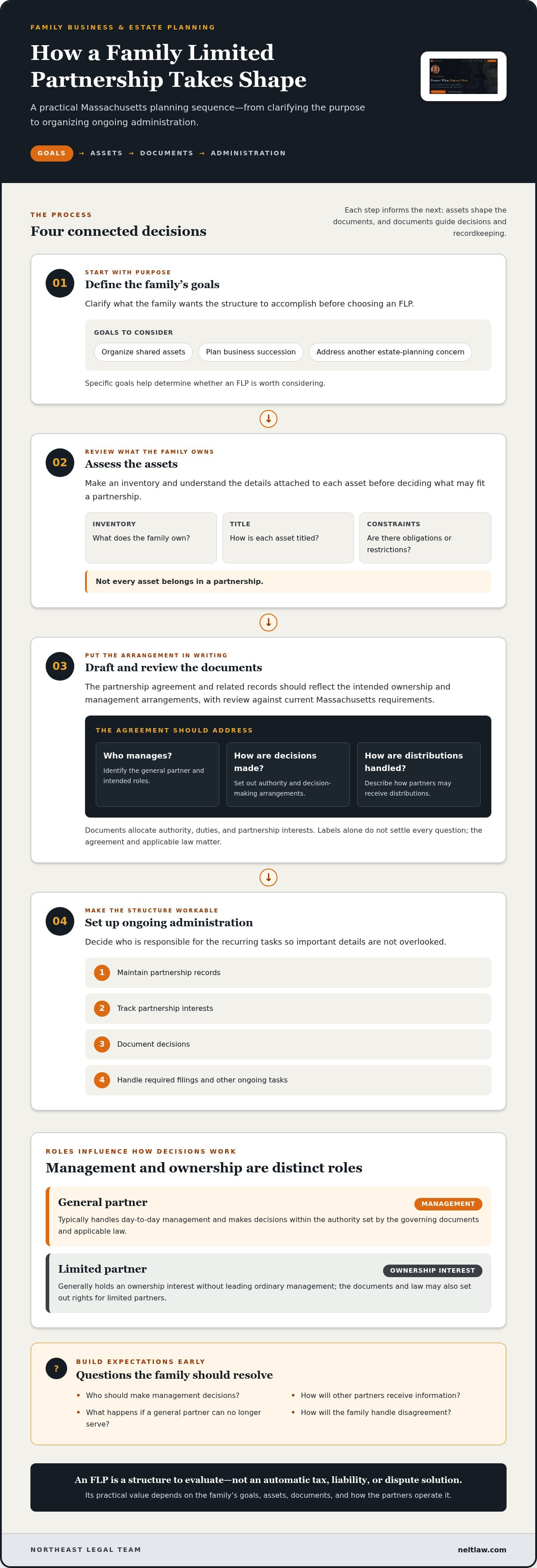
Building an FLP involves a series of connected decisions, not simply signing an agreement. Start by identifying the family’s goals, then review which assets might fit, prepare governing documents, and establish a workable approach to administration. Each step affects the next: the assets shape the documents, while the documents guide how partners make decisions and keep records.
An FLP’s documents allocate authority, duties, and partnership interests. That allocation should reflect the family’s intended roles and be reviewed in light of current Massachusetts law and relevant tax rules. Cornell Law School’s Family Limited Partnership definition and explanation offers a general overview, but it can’t determine how a particular agreement or asset transfer will be treated in Massachusetts.
- Define the goals. Clarify whether the family wants to organize assets, plan for business succession, or address another estate-planning concern. Specific goals help determine whether an FLP is worth considering.
- Assess the assets. Make an inventory of what the family owns, how each asset is titled, and whether there are existing obligations or restrictions. Not every asset belongs in a partnership.
- Draft and review the documents. The partnership agreement and related records should reflect the intended ownership and management arrangements. Review the documents against current Massachusetts requirements.
- Set up administration. Decide who will maintain records, track partnership interests, document decisions, and handle required filings or other ongoing tasks. Assigning responsibility helps prevent important details from being overlooked.
What decisions shape the partnership agreement?
The agreement should describe who serves as general partner, how decisions are made, and how partners may receive distributions. It should also address transfers of interests and succession if a partner dies, becomes unable to serve, or wants to leave. Written procedures give relatives a shared reference point when disagreements arise. Because legal requirements and tax consequences can change, the terms should be reviewed in light of the family’s circumstances before the family relies on them.
Consider a family business where one relative manages daily operations and others hold partnership interests. The documents can clarify which decisions belong to the manager and which require broader approval. They can also set expectations for sharing information and handling a proposed transfer. These details don’t eliminate conflict, but they can make the decision-making process less uncertain.
What happens when family assets enter the partnership?
First, confirm ownership and gather supporting records, such as account statements, business documents, deeds, or existing agreements. The family may also need to assess asset values and identify how each proposed contribution should be documented. A transfer can involve more than changing a name on a record. Real estate, business interests, and financed property may raise distinct title, lender, contractual, or tax questions.
Before transferring an asset, understand the required steps and possible consequences. Contributing an asset to an FLP doesn’t automatically create tax savings or creditor protection. A personalized estate planning assessment can help connect a proposed structure with the family’s succession needs, documents, and broader goals.
Family Limited Partnership vs. LLC, Trust, or Will: What Changes?
These tools can seem interchangeable because each may form part of a family’s plan, but they serve different legal purposes. An FLP organizes partnership interests and management. An LLC is a business entity that can hold and manage assets under its governing documents. A trust can hold assets under terms set by its creator, while a will gives instructions for distributing property at death. Choose a point of comparison by identifying the problem you want to solve, not by focusing on the name of a structure.
| Structure | Main purpose | Management and beneficiaries | Administration and limitations |
|---|---|---|---|
| Family limited partnership | Organize family-owned assets or business interests | General partners typically manage; limited partners hold interests. The agreement defines rights and distributions. | Requires partnership documents and ongoing administration. It doesn’t automatically avoid probate, taxes, or creditor claims. |
| LLC | Operate or hold assets through a limited liability company | Members own interests; management follows the operating agreement and applicable law. | Requires entity records and ongoing compliance. Its protections and tax treatment depend on circumstances and proper operation. |
| Trust | Hold and manage property under trust terms | A trustee manages trust property for beneficiaries named or described in the trust. | Assets generally need to be properly transferred or designated. A trust doesn’t automatically address every tax, business, or creditor concern. |
| Will | Direct how property should be handled at death | Names beneficiaries and can nominate a personal representative, subject to applicable law. | Doesn’t manage assets during life; property passing under a will may go through probate. |
When might an LLC or trust be a better comparison?
Consider an LLC if the central question is how to organize and manage a business or asset-holding entity. Consider a trust if the family’s focus is how a trustee should manage property for beneficiaries under specific terms. Neither is universally better than an FLP. Compare the choices against the assets involved, who should make decisions, who should benefit, and how the family expects its needs to change. Families planning a business transition can also explore Massachusetts business succession planning.
Does an FLP replace a will or estate plan?
No. Partnership documents govern the partnership, but they don’t replace a complete estate plan. A will, beneficiary designations, powers of attorney, healthcare directives, and any trust should be reviewed together so their instructions work as intended. An FLP also doesn’t automatically keep assets out of probate or eliminate taxes or creditor claims. The result depends on ownership, applicable law, and how each plan is structured and maintained.
For a family limited partnership Uxbridge MA families are considering, the useful comparison is how each option fits the family’s full picture, not which one sounds most protective. Coordinating the documents can help reduce gaps or conflicting instructions. A flat-fee estate planning guide can help explain how estate planning fits into that broader review.
Is a Family Limited Partnership Worth the Complexity for Your Family?
An FLP may help organize family assets or support a business transition, but the ongoing work can outweigh its value for some families. Maintaining records, following the partnership agreement, and coordinating tax and legal responsibilities take time. The central question isn’t whether an FLP can be useful in theory. It’s whether its practical role justifies the responsibilities for your family.
Evaluate an FLP against your family’s goals, the duties it creates, and the alternatives available. Potential planning uses are not guaranteed outcomes. Whether a partnership affects taxes, liability, or succession depends on the facts, the documents, how the arrangement is maintained, and the applicable rules. Work through this checklist:
- Assets: Are the assets you’re considering suitable for shared partnership ownership and administration?
- Goals: What specific management, succession, or estate-planning need should the structure address?
- Partner roles: Are the proposed managers and other partners comfortable with their authority and responsibilities?
- Recordkeeping: Who will maintain financial records, document decisions, and track ownership interests?
- Family communication: Can relatives discuss expectations about control, distributions, and future changes?
What responsibilities continue after setup?
Creating the partnership is only the beginning. Partners should follow the governing documents, keep ownership and financial records organized, and document important decisions. Tax filings and other reporting depend on the partnership’s circumstances, so don’t assume a single set of forms or deadlines applies to every FLP. Review current federal and Massachusetts obligations and assign responsibility for ongoing tasks so they don’t fall between family members.
Administration can feel manageable when roles are clear and the family has a reliable process. It may feel burdensome if no one wants to handle records or decisions, or if the structure requires more coordination than the assets and goals justify. Be candid about that trade-off before moving forward.
Which family circumstances deserve closer review?
An FLP merits careful review when a family business has multiple owners, succession plans are unsettled, or assets are varied and complex. Family members may disagree about who should lead, whether distributions are appropriate, or when an interest can be transferred. Different financial needs or visions for the business can also affect whether the arrangement feels fair and workable.
Those concerns don’t automatically rule out an FLP. They do make clear written expectations and open family communication especially valuable. If relatives have different goals, identify the points of disagreement before choosing a structure. That conversation can help show whether an FLP supports a shared plan or adds another layer of tension and administration.
For families considering a family limited partnership Uxbridge MA, a personalized review can compare the structure with business succession and broader estate-planning needs. Explore a personalized estate-planning assessment to clarify your goals, responsibilities, and possible alternatives.
Discussing a Family Limited Partnership With an Uxbridge Estate Planning Attorney
A productive planning conversation starts with a clear picture of what your family owns and hopes to accomplish. You don’t need to have already decided that an FLP is the answer. Bring the information you have, note what remains uncertain, and use the discussion to consider how a potential structure fits with your estate plan and any business succession needs.
What should you prepare for an initial planning conversation?
Gather records that help explain ownership, obligations, and your family’s priorities. A complete file isn’t necessary to begin, but these materials can make it easier to identify questions and potential complications:
- Asset information: List major assets, current owners, and how each is titled. Include relevant ownership records for real estate, investments, and business interests.
- Business documents: Bring operating or partnership agreements, ownership information, and any written succession plans that relate to a family business.
- Existing estate documents: Gather current wills, trusts, powers of attorney, and healthcare directives so the proposed approach can be considered alongside them.
- Family priorities: Note who you expect to make future decisions, what concerns you about control or succession, and where family members may have different expectations.
It can also help to write down questions in advance. For example, consider how management authority might be assigned, how a proposed plan could affect existing ownership arrangements, and what ongoing responsibilities the family would need to handle. Specific questions keep the conversation focused on decisions that matter to your family.
How can a Massachusetts planning assessment clarify your options?
A personalized assessment can consider whether an FLP fits your assets and goals, or whether another planning approach may better address a particular need. Northeast Legal Team can review the proposed structure and documents, consider succession priorities, and identify how the plan may need to coordinate with wills, trusts, and other estate-planning documents. Tax and legal consequences depend on the facts, so the discussion should focus on your circumstances rather than broad promises about results.
Northeast Legal Team works with families on estate planning, asset protection, and business succession planning. Uxbridge families in Worcester County, as well as families in Middlesex County, considering a family limited partnership Uxbridge MA can use a planning conversation to clarify desired roles, family concerns, and practical next steps. The firm offers a free consultation or assessment without obligation, providing a starting point for discussing personalized recommendations.
To discuss your family’s planning needs, schedule a consultation.
Choose a Next Step That Fits Your Family
You don’t have to settle every planning question before moving forward. Start by choosing one priority, such as clarifying who should guide a family business or making sure your existing plans reflect your wishes. That focus can make a conversation about a family limited partnership Uxbridge MA families are considering more practical and less overwhelming.
The right structure should fit your family’s assets, relationships, and responsibilities, not just sound appealing in theory. Northeast Legal Team helps families consider estate planning, asset protection, and business succession needs together. A free consultation or assessment without obligation can be a starting point for discussing your goals and possible approaches, without assuming an FLP is the answer.
If you’re ready to talk through what matters most to your family, schedule a free estate planning consultation. A thoughtful conversation can help you move ahead with greater clarity and confidence.
Frequently Asked Questions
Can a family limited partnership protect assets from creditors in Massachusetts?
An FLP doesn’t make family assets unreachable by creditors. A creditor’s options can depend on who owes the debt, whether the asset belongs to the partnership or a partner, the partnership agreement, and applicable law. Personal guarantees, existing claims, and transfers made to hinder creditors can raise separate concerns. Before moving assets into a partnership, consider the specific ownership and debt situation rather than relying on a general promise of protection.
Does a family limited partnership avoid probate in Massachusetts?
Not automatically. Property titled in the partnership’s name may be treated differently from property an individual owns directly, but a deceased partner’s partnership interest still needs a planned path. Depending on the agreement and the partner’s estate plan, that interest may need to be addressed through probate or another transfer process. For example, the agreement might outline what happens to an interest after death, but it should coordinate with the partner’s will and other documents.
How are family limited partnerships taxed by the IRS?
For federal tax purposes, an FLP treated as a partnership generally passes tax items through to its partners rather than paying income tax as a separate corporation. The partnership may have filing and information-reporting responsibilities, and partners generally report their allocated shares even if they don’t receive an equivalent cash distribution. Tax treatment depends on the partnership’s classification and circumstances, so review current federal and Massachusetts rules before forming or funding one.
Can a family limited partnership own real estate in Massachusetts?
Yes, an FLP can own real estate if the property is properly conveyed to it and the transfer is completed under applicable requirements. Before transferring a Uxbridge property, review the deed, current ownership, any mortgage or other agreement, and possible tax and recording consequences. A transfer can affect more than the name on title. Evaluate the specific property and ownership arrangements before taking action.
Who can be a general partner in a family limited partnership?
A general partner may be an individual or, where permitted by the governing documents and applicable law, an entity. The choice affects who will make management decisions and carry out the general partner’s responsibilities. For example, a family may consider whether one person has the time and judgment for the role, or whether an entity-based arrangement better fits its plans. The partnership’s governing documents and applicable law determine eligibility and authority.
Is a family limited partnership the same as a family trust?
No. An FLP is a partnership with general and limited partners, while a trust is an arrangement in which a trustee manages property under trust terms for beneficiaries. They can address different needs and may sometimes be used together, but one doesn’t automatically replace the other. A family in Worcester or Middlesex County can compare the structures by asking who should manage each asset, who should benefit, and what instructions should apply during life or after death.
What happens to a family limited partnership when a general partner dies?
The result depends on the partnership agreement and applicable law. The documents may provide a process for appointing a successor or continuing the partnership; without clear provisions, the death may raise questions about management, continuation, or winding up. Families should also consider how the deceased partner’s interest is handled and whether the will or trust aligns with the agreement. Reviewing succession provisions in advance can help the family understand its next steps.


