

What if a trust can help shield a beneficiary’s inheritance but can’t keep every creditor away? If you’re asking “what is a spendthrift clause in a trust Templeton MA,” you’re likely trying to understand how much protection it really offers. The key distinction is whether assets are still held in the trust or have already been distributed to a beneficiary.
In Massachusetts, a valid spendthrift provision generally restricts both a beneficiary’s ability to transfer their trust interest and a creditor’s ability to reach it. That protection has limits. Certain claims, including child support and alimony, may reach a beneficiary’s interest, and funds generally are no longer protected by the clause once distributed. The rules also differ when someone creates a trust for their own benefit.
This guide explains how spendthrift clauses work under Massachusetts law, what they may protect, and where they fall short. You’ll also learn what to consider before adding one, including how trustee discretion and distribution terms can affect the plan. These details can help you discuss how a trust may fit your family’s goals with a Massachusetts estate-planning attorney.
Key Takeaways
- Learn what is a spendthrift clause in a trust Templeton MA and how it can restrict transfers of a beneficiary’s trust interest.
- Understand why assets held in a trust may be treated differently from funds already distributed to a beneficiary.
- Explore the limits of spendthrift protection under Massachusetts law, including situations that may call for closer review.
- Consider how a beneficiary’s needs, potential creditor concerns, and future distributions may shape whether this provision fits a family trust.
- Prepare for a conversation with an estate-planning attorney by gathering your goals, asset details, concerns, and existing documents.
What Is a Spendthrift Clause in a Massachusetts Trust?
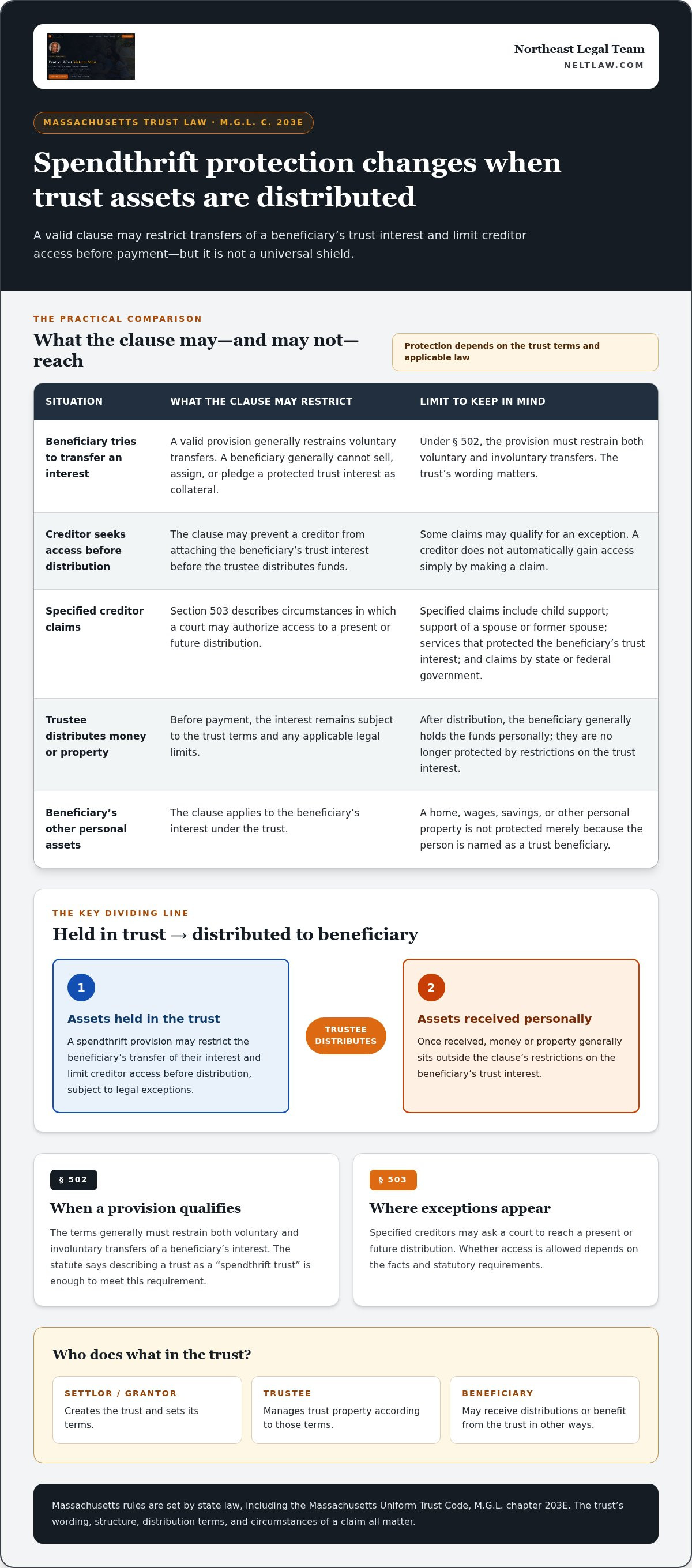
A spendthrift clause restricts a beneficiary from transferring or pledging their interest in a trust. It can also limit creditors’ ability to reach that interest before the trustee distributes funds. The person who creates the trust, often called the settlor or grantor, sets its terms. The trustee manages trust property according to those terms, while the beneficiary may receive distributions or benefit from the trust in other ways.
A spendthrift clause can restrict transfers of a beneficiary’s trust interest, but it does not guarantee protection from every creditor or claim. Assets held in the trust are different from money or property already distributed to a beneficiary. After a distribution, the beneficiary generally holds those funds personally, outside the clause’s restrictions on the trust interest.
If you’re researching what is a spendthrift clause in a trust Templeton MA, the practical questions are whether a beneficiary can give away a future interest and whether a creditor can reach it before payment. The answers depend on the trust’s terms and applicable law. A general overview of how a spendthrift trust works can explain the concept, but Massachusetts rules and the specific document matter.
How does a spendthrift provision work for a beneficiary?
If the provision restricts voluntary transfers, a beneficiary generally can’t sell, assign, or pledge a protected trust interest as collateral. The clause may also prevent a creditor from attaching that interest before the trustee makes a distribution. This does not block every claim: Massachusetts law recognizes limits and exceptions that depend on the circumstances.
Hypothetical family example: Jordan’s aunt creates a trust naming Jordan as a beneficiary and includes a spendthrift clause. Jordan later promises a lender that future trust payments will cover a loan. The clause may restrict that attempted transfer of Jordan’s trust interest. If the trustee later distributes money to Jordan, however, those funds are no longer held in the trust and may be treated differently.
What does the clause not do?
A spendthrift provision applies to the beneficiary’s interest under the trust, not automatically to everything the beneficiary owns. It does not erase personal debts, prevent someone from filing a lawsuit, or guarantee that a court order can never affect trust assets or distributions. The clause’s reach depends on its wording, the trust’s structure, and the law that applies to the claim.
- Trust interest: The clause may restrict transfers or creditor access before a distribution, subject to legal exceptions.
- Distributed property: Once received, money or property belongs to the beneficiary and is generally outside the clause’s protection.
- Other personal assets: A beneficiary’s home, wages, or savings aren’t protected merely because they’re named in a trust.
A spendthrift clause is one part of a trust plan, not a universal shield. The trustee’s authority, the timing and conditions of distributions, and the beneficiary’s rights all shape how the arrangement works. Reviewing those details as part of a broader estate plan can help a family set expectations and choose terms that reflect its goals.
How Massachusetts Law Treats Spendthrift Clauses
For Templeton families, spendthrift clauses are governed by Massachusetts state law, not a separate local trust rule. The Massachusetts Uniform Trust Code (MUTC), found in Massachusetts General Laws chapter 203E, provides the framework. Sections 502 and 503 are key starting points: one addresses when a spendthrift provision is valid, while the other describes circumstances in which certain creditors may seek access to a beneficiary’s interest.
Which Massachusetts trust-law provisions should readers know?
Under M.G.L. c. 203E, § 502, a provision generally qualifies as a spendthrift provision when it restrains both voluntary and involuntary transfers of a beneficiary’s interest. In plain English, the trust must restrict the beneficiary from transferring the interest and restrict creditors from reaching it. The statute says that describing a trust as a “spendthrift trust” is enough to meet this requirement.
Section 503 sets out important limits. In specified circumstances, it allows a court to authorize a beneficiary’s creditor to reach a present or future distribution. These circumstances include certain claims for child support or support of a spouse or former spouse, claims for services that protected the beneficiary’s interest in the trust, and claims by the state or federal government. The scope and application depend on the facts and statutory requirements; a creditor does not automatically gain access simply by making a claim.
These sections offer a useful map, not a decision about any particular trust. Readers can review the spendthrift clause definition and limitations for general background, then look to the Massachusetts statutes for state-specific rules. This overview isn’t legal advice. The statutory text and its current application should be reviewed in context.
Why does the trust’s wording matter?
A trust’s label alone may not tell the whole story. Section 502 focuses on whether the terms actually restrain both kinds of transfer, while section 503 addresses claims that may be allowed despite that restriction. Clear drafting helps the trustee understand what the trust permits, what it restricts, and how to respond when a beneficiary or creditor asks for a transfer or payment.
Distribution terms matter, too. If the trustee has discretion over whether and when to distribute funds, that can affect what the beneficiary may demand and how the trust is administered. Discretion does not erase statutory exceptions or guarantee that a creditor can’t reach a distribution. The document’s language, the trustee’s authority, and the type of claim all play a role.
A statute sets the general rule; the trust’s terms and the facts determine how that rule applies to a particular beneficiary. Knowing the statutory framework is a starting point, not a promise of a specific result. An attorney can review the clause alongside the rest of a living trust and estate plan to help align its terms with your family’s goals.
What a Spendthrift Clause Cannot Protect: Limits and Exceptions
A spendthrift clause isn’t an all-purpose shield. Its effect depends on what property is involved, who created and funded the trust, the trust’s terms, and the kind of claim at issue. Massachusetts law recognizes circumstances in which a creditor may reach a beneficiary’s interest or distribution, so the presence of a clause alone can’t predict the outcome of a dispute.
Can creditors reach trust assets or distributions?
The distinction between an undistributed trust interest and money already paid to a beneficiary is central. Under Massachusetts General Laws chapter 203E, section 503, certain support claims, including child support and alimony, may qualify for an exception to spendthrift protection. Claims by the state or federal government may also be relevant. The exact scope depends on the statute and the specific claim.
- Undistributed trust interest: A valid spendthrift provision may restrict a creditor from reaching the beneficiary’s interest before the trustee distributes funds, subject to statutory exceptions.
- Funds already distributed: Once payment reaches the beneficiary, the spendthrift restriction generally no longer protects those funds as trust property. Other laws may still affect whether a creditor can collect.
- Assets the creator placed in a trust: The result can differ if the person who created and funded the trust is also a beneficiary. Section 505 addresses creditor claims involving a settlor’s interest in a trust.
For example, imagine a grandparent creates a trust for a grandchild, who later faces a creditor claim. The analysis may differ depending on whether the money remains in the trust, has been distributed, or the claim falls within an exception. This hypothetical illustrates the questions to ask, not a prediction of what a court would decide.
Does a clause protect assets placed in a trust by its creator?
Who created and funded the trust matters. A person who establishes a trust for someone else generally has a different role from someone who places assets in a trust while retaining the right to benefit from them. Under M.G.L. c. 203E, § 505, a settlor generally can’t use a spendthrift provision to shield their own beneficial interest from their creditors. A revocable trust’s assets may remain subject to the settlor’s creditors during life; for an irrevocable self-settled trust, creditors may reach the maximum amount distributable to the settlor.
These limits don’t mean a trust has no planning value. They mean the plan should account for the people who contribute assets, the people who benefit, and the trust’s distribution rules. If you’re asking what is a spendthrift clause in a trust Templeton MA, start by identifying whose assets are involved and whether they remain in the trust or have been paid out. The trust language and facts can change the analysis, so an attorney should review the document and relevant provisions before anyone relies on a particular protection.
When Might a Spendthrift Clause Fit a Family Trust?
A spendthrift clause may be worth discussing when you want an inheritance managed under terms that support a beneficiary’s long-term needs. It’s one planning tool, not a substitute for a complete estate plan or a guarantee against every creditor claim. Consider who will manage the assets, how and when distributions may be made, and how much flexibility the beneficiary should have.
What family circumstances may prompt this discussion?
Families may consider restrictions when a beneficiary is young, has limited experience managing a large inheritance, or has circumstances that make steady access more helpful than receiving assets all at once. A trustee could, for example, distribute funds over time or make payments under terms set out in the trust. These are planning possibilities, not assumptions about a beneficiary’s character or abilities.
Concerns about debt, spending, or future financial pressure may also prompt questions. But those concerns don’t automatically mean a spendthrift provision is suitable. Restrictions can limit a beneficiary’s control and access, while the trustee takes on ongoing responsibilities to follow the document and make decisions within its terms. Weigh those trade-offs alongside the beneficiary’s needs, relationships, and preferences.
Start by asking what you want the trust to accomplish. Is the priority preserving assets for future needs, providing steady support, or giving a beneficiary more independence? The answers can help shape a plan that reflects your family’s goals instead of relying on a standard provision without considering how it will work in practice.
How can families balance protection and beneficiary access?
Distribution terms help set that balance. A trust might provide scheduled payments, giving the beneficiary a predictable amount at stated times. Another arrangement might give the trustee discretion to decide whether and when to distribute funds under standards written into the trust. Scheduled payments may offer more predictability, while discretion may allow decisions to respond to changing circumstances. Neither approach is right for every family, and trustee discretion should be clearly defined so the role and limits are understood.
Consider how a beneficiary might use the trust at different stages of life. Would regular support meet the intended goal, or could a health, education, or other significant need call for flexibility? Clear terms can guide the trustee and help the family communicate expectations. The trustee’s ability to carry out those terms matters as much as the clause itself.
Spendthrift planning also serves a different purpose from planning focused on eligibility for public benefits. If that distinction is part of your family’s questions, a guide to Medicaid asset protection trusts in Massachusetts can help clarify the separate planning goals. The right structure depends on the circumstances and applicable rules.
For families in Templeton, reviewing distribution terms alongside the wider estate plan can make the decision more manageable. Explore trust-planning services to learn how the terms of a trust can fit within a broader estate plan.
Discussing a Spendthrift Clause With a Templeton, MA Estate-Planning Attorney
Understanding the basics is a helpful start, but deciding whether a spendthrift clause fits your family calls for a closer look at the trust terms and your goals. If you’re researching what is a spendthrift clause in a trust Templeton MA, prepare a few details before a planning conversation so you can focus on the decisions that matter most.
What should you prepare before a trust-planning conversation?
Gather what you have, even if your documents are older or your goals are still taking shape. You don’t need to resolve every question in advance. A general outline can help an attorney understand whom you want to benefit, what you hope the trust will accomplish, and where you’d like guidance.
- Beneficiaries: List the people you may want to include and note any circumstances that could affect how they receive support.
- Goals: Write down what matters most, such as steady distributions, flexibility for changing needs, or limits on transfers.
- Assets: Prepare a general outline of the property you may want the trust to address. You can discuss sensitive details privately during the planning process.
- Concerns: Note questions about future distributions, creditor exposure, financial vulnerability, or the trustee’s role.
- Existing documents: Bring any current trust, will, beneficiary designation, or other estate-planning document that may affect the plan.
Keep sensitive financial details out of public comments and unsecured messages. You can start with a general summary and discuss private information through an appropriate channel.
How can local legal guidance help clarify next steps?
An individualized review connects the trust’s language with the outcomes you want for your family. A Massachusetts estate-planning attorney can consider how the spendthrift provision works alongside trustee authority, distribution terms, and your other estate documents. That broader view may reveal terms that need clarification or questions to address before the trust is finalized.
Templeton is in Worcester County, but spendthrift trust rules come from Massachusetts law, not a separate local trust standard. Families in Worcester County and Middlesex County can use the same state-law framework, while the legal analysis focuses on the trust and the facts of each situation.
A trust works as a plan, not as a single clause, so its terms should be reviewed together. When comparing planning options, consider the scope of the documents and services involved as well as the fee. Northeast Legal Team offers fixed rates for drafting and executing estate-planning documents, including wills, trusts, and powers of attorney.
A planning conversation can help you identify the decisions to make and the documents to review. Learn about the firm’s estate-planning services and how they can support a plan for your family.
Take the Next Step With Confidence
Your next step can be a focused conversation about the legacy you want to leave and the kind of support your beneficiaries may need. Bring your questions and any existing trust documents, then consider how each choice fits your family’s priorities. If you’re still wondering “what is a spendthrift clause in a trust Templeton MA,” an individualized review can help turn that question into a practical planning decision.
Northeast Legal Team provides estate-planning services, including wills, trusts, powers of attorney, and healthcare directives, to individuals and families in Middlesex County and Worcester County. A free consultation or assessment gives you a chance to discuss your goals without obligation and decide what makes sense for your family.
Schedule a free estate-planning consultation with Northeast Legal Team to discuss a trust plan shaped around your family’s goals.
Frequently Asked Questions
What is a spendthrift clause in a trust?
A spendthrift clause is trust language intended to limit a beneficiary’s ability to transfer or pledge their interest and, within legal limits, restrict creditor access before distribution. If you’re searching “what is a spendthrift clause in a trust Templeton MA,” focus on what the trust actually says and who may receive payments. A clause doesn’t decide every claim in advance, so review the full document and circumstances before relying on it.
Is a spendthrift clause enforceable in Massachusetts?
Massachusetts recognizes spendthrift provisions, but whether a particular clause is effective depends on its wording and the law that applies. A review may consider whether the terms address both a beneficiary’s transfers and creditor claims, as well as any statutory exceptions. Before changing a trust or relying on its protections, have the current document reviewed under Massachusetts law. A general online explanation can’t determine the result of a specific dispute.
Can a spendthrift clause protect a trust beneficiary from all creditors?
No. The clause shouldn’t be treated as a barrier to every creditor or legal claim. A support claim or a claim by the state or federal government may raise different questions from an ordinary unpaid personal loan. A claim involving a payment already received may also require separate analysis. The trust’s structure and the beneficiary’s rights matter. A Massachusetts attorney can assess the specific claim and trust terms without promising a particular outcome.
Does a spendthrift clause protect assets someone places in their own trust?
Generally, a person shouldn’t assume that transferring assets into a trust they created will keep those assets beyond their own creditors’ reach. Massachusetts treats a creator’s interest differently from a trust established for another person’s benefit. The analysis can change depending on whether the trust is revocable or irrevocable and what the creator may receive from it. Get legal advice before transferring property or relying on a trust for creditor protection.
What happens if a beneficiary receives a trust distribution?
A distribution may be treated differently once it reaches the beneficiary than while it remains in the trust. For example, money paid into a beneficiary’s bank account is no longer simply an undistributed trust interest, though other legal protections may apply. A beneficiary facing a collection demand should keep relevant trust and payment records and get advice before moving or spending funds. The trustee should also follow the document’s distribution terms and applicable law.
Can a trustee refuse to make a distribution because of a spendthrift clause?
Not automatically. A spendthrift restriction doesn’t, by itself, give a trustee unlimited authority to deny a payment. The answer depends on whether the trust requires a distribution or gives the trustee discretion, and on any conditions attached to payment. A trustee may have different responsibilities under a fixed payment schedule than under discretionary terms. If a beneficiary disputes a decision, the full trust document and the trustee’s authority need review.
Should a Templeton, Massachusetts family include a spendthrift clause in a trust?
It depends on the family’s goals, the beneficiary’s circumstances, and how much access or flexibility the trust should allow. A Templeton family might discuss the clause while planning an inheritance intended to support a beneficiary over time. Massachusetts trust law applies in Templeton and across Worcester and Middlesex Counties, but individual terms still matter. Bring your goals and existing documents to an estate-planning conversation before deciding whether the provision fits.


