

A signed trust can still leave important assets outside its plan if ownership and beneficiary details aren’t reviewed. If you’re learning how to title assets in a trust Sturbridge MA, match each asset to the right step rather than assuming everything should be transferred into the trust.
Changing a deed or account record can feel daunting, but the first step is straightforward: identify how each asset is currently owned and compare that record with the trust. Some assets may need new ownership records, while others are handled through beneficiary designations. A change made without considering the trust terms, family needs, or financial implications can create confusion later. Creating a trust and funding it are separate parts of estate planning, and both deserve attention.
This guide explains how those steps differ and what to review for common assets, including real estate, bank accounts, and retirement accounts. You’ll learn which records to gather and which ownership or beneficiary details may need attention. For Sturbridge property owners, it also covers how to organize a review of real-estate records in Worcester County. A practical checklist can help you address one asset at a time.
Key Takeaways
- Trust funding is separate from signing the trust document. Identify which ownership or beneficiary updates help carry out your plan.
- For how to title assets in a trust Sturbridge MA, match each asset to an appropriate approach instead of assuming every asset should be retitled.
- Use an asset inventory to track current owners, account types, beneficiaries, and supporting records before making changes.
- Real estate, financial accounts, personal property, and beneficiary-based assets can have different requirements, including institution-specific forms.
- Compare deeds, account records, and beneficiary designations with the trust terms to spot gaps and confirm that updates are complete.
What It Means to Title Assets in a Trust in Sturbridge, MA
Trust funding means aligning an asset’s ownership or beneficiary arrangements with the plan set out in the trust. Signing the document creates the trust, but it doesn’t automatically transfer a house, bank account, or other property into it. Review each asset separately. The appropriate step depends on how it’s owned, the trust terms, and your circumstances.
That distinction is central to understanding how to title assets in a trust Sturbridge MA. Some property may be retitled in the trust’s name; other assets may be coordinated through beneficiary designations. Some may remain outside the trust. A trust doesn’t automatically receive everything you own, so signing the document doesn’t confirm that every intended asset is included.
How trust ownership differs from personal ownership
A trustee holds or manages trust property according to the written instructions in the trust. The trustee’s legal title and responsibilities are distinct from the interests of the beneficiaries, who may receive benefits under the trust’s terms. For a plain-language overview of these roles and the principles behind them, see Trust law.
When an asset is retitled, the ownership record should identify the trust and trustee in a way that matches the governing document. Check names, trustee roles, and the trust date. If a deed or account record uses a different name or date, it may be harder to confirm how the asset relates to the trust. Keep copies of the signed trust and updated ownership records together.
Why Sturbridge homeowners should review trust funding
For a Sturbridge home, review the current deed alongside the trust before making any ownership change. The deed records the property’s ownership. Transferring the property into a trust involves preparing and recording an updated deed through the relevant Worcester County recording process. Check the proposed deed against the property records and trust language rather than relying on a general form.
Trust creation means signing the document; trust funding means taking asset-specific steps to align property with its terms. If a home intended to be part of the plan remains titled only in an individual’s name, the estate plan may not work as intended for that property. A transfer can also raise questions about existing ownership arrangements and related documents, so review the deed before changing it.
Start with an inventory listing each asset, its current owner, any named beneficiaries, and the records that show those details. Then compare the inventory with the trust. This makes it easier to identify possible follow-up without assuming every asset belongs in the trust. For Sturbridge property owners, review the trust terms alongside the deed and local recording records. Families with property or other assets in Worcester and Middlesex counties can use the same inventory to keep their records organized.
How to Title Real Estate and Financial Assets in a Massachusetts Trust
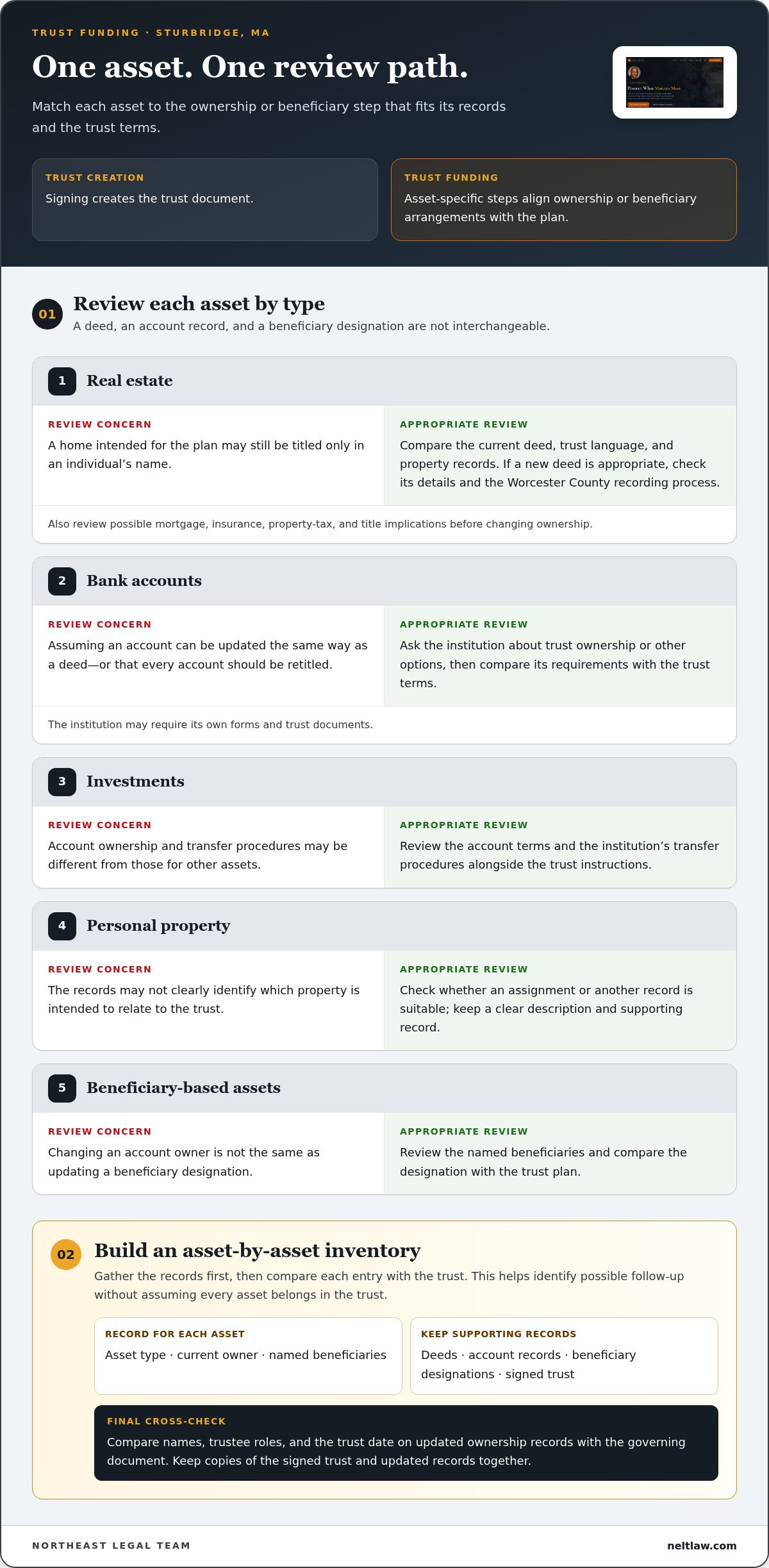
There isn’t one transfer method that fits every asset. A Sturbridge home may call for a deed, while a financial account may require the institution’s own process. Some assets are handled through beneficiary designations rather than trust ownership. To understand how to title assets in a trust Sturbridge MA, compare each asset with the trust terms and the rules that apply to its current ownership.
Use these examples to organize your review, not as automatic instructions:
| Asset type | Approach to review | Key detail |
|---|---|---|
| Real estate | Review whether a new deed is appropriate | Match the deed to the trust and property records |
| Bank accounts | Ask about trust ownership or other options | The institution may require its forms and trust documents |
| Investments | Review account ownership and transfer procedures | Consider account terms and the trust’s instructions |
| Personal property | Check whether an assignment or other record is suitable | Keep a clear description and supporting record |
| Beneficiary-based assets | Review the named beneficiaries | A designation is distinct from changing account ownership |
Retitling a Sturbridge home or other real estate
Changing a home’s ownership generally involves preparing a new deed for that specific property. Sturbridge property owners can use the Worcester County Registry of Deeds as a local recording reference. The deed should accurately reflect the intended ownership and align with the trust language. A general form may not account for the property’s existing title details.
Before changing a deed, review possible mortgage, insurance, property-tax, and title implications as part of your plan. The issues depend on the property and existing arrangements, so don’t assume a transfer has no effect. Massachusetts trust resources, including Massachusetts law about trusts, provide legal context but don’t replace review of your specific documents.
Handling accounts, investments, and beneficiary-designated assets
For bank and investment accounts, review the institution’s process for trust ownership and the documents it requires. It may request its own forms and information about the trust or trustee. Compare those instructions with the trust terms before submitting an ownership change. Save confirmation and updated statements with your estate-planning records.
Retirement accounts need special, tax-sensitive review before any ownership change. Don’t assume retitling an account is the same as updating who receives it. Changing an account owner alters the ownership record; changing a payable-on-death or beneficiary designation changes who is named to receive the asset under that designation. The appropriate choice depends on the account and plan.
Coordinating account and beneficiary records with a living trust can help prevent conflicting instructions. An attorney can compare deeds, account requirements, and beneficiary records with the trust terms. Living trust and estate planning guidance can help you work through those details as part of a complete plan.
What Can Go Wrong When Funding a Trust, and How to Compare Your Options
Putting every asset into a trust isn’t automatically the best choice. The goal is to make each asset work with your estate plan, not to change every ownership record without considering the effect. Retitling, updating a beneficiary, or leaving an asset outside the trust can each be appropriate, depending on the asset, trust terms, and your priorities.
Different assets call for different reviews. Real estate may require deed review, bank and investment accounts may involve institution-specific procedures, and retirement accounts need careful beneficiary and tax review. Jointly owned property depends on its existing ownership, while vehicles and business interests may have distinct transfer requirements. Approach “how to title assets in a trust Sturbridge MA” one asset at a time.
- Retitle an asset: Ownership changes to the trust or trustee if that approach fits the trust terms and the asset’s rules. This may support management under the trust, but a transfer can raise questions about lender, insurer, tax, or institution requirements.
- Update a beneficiary: The asset remains under its existing ownership arrangement while its beneficiary record is reviewed and potentially revised. The designation should coordinate with the overall plan rather than conflict with trust instructions.
- Keep an asset outside the trust: Some property may remain individually or jointly owned when that better fits the circumstances. Record why it remains outside and how it is addressed in the broader estate plan.
Which assets may need a different approach?
Retirement accounts deserve special attention because changing ownership and changing beneficiaries aren’t interchangeable, and either choice may have tax considerations. Jointly owned property also needs review: the other owner’s rights and the current ownership record can affect what changes are possible. Existing beneficiary designations may direct an asset differently from the trust. Vehicles and business interests have their own transfer rules, so review applicable requirements before changing ownership.
How to weigh convenience, control, and potential consequences
Retitling may bring an asset under the trustee’s management according to the trust terms, while keeping it personally owned may preserve a familiar ownership arrangement. A beneficiary update can direct who receives an asset without placing it in the trust during your lifetime. No option is universally more convenient or protective. Consider how each affects your control, intended administration, and family plan.
Before making changes, identify questions involving a lender, insurer, financial institution, or tax treatment. These are issues to assess, not outcomes to assume. A deed change or account update may require a review of related records, but the implications depend on the asset and circumstances. Avoid relying on a broad rule or an isolated form.
An asset-by-asset legal review can compare the trust language with deeds, account ownership, beneficiary records, and documents for jointly held property or business interests. This comparison can reveal inconsistent names, outdated designations, or an asset that hasn’t been addressed. Recording why each asset is retitled, assigned a beneficiary, or left outside the trust helps keep the plan coherent and makes future reviews easier.
A Step-by-Step Trust Funding Checklist for Sturbridge Residents
A written checklist turns trust funding into manageable decisions. Start with a complete inventory, then handle each asset according to its ownership and the trust plan. If a record is unclear, flag it for review rather than guessing or making a change that could affect another owner or beneficiary.
- Gather the trust documents and asset records. Collect the signed trust and any amendments, current deeds, recent account statements, and beneficiary records. Include documents showing how jointly owned property is titled. These records provide a starting point for comparing what you own with what the trust says.
- Build an asset inventory. For each item, note its description, current owner or owners, account type, financial institution if applicable, named beneficiaries, and the document supporting the information. Add a column for intended treatment, such as review for retitling, beneficiary update, or remaining outside the trust. Mark discrepancies for legal review.
- Review the trust’s instructions. Compare the inventory with the trust language and identify which assets the plan intends the trustee to manage. Don’t assume every asset should be transferred or that a general direction in the trust completes an ownership change. Resolve unclear names, dates, or instructions before preparing paperwork.
- Separate the tasks by asset type. Treat deed work, financial-account paperwork, and beneficiary updates as distinct tasks. A Sturbridge real-estate transfer may call for a property-specific deed and review of Worcester County recording procedures. Banks and investment firms may use their own forms and require trust documentation. A beneficiary change follows a different process from changing an account owner.
- Prepare and submit each update carefully. Use instructions that match the asset and intended result. For real estate, coordinate deed preparation and submission with the relevant recording process. For financial accounts, follow the institution’s trust-ownership process. For beneficiary-based assets, complete the appropriate designation paperwork and keep a copy.
- Confirm the changes and follow up. Keep recorded deeds, account confirmations, updated statements, and beneficiary acknowledgments with your trust records. Compare each completed change with the inventory and trust plan. If an institution’s records still show the old owner or beneficiary, or a deed record doesn’t reflect the intended arrangement, note the item for resolution rather than treating it as complete.
This process helps you see what has been updated and what still needs attention. Deed language, account requirements, and trust terms need to work together, so a legal review can help identify conflicts before they become harder to resolve. Explore estate planning guidance for your family as you organize the funding steps.
How a Massachusetts Estate Planning Attorney Can Help Complete Trust Funding
A trust-funding plan works best when its instructions match the records that control each asset. An estate planning attorney can review the trust alongside your asset inventory, deeds, account ownership information, and beneficiary designations. A coordinated review can identify items that may be missing, named inconsistently, or handled in a way that doesn’t reflect your intentions.
This can be especially helpful if you’re unsure how to title assets in a trust Sturbridge MA. A home, a jointly owned account, and a retirement asset don’t necessarily follow the same process. An attorney can help distinguish questions about trust language from those involving institution-specific paperwork or an individualized review before ownership or beneficiary changes.
What an attorney can review in a trust-funding plan
An attorney can compare the trust terms with the inventory and supporting documents, then identify apparent gaps or conflicting instructions. For example, a deed may use a different ownership description than the trust plan anticipates, or an account’s beneficiary record may need to be considered alongside the trust. The appropriate next step depends on the asset and circumstances. A review can clarify what needs attention without assuming every asset should be transferred.
For real estate, local context matters. Review Sturbridge property documentation with the relevant Worcester County recording process in mind, alongside the existing deed and the trust’s exact terms. An attorney can help coordinate appropriate document updates and explain which records to retain. Northeast Legal Team provides estate-planning and living-trust services, including flat-fee estate-planning document preparation.
Prepare for a conversation about your Sturbridge assets
You don’t need to resolve every question before seeking guidance. Bringing a few key records can make the discussion more focused and help identify the decisions that matter most to your family.
- The signed trust and any amendments
- The current deed for Sturbridge property
- Recent account statements and records of account ownership
- Current beneficiary designations and questions about who you intend to benefit
- Your asset inventory, including any unclear or conflicting records
Northeast Legal Team serves families in Worcester County with estate-planning guidance, including living trusts and related planning documents. Families in Middlesex County can also discuss how deeds, financial records, and beneficiary choices fit with their trust and identify appropriate follow-up steps.
If you’d like to talk through your trust-funding plan, schedule a free estate planning consultation. Bring your questions and available records to discuss a clear next step.
Make Your Trust Plan Easier to Keep Current
Trust funding may need another review when your assets or family plans change. A home purchase, a new account, a change in who you want to provide for, or a revised trust can be a reason to revisit your records. Periodically comparing your documents with your current assets can help keep the plan aligned with your intentions.
If you’re still working through how to title assets in a trust Sturbridge MA, a focused review can turn open questions into a practical plan. You can address the records one by one and make thoughtful decisions for the people who matter to you.
Discuss your trust-funding next steps with Northeast Legal Team. Schedule a free consultation to review your estate-planning documents and plan your next step.
Frequently Asked Questions
Can I transfer my house into a trust if I still have a mortgage?
Possibly, but having a mortgage doesn’t by itself determine whether transferring the house is appropriate. The deed, loan terms, applicable rules, insurance arrangements, and trust structure may all matter. Before signing or recording a deed, have the specific documents reviewed with Massachusetts counsel. For a Sturbridge property in Worcester County, local deed records are part of that review, but the right steps depend on your circumstances.
Does putting my Sturbridge home in a trust change my property taxes?
A trust transfer doesn’t automatically mean your property taxes will rise or that you’ll receive an exemption. The result can depend on the ownership details, trust terms, applicable tax rules, and local assessment practices. Don’t rely on a general rule to predict what will happen to your home. Before changing ownership, have the proposed deed and tax questions reviewed in light of your property and circumstances.
Can I put my IRA or 401(k) directly into a living trust?
Retirement accounts need special care and are commonly addressed through beneficiary designations rather than retitling the account in a trust’s name. Changing ownership or beneficiaries can affect tax treatment and distribution planning. For example, naming a trust as a beneficiary may raise different planning questions than naming an individual. The appropriate choice depends on the account, trust terms, and your goals, so seek professional guidance before making changes.
What happens if I forget to title an asset in my trust?
An asset left outside the trust may not receive the treatment your plan intended. What happens later depends on how the asset is owned, whether it has a beneficiary designation, and applicable Massachusetts law. Probate isn’t inevitable in every case. If you find an account or property that may have been overlooked, gather its ownership and beneficiary records and ask an estate-planning attorney how it fits with your existing documents.
Can a trust own a car in Massachusetts?
A trust may be able to own a vehicle, but don’t assume the transfer works like changing a real-estate deed. The trust document, vehicle title, insurance arrangements, and current Massachusetts RMV procedures may all be relevant. Before changing the title, review the applicable requirements and consider whether trust ownership fits your broader plan. The best approach depends on your vehicle, trust terms, and circumstances.
Does a living trust replace a will in Massachusetts?
No. A living trust and a will serve different roles, and creating a trust doesn’t automatically make a will unnecessary. A will may address property that wasn’t transferred to the trust, along with other matters that depend on your family situation. The documents should work together as part of a complete estate plan. Families in Worcester and Middlesex counties can review their plan with counsel to see whether it reflects their wishes.


