

A simple estate doesn’t always need the most involved court process. The formal probate process in West Brookfield, MA may be needed when a will is unclear, altered, or lost; when someone challenges its validity; or when a minor or incapacitated beneficiary lacks a conservator. It gives the court a way to resolve questions about the will and appoint a Personal Representative to manage the estate.
It’s understandable to feel unsure about which probate path fits your family’s situation. This article explains when formal probate is needed, how it differs from informal probate and voluntary administration, and what to prepare for the petition. You’ll also learn how notice, possible court hearings, and the Personal Representative’s role fit into the process, helping you approach the next decisions with greater clarity.
Key Takeaways
- Recognize the estate and family circumstances that can make court-supervised probate necessary.
- Compare formal probate, informal probate, and voluntary administration to understand which path may fit the estate.
- See what information and supporting documents go into a formal probate petition.
- Understand how notice, court review, and the Personal Representative’s authority shape estate administration.
Appointment and authority of a Personal Representative
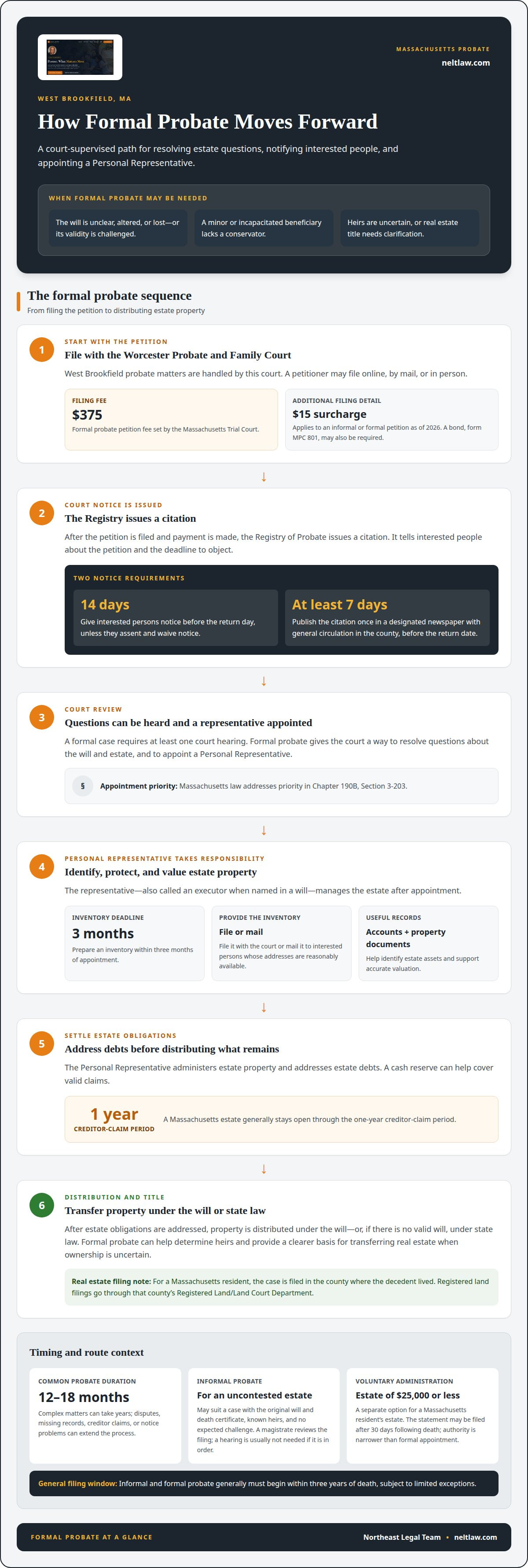
West Brookfield probate matters are handled by the Worcester Probate and Family Court. Formal probate gives the court a process for appointing a representative and resolving questions about the estate.
A petitioner may file online, by mail, or in person. The Massachusetts Trial Court sets the formal probate petition filing fee at $375. After filing and payment, the Registry of Probate issues a citation. A bond, form MPC 801, may also be required. Massachusetts law addresses appointment priority in Chapter 190B, Section 3-203.
Serving Interested Persons and Publishing the Citation
A citation is the court’s notice of the probate petition and the deadline for interested people to object. According to Massachusetts General Court, petitioners must give interested persons notice at least 14 days before the return day, unless they assent and waive notice.
The petitioner must also publish the citation once in a designated newspaper with general circulation in the county where the case is pending, at least 7 days before the return date. These steps give heirs and beneficiaries notice of the requested appointment and a chance to raise concerns about the will or proposed representative.
Personal Representative Duties
A Personal Representative, also called an executor when named in a will, manages the estate after appointment. The representative prepares an inventory within 3 months and files it with the court or mails it to interested persons whose addresses are reasonably available.
The representative administers estate property and distributes it under the will or, if there is no will, state law. Beneficiaries rely on an accurate account of the property and an orderly transfer of what they inherit.
A voluntary personal representative has narrower authority than a court-appointed representative. This person cannot be a creditor of the deceased, obtain medical records, or bring or settle a wrongful death action for the estate. A lawyer can explain how this limited role differs from formal appointment when the estate’s needs require those powers.
What else do you need to know about the probate process?
Whether probate is needed depends on how the decedent owned assets and who must receive them. Timing, creditor claims, and real estate can also affect administration.
When an Estate Needs Probate
Probate is generally used to transfer assets owned solely by the decedent through an authorized representative. Assets with a surviving joint owner may pass without probate, so review the ownership records. Formal probate can also help determine heirs when someone dies without a will, or when a will is challenged and found invalid. The court process clarifies who may receive estate property.
In Massachusetts, informal and formal probate generally must begin within three years of death, subject to limited exceptions. A late and limited proceeding may help confirm title, but claims may not be presented against the estate, including claims by the Division of Medical Assistance.
Estate Assets, Inventory, and Distribution
The Personal Representative identifies, protects, and values estate property, then prepares an inventory within three months of appointment. The inventory must be filed with the court or mailed to interested persons whose addresses are reasonably available. Account statements and property documents help identify estate assets and support an accurate valuation.
The representative also addresses estate debts before distributing the remaining property. A Massachusetts estate generally stays open through the one-year creditor-claim period, and a cash reserve can help cover valid claims. Distribution follows the will or, if there is no valid will, state law.
Formal Probate and Real Estate Title
Formal probate can establish who inherits real estate and help clear title when heirs are uncertain. It may be especially important if the decedent died without a will or the will’s validity is contested. A court decree identifying heirs can provide a clearer basis for transferring property.
For a Massachusetts resident, the case is filed in the county where the decedent lived. Registered land filings go through the county’s Registered Land/Land Court Department. These steps matter because unclear ownership can complicate a later transfer or sale.
Probate Costs and Timelines
The Massachusetts Trial Court sets the formal probate petition filing fee at $375. As of 2026, Massachusetts adds a $15 surcharge to an informal or formal probate petition. A citation fee and newspaper publication may add expenses, while the total depends on the estate’s needs.
Massachusetts probate commonly takes 12-18 months, including cases in Worcester County, though complex matters can take years. A formal case requires at least one court hearing. Disputes over a will, missing records, creditor claims, or notice problems can extend the process and delay distribution.
Choosing between informal probate, formal probate, and voluntary administration
The formal probate process in West Brookfield, MA gives a judge a way to resolve estate questions and appoint a Personal Representative. It can address disputes or uncertainty that an administrative filing may not resolve. Massachusetts General Court says informal and formal probate generally must begin within three years of death, subject to limited exceptions. The estate’s circumstances help determine which route fits.
Informal probate may suit an uncontested estate when the representative has the original will and death certificate, knows where all heirs are, and doesn’t expect a challenge. A court magistrate reviews the filing, usually without a hearing if it is in order. A representative may receive permission to proceed within seven days after filing a form. Heirs and beneficiaries are typically notified before filing.
Voluntary administration is a separate option for a Massachusetts resident’s estate valued at no more than $25,000. The statement may be filed after 30 days following death. This route provides narrower authority than formal appointment. For example, a voluntary representative cannot bring or settle a wrongful death action for the estate, so required actions can affect the choice.
Formal probate may be necessary when a will is contested, unclear, altered, or lost, or when a minor or incapacitated beneficiary lacks a conservator. A judge can review the petition and hear objections before appointing a representative. If a public administrator or creditor petitions while making a claim against the estate, formal probate is required. Late and limited probate may be commenced only more than three years after death and serves a narrower purpose. For families weighing the formal probate process in West Brookfield, MA, the will’s condition, notice requirements, and authority needed to administer the estate are central considerations.
Completing the formal probate petition
A clear filing connects the decedent, the will, interested people, and the appointment being requested. In Massachusetts, the formal petition is form MPC 160, the Petition for Formal Probate of Will and/or Appointment of Personal Representative. Its details should align with the supporting records, so inconsistencies in names, relationships, or documents can be addressed before filing.
The packet includes form MPC 162, listing the surviving spouse, children, and heirs at law. It typically includes the original will and codicils, if available, plus a certified death certificate. If that certificate isn’t available, an affidavit may be used. When a will exists, the Devisees form, MPC 163, is required. The court’s formal probate instructions are in MPC 963, and its checklist is MPC 967.
Other paperwork depends on the estate. A bond, form MPC 801, may be required for the proposed representative. The court may also require an Affidavit of Domicile, MPC 485; an Affidavit of Witness to Will, MPC 480; or an Assent and Waiver of Notice/Renunciation/Nomination/Waiver of Sureties, MPC 455. These forms address specific facts, such as domicile, will witnesses, or interested people who waive notice.
An interested person, as defined in Chapter 190B, Section 1-201, may file the petition. A formal probate filing can be submitted online, by mail, or in person. Before filing, compare names and dates across the petition, will, death certificate, and heir information. A petition may be amended as a matter of right before an appearance is filed before 10:00 a.m. on the return day; afterward, court approval by motion is needed. Careful preparation helps the court review the requested appointment and supporting records together.
For help organizing a formal probate filing and its supporting documents, connect with probate and estate administration support.
Northeast Legal Team: Wills & Estate Plans
Northeast Legal Team helps families understand probate and estate administration, including the decisions involved in appointing a Personal Representative and preparing an estate for distribution. If you’re handling a current estate, probate and estate administration support can help you make sense of the process and its paperwork.
For planning ahead, Wills & Estate Plans and Living Trusts can help organize how your wishes and assets should be handled. Power of Attorney and Healthcare Directives address who may act on your behalf and communicate your care preferences if you can’t speak for yourself. The right planning tools depend on your goals and family circumstances.
Contact Northeast Legal Team to discuss your estate planning or probate questions, or visit neltlaw.com.
Take the Next Step Toward a Clear Plan
After a loss, the next decisions can feel personal as well as practical. Gather the will, asset records, and family details in one place, then note the questions that still need answers. This preparation can make a conversation about the formal probate process in West Brookfield, MA more focused and help clarify what your family needs to address next.
Planning ahead can also give loved ones clearer direction. Northeast Legal Team offers Wills & Estate Plans, Living Trusts, and Power of Attorney documents to help people organize their wishes and prepare for future decisions. These tools serve different purposes, so the right starting point depends on your circumstances and priorities.
If you’re managing an estate or considering steps to protect your family’s plans, speak with Northeast Legal Team about your situation. A thoughtful conversation can help you identify a practical path forward. Contact Northeast Legal Team to discuss your next step.
Frequently Asked Questions
When is probate needed?
Probate is generally needed when assets are solely in the decedent’s name and someone needs legal authority to administer or transfer them. For example, a bank account titled only to the deceased may require a court-appointed representative before it can be handled for beneficiaries. By contrast, property jointly held with a surviving spouse may pass without probate. Start by reviewing how each asset is titled.
When Is It Necessary To Probate An Estate?
An estate may need probate if its property cannot be transferred through ownership arrangements already in place. A home titled only to the decedent is a practical example, especially when heirs need clear ownership. Probate may also be needed to establish heirs if there’s no valid will. The key question is whether an asset requires a court-authorized transfer, not simply whether the person left a will.
How do you file a formal probate petition in Massachusetts, and which forms are required?
Begin with form MPC 160, the petition requesting formal probate or appointment of a Personal Representative. The filing also identifies surviving spouses, children, and heirs through form MPC 162. Include the original will and a certified death certificate when available. Other paperwork depends on the estate, such as a witness affidavit or bond forms. The facts about the will, proposed representative, and heirs determine which supporting documents apply.
What are the deadlines and notice requirements for formal probate in Massachusetts?
Informal or formal probate generally must begin within three years after death, subject to limited exceptions, according to Massachusetts General Court. For formal probate, interested persons must receive citation notice at least 14 days before the return day unless they assent and waive notice. The citation must also be published in a designated newspaper before the return date. Keep the return day in view when organizing notice.
When is formal probate required instead of informal probate or a voluntary administration?
Formal probate is appropriate when the court must resolve a disputed or unclear issue, rather than process an uncontested filing administratively. For example, altered wording in a will or a challenge to its validity may require formal review. A minor or incapacitated beneficiary without a conservator can also affect the choice. Voluntary administration is limited to qualifying small estates, so the assets involved and the authority needed matter.
How are heirs and creditors notified during Massachusetts formal probate?
Heirs and other interested people receive notice through a court-issued citation that identifies a deadline for objections. The petitioner serves the citation and publishes it in a designated newspaper. The Division of Medical Assistance receives the citation, petition, and death certificate by certified mail at least 14 days before the return day. Most creditor claims against an estate are barred unless brought within one year of the decedent’s death.


