

A business’s future depends on more than naming a successor. A business succession attorney in Upton, MA can help connect succession and continuity planning with estate planning, so ownership, decision-making, and personal wishes work together. The aim is to make the transition clearer for the people who will carry the business forward.
It’s understandable to focus first on who might take over. But without a plan for what happens when you step away, become unable to lead, or transfer ownership, the business and the people who depend on it may face uncertainty. Thinking through these possibilities is a practical way to protect the work you’ve built.
This article explains how succession and continuity planning can support a business transition, how estate planning fits in, and how attorney guidance can help you prepare. You’ll also learn what to consider when choosing a legal path and how to organize your next steps at a manageable pace.
Key Takeaways
- Bring your personal estate plan and business transition goals into the same conversation so your wishes and the business’s future are considered together.
- Identify who could lead or make decisions during a transition, then map out the practical steps that would help operations continue.
- Look for attorney guidance that explains your options clearly and connects succession planning with the estate-planning tools relevant to your circumstances.
- Use reviews as one part of your research: focus on comments about communication and relevant legal guidance, while weighing them alongside your own priorities.
Estate planning for business owners
For a business owner, estate planning connects personal wishes with business ownership. Start by listing each ownership interest, company asset, real estate holding, and person authorized to make decisions. Compare that inventory with your will, trust, and incapacity documents. If one document directs shares to a family member while another names a different decision-maker, flag the mismatch for review. A business succession attorney in Upton, MA can help coordinate these choices with your intended transition.
Estate planning and elder law may overlap when an owner considers future care. Include Medicaid and healthcare planning questions alongside decisions about who can manage finances or communicate care preferences if you cannot act. Name a trusted person in the appropriate documents, then explain where essential records are kept. For example, a co-owner may know daily operations but not your personal care wishes. Keeping those roles separate can make responsibilities clearer.
Massachusetts estate planning also calls for an organized view of assets and ownership records. In Upton, probate for estates is handled by the Worcester Probate and Family Court. Gather a current asset list, beneficiary information, and signed planning documents. Keep business ownership records with the plan, including agreements that explain transfer expectations. Reviewing these records together can reveal gaps before family members need to address them during a difficult transition.
Real estate law matters when an owner or business holds land, a building, or other property. Gather deeds, trustee certificates, and homestead declarations with the relevant ownership records. Compare the name on each deed with your estate documents, especially when property is held through a trust. If a building supports business operations, record who manages it and how that responsibility fits into the succession plan. This connects property decisions with the wider business plan.
Business succession and continuity planning
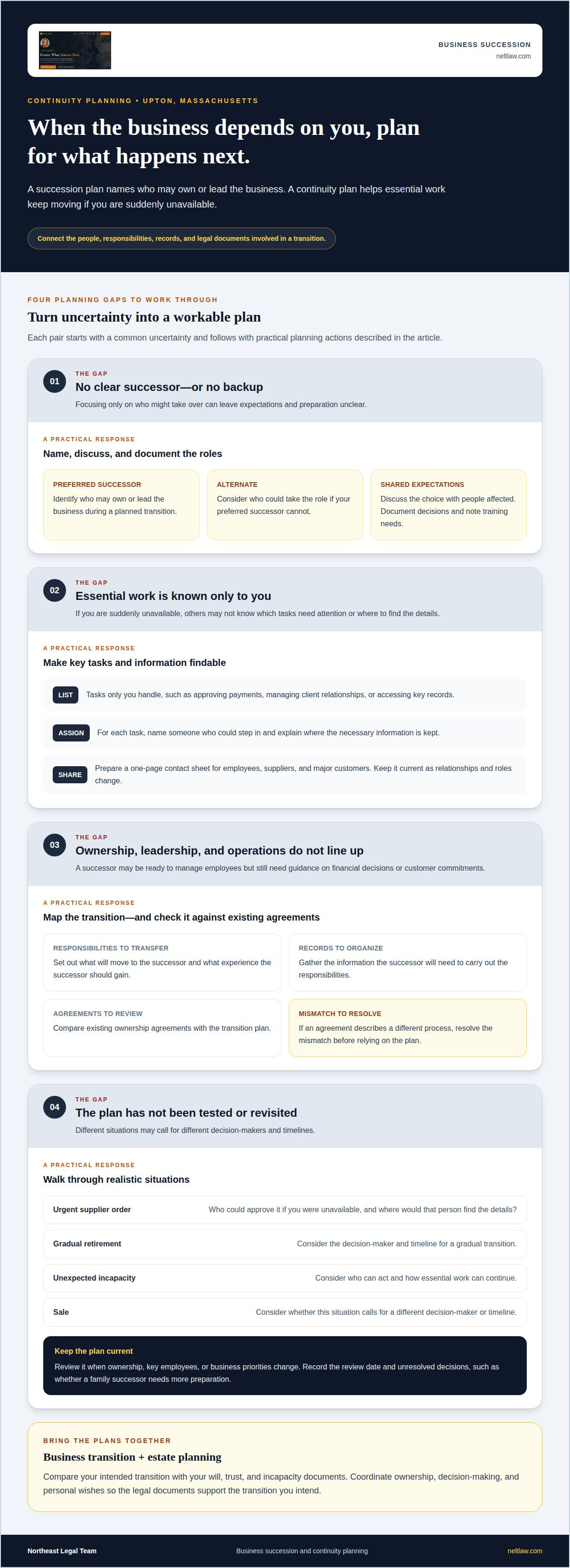
A succession plan identifies who may own or lead the business during a planned transition. Start by naming a preferred successor, then consider an alternate if that person cannot take the role. In a family company, the successor might be a child involved in daily operations, while another family member takes on different responsibilities. Discuss the choice with those affected and document the decisions. Clear conversations can reveal training needs and differing expectations before a transition begins.
Continuity planning focuses on keeping essential work moving if you’re suddenly unavailable. List the tasks only you handle, such as approving payments, managing client relationships, or accessing key records. For each task, name someone who could step in and explain where to find the necessary information. A one-page contact sheet for employees, suppliers, and major customers can help reduce confusion. Keep it current as roles and business relationships change.
Next, map how ownership, leadership, and daily operations connect. A successor may be ready to manage employees but need guidance on financial decisions or customer commitments. Set out a practical transition plan: identify responsibilities to transfer, records to organize, and experience the successor should gain. Review any existing ownership agreements alongside the plan. If an agreement describes a different process, resolve the mismatch before relying on the plan.
Test the plan with realistic situations. For example, ask who could approve an urgent supplier order if you were unavailable and where that person would find the necessary details. Also consider gradual retirement, unexpected incapacity, or a sale. Each situation may call for a different decision-maker and timeline. A business succession attorney in Upton, MA can help connect these operational choices with the legal documents that support your intended transfer.
Review the plan when ownership, key employees, or business priorities change. Record the review date and note unresolved decisions, such as whether a family successor needs more preparation. For help shaping the legal side of a transition, consider business succession planning as part of a coordinated plan for your company’s future.
Attorney experience and client guidance
Choose counsel whose work connects estate planning with business transitions. In an initial discussion, explain your ownership structure, intended successor, and main concern. Ask how the attorney would organize the legal questions and identify documents to review. A clear process should help you understand which decisions are yours and what information will support them. Relevant experience matters most when it relates to the choices your business actually faces.
Consider the attorney’s background in estate planning and probate, then ask how that experience applies to succession. Attorney Todd Rosenfield has advised Massachusetts families on estate planning and probate since 1997. Before focusing on elder law and estate planning, Massachusetts attorney Jay Marsden worked as an investment advisor at Fidelity Investments in Boston for over 16 years. These examples show why relevant legal and financial experience can matter when a plan involves family, ownership, and long-term assets.
For a planning conversation, bring a concise folder of business and personal records. Include ownership documents, existing estate papers, a list of key responsibilities, and your preferred successor. Ask the attorney to identify inconsistencies, explain options in plain language, and outline the decisions that need your input. For example, if a successor is ready to manage daily work but not ownership, ask how the plan can distinguish those roles.
Good guidance should leave you with practical next steps, not just unfamiliar legal terms. Ask which decisions remain open, which documents need attention, and who should participate in the next discussion. Write down the answers and assign each task to someone responsible. If relatives or co-owners disagree, identify the specific issue and what each person hopes to protect. That gives the attorney a useful starting point for addressing competing priorities.
As you compare experience, focus on communication as well as credentials. Notice whether the attorney listens carefully, answers directly, and explains how each recommendation relates to your goals. A Massachusetts business owner should leave the discussion better able to decide what to address first, who needs to be involved, and how legal planning can support a thoughtful transition.
Business succession attorney reviews and ratings near Upton MA
Reviews can offer clues about an attorney’s communication style, but a star score alone can’t show whether the fit is right. When looking for a business succession attorney in Upton, MA, look for comments about estate planning, ownership transitions, or complex family decisions. A review about an unrelated legal matter may reveal little about succession work. Read the details, not just the rating.
Use a simple comparison process. First, note whether reviews describe clear explanations and careful listening. Next, look for practical examples, such as helping someone understand unfamiliar documents or weigh transition choices. Then compare those themes across multiple reviews and dates. Recurring details offer more context than one especially positive or negative review.
- Relevance: Does the reviewer describe business, estate, or succession planning?
- Communication: Do reviewers mention understandable answers and attentive listening?
- Process: Are responsibilities and next steps explained clearly?
- Context: Does the review describe a specific experience?
Keep each review in perspective. A person’s experience reflects their circumstances, expectations, and legal matter. A brief comment may not explain the issue or work involved. Use reviews to identify questions for your own discussion. For example, if someone mentions unclear paperwork, ask how legal documents and decisions would be explained in your situation.
Ratings can’t replace an assessment of relevant experience. Consider whether the attorney understands Massachusetts estate planning and can discuss how ownership decisions relate to personal planning. Bring a short summary of your goals to a conversation. Notice whether the attorney listens, addresses your concerns, and explains possible next steps. For business succession attorney guidance in Upton, MA, that direct conversation adds useful context to what reviews tell you.
The most helpful choice isn’t necessarily the attorney with the highest score. Weigh review details alongside your goals, the attorney’s answers, and the clarity of the discussion. This can help you decide whether the attorney’s experience and communication style suit the transition you’re considering.
Northeast Legal Team: Wills & Estate Plans
Northeast Legal Team can help connect your business transition goals with your personal estate plan. Turn to the firm when deciding how to document your wishes or when existing plans need to reflect a change in ownership or family circumstances. A will can record how you want your estate handled, while a Living Trust can support broader planning goals. A Power of Attorney can name someone to act on financial matters if you’re unable to manage them yourself, and Healthcare Directives can express your care preferences.
Preparing for a conversation can make the next steps clearer. Bring your current estate documents, a summary of your business ownership, and questions about who should make decisions during a transition. Northeast Legal Team can help you consider how Wills & Estate Plans, Living Trusts, Power of Attorney, and Healthcare Directives fit your needs.
Contact Northeast Legal Team for a free consultation about planning for your business’s future.
Shape the legacy you want to leave
Your business carries more than ownership records. It also reflects the standards, relationships, and purpose you’ve built over time. Before making legal decisions, consider what you hope will continue after your role changes. Which values should guide the next leader? What do you want employees, customers, or family members to understand about the transition? Clear answers can turn broad intentions into choices your plan can address.
A business succession attorney in Upton, MA can help put those priorities into a practical legal framework. Begin by writing down your goals and the questions you still need to resolve. Northeast Legal Team can help connect those goals with your estate planning needs.
Contact Northeast Legal Team to discuss your next step. Thoughtful planning can help you approach the future with greater clarity and care for the legacy you’ve built.
Frequently Asked Questions
Are there business succession attorneys near Upton, MA?
Yes. Northeast Legal Team serves Worcester County, where Upton is located, as well as Middlesex County. For a local fit, consider whether your needs involve an ownership transition, estate documents, or both. Before a discussion, prepare a short description of your business structure and the main decisions you want to make. This keeps the conversation grounded in your circumstances.
What business succession planning services do Upton, MA attorneys offer?
Services can include planning for changes in ownership and leadership alongside estate documents that support your intentions. Northeast Legal Team offers business succession planning and estate planning, including wills, trusts, powers of attorney, and healthcare directives. A free consultation is available to discuss your situation and provide recommendations without obligation. For example, you might ask how your personal plan should align with a proposed transfer to a family member.
How should I choose a business succession attorney in Massachusetts?
Choose an attorney who can explain how the legal work connects to your transition goals. Bring a brief outline of your ownership structure, potential successor, and unresolved decisions. Ask how the attorney will identify questions requiring your input and explain the documents involved. Notice whether the answers are understandable and focused on your circumstances. A useful discussion should clarify what you need to decide next.
What Massachusetts laws and tax rules affect business succession planning?
The legal and tax questions depend on your business structure, ownership documents, assets, and planned transfer. Those details affect which documents need review and what tax considerations may arise. Rather than relying on a general rule, identify the transaction you’re considering, such as a transfer to a relative or a sale. Then discuss how that plan interacts with your estate documents and relevant tax planning.
What succession options can a family-owned business in Upton, MA consider?
A family business might transfer leadership to a relative already involved in daily work, prepare another family member to take on a larger role, or plan a sale. Each path raises different questions about readiness, responsibilities, and family expectations. For example, an involved child may be suited to lead operations, while ownership decisions need separate discussion. Compare the options with the needs of the business and the family’s priorities.


