

What happens next when a loved one dies and the family isn’t sure whether probate is needed? It’s a common and understandable concern. Some assets may pass outside probate, while others may require court filings and careful administration. Massachusetts estate law can feel difficult to sort through when you’re grieving and trying to make decisions together.
Understanding the basic process can make the next steps more manageable. This article explains how probate generally works in Massachusetts, what a personal representative may need to do, and why the process varies with the estate and its assets. You’ll also find practical ways to organize records and identify questions. Northeast Legal Team provides probate administration guidance to families in Middlesex County and Worcester County.
Key Takeaways
- Learn how estate law addresses a person’s property and affairs after death, and why families may face administrative questions while grieving.
- See the general stages of Massachusetts probate and why the appropriate filing route depends on the estate’s circumstances and current rules.
- Compare assets that may be handled in probate with those that may transfer through joint ownership, beneficiary designations, or a trust.
- Use a practical checklist to gather records and identify questions, while distinguishing preparation from steps that require court appointment or legal authority.
- Find out how probate administration guidance from Northeast Legal Team can help families in Middlesex and Worcester Counties organize next steps.
What estate law covers when a Massachusetts resident dies
A death can leave a family grieving while practical questions arise: Who can access information about the deceased person’s property? Is there a will? Does the family need to file with a court? In this article, estate law means the rules and legal steps involved in handling a person’s property and affairs after death. The details depend on how assets are owned, whether a valid will exists, and the family’s circumstances.
Probate is a court process that may be used to establish a will’s validity and appoint a personal representative to administer the estate. Massachusetts has different probate routes, and the appropriate one depends on the facts and applicable court requirements. Not every asset is handled in the same way: some property may pass through the estate, while other property may transfer under a beneficiary designation, joint ownership arrangement, or trust.
Probate administration addresses a person’s affairs after death; estate planning prepares for decisions during life and can shape how those affairs are handled. The two are connected, but serve different purposes. A will, trust, or other planning document can provide direction, yet property ownership and applicable rules still matter.
What does probate help a family accomplish?
Probate provides a legal framework for settling matters that require estate administration. Depending on the case, it can establish who is authorized to act, provide a process for addressing estate property and obligations, and support the eventual distribution of assets. In Massachusetts, a personal representative is appointed through the probate process. The appointment helps distinguish official estate actions from steps relatives might take simply as family members.
The representative’s role and the court’s involvement depend on the case. This overview explains general concepts, not what a particular family should file or do. If ownership, authority, or a family member’s rights are uncertain, legal guidance can help clarify the questions before decisions are made.
How a will or the absence of one can shape the process
A will can record a person’s wishes for distributing property and nominate someone to serve as personal representative. That nomination matters, but it does not mean every asset avoids probate or that the nominated person can act before receiving the required legal authority. Families may still need to identify which property belongs to the probate estate and follow the appropriate court process.
If someone dies without a will, Massachusetts intestacy rules determine how probate property is distributed among eligible relatives. The result can depend on which family members survive the person, so assumptions about who inherits may be mistaken. A will can provide direction, but it does not replace a review of asset ownership and applicable rules.
For an initial review, gather any will or trust documents, recent account statements, property records, and financial institution contact information. Keep these records organized, but don’t treat access to a document or account as proof of authority to manage it. Identifying what exists is a useful first step; deciding who may act is a separate legal question.
The Massachusetts probate process, from the first filing to administration
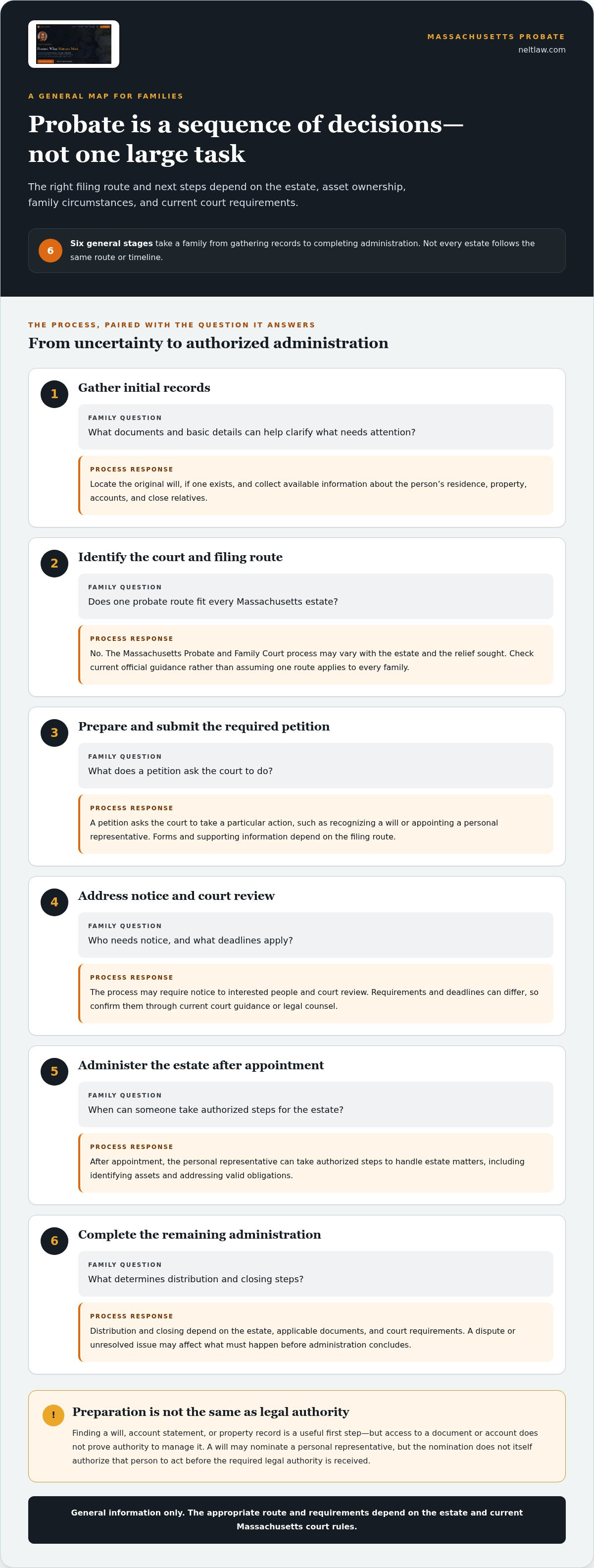
After a death, it can help to think of probate as a sequence of decisions rather than one large task. The Massachusetts Probate and Family Court handles probate matters, but the appropriate filing route depends on the estate’s circumstances and current rules. A will, asset ownership, and questions raised by the family can all affect the process. For a current overview of probate types and forms, consult the state’s Massachusetts Probate Process guidance.
The steps below offer a general map, not a checklist that applies to every estate. In broad terms, identify the records, determine the appropriate filing, obtain authority to act, administer estate matters, and complete the required closing steps. Estate law provides the framework, while the details of each case shape how the process unfolds.
- Gather initial records. Locate the original will, if one exists, and collect available information about the person’s residence, property, accounts, and close relatives. These details can help clarify what needs attention.
- Identify the appropriate court and filing route. The Massachusetts Probate and Family Court process may vary based on the estate and the relief sought. Review current official guidance rather than assuming one route fits every family.
- Prepare and submit the required petition. A petition asks the court to take a particular action, such as recognizing a will or appointing a personal representative. Required forms and supporting information depend on the filing route.
- Address notice and court review. The process may require notice to interested people and court review. Requirements and deadlines can differ, so confirm them through current court guidance or legal counsel.
- Administer the estate after appointment. Once appointed, the personal representative can take authorized steps to handle estate matters, including identifying assets and addressing valid obligations.
- Complete the remaining administration. Distribution and closing steps depend on the estate, applicable documents, and court requirements. A dispute or unresolved issue may affect what must happen before administration concludes.
What happens at the start of a probate matter?
Start by locating the will and organizing basic records, rather than assuming a relative can act for the estate. The petition is the formal request that allows the court to consider an appointment or other probate action. Current Massachusetts court forms and instructions explain filing requirements. Check deadlines and notice rules for the specific route and circumstances.
What happens after a personal representative is appointed?
Appointment gives the personal representative legal authority to take certain estate actions. The representative generally works to identify estate property, keep relevant records, and address valid obligations before distribution. Beneficiaries should not rely only on informal family expectations: distributions generally follow the will, if applicable, and Massachusetts law. The appropriate final steps vary by case.
Timing also varies. The estate’s complexity, disagreements, missing information, and court processes can affect how long administration takes, so no single timeline applies to every family. Northeast Legal Team provides probate administration representation to help families understand next steps and organize the process. Probate administration guidance can help bring structure to the work.
Which assets may go through probate, and which may pass another way?
A will can guide how probate property is distributed, but signing one doesn’t automatically keep every asset out of probate. Start by checking how each asset is legally owned and whether it has a transfer feature, such as a beneficiary designation. Those details can help families understand what may require court administration and what may pass through a different process.
| Asset or ownership arrangement | How it may transfer |
|---|---|
| Property titled only in the deceased person’s name, with no applicable transfer designation | May be part of the probate estate and administered through probate. |
| Property jointly owned with a right of survivorship | May pass to the surviving owner outside probate, depending on the title and applicable rules. |
| Life insurance or retirement account with a valid beneficiary designation | May transfer to the named beneficiary under the account or policy terms. |
| Property titled in a trust | May be handled under the trust’s terms rather than as individually owned probate property. |
This is a general comparison, not a determination of what belongs in a particular estate. Joint ownership doesn’t always include survivorship rights, and beneficiary information may need review. Account terms, deeds, trust records, and current law all matter. Labels such as “joint” or “in trust” are a starting point, not the whole answer.
How ownership and beneficiary designations affect transfer
Imagine a person owns a bank account solely in their name and has no beneficiary arrangement for it. That account may need to be addressed through probate. If the person separately has a life insurance policy naming a beneficiary, the policy proceeds may transfer under that designation instead. The result depends on the actual records and circumstances, so these examples are educational rather than advice for an individual family.
Gather account statements, beneficiary confirmations, and property records to see how each asset is titled. The Massachusetts Informal Probate Checklist can help families identify documents relevant to an informal probate filing. Collecting records is not the same as determining which assets are subject to probate.
When a trust changes the estate-administration picture
Property properly transferred into a trust may be administered under the trust’s terms rather than through the probate estate. Creating a trust and transferring assets into it are separate steps. If an asset remains titled only in the individual’s name, the trust document alone may not determine how that asset transfers. Review funding records and ownership documents together.
Trusts and other planning choices should fit the person’s circumstances and be coordinated with how assets are held. For more context on lifetime planning and legal-service pricing structures, see this estate planning attorney flat-fee guide. No trust or beneficiary designation guarantees that disputes or court involvement will never arise.
A practical Massachusetts probate checklist for the personal representative
Being named in a will can bring a sense of responsibility and a long list of questions. Start by organizing what the family knows. Gathering records and noting what’s missing can clarify the estate’s picture, but it doesn’t authorize anyone to manage or distribute property. In Massachusetts, a personal representative’s authority comes through the applicable court process. Keep preparation separate from actions that require legal authority.
Documents and information to gather
Begin with records you can locate and contacts who may help identify what exists. Keep a simple inventory, note where each item came from, and mark documents that still need to be found.
- Planning documents: Locate the will, any trust documents, and related amendments or updates. Keep originals secure and note where they are stored.
- Financial information: Gather available account statements, investment records, and information about debts or recurring obligations. Record the institution and account type without circulating sensitive details unnecessarily.
- Property and insurance records: Look for deeds, vehicle ownership records, insurance policies, and other documents that may help identify property or coverage.
- People and contacts: Make a working list of potential heirs, named beneficiaries, known creditors, and relevant financial or tax professionals. Record contact details as needed to organize follow-up.
- Open questions: Track missing records, unclear ownership, and conflicting information. A question log helps distinguish what’s known from what still needs review.
A dated folder or secure digital record can keep the work manageable. Save correspondence, note who was contacted and when, and record decisions along with the information they were based on. Good records make it easier to explain the estate’s status and avoid relying on memory during a stressful period.
Decisions to pause until authority and facts are clear
Collecting information is different from acting for the estate. Before taking estate-related steps, a proposed personal representative should understand whether the court has appointed them and what authority the appointment provides. A will’s nomination alone doesn’t confirm that the person can access accounts, sell property, or make distributions.
- Don’t distribute property based on family assumptions. The will, ownership records, beneficiary terms, and applicable law may all affect who receives an asset.
- Separate preservation concerns from final decisions. If property appears at immediate risk, document the concern and seek guidance about an appropriate response. Preservation needs aren’t the same as authority to transfer or distribute property.
- Keep disputed or unclear matters on the question list. Note competing accounts of what the deceased person intended, but don’t treat informal statements as confirmed legal instructions.
Probate responsibilities can feel easier to manage when each task is recorded and handled in order. For an overview of legal support, read the flat-fee probate attorney guide. Northeast Legal Team provides probate administration assistance to families in Middlesex County and Worcester County. Request a probate consultation to discuss responsibilities and organize next steps.
When Massachusetts estate law guidance can help your family move forward
Probate questions often become more specific as a family gathers records. A will may be hard to interpret, an account’s ownership may be unclear, or relatives may disagree about what should happen next. Legal guidance can help clarify which questions need attention, what information is missing, and how to approach administration without relying on assumptions.
Situations where personalized guidance may be valuable
Case-specific guidance may be useful if the family is unsure whether a document is the latest will, who may be entitled to inherit, or whether property belongs to the probate estate. It can also help if a potential personal representative is unclear about their responsibilities or authority. These questions can affect the next steps, but not every estate requires the same process or level of legal support.
Additional complexity may arise when relatives disagree, records conflict, or assets have unusual ownership arrangements. A family business, property held with another person, or trust-related questions may call for a closer review of documents and circumstances. If business interests are part of the estate, this guide to business succession planning in Massachusetts offers related context. The right guidance depends on the issues involved, not simply on whether a family has a will.
A calm first step with Northeast Legal Team
Northeast Legal Team assists with probate administration for clients in Middlesex County and Worcester County, Massachusetts. The firm offers a free consultation or assessment, without obligation, to discuss the circumstances and possible next steps. You don’t need to have every record in hand before starting a conversation.
To make the discussion more useful, gather any available will or trust documents, a brief list of known assets, and the questions causing the most concern. Note what remains unknown, such as unclear account ownership or missing paperwork. This gives the conversation a practical starting point and helps separate confirmed facts from assumptions.
The firm offers flat-fee legal services, with the scope depending on the needs of the matter. This structure can make it easier to understand how legal support is arranged without assuming every probate case involves identical work. Guidance can help a personal representative organize responsibilities, understand filings, and work through questions as administration proceeds.
Probate can feel like a series of unfamiliar decisions, but you can begin with a clear conversation about what your family knows and what remains unresolved. If you’re ready to discuss probate administration and possible next steps, schedule a free consultation or assessment.
Take the next step with a clearer plan
Grief can make even a small decision feel heavy. You don’t have to resolve every estate law question at once. Write down what your family knows, what remains uncertain, and which decision needs attention first. This can make conversations more focused and help prevent assumptions from becoming actions.
Your records don’t have to be complete before you seek guidance. Bring the documents and questions you have, and note what you’re still trying to locate. A conversation about probate administration can help you understand where legal support may be useful and identify a practical direction for your family’s circumstances.
Northeast Legal Team offers a free consultation or assessment without obligation for families seeking probate guidance in Middlesex County and Worcester County. Schedule a free consultation or assessment to discuss your concerns and possible next steps.
Frequently Asked Questions
What does estate law cover in Massachusetts?
In Massachusetts, estate law can address how a person’s property and affairs are handled during incapacity and after death. For families, that may involve coordinating documents such as a will or trust with account and property records. For example, a will’s instructions may not control an account with its own beneficiary designation. The right interpretation depends on the documents, ownership, and circumstances, so general information can’t determine what applies to a specific estate.
Is probate required for every estate in Massachusetts?
No, probate isn’t required for every asset or situation. A jointly owned home, for example, may transfer differently from a bank account titled only in the deceased person’s name, depending on the ownership terms and applicable rules. A will doesn’t by itself remove all property from probate. Before treating an asset as outside the estate, review its title, account terms, and beneficiary information under current Massachusetts law.
Can an estate be settled without probate in Massachusetts?
Some assets may transfer outside probate through joint ownership, a beneficiary designation, or trust ownership, but that doesn’t establish that the entire estate can be settled without court involvement. For example, a trust may hold one property while another asset remains titled in the person’s individual name. These arrangements can also raise questions about records or competing claims. Review the relevant documents before making distribution decisions.
How long does probate take in Massachusetts?
There isn’t one reliable timeline for every Massachusetts probate matter. A straightforward filing may follow a different path from an estate with disputed documents, difficult-to-locate property, or unresolved obligations. Court procedures and the filing route can also affect progress. Rather than treating a general estimate as a promise, ask what stages apply to the specific estate and which current court deadlines or requirements need attention.
What does a personal representative do during probate?
A personal representative manages estate responsibilities within the authority granted and the rules that apply. Depending on the matter, this can involve tracking property, preserving records, communicating with interested parties, and addressing valid obligations. For example, keeping a dated record of a creditor inquiry or court communication can help explain later decisions. The representative should confirm their authority before taking consequential steps, especially before transferring or distributing property.
Do I need a lawyer for probate in Massachusetts?
Not every estate calls for the same level of legal support, and whether to retain a lawyer depends on the filings and circumstances. Guidance can be useful if relatives disagree, documents conflict, or the representative is unsure how to respond to a court notice. Northeast Legal Team provides probate administration assistance to families in Middlesex County and Worcester County, Massachusetts, helping them understand responsibilities and organize next steps.
What should I bring to a probate consultation?
Bring whatever is available, such as a will or trust, court notices, property information, and a short list of questions. You don’t need to postpone a conversation because a bank statement or deed is missing. Note what you have been unable to locate and avoid sending account numbers or other sensitive financial details through an insecure channel. The attorney can explain what additional records may help clarify the estate’s situation.


