

Searching for a “poa attorney near me” is about more than finding someone to prepare paperwork. The authority you grant, when it begins, and whom you trust to use it can all affect how your affairs are handled if you can’t manage them yourself. It’s worth understanding those choices before signing a document.
In Massachusetts, a financial power of attorney and a health care proxy serve different purposes. A POA’s authority depends on how the document is drafted. A well-considered plan reflects your needs, sets appropriate limits, and names an agent you trust to act in your best interests.
This guide explains what a Massachusetts POA can cover, how timing and durability affect its use, and what to consider when choosing an agent. You’ll also find a checklist for preparing for a legal consultation and learn how Northeast Legal Team can help you make informed choices as part of a personalized estate plan.
Key Takeaways
- Before searching for a poa attorney near me, write down the financial matters you may want someone to handle.
- Compare financial, limited, and durable POA features to understand how wording can shape authority and timing.
- A POA does not automatically give an agent unlimited power. A carefully drafted document can set boundaries.
- Prepare for a consultation by listing your needs, preferred agent, important limits, and questions about related documents.
- Northeast Legal Team helps people in Middlesex and Worcester counties plan powers of attorney as part of an estate plan.
Searching for a POA Attorney Near Me in Massachusetts? Start With the Decisions You Need Covered
Choosing someone to act on your behalf is a personal decision. You’re deciding who may step in, what they may handle, and how to make your wishes clear. If you’re searching for a poa attorney near me, start by identifying the decisions you want covered. Not every power of attorney grants the same authority.
A power of attorney, or POA, is a legal document that gives an appointed person, called an agent, specified authority to act for you, the principal. This general Power of Attorney overview outlines the document’s purpose and types. In Massachusetts, the wording sets the scope of the agent’s authority and any limits you include. A POA addresses decisions during your lifetime. It isn’t a document for distributing property after death, which is addressed through estate documents such as a will or trust.
What does a power of attorney allow an agent to do?
It depends on the authority you grant. A financial POA might authorize an agent to handle bills or manage certain transactions on your behalf. These are examples, not automatic powers. The document’s terms and your instructions determine the agent’s authority. Before drafting, consider which tasks you want help with and which decisions you want to keep under your control. Clear wording can distinguish between them.
A financial POA is also different from a health care proxy, which appoints someone to make medical decisions. They address separate needs, so consider financial and healthcare planning as related but distinct parts of a broader estate plan.
When might Massachusetts residents consider creating a POA?
Planning ahead can be useful before a time when managing financial matters may become harder, whether because of illness, injury, travel, or another change in circumstances. You don’t need to be older or facing a health concern to think ahead. A document prepared in advance can give your chosen agent written direction about the matters you’ve entrusted to them, rather than leaving loved ones uncertain about what help you would want.
For residents of Middlesex and Worcester counties, local estate-planning guidance can put a POA in context with other personal documents and priorities. Start by noting the tasks you may want covered, the person you trust to handle them, and any boundaries that matter to you. Those details give an attorney a practical starting point for shaping a document around your needs.
Massachusetts Power of Attorney Types: Match the Document to the Authority and Timing
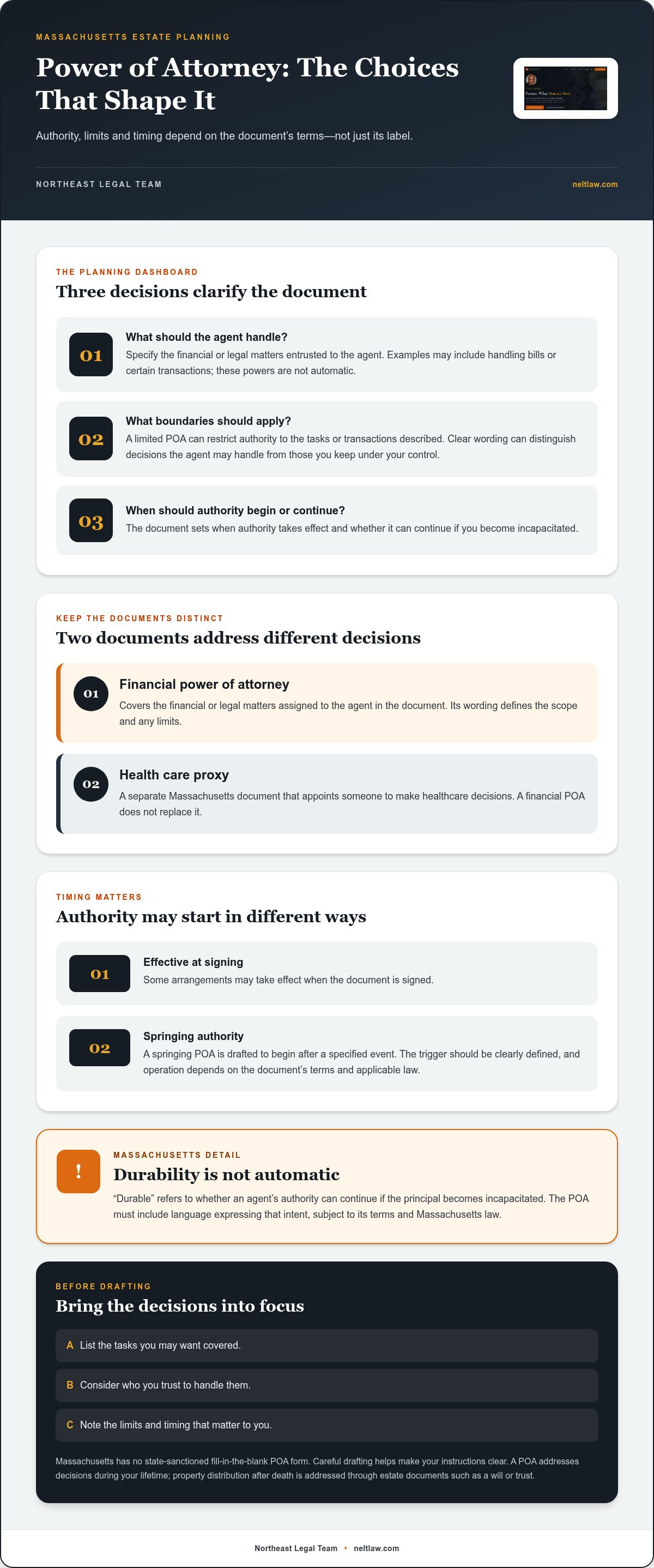
A power of attorney is not one-size-fits-all. In Massachusetts, the document’s wording defines what an agent may do, any boundaries you set, and when authority takes effect. The distinctions below can help you organize your questions, but the exact terms matter more than the label alone.
- Financial power of attorney: Gives an agent authority over the financial or legal matters specified in the document. Consider which responsibilities you want the agent to handle.
- Limited authority: Restricts the agent’s power to tasks or transactions described in the document. Think about what to include or exclude.
- Durability: Addresses whether authority can continue if the principal becomes incapacitated, subject to the document’s terms and Massachusetts law. Consider whether you want it to continue in that situation.
These are planning features, not necessarily three separate document forms. A financial POA can grant broad or limited authority, while durability concerns what happens if capacity changes. Massachusetts has no state-sanctioned fill-in-the-blank POA form, so careful drafting can make your instructions clear. If you’re searching for a poa attorney near me, bring examples of the decisions you want covered rather than relying on a document label to explain its effect.
What does durable mean in a power of attorney?
In plain English, “durable” refers to whether an agent’s authority can continue if you later become incapacitated. In Massachusetts, a POA isn’t automatically durable. The document must include language expressing that intent. The document also controls when authority begins. Some arrangements may take effect at signing, while a springing POA is drafted to begin after a specified event. The trigger should be clearly defined, and how the document operates depends on its terms and applicable law.
How is a financial POA different from a health care proxy?
A financial POA addresses the financial or legal matters assigned to the agent in its terms. A Massachusetts health care proxy is a separate document for healthcare decisions, not another name for a financial POA. Each addresses a different kind of decision, so planning one doesn’t replace considering the other. For more detail on expressing medical wishes, Northeast Legal Team’s Massachusetts living will and healthcare wishes guide explores that side of planning.
As you compare options, focus on three points: the tasks covered, any limits, and the circumstances under which authority begins or continues. A document tailored to those choices can make your intentions easier to understand. To fit POA planning into a broader estate plan, explore power of attorney planning with Northeast Legal Team.
Choosing a Massachusetts POA Agent: Balance Trust, Responsibility, and Clear Limits
Naming an agent doesn’t automatically give that person unlimited authority. A POA grants only the authority described in its terms, so consider both who should act and what you’re comfortable having them handle. The right choice is personal. Reliability, sound judgment, and willingness to take on the responsibility may matter as much as the person’s relationship to you.
Questions to consider before naming an agent
There’s no universally correct choice. Consider how each possible agent handles responsibilities and communicates, especially if they may need to coordinate with banks, bill providers, or family members. A trusted person should understand your priorities and respect your boundaries. Discussing the role beforehand gives them a chance to understand what you’re asking and decide whether they’re willing to serve.
- Can this person manage important tasks carefully, keep clear records, or communicate about decisions?
- Do they understand what matters to you and respect the limits you want to set?
- Are they willing and practically able to take on the role if needed?
- Would naming a backup agent make sense for your circumstances?
A backup may be worth discussing if your first choice could be unavailable or unable to serve. The document’s wording should make clear how an alternate agent fits into the plan. Consider your circumstances and relationships. A family member isn’t automatically the best fit, and someone outside the family may be better suited if they’re dependable and understand your wishes.
How can a POA define boundaries and reduce uncertainty?
Clear document language can identify the decisions entrusted to the agent and state the limitations you want to apply. For example, you might want an agent to manage routine financial tasks while keeping a particular type of decision outside their authority. Whether a specific restriction is workable depends on the document and applicable law, so discuss your goals with an attorney rather than relying on informal notes or assumptions.
Specific instructions can give an agent and family members a clearer reference point. They may help everyone understand the agent’s responsibilities and where the authority stops, though wording can’t guarantee that disagreements will never arise or dictate how every situation will unfold. Be candid about concerns, including privacy, family dynamics, and the level of oversight that would help you feel comfortable.
If you’re looking for a poa attorney near me, bring your preferences and questions to the conversation. Northeast Legal Team prepares power of attorney documents as part of personalized estate planning. A power of attorney planning consultation can help you consider an agent, clarify your priorities, and discuss document language that reflects the authority you intend to grant.
Preparing to Meet a POA Attorney Near You: A Massachusetts Planning Checklist
A little preparation can make a power of attorney conversation more focused. Before meeting with an attorney, note what you want an agent to handle, whom you’re considering, and what limits matter to you. You don’t need to have every answer. A written summary gives you a useful starting point for discussing the document’s scope, execution, and place in your estate plan.
What information should you bring to a POA consultation?
Bring a short list of decisions you may want someone to handle, such as paying bills or managing certain financial transactions. Note your preferred agent and any alternate you’re considering, along with questions or concerns about the role. Existing wills, trusts, or POA documents can help the attorney understand your current plan and what you want to update or coordinate.
Use this four-step checklist to organize your thoughts:
- List your needs. Describe the financial matters where you may want help, using practical examples rather than broad phrases like “handle everything.”
- Identify an agent. Write down your preferred person and, if appropriate, an alternate. Consider whether each person understands your priorities and is willing to serve.
- Note your boundaries. Record the decisions you want included, limits you want discussed, and matters you prefer to keep outside the agent’s authority.
- Discuss related documents. Bring relevant estate-planning papers and ask how a POA may fit alongside your will, trust, or other planning documents.
A concise written summary is enough. Include the questions you most want answered, such as how the document’s scope will be expressed or how it fits with your existing plan. If you’re searching for a poa attorney near me, these notes can turn a general search into a practical conversation about your needs.
What happens after the POA document is prepared?
The attorney can review the proposed language with you, explain how it reflects your instructions, and guide you through finalizing and signing the document. Ask how Massachusetts requirements apply to your particular POA, including any signature, witness, or notarization details. Formalities can depend on current law and the document’s intended use, so get guidance for your circumstances rather than relying on a general checklist.
Once finalized, keep the document with your important records and understand how it relates to your broader estate plan. Northeast Legal Team drafts estate-planning documents for flat fees, which can make document-preparation costs easier to anticipate. The flat-fee estate planning attorney guide explains this approach in more detail.
Bring your questions and documents to Northeast Legal Team for a power of attorney planning consultation and personalized recommendations.
Local Power of Attorney Help in Middlesex and Worcester Counties
For residents of Middlesex and Worcester counties, power of attorney planning can be part of a broader effort to make important decisions easier for loved ones if help is needed. Northeast Legal Team assists individuals and families with POA documents as part of estate planning. If you’ve searched for a poa attorney near me, consider how the document fits your wishes, family circumstances, and other planning needs.
How POA planning can fit into a broader estate plan
A POA addresses authority during your lifetime, while a will or trust can address different estate-planning goals. Healthcare directives address healthcare planning separately from a financial POA. The right mix depends on your priorities and circumstances, so planning may involve reviewing existing documents and identifying gaps or inconsistencies. A coordinated approach can make it easier to understand the distinct purpose of each document.
Northeast Legal Team drafts estate-planning documents for flat fees, which can make legal document costs more predictable. To learn more about this approach, explore the 2026 Massachusetts estate planning flat-fee guide. The goal is not to add documents for their own sake, but to consider which ones reflect your plans and offer useful direction to the people you trust.
A low-pressure next step for local families
You don’t need to arrive with a finished plan or perfect paperwork. A consultation or assessment is an opportunity to explain what matters to you, ask questions, and discuss personalized recommendations for POA planning within your estate plan. Northeast Legal Team offers a free consultation or assessment with no obligation to proceed, so you can understand possible next steps before making a decision.
Gather any documents you already have and jot down the questions you want answered. If you’re unsure whether your current POA reflects your wishes or how it relates to a will, trust, or healthcare directive, those concerns are a natural place to begin. Planning conversations can start with questions, not perfect paperwork.
Schedule a free, no-obligation assessment to discuss your priorities with Northeast Legal Team.
Take the Next Step Toward a Plan That Feels Right
Choosing a power of attorney agent and shaping their authority are personal decisions. You don’t need to settle every detail before moving forward. Start with the question that matters most: what would you want someone you trust to handle if you couldn’t manage it yourself?
If you’re searching for a poa attorney near me, use your questions as a starting point for a conversation about your wishes, concerns, and next steps. A thoughtful planning discussion can help you move from uncertainty toward a plan that reflects your priorities. Northeast Legal Team offers a free, no-obligation estate planning assessment with personalized recommendations for individuals and families in Middlesex and Worcester counties. Flat-fee drafting can also make document-preparation costs more predictable.
Schedule your free, no-obligation estate planning assessment to discuss your priorities and take the next step at your own pace.
Frequently Asked Questions
Does a power of attorney give someone control over everything I own?
No. Signing a POA doesn’t automatically give an agent control over every asset or decision. For example, authority to pay household bills doesn’t necessarily include authority to sell property or make gifts. The document’s language and applicable law determine what the agent may do. Before signing, review the powers and restrictions with a Massachusetts estate-planning attorney, especially if you want certain accounts or transactions handled differently.
Can I choose when my power of attorney becomes effective?
The document can address when an agent’s authority begins, but don’t assume the timing from its title alone. It may provide for authority to start at a stated time or depend on a specified condition. If you’re considering a condition, ask how it will be assessed and what happens if there’s uncertainty. A Massachusetts attorney can explain how the proposed wording works under current law.
What happens to a power of attorney when the principal dies?
Generally, a POA addresses authority during the principal’s lifetime. It isn’t a will or a set of instructions for distributing property after death. An agent shouldn’t assume the POA authorizes new actions after the principal dies. Other estate documents and legal processes may govern what happens to property. If a payment or transaction is pending at the time of death, seek advice about that specific situation before proceeding.
Can I revoke a power of attorney after I sign it?
You may be able to revoke a POA, but the applicable steps depend on the document, circumstances, and law. If you want to end or change an appointment, ask an attorney how to prepare and communicate the revocation, including who should receive notice. Simply destroying your copy may leave an agent or institution unaware of the change. Keep a record of communications and ask how to address any pending transactions.
Can the same person be my financial agent and health care proxy?
Yes, you may choose the same trusted person for both roles, but a financial POA and a Massachusetts health care proxy are separate documents with different purposes. Someone you trust to manage bills may or may not be the person you want communicating about medical care. Consider whether your choice understands your wishes and can take on each responsibility, then review each appointment separately with an estate-planning attorney.
Do I need a lawyer to create a power of attorney in Massachusetts?
You may be able to prepare a POA without an attorney, but legal guidance can help tailor the language to your goals and explain current signing requirements. Review can be especially helpful if you have several accounts, own property, or want the POA coordinated with a trust. If you’re looking for a poa attorney near me in Middlesex or Worcester County, bring your questions and existing estate documents to the discussion.
Can an agent use a power of attorney to change my will?
Don’t assume a POA lets an agent change your will. The agent’s authority depends on the document and applicable law, and a will has its own legal requirements. If you want to revise who receives property or update other estate instructions, discuss making that change directly with an estate-planning attorney. Ask how the POA and your will work alongside each other so you don’t rely on an agent acting beyond their authority.


