

Did you know that only 22% of small businesses in our state have a formal plan for what happens when the owner steps down? It's a startling figure, especially since only 30% of family-owned businesses successfully transition to the second generation. You've spent years building something meaningful, yet without proactive business succession planning massachusetts owners often find their legacy at risk. It's completely normal to feel a bit overwhelmed by the prospect of complex tax laws or the potential for family tension once you decide to retire.
You deserve a transition that feels like a sigh of relief rather than a legal headache. In this guide, you'll discover how to protect your life's work and support your family through a clear, compassionate framework. We'll explore a roadmap for exiting your business that ensures your employees are secure, your financial future is stable, and your loved ones are protected from the $2 million Massachusetts estate tax cliff. We're going to break down the essential steps to move from uncertainty to a place of total confidence in your business's future.
Key Takeaways
- Discover why proactive business succession planning massachusetts is the most effective way to protect your life's work from unexpected transitions.
- Learn how tools like buy-sell agreements and living trusts act as a safety net for your partners while keeping your private business matters out of public probate court.
- Evaluate whether a family transition or an employee buyout is the right path to ensure your team is cared for and your retirement is secure.
- Follow a clear five-step checklist to move from feeling overwhelmed to having a concrete roadmap for your eventual exit.
- Understand how a flat-fee model replaces the stress of hourly legal bills with the calm certainty of a fixed price for your peace of mind.
What is Business Succession Planning in Massachusetts?
You've spent decades building your business. It's more than just a job; it's your life's work and a vital part of your identity. But what happens when you're ready to step away? What is Business Succession Planning? At its heart, it's a proactive roadmap for the future of your company. For the nearly 600,000 small businesses across the Commonwealth, business succession planning massachusetts is the difference between a chaotic crisis and a graceful handoff. Whether you operate in the bustling commercial hubs of Middlesex County or the tight-knit communities of Worcester County, having a local strategy ensures your family's financial stability isn't left to chance.
There's a massive difference between a "sudden exit" caused by an emergency and a "planned transition" that respects your timeline. A planned approach lets you choose your successor and mentor them over several years. It allows you to protect the full market value you've worked so hard to create. Without a clear plan, your business could face a "fire sale" where assets are sold for pennies on the dollar just to cover immediate debts or taxes. We want to help you avoid that stress and replace it with the calm certainty that your legacy is secure.
More Than Just a Will: The Business Context
Many owners believe their personal will covers everything they need. It doesn't. While a will distributes your personal belongings, it doesn't provide the day-to-day operational instructions a company needs to survive your absence. Without a specific business plan, your company could fall into "probate paralysis." This happens when the court freezes business operations while waiting for an executor to be appointed. During that time, bills go unpaid, customers leave, and the reputation you built starts to crumble. Planning today prevents this heartache and ensures your business keeps running smoothly for your employees and clients.
The Consequences of Inaction
Inaction creates a vacuum that others will fill, often in ways you wouldn't like. If you become incapacitated tomorrow, who signs the paychecks? If there's no clear leader, your best employees might leave for more stable competitors out of fear for their own futures. You also risk having a Massachusetts court decide who should run your company. This often leads to family disputes that can take years to resolve in the legal system. By taking action now, you prevent the loss of value that occurs during leadership voids and ensure your family is taken care of without the burden of legal uncertainty.
Key Legal Tools for a Seamless Transition
Think of these legal tools as the structural support for your legacy. They aren't just paperwork; they're the mechanisms that ensure your wishes are carried out exactly as you intended. Effective business succession planning massachusetts relies on a few core instruments that work together to protect your family and your team. These tools help you avoid the "probate paralysis" mentioned earlier, replacing uncertainty with a clear, legal path forward.
The Buy-Sell Agreement: Your First Line of Defense
If you have partners, a buy-sell agreement is your most critical document. It functions like a prenuptial agreement for your business. It clearly outlines what happens if a partner decides to retire, becomes disabled, or passes away. By establishing a fair valuation method while everyone is on good terms, you prevent emotional disputes later. If a trigger event occurs, then the agreement dictates the next steps automatically. Often, these agreements are funded by "key person" life insurance. This means if a tragedy occurs, the business has the immediate cash to buy out the departing owner's shares. This provides financial security to their family without draining the company's operating capital or forcing a sale to an outsider.
Trusts as a Continuity Tool
A Revocable Living Trust is another powerhouse for Massachusetts owners. If you hold your business interests in your own name, those interests must pass through the public probate courts in Worcester or Middlesex County before reaching your heirs. This process is slow, expensive, and completely public. By using a trust, your business operations remain private and stay out of the court's hands. Most importantly, a trust allows your successor to step in immediately. If you aren't there to sign payroll on Friday, your successor has the legal authority to do it. This keeps your doors open and your employees paid while your family focuses on what matters most. Additionally, since the Massachusetts estate tax exemption is $2,000,000, a trust is a vital tool for managing the tax implications that apply to your entire estate value.
Protecting Your Daily Operations
Beyond the business structure, you need to protect yourself as the leader. Durable Power of Attorney and Healthcare Directives are essential. These documents ensure that if you are temporarily unable to make decisions, a person you trust can step in to handle legal and medical matters. Without these, your family might have to petition a judge for guardianship, a process that is both stressful and costly. When you start building your plan, these foundational pieces ensure that your transition is guided by your wisdom, not by court-appointed strangers. Using these tools as part of business succession planning massachusetts creates a safety net that covers both your professional and personal life.
Family Limited Partnerships (FLPs)
For those looking to transition leadership gradually, a Family Limited Partnership can be a gentle way to pass the torch. It allows you to gift interests in the business to the next generation while you maintain control over daily operations. This is a helpful way to mentor your children, giving them a stake in the company's success while you still provide the steady hand of experience. It's a methodical way to move from owner to mentor, ensuring the next generation is truly ready to lead.
Choosing the Right Path: Family, Employees, or Sale?
Deciding who will lead your company into the future is perhaps the most emotional hurdle in business succession planning massachusetts. It's a choice between your family's heritage, your employees' stability, and your own financial security. There's no one-size-fits-all answer, but there is a right path for your specific goals. We've seen that the most successful transitions happen when owners look beyond the balance sheet and consider the human stories involved.
The Family Transition: Balancing Fairness and Competence
If you have children, you likely feel a pull to keep the business in the family. However, you must ask: are they ready and, more importantly, do they actually want to lead? We often help parents navigate the delicate balance of "equal vs. equitable" distributions. This means ensuring the child who runs the business is rewarded for their hard work, while those outside the company still receive a fair inheritance through other assets. It's about preserving family harmony as much as business value. Northeast Legal Team acts as a neutral guide during these sensitive discussions, helping to facilitate a transition where your successor moves from being "the boss's kid" to a respected leader through a structured training period.
The Employee Buyout: Rewarding Your Team
For many owners, their staff is a second family. An Employee Stock Ownership Plan (ESOP) or a direct buyout allows you to reward the people who helped you build your legacy. This path provides a sense of continuity that a third-party sale might lack. It ensures your company's culture stays intact and provides your employees with a stake in the future. It's a powerful way to ensure the business you built continues to serve the community that supported you.
Selling Your Business in Massachusetts
If a family transition or employee buyout isn't the right fit, selling to a third party might be the best way to maximize your retirement fund. In the Central Massachusetts market, buyers look for clean books and a solid legal structure. Preparing for due diligence today ensures you aren't caught off guard during negotiations. We help you conduct a legal audit to polish your records, making your business more attractive to buyers while protecting your brand identity after the sale; if you are considering international stakeholders, you can find out more about specialized legal consultancy in the UAE. This preparation is a core part of business succession planning massachusetts, as it allows you to exit on your own terms with your financial future secure.
The Overlap Period: A Safer Handoff
Regardless of the path you choose, avoid a clean break on day one. A slow handoff, or an "overlap period," allows you to transfer institutional knowledge and vital client relationships. This gradual transition is significantly safer for the business's health. It gives the new leadership a chance to find their footing while you're still there to offer the steady hand of experience. Moving from owner to mentor in this way provides a sense of relief, knowing that your life's work is in good hands before you fully step into retirement.
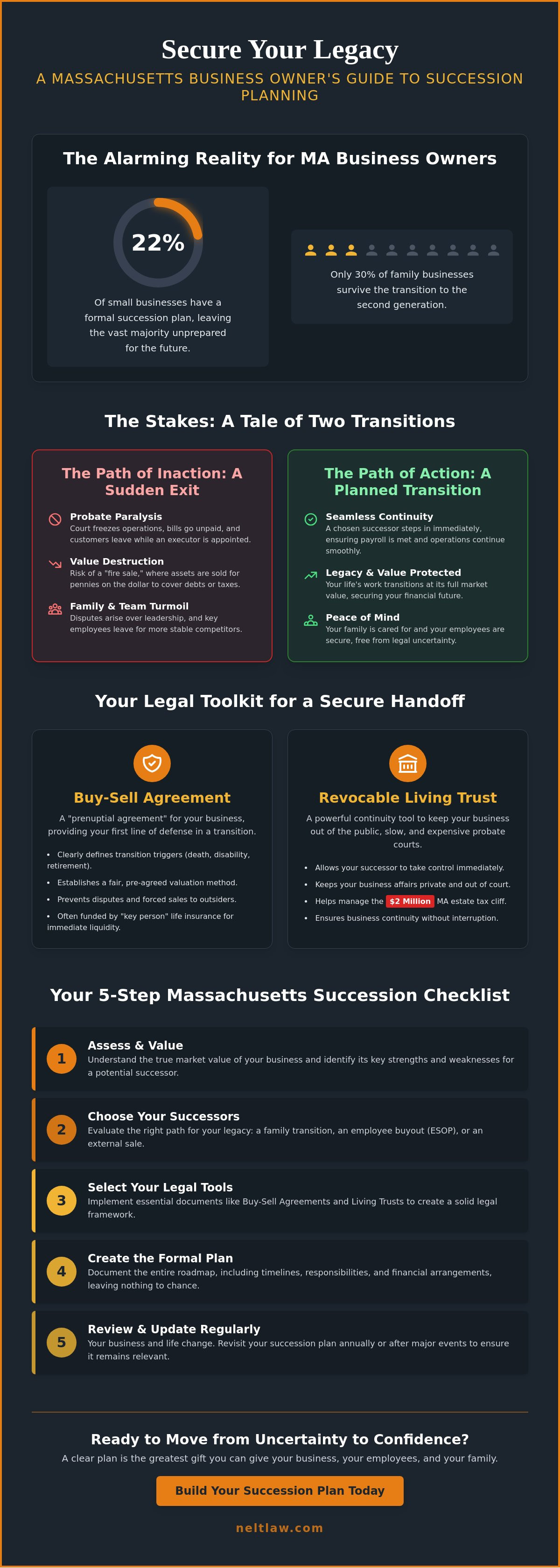
Your 5-Step Massachusetts Succession Checklist
Moving from a "big picture" idea to a concrete plan can feel like a mountain to climb. We find that breaking business succession planning massachusetts into a logical sequence helps replace that heavy feeling of being overwhelmed with a sense of progress. This isn't just about paperwork; it's about building the bridge between your current hard work and your future peace of mind. Since only 22% of small businesses in our state have a formal plan, following these steps puts you in a position of strength and clarity that most of your peers lack.
Step 1: The Soul-Searching Phase
Before you call an attorney or an accountant, you need to look inward. Ask yourself: When do I truly want to step back? How much monthly income do I need to maintain my lifestyle in retirement? You also need to identify your "non-negotiables." Perhaps you want to ensure the company name never changes, or you want to guarantee that long-term employees stay on board for at least three years. Take a moment to write a single sentence that defines your ideal exit. For example: "I want to retire by age 68 with a stable income, knowing my daughter is leading the company with our core values intact."
Step 2: The Massachusetts Legal Context
Your business doesn't exist in a vacuum. It's subject to specific state laws that can impact your transition. Start by reviewing your current corporate bylaws or operating agreements. Are they outdated? Do they still reflect how you actually run things? You also need to check for compliance with local regulations, such as the Massachusetts corporate excise tax or the state's unique estate tax rules. Identifying "red flags" now, like an old estate plan that doesn't account for the $2,000,000 exemption, prevents expensive surprises for your heirs later.
Step 3: Valuation and Successor Training
You can't plan for a transition if you don't know what the business is worth. Conduct a professional valuation to get a realistic number for your retirement math. Once you have a target, identify your successor and start their training. This "Overlap Period" is where you pass on the relationships and wisdom that aren't found in any manual. It's about moving from being the "doer" to being the "mentor."
Step 4: Execute the Legal Instruments
Now is the time to draft the legal instruments we discussed earlier. This includes your Buy-Sell Agreements, Living Trusts, and Power of Attorney documents. If you're ready to secure your legacy, you can schedule a strategy session to ensure these documents are drafted with compassion and precision. Having these in place means your family and employees are protected if something happens to you tomorrow. It turns your wishes into a legally binding reality.
Step 5: Review and Update
Life changes. Tax laws evolve. Your children's career goals might shift. A good plan isn't a "set it and forget it" document. Review your succession strategy at least once a year or whenever a major life event occurs. This ensures your roadmap always leads to the destination you want, no matter how the landscape around you changes. Regular updates provide the ongoing certainty that your hard work will always be protected.
Northeast Legal Team: A Reassuring Partner for Your Business
At Northeast Legal Team, we believe that business succession planning massachusetts should be about more than just asset transfers. It's about honoring the years of sweat equity you've poured into your company and ensuring your family's future remains bright. We view ourselves as your protective family advocate, standing by your side as you navigate these deeply personal decisions. Our philosophy is rooted in three simple pillars: protection, legacy, and family continuity. We aren't just here to file documents; we're here to help you secure the life you've built for yourself and those you love.
Serving the communities of Middlesex and Worcester counties, we bring a blend of local expertise and genuine warmth to every consultation. We understand the unique challenges facing Massachusetts business owners, from the $2,000,000 estate tax exemption to the complexities of local corporate regulations. Our goal is to transform a potentially overwhelming process into one that feels manageable and safe, providing a steady hand that guides you toward a sense of relief and certainty.
The Flat-Fee Advantage for Business Owners
One of the biggest barriers for business owners is the fear of the "ticking clock." Traditional law firms often rely on hourly billing, which can make you feel rushed or hesitant to ask the questions that truly matter. We've removed that anxiety by utilizing a flat-fee pricing model. This provides the transparency and certainty you crave. You'll know exactly what your investment is from the very beginning, allowing us to focus entirely on your goals rather than the stopwatch.
Our comprehensive business succession packages include everything you need for a smooth transition. This typically involves drafting buy-sell agreements, establishing living trusts, and creating power of attorney documents. By bundling these services into one predictable price, we ensure you have a complete safety net without the stress of "meter-running" legal bills. This approach allows for deep, unhurried conversations where we can explore every "what-if" scenario together. It's about providing predictable costs for predictable peace of mind.
Starting the Conversation with David E. Walker, Esq.
We know that the first step is often the hardest. That's why we take a "listen-first" approach. We want to hear the human story behind your business. What are your fears? What are your dreams for your children? When you meet with David E. Walker, Esq., you'll find a friendly guide who values your perspective. We don't use intimidating jargon or cold, clinical language. Instead, we offer a supportive environment where you can speak freely and feel heard.
Our goal is to move you from a state of concern to a state of resolution. During your assessment, we'll walk through your current situation and identify the most compassionate path forward for your unique family dynamics. If you're ready to replace your anxiety with a clear roadmap, we invite you to take that first step. You can schedule your free business succession assessment today. Let's work together to ensure your legacy is protected for generations to come through thoughtful business succession planning massachusetts.
Your Path to a Secure Business Future
You have spent years building your reputation and your company's value. Now, you have the opportunity to ensure that legacy continues on your own terms. Whether you choose to pass the torch to a family member, reward your employees through a buyout, or sell to a third party, your decision deserves the protection of a formal strategy. By using tools like living trusts and buy-sell agreements, you can avoid the delays of probate and the financial stress of the Massachusetts estate tax.
Effective business succession planning massachusetts owners can rely on is about more than just numbers; it's about the people you care for. At Northeast Legal Team, we bring over 14 years of experience to every plan, offering the transparent certainty of flat-fee pricing. We take a compassionate, mentor-led approach to help you navigate complex family dynamics without the fear of a ticking clock. Our goal is to make this transition feel like a natural, safe progression for your life's work.
You don't have to face these big decisions alone. Take the first step toward total peace of mind and secure your business legacy with a free assessment from Northeast Legal Team. It's time to turn your hard-earned success into a lasting legacy for your family and community.
Frequently Asked Questions
When is the best time to start business succession planning in Massachusetts?
The ideal time to start is at least five to ten years before you anticipate retiring or stepping away. This window gives you the necessary time to identify and mentor a successor, conduct a proper valuation, and address complex tax implications. If you begin the process early, you can ensure a gradual handoff that feels like a natural transition rather than a stressful event for your family and employees.
What is the difference between an estate plan and a business succession plan?
An estate plan focuses on your personal assets and how they will be distributed to your loved ones after you pass away. In contrast, business succession planning massachusetts owners utilize focuses specifically on the future of your company's leadership and operations. While your estate plan protects your family's inheritance, your succession plan protects the jobs of your employees and the continuity of the services you provide to your clients.
How does a Buy-Sell Agreement work if I have a business partner?
A Buy-Sell Agreement acts as a prearranged contract between you and your partners that dictates how ownership shares are handled during major life events. If a partner passes away, becomes disabled, or chooses to retire, then the agreement ensures the remaining partners can buy out those shares at a fair, predetermined price. This provides immediate financial security to the departing partner's family while keeping the business stable and in trusted hands.
Can I include my business in my Revocable Living Trust?
Yes, including your business interests in a Revocable Living Trust is a highly effective way to ensure continuity. By doing so, you allow your business interests to bypass the public probate process in counties like Middlesex or Worcester. This keeps your private business matters out of the public eye and allows your designated successor to take over operations immediately if you are no longer able to lead, preventing any gaps in payroll or management.
What happens to my Massachusetts business if I die without a succession plan?
If you pass away without a plan, your business interests will enter the probate court system, where a judge will decide who has the legal authority to manage your company. This often leads to family disputes and operational paralysis as the court works through the legal requirements. This state of uncertainty can quickly erode the value of your life's work and leave your employees and loved ones in a state of deep anxiety during an already difficult time.
How much does business succession planning cost with Northeast Legal Team?
We utilize a transparent, flat-fee pricing model for all our planning packages so you never have to worry about a ticking clock or unpredictable legal bills. During your initial assessment, we will listen to your story and provide a clear, fixed quote based on the specific goals you want to achieve. This approach allows us to focus entirely on your protection and peace of mind without the pressure of hourly billing.
Do I need a succession plan if I plan to sell my business to an outsider?
You definitely need a plan even if your goal is an outside sale. A solid succession strategy helps you clean up your legal structure and financial records today, which makes your company much more attractive to potential buyers during due diligence. It also ensures that your personal retirement goals and your brand's reputation are protected throughout the negotiation and sale process, giving you the financial security you deserve.
How often should I update my business succession plan?
You should review your plan at least once a year or whenever a major life event occurs, such as a marriage, a birth, or a significant change in the business's value. Since the Massachusetts estate tax exemption is $2,000,000 for those passing away on or after January 1, 2023, an older plan might not account for these current rules. Regular updates ensure your roadmap always reflects your current family dynamics and the latest legal requirements.


