

What if the person who’s always led your family business couldn’t make decisions tomorrow? Without a clear plan, uncertainty about ownership and leadership can place business continuity and family relationships under strain. A family business succession plan Phillipston MA owners can rely on brings those decisions into focus before a transition becomes urgent.
It’s understandable to feel unsure about who should take the lead, how other family members will be treated, or whether business documents align with your personal estate plan. These decisions are connected, and addressing them thoughtfully can help reduce confusion when the time comes to pass the business on.
This step-by-step guide explains how to clarify family and business goals, consider who should own and manage the company, and coordinate succession planning with wills, trusts, and other estate planning documents. You’ll see how legal planning can support continuity while respecting the people and relationships behind the business. With a thoughtful sequence of decisions, you can move toward a transition structure that reflects what matters most to your family.
Key Takeaways
- A family business succession plan Phillipston MA owners develop should clarify who will lead, who will own the business, and how the transition is intended to happen.
- Review the business’s legal structure and governing documents before choosing a transition approach, since they can affect available options.
- Don’t rely on a will or verbal agreement alone; business ownership and governance documents serve different purposes from personal estate planning documents.
- Start with clear goals, then gather entity records, existing agreements, ownership details, and a basic operations overview to guide planning.
- Connect succession decisions with wills, trusts, and other estate planning needs so the transition can better reflect family and business goals.
Why a Phillipston Family Business Needs a Succession Plan Before a Transition
Succession planning means preparing for future changes in who owns a family business and who leads its daily work. For a Massachusetts family business, it’s a way to make thoughtful decisions before a transition is urgent, rather than leaving relatives and employees to guess what should happen next.
In Phillipston and across Worcester County, a family business may depend on an owner who holds key relationships, makes routine decisions, and understands how the operation runs. If that person suddenly becomes unavailable, employees may be unsure who can approve expenses or direct work. Family members may also have different expectations about who should take charge or receive an ownership interest. Clear preparation gives everyone a steadier starting point.
What a family-business succession plan is designed to do
A succession plan is a practical roadmap for how a family business’s ownership and leadership responsibilities may change over time. Those are related, but distinct, decisions: someone may own a share of the company without managing daily operations, while a future leader may need defined authority to guide the team.
A plan can set out the intended roles, timing, and steps for a transition, along with contingencies if circumstances change. It also gives the family a chance to identify and prepare future leaders, an element discussed in this overview of Succession Planning in Family Businesses. The right approach depends on the company and the family’s goals, but writing down decisions can make expectations easier to understand and revisit.
Signs that a Phillipston business should begin planning
There’s no need to wait for a retirement date. A succession conversation can begin when an owner starts thinking about stepping back, a leadership role is becoming difficult to fill, or a family member expresses interest in joining or leading the business. A planned sale or a change in family circumstances can also prompt owners to consider what continuity should look like.
Health changes or a sudden loss of availability can expose uncertainty about who has authority to keep operations moving. If those questions haven’t been discussed, family members may have to make important decisions while also managing a stressful moment. Starting earlier creates room to listen, compare goals, and identify disagreements before they become harder to resolve.
A calm first conversation doesn’t require the family to settle every detail. It can simply establish what the current owner hopes to preserve, who may be interested in future roles, and which decisions need further planning. That foundation can help the family move toward a transition that supports both the business and the relationships around it.
The Ownership, Leadership, and Legal Decisions in a Massachusetts Succession Plan
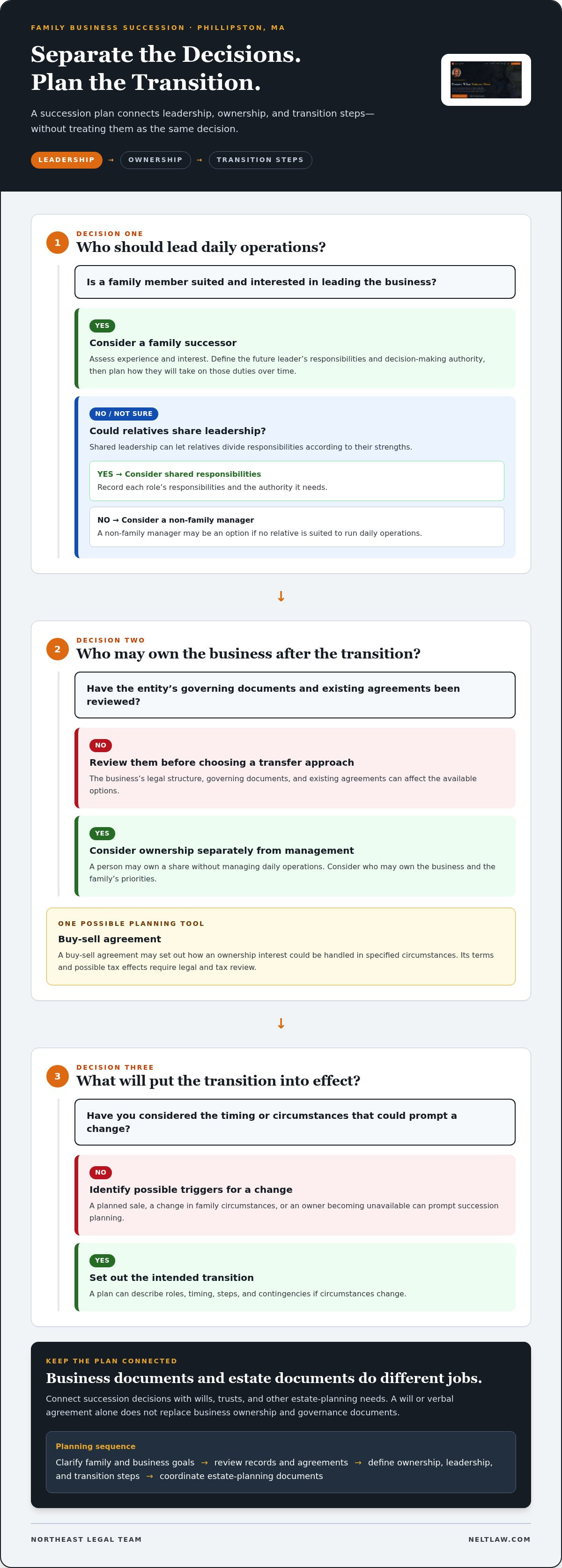
Once the family has begun discussing a future transition, separate three questions: who will lead the business, who will own it, and what steps will put the change into effect. These decisions affect one another, but they don’t have to be assigned to the same person. The right approach depends on the business’s legal structure, its governing documents and existing agreements, family goals, and applicable law. For broader context, read about business succession planning in Massachusetts.
Choosing and preparing the next leader
A family successor may offer continuity, while shared leadership can let relatives divide responsibilities according to their strengths. A non-family manager may be another option if no relative is suited to run daily operations. Family ties alone don’t establish who is ready to lead. Consider experience, interest, and the decisions each role requires. The family can record responsibilities and decision-making authority, then set out how a future leader will take on those duties over time.
Planning ownership transfer and business documents
Ownership is a distinct question from management. Before choosing how ownership might change, review the entity’s governing documents and existing agreements. A buy-sell agreement may be one tool for setting out how an ownership interest could be handled in specified circumstances, but its terms and possible tax effects require legal and tax review. Massachusetts rules and the business’s structure can affect the available options, so don’t assume one transfer method fits every company.
| Decision | Questions to consider | What to review |
|---|---|---|
| Leadership | Who has the skills and interest to direct daily operations? Could responsibilities be shared? | Current roles, future responsibilities, and the authority each role needs. |
| Ownership | Who may own the business after the transition, and what are the family’s priorities? | Entity documents and existing ownership or transfer agreements. |
| Transition steps | What timing or circumstances could prompt a change? | Relevant agreements and the owner’s broader estate-planning documents. |
A family business succession plan Phillipston MA owners create should connect these decisions without treating them as interchangeable. For example, a relative could receive an ownership interest while a different person manages the company. A planning conversation can help clarify how business succession needs fit with personal estate planning. Northeast Legal Team offers business succession planning guidance to help families consider a plan suited to their goals.
How a Succession Plan Addresses Family Conflict and Continuity Concerns
A will or a verbal family agreement may express important wishes, but neither should be assumed to answer every question about how a business will be managed or how decisions will be made. Business governance documents, ownership agreements, and personal estate documents serve different purposes. A clear plan considers how they fit together instead of relying on a single document or conversation to cover every possibility.
Separating family expectations from business decision-making
Family members may care deeply about the business while having different ideas about its future. One relative might expect to help guide major decisions, while another assumes the current owner will choose a single successor. A structured discussion can bring those expectations into the open without treating disagreement as disloyalty.
Consider recording who participates in business decisions, which roles carry decision-making authority, and how the family will revisit a disagreement that cannot be resolved at first. For example, family members might agree to set aside a regular meeting to discuss business matters and identify a process for escalating unresolved questions. Written responsibilities won’t guarantee agreement, but they can give everyone a shared reference point when memories or assumptions differ.
Coordinating business succession with an owner’s estate plan
Business planning should also be considered alongside the owner’s personal estate plan. A will, trust, or power of attorney addresses personal planning needs, while business governance documents address the company’s internal decision-making and ownership arrangements. Their purposes differ, and the effect of any document depends on its terms and applicable law. Reviewing them together can help identify gaps or inconsistencies before a transition.
For instance, an owner may have made personal plans for their assets but not revisited whether the business’s agreements reflect the same intentions. That doesn’t mean one document automatically controls every business decision. It means the connections deserve careful review as part of a family business succession plan Phillipston MA families develop.
Personal planning can raise questions about which documents may be appropriate and how they relate to business goals. This overview of estate planning attorney flat-fee guidance offers additional context. A coordinated review of business and estate planning documents can help owners understand how their plans work together, without assuming a particular tax outcome or legal effect.
How to Build a Family Business Succession Plan in Phillipston, MA
A manageable plan starts with clear priorities, not perfect answers. For a family business succession plan Phillipston MA owners can use as a working guide, take the decisions in sequence, gather the records that show how the business operates, and note which questions need legal review. Owners in Phillipston and across Worcester County can use the same practical approach; the location doesn’t create a separate set of succession rules. Timing and legal requirements depend on the business and the transition, so there’s no standard completion period that fits every family.
Prepare for a focused succession-planning conversation
Before a planning discussion, consider when you’d like a transition to begin, whether you hope to stay involved, and what you want the business and family relationships to preserve. You don’t need every answer in advance. A list of uncertainties gives the conversation a useful starting point.
Gather records that help describe both the business and your personal planning. Depending on what exists, these may include:
- Entity formation and governance records, plus any ownership, shareholder, or operating agreements.
- A current ownership breakdown and a basic overview of operations, key roles, and regular decisions.
- Existing wills, trusts, powers of attorney, and other estate-planning documents.
- Notes about possible successors, desired timing, and questions family members want addressed.
Having these materials together helps reveal where documents or expectations may need attention. If a record is missing, note that rather than putting the entire planning process on hold.
Turn decisions into a plan that can be revisited
Use the discussion to work through a practical sequence:
- Set goals: Identify what the owner hopes to preserve and what a successful transition means to the family.
- Review documents: Compare existing business agreements and estate plans with those goals.
- Identify successors: Consider who may lead, who may own the business, and what preparation each role requires.
- Select a structure: Explore an approach that fits the company’s documents, family priorities, and applicable law.
- Record next steps: Note agreed roles, milestones, contingencies, open questions, and who is responsible for follow-up.
A plan should be useful beyond the day it’s written. Revisit it after a major family change, a shift in the business, or a change in ownership so the written steps continue to reflect current circumstances. A legal planning conversation can help connect business succession with estate-planning needs and identify issues that call for further review.
To discuss your family’s goals and next steps, schedule a free succession-planning consultation or assessment with Northeast Legal Team.
Work With Northeast Legal Team on Your Phillipston Succession Plan
A succession-planning conversation can help connect your goals for the business with decisions about ownership and your personal estate plan. You don’t need to arrive with every answer settled. Start with what you hope will happen, what concerns you, and which choices still feel uncertain. Northeast Legal Team provides business succession planning and estate planning, including wills, trusts, and powers of attorney.
What to discuss with a succession-planning attorney
Bring the questions that matter most to your family and business. You might discuss when you’d like a transition to begin, whether you plan to remain involved, who may be interested in future leadership, and what needs attention first. The legal options depend on the business structure, its documents, and your family’s circumstances, so advice should be tailored to those details.
If you have a will, trust, or power of attorney, include it in the conversation where relevant. Reviewing personal and business plans together can help identify questions about how your wishes relate to the company’s existing ownership and governance arrangements. The aim is to understand how the pieces fit, not to assume one document answers every succession question.
A manageable next step for Phillipston business owners
Gather the documents you already have, such as entity records, business agreements, ownership information, and estate-planning documents. Then make a short list of unresolved decisions. For example: who could take on leadership, what responsibilities might change first, and which agreements need review? You can begin even if some records are missing or family members haven’t reached agreement on every point.
Taking a thoughtful step now gives you time to discuss options calmly, before a business or family change makes decisions feel more pressing. A planning conversation can help you organize the questions and consider a path that reflects your priorities, without requiring you to have a finished plan in hand.
To discuss your situation, request a free consultation or assessment with Northeast Legal Team about your family business succession plan in Phillipston, MA.
Take the Next Step Toward a Thoughtful Transition
A durable succession plan connects three decisions: who will lead the business, who will own it, and how a transition will take effect. It also accounts for family expectations and the owner’s personal estate plan, so business agreements and estate documents can be considered together. You don’t need every detail resolved before you begin. A clear list of goals, current documents, and open questions is a practical starting point.
For a family business succession plan Phillipston MA owners can shape around their family and company, Northeast Legal Team provides business succession planning and estate planning services. A planning conversation can help you explore your priorities and consider how your business and personal plans fit together, without pressure to have all the answers at once.
Schedule a free consultation or assessment with Northeast Legal Team to discuss your situation. Taking one thoughtful step now can help you approach the next chapter with greater clarity and care for the business and the people who matter to you.
Frequently Asked Questions
What should a family business succession plan include?
A useful plan addresses future leadership, ownership changes, decision-making authority, and what should happen if circumstances disrupt the expected transition. It should also be considered alongside the company’s governing documents and the owner’s personal estate plan. The right documents and structure depend on the business and family’s situation, so treat a general checklist as a starting point for discussion, not a substitute for advice tailored to your circumstances.
When should a family business in Phillipston start succession planning?
Start before a planned retirement or sale, while there’s time to discuss goals and prepare potential successors. A family business succession plan Phillipston MA owners begin early can also help identify open questions at a manageable pace. A major health change or unexpected departure may make decisions more urgent. You don’t need to finalize every detail at once; early conversations give the family time to clarify priorities and plan next steps.
Does a will create a complete business succession plan in Massachusetts?
No, a will may be one part of an owner’s estate plan, but it may not address every business issue, such as leadership responsibilities or the company’s governing documents. Succession planning considers how ownership and management could change and how those plans relate to personal estate planning. The appropriate documents and their legal effects depend on the business’s circumstances and current Massachusetts law, so avoid assuming a will alone covers the transition.
How can a family business reduce conflict during succession?
Begin with a structured conversation about goals, roles, timing, and how business decisions will be made. Then document responsibilities and the process for addressing questions or disagreements. For example, clarify who can make routine operating decisions and how significant issues will be discussed. A written plan can’t guarantee that everyone will agree, but it can make different expectations visible earlier and give family members a clearer basis for discussion.
Can a business owner transfer leadership without transferring ownership?
Yes, leadership and ownership are separate decisions, so a business may plan for management responsibilities to change while ownership remains with the current owner. For instance, a successor might take on daily operations while the owner retains an ownership role for a period. Whether and how this arrangement works depends on the company’s structure, governing documents, goals, and applicable law. Review those details before deciding how to put the transition into effect.
How does business succession planning connect to estate planning?
Business succession planning and estate planning can be connected because an owner’s business interests may form part of their broader personal estate. Wills, trusts, and powers of attorney have distinct purposes and shouldn’t be treated as interchangeable business documents. Reviewing the plans together can help identify questions about whether business arrangements and personal wishes align. The right approach depends on the owner’s circumstances and the terms of the relevant documents.
What should I bring to a succession-planning consultation?
Bring available governing documents, ownership details, existing business agreements, and personal estate-planning documents, such as wills, trusts, or powers of attorney. It also helps to note your preferred timing, potential successors, and decisions that remain unresolved. You don’t need a complete plan to begin. Northeast Legal Team offers a free consultation or assessment without obligation for owners in Worcester County and Middlesex County, including families planning for a Phillipston business.


