

Could moving a home or savings into someone else’s name protect it from a lawsuit, or create a bigger problem? For people thinking about protecting assets from lawsuits Princeton MA, the answer depends on the timing, the asset, and the purpose of the decision. A transfer made in response to a claim is not the same as thoughtful, lawful planning.
It’s understandable to worry that a claim could put your home, savings, or business interests at risk. Massachusetts offers planning tools, but each has limits. Changing ownership without understanding the legal and tax consequences may add risk instead of reducing it.
This guide explains the difference between legitimate planning and improper transfers, and describes options such as the Massachusetts homestead exemption, insurance, trusts, and business structures. It also outlines how to identify personal or business risks and prepare for a legal consultation. The goal is to help you make an informed next move, not promise that any strategy will prevent a lawsuit.
Key Takeaways
- Protecting assets from lawsuits Princeton MA starts with lawful advance planning, not last-minute transfers that could create legal problems.
- Massachusetts homestead protections, insurance, trusts, and business structures may help manage exposure, but each has limits.
- Compare planning tools by their purpose, effect on control, and fit with your personal or business circumstances.
- Build a clearer picture of your risks by organizing an asset inventory, reviewing existing documents, and identifying family and business priorities.
- An individualized plan can coordinate asset-protection considerations with estate planning and business succession goals.
Asset Protection in Princeton, MA: Planning Realities
Asset protection is lawful advance planning to manage exposure to potential claims while respecting creditors’ rights and existing obligations. It is not a way to make valid claims disappear. Planning can shape how assets are owned and managed, but it does not provide immunity from lawsuits. The general Asset Protection Overview describes legal techniques and the role of laws governing creditors, trusts, and transfers. The right approach depends on the facts and applicable Massachusetts rules.
For a Princeton household, planning may involve home equity, savings, investment property, business interests, and family needs. These priorities can overlap, but they are not interchangeable. A plan that preserves access to funds for everyday expenses may differ from one focused on rental property or a future business transition.
Which assets and risks should Princeton residents consider?
Start with an inventory instead of assuming every asset faces the same risk. For each asset, note who owns it, any debt or personal guarantee attached to it, existing insurance, your role in a business, and related obligations. Include jointly owned property and family needs. This overview can help identify questions to address before making changes.
For example, a Princeton homeowner may be concerned about home equity after a property-related claim. A local small-business owner may be more concerned about business debts or a dispute connected with a personal guarantee. A rental-property owner may need to consider how ownership and insurance relate to risks associated with that property. These examples are starting points, not predictions that a particular person will face a claim. The nature of a dispute, ownership records, debts, and other circumstances affect the analysis.
Why asset protection is different from hiding assets
Lawful planning considers your full financial picture and existing obligations. Concealing property or transferring it to obstruct a creditor is different and may create serious legal complications. If a claim has already arisen, or you reasonably anticipate one, timing can affect which steps are appropriate. Don’t retitle or give away assets on your own to try to put them beyond a creditor’s reach.
Planning conversations do not have to wait until a problem appears. Reviewing ownership, insurance, and estate documents in advance can help you understand potential exposure and consider options that fit your goals. If a claim is underway or expected, explain that early in any legal review so the circumstances can be assessed accurately.
Effective protecting assets from lawsuits Princeton MA planning depends on the person, property, and obligations involved. No trust, ownership structure, insurance policy, or other tool guarantees a lawsuit-free outcome or shields every asset. The goal is to understand where risks may arise and make informed, lawful decisions that account for family and business priorities.
Massachusetts Asset-Protection Tools: How Trusts, Homestead Rules, and Insurance Work
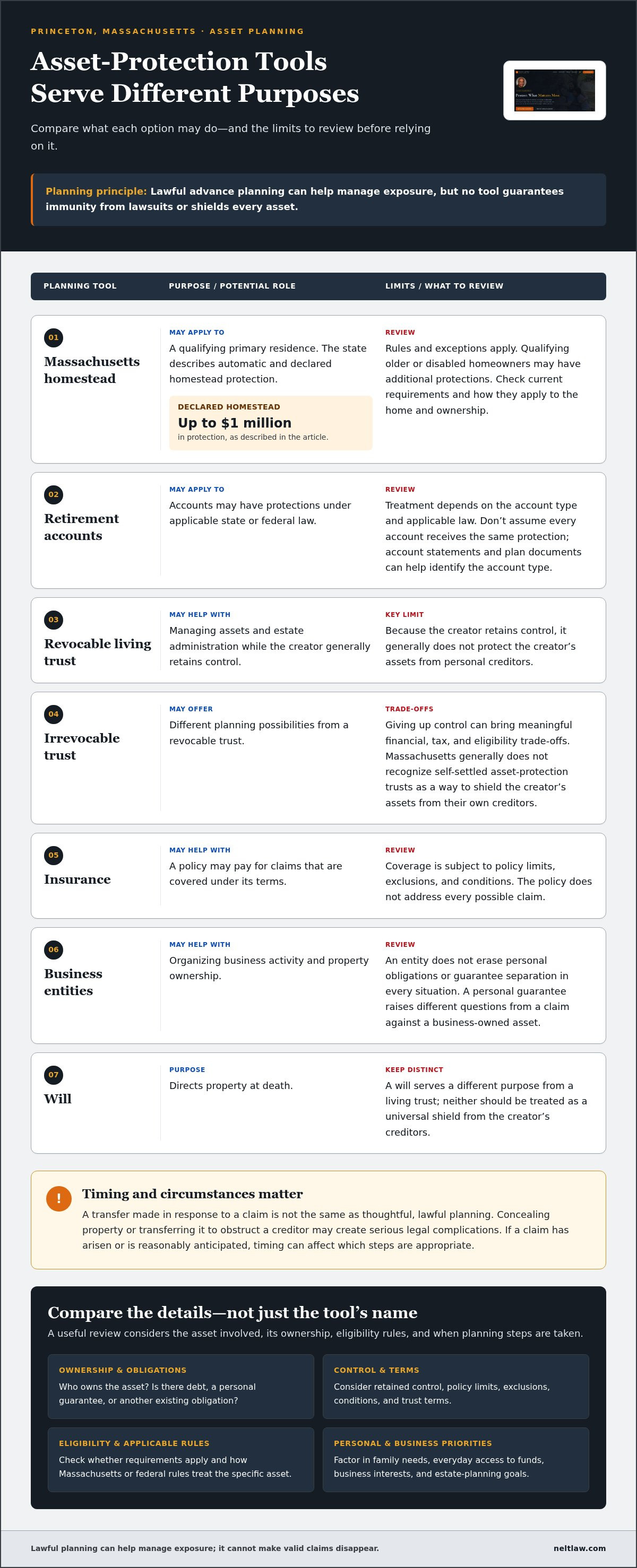
No single tool fits every risk. Insurance may respond to covered claims, ownership structures can separate certain business or property interests, and estate-planning documents organize how assets are managed or passed on. These tools serve different purposes. A will directs property at death, while a living trust can help manage assets and estate administration. Neither should be treated as a universal shield from the creator’s creditors.
For protecting assets from lawsuits Princeton MA, consider the asset involved, how it is owned, whether eligibility rules apply, and when planning steps are taken. A tool’s name alone does not establish protection. Terms, exclusions, retained control, existing obligations, and the circumstances of a claim all matter.
What Massachusetts homestead and retirement protections may cover
Massachusetts provides homestead protection for qualifying primary residences. The state describes automatic and declared protection, with a declared homestead generally providing up to $1 million in protection. Qualifying older or disabled homeowners may have additional protections. Rules and exceptions apply, so review the Massachusetts Homestead Act and determine how current requirements apply to your home and ownership.
Retirement accounts require a separate review. Potential protection depends on the account type and applicable state or federal law, so don’t assume every account receives the same treatment. Account statements and plan documents can help identify the type of account you hold.
How trusts, insurance, and business entities serve different purposes
A revocable living trust generally lets its creator retain control and can support estate administration. Because the creator retains control, it usually does not protect the creator’s assets from personal creditors. An irrevocable trust may offer different possibilities, but giving up control can carry meaningful financial, tax, and eligibility trade-offs. Massachusetts generally does not recognize self-settled asset-protection trusts as a way to shield a creator’s assets from their own creditors.
Insurance addresses another kind of risk. A policy may pay for covered claims, subject to its limits, exclusions, and conditions. Business entities can help organize business activity and property ownership, but they do not erase personal obligations or guarantee separation in every situation. For example, a business owner’s personal guarantee raises different questions from a claim against a business-owned asset.
Wills, trusts, and business entities also have distinct roles. A will directs how property is distributed after death. A trust may help manage property during life or at death. An entity organizes business ownership and activity. Don’t choose among them based only on a promise of protection. A personalized asset-protection review can help connect these options to your goals and circumstances.
Which Asset-Protection Strategy Fits? Compare Benefits, Limits, and Timing
Tools that support estate administration do not necessarily protect assets from a lawsuit. A will directs how property is distributed after death, but generally does not shield assets during the owner’s lifetime. A revocable living trust can help organize asset management and transfer, yet retaining control usually means it should not be treated as automatic creditor protection. The useful question is not simply which tool offers protection, but which tool fits the asset, risk, and family or business priorities.
| Tool | Purpose | Control and limits | Why individual review matters |
|---|---|---|---|
| Insurance | May respond to covered claims. | Coverage depends on policy terms, limits, exclusions, and conditions. | Review the risks insured and the gaps that may remain. |
| Homestead protection | May protect qualifying home equity under Massachusetts law. | Eligibility, ownership, and statutory exceptions affect its reach. | Confirm how the rules apply to the residence and its owners. |
| Revocable trust | Can support asset management and estate administration. | The creator generally retains control; it isn’t an automatic shield from personal creditors. | Consider administration goals separately from creditor concerns. |
| Irrevocable trust | May serve specific planning goals, depending on its terms. | Giving up control can bring significant financial and tax trade-offs. | Review the structure, timing, and consequences before transferring assets. |
| Business entity | Organizes business ownership and activity. | Doesn’t erase personal guarantees or ensure separation in every situation. | Consider the business’s assets, operations, and existing obligations. |
When an estate-planning tool may not protect assets from a lawsuit
Estate administration and asset protection are related, but they are not interchangeable. A will helps direct distribution, and a revocable trust may make asset management easier. Neither should be assumed to prevent a creditor from pursuing an owner’s assets. Existing judgments, pending claims, insolvency, or the purpose behind a transfer can change the legal analysis. Share those facts before taking action.
Why a plan should account for control, family, and business needs
A homeowner may prioritize use of the family residence. A rental-property owner may focus on property-related exposure. A business owner may need to retain authority to operate, while retirement savings require review based on account type and applicable rules. Some structures may limit access or control. The right balance depends on what you need to retain and the goal you are addressing.
Medicaid planning is a separate context with its own eligibility considerations, not a shortcut for lawsuit protection. For that distinct topic, see this Massachusetts Medicaid asset-protection trust guide.
Timing matters, but planning early does not defeat every future claim. Once a claim appears, transferring or retitling assets will not reliably protect them and may raise additional legal concerns, especially if the purpose is to obstruct a creditor. Before changing ownership, review the full picture: the asset, debts, control you want to keep, family needs, business obligations, and any current or anticipated claim.
How to Prepare a Lawful Asset-Protection Plan in Princeton
A useful planning discussion starts with a clear picture, not a rushed ownership change. For protecting assets from lawsuits Princeton MA, organize your goals and records first. Then review possible steps in light of your obligations, family needs, and business responsibilities.
Use this sequence to prepare:
- Identify your goals. Decide what matters most, such as preserving family stability, keeping a home, planning for a dependent, or preparing for a business transition.
- Inventory your assets. List real estate, savings, investments, retirement accounts, and business interests. Record how each is owned and note related debts.
- Map possible exposures. Consider insurance coverage, personal guarantees, business roles, property responsibilities, pending disputes, and other existing obligations.
- Review current documents. Gather your will, trust, power of attorney, business agreements, property records, and insurance policies. Note outdated information or unclear ownership.
- Discuss options before acting. A lawyer can review proposed changes alongside legal, tax, ownership, and family consequences, including whether a claim or obligation affects the available choices.
What to gather before discussing asset protection
Bring property deeds or ownership records, account information, business documents, insurance policies, and existing estate-planning documents. Write down debts, guarantees, pending disputes, and significant upcoming transactions, such as a property purchase or business sale. A practical checklist is: Gather your ownership records, account details, business and insurance documents, estate plan, debts, guarantees, disputes, and upcoming transactions.
Also consider the outcome you want. Preserving family stability may call for different priorities than preparing a successor to run a business. Naming those goals helps focus the discussion on what you need to protect and how much control you want to retain.
How to review a plan after life or business changes
Revisit your plan after marriage, divorce, an inheritance, a property purchase, a business change, or a major shift in debt. These events can affect ownership and responsibilities, or make existing documents inconsistent with your wishes. Business owners considering continuity can include Massachusetts business succession planning in that review.
There is no single review schedule that fits everyone. A periodic legal review can help you spot changes in your circumstances or relevant rules before relying on an outdated plan. Don’t transfer or retitle property to frustrate a creditor or bypass legal obligations. If a claim is pending or anticipated, explain that clearly before taking any step.
To review your goals, documents, and potential options in a calm, personalized discussion, schedule an asset-protection consultation.
Discuss Princeton Asset Protection with Northeast Legal Team
Asset protection is most useful when it reflects your circumstances, not a promise that a particular document or structure will prevent a lawsuit. Northeast Legal Team helps Princeton residents consider lawful options in light of their assets, existing obligations, family priorities, and business responsibilities. The aim is to understand the choices and trade-offs, then decide what may fit.
A personalized review can connect asset-protection considerations with estate planning, trusts, and business succession when appropriate. For example, a business owner may want to consider how ownership planning relates to a future transition while keeping personal and family goals in view. These issues can overlap, but each tool has a distinct role. Recommendations depend on your facts and applicable Massachusetts law, and no plan can guarantee protection from every claim.
What a personalized legal review can clarify
A discussion can help bring several parts of the picture together:
- How property and business interests are currently owned, and whether debts or guarantees are attached.
- What your existing will, trust, powers of attorney, insurance policies, and business documents are designed to do.
- Which personal, property-related, or business exposures may deserve attention.
- How possible planning choices may affect control, family needs, and business continuity.
Bring what you have, even if documents are incomplete or you are unsure which questions to ask. A clear explanation of your priorities can be as helpful as a complete file. If you are also considering how legal-planning costs are structured, this flat-fee estate-planning guidance offers related context.
Take a measured next step toward protecting what matters
You do not need to arrive with a predetermined strategy. Start with questions, the documents you already have, and what you hope to preserve, whether that is family stability, a home, savings, or a business interest. A careful review can help distinguish options worth exploring from steps that may not fit your situation.
Northeast Legal Team offers a free consultation or assessment without obligation. You can discuss your circumstances and consider possible next steps without pressure. A conversation does not itself create legal protection or commit you to a particular plan, but it can help clarify what information matters and what choices may warrant closer review as you consider protecting assets from lawsuits Princeton MA.
Schedule a free consultation with Northeast Legal Team
Make Your Next Planning Decision With Confidence
Asset planning does not need to begin with a major change. It can start with a conversation about what you want to preserve, what questions remain, and which decisions should wait until you understand their consequences. That gives you a steadier starting point for protecting assets from lawsuits Princeton MA while keeping your family and long-term plans in view.
Bring the concerns that feel most important, even if you are still sorting through the details. David E. Walker, Esq., founding attorney and senior advisor at Northeast Legal Team, can help you consider how your circumstances relate to estate planning and asset-protection options. Use the discussion to clarify priorities and choose a thoughtful next step, without arriving with a solution already chosen.
Schedule a free, no-obligation consultation with Northeast Legal Team to discuss your questions and explore a plan that reflects what matters to you.
Frequently Asked Questions
Can a trust protect my assets from a lawsuit in Massachusetts?
A trust does not automatically protect your assets from a lawsuit in Massachusetts. A revocable trust generally leaves you in control, so it typically will not shield your property from your own creditors. An irrevocable trust may work differently, but transferring assets can mean giving up control and may bring tax or eligibility consequences. Massachusetts generally does not recognize self-settled asset-protection trusts as a way to protect a creator’s assets from their own creditors.
Is my home protected from lawsuits in Massachusetts?
Massachusetts homestead law may protect some equity in a primary residence. As of October 2026, automatic protection is up to $125,000, while a properly declared homestead may protect up to $1 million. Qualifying homeowners who are age 62 or older, or have a disability, may have separate protections. Exceptions and eligibility rules apply, so the amount that may be protected depends on your circumstances and ownership.
Can I transfer assets to a family member to avoid a lawsuit?
You should not transfer assets to a family member to keep them from a creditor or defeat a claim. A transfer made for that purpose may be challenged, and changing the name on an account or deed does not necessarily remove your legal or financial obligations. If you are considering a gift for a legitimate family reason, discuss its legal, tax, and ownership effects before acting, especially if a dispute or creditor claim is possible.
When should I start protecting my assets from lawsuits?
Start planning before a specific claim is on the horizon, when you can review ownership, insurance, and business arrangements without the pressure of an immediate dispute. For protecting assets from lawsuits Princeton MA, useful prompts include buying rental property, taking on a personal guarantee, or bringing a new owner into a business. Early planning can offer options, but it cannot guarantee that future claims will not arise.
Are retirement accounts protected from lawsuits in Massachusetts?
Some retirement accounts may receive protection under federal or Massachusetts law, but the rules depend on the account type and circumstances. Employer-sponsored plans and individual retirement accounts may not be treated alike. Before changing contributions, withdrawing funds, or moving an account, identify the plan type and review its governing documents. Assuming that all retirement savings are protected, or that none are, may lead to poor decisions.
What happens if I try to protect assets after a lawsuit is filed?
A transfer after a lawsuit is filed may be closely examined and could be challenged, particularly if it appears intended to put property beyond a creditor’s reach. Don’t move or retitle assets to avoid a claim or disregard court obligations. Instead, promptly gather relevant ownership records, financial documents, and court papers, and seek legal guidance about your options. The effect of any action depends on the facts and applicable law.
Do I need an asset-protection lawyer in Princeton, MA?
You are not required to hire a lawyer simply to think about asset protection, but legal guidance can help when ownership, debts, business interests, or an existing claim make the choices more complex. A lawyer can review how your documents and goals fit together under Massachusetts law. For Princeton residents in Worcester County, as well as families and business owners in Middlesex County, individualized advice can help clarify which questions need attention.


