

In Massachusetts, a document called a living will may not carry the legal authority you expect. A living will, also called a personal directive, can explain your care wishes, but it isn’t legally binding here. That distinction matters when estimating living will cost: first understand what each document does, then compare the work and support included.
If you’re weighing a free form, an online document, or help from an attorney, it’s natural to wonder what you need and whether the price could change. The key document for naming someone to make healthcare decisions on your behalf is a Health Care Proxy. Your written wishes can guide that person and help your family and care team understand what matters to you.
This guide explains how Massachusetts healthcare-planning documents work, what can shape legal fees, and how to compare DIY forms with professional support. You’ll also learn when a straightforward form may meet your needs and when it may help to coordinate your documents with a broader estate plan, so you can choose a clear next step with fewer surprises.
Key Takeaways
- The living will cost depends on the documents you need, the guidance involved, and whether healthcare planning is part of a broader estate plan.
- In Massachusetts, written care preferences can offer guidance, while a Health Care Proxy names the person who may make healthcare decisions if you can’t.
- Family circumstances, existing paperwork, and the need to coordinate documents can affect the work involved and the fee structure.
- Free forms may suit straightforward needs, while personalized legal guidance can help when wishes are complex or several documents need to work together.
- Identify your care wishes, discuss which documents fit your situation, then review the scope and fees before deciding how to proceed.
What Does a Living Will Cost, and What Does It Cover?
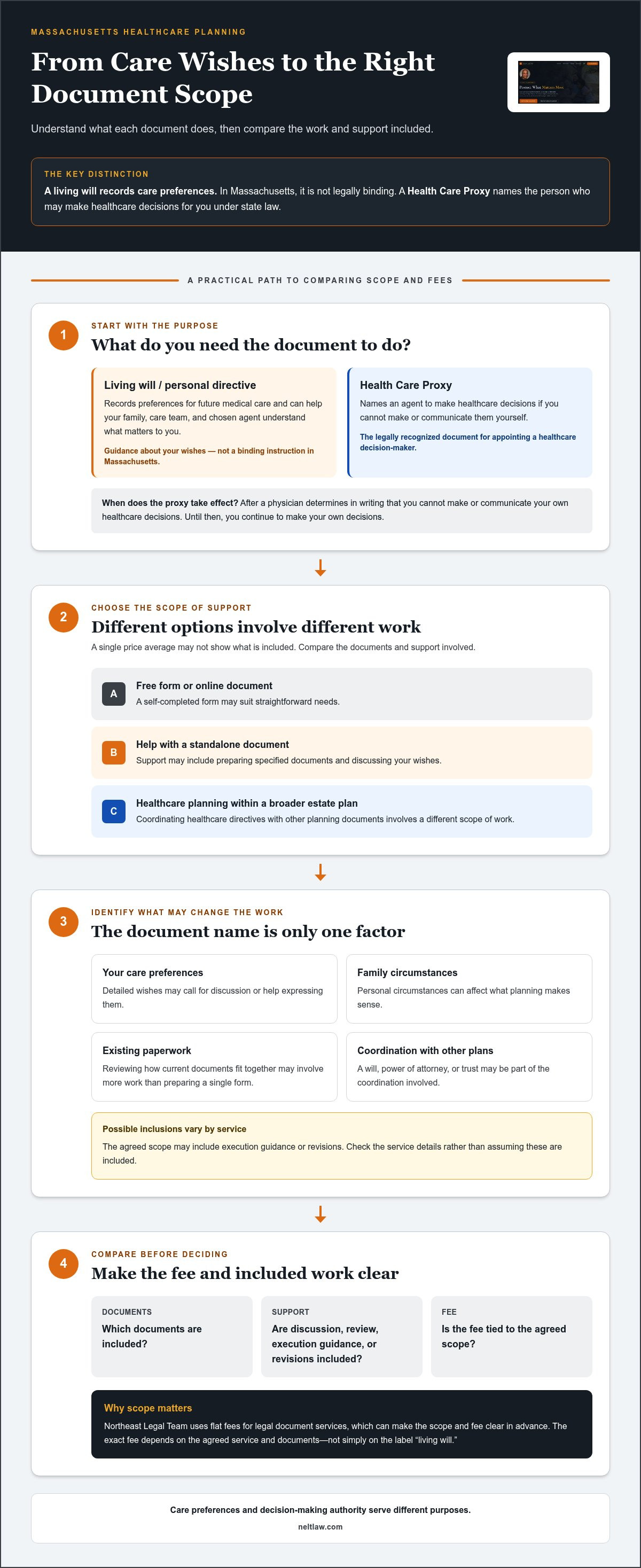
The living will cost depends on what you need: a form you complete yourself, help preparing a standalone document, or healthcare planning coordinated with a broader estate plan. These are different scopes of work, so a single price average may not tell you what’s included. A fee may cover preparing specified documents, discussing your wishes, and agreed guidance on completing them. The exact scope depends on the service and documents you choose.
People often use “living will” to mean written instructions about future medical care, such as preferences they want considered if they can’t speak for themselves. This is one type of advance directive, a broad term for documents that communicate healthcare preferences or identify someone to act for you. A free form, a standalone legal service, and a package of estate-planning documents each involve a different level of support.
What work might a living-will fee include?
Preparing a document is only one possible part of the work. You may also want to discuss your wishes, get help expressing them, or coordinate written preferences with related healthcare directives. If you already have documents, reviewing how they fit together may involve more work than preparing a single form.
The agreed scope may also address execution guidance or revisions, but those details vary by service. Review the work and documents included before proceeding. Northeast Legal Team uses flat fees for legal document services, which can make the scope and fee clear in advance. The exact fee depends on the agreed service and documents, not simply on the label “living will.”
Why does the name of the document matter in Massachusetts?
In Massachusetts, a living will or personal directive can communicate care preferences, but it isn’t legally binding. The Health Care Proxy is the document used to appoint a healthcare agent to make decisions if you become unable to make or communicate them. The proxy takes effect after a physician determines in writing that you can’t make or communicate your own healthcare decisions.
That distinction matters when comparing forms or estimating the work involved. A document that records your preferences serves a different purpose from one that names a decision-maker, and some people may want both. For more on local terminology and planning considerations, read this Massachusetts living will attorney guide. Identifying what you want each document to do is a practical first step toward choosing the right scope of support.
How Massachusetts Living Wills and Healthcare Proxies Work
These documents serve related but different purposes. A living will, sometimes called a personal directive, records your preferences for future medical care. A Massachusetts Health Care Proxy names an agent to make healthcare decisions for you if you’re unable to make or communicate them yourself. One expresses your wishes; the other gives a chosen person decision-making authority under state law.
Does Massachusetts recognize a living will as a binding document?
No. Massachusetts does not treat a living will as a legally binding document. Your written preferences can still help your healthcare agent, family, and medical team understand what matters to you, but they don’t appoint an agent or carry the same legal authority as a Health Care Proxy. The state’s explanation of Massachusetts law on healthcare proxies outlines this distinction.
A Health Care Proxy is the legally recognized document for appointing someone to make healthcare decisions on your behalf. It becomes effective only after a physician determines in writing that you can’t make or communicate your own healthcare decisions. Until then, you continue to make your own decisions.
How is a healthcare proxy different from a living will?
Think of the documents as answering different questions:
- Living will or personal directive: What care preferences do you want others to understand?
- Health Care Proxy: Who should make healthcare decisions for you if you can’t make or communicate them?
Written wishes can help your chosen agent make decisions with a clearer understanding of your values. For example, you might describe what quality of life means to you or share your views about certain treatments. The proxy gives the agent authority to make decisions when the legal conditions are met, while your written preferences offer guidance rather than a binding set of instructions.
Planning needs differ from person to person. Your health, family circumstances, and existing documents may affect what makes sense, so don’t assume one form will address every concern. The living will attorney guide for Massachusetts offers more context on expressing healthcare wishes and planning related documents.
Understanding the distinction can also clarify what you’re paying for: the living will cost may involve help documenting preferences, preparing a proxy, or coordinating both with other planning documents. To discuss how your wishes and healthcare directives fit together, explore Northeast Legal Team’s healthcare-directive planning.
What Factors Change the Cost of a Living Will?
The work involved depends on more than the document’s name. A focused drafting task differs from discussing detailed care preferences or coordinating healthcare directives with a will, power of attorney, or trust. Family circumstances and existing paperwork can also affect how much review and coordination the plan calls for.
| Service scope | What may affect the work |
|---|---|
| Standalone document | Whether you need a document prepared from the beginning or have existing paperwork to review. |
| Related healthcare directives | Whether your preferences and decision-maker appointment need to be prepared or considered together. |
| Consultation | How much discussion is needed to clarify your wishes and identify the documents that fit your situation. |
| Broader estate plan | Coordination with other planning documents and the needs of your family or circumstances. |
Two people can request documents with similar names and receive different quotes because the review, discussion, and coordination each person needs may not be the same. For example, someone with clear preferences and no existing documents may need a different scope of work from someone with more involved family circumstances or paperwork that needs to be considered alongside new directives.
What is included in a standalone document versus an estate plan?
A standalone service focuses on a defined document or task. Broader planning may involve looking at how several documents fit together and whether they reflect consistent wishes. To compare options, review the work included, such as drafting, revisions, and guidance on completing or signing documents. Confirm those details in the agreed scope rather than assuming they’re included. This estate planning flat-fee guide explains how broader fee structures can be presented.
Coordination also has a practical side. The Massachusetts Medical Society discusses healthcare proxies and end-of-life care, including the value of communicating wishes. Clear communication can help your chosen decision-maker better understand the preferences you’ve expressed.
Can a flat fee make the cost easier to understand?
A flat fee can make budgeting clearer when it is tied to a defined scope of work. Northeast Legal Team offers flat-fee document services, so you can discuss the specific documents and work covered before proceeding. Hourly billing ties the fee to time spent; neither approach is always less expensive. Compare what work is included and how any additional work is handled.
Is a Free Form Enough or Is Legal Guidance Worth It?
A free or online form can be a reasonable starting point, and using one doesn’t automatically make it invalid. But a low upfront cost doesn’t tell you whether the form fits your wishes, circumstances, or the role you want a decision-maker to have. The right choice depends on how clear your needs are and how confident you feel completing the documents correctly.
When might a basic form meet someone’s needs?
A basic form may suit someone with straightforward preferences who understands what the document does and doesn’t do. For example, you may already know whom you want to name as your healthcare agent and feel comfortable expressing your wishes in clear, direct language.
Read the form’s instructions and review current Massachusetts requirements before signing. A form’s source and low cost don’t, by themselves, establish that it’s suitable for your situation. If you’re unsure what a question means or whether the document addresses your goal, pause before relying on it.
When might personalized legal help be valuable?
Tailored guidance may be useful if your wishes are difficult to put into words, family relationships could complicate decision-making, or you’re coordinating healthcare directives with other estate documents. A legal professional can help clarify what you want each document to accomplish, consider how the documents work together, and discuss how to communicate your preferences to the person you appoint.
For instance, if you’re updating an existing estate plan, the task may involve more than filling out a new form. Reviewing the plan as a whole can help you identify documents that may need to be considered together. The 2026 estate planning flat-fee guide explains how defined legal-service scopes can support broader planning.
Use this quick framework to decide what kind of support may fit:
- Complexity: Are your wishes and family circumstances straightforward, or do they raise questions you can’t resolve from the form?
- Confidence: Do you understand the document’s purpose and instructions, including how to complete it?
- Coordination: Does this document need to work alongside other healthcare or estate-planning documents?
If your needs are simple and you feel confident, self-help may be enough for you. If you have unanswered questions or several documents to align, a conversation with a legal professional can help define the work before you decide. Northeast Legal Team offers a free, no-obligation assessment to discuss healthcare directives and estate-planning needs. Discuss your healthcare-planning options and take a measured next step.
Plan Your Healthcare Documents with Northeast Legal Team
You don’t need to have every decision settled before taking a first step. A simple plan can help you move from thinking about your care preferences to understanding which documents may fit and what legal work is involved. Northeast Legal Team provides healthcare-directive and estate-planning services, with flat-fee document services and a free, no-obligation consultation to discuss your needs.
What should you prepare before discussing a living will?
A few private notes can make the conversation more focused. You might jot down:
- Your general preferences for future medical care and any questions about how to express them.
- Who you trust to make healthcare decisions if you’re unable to do so yourself.
- Any healthcare or estate-planning documents you already have, such as a Health Care Proxy, will, or power of attorney.
- Questions about how your documents work together, what needs updating, or what steps are involved in completing them.
You don’t need to share sensitive details publicly or arrive with polished instructions. The goal is to identify what you know, what you’re unsure about, and whether related documents may need review. If your wishes have changed or your family circumstances have shifted, make a note of that too.
How can a consultation clarify scope and fees?
A consultation can help you discuss your goals, identify relevant healthcare documents, and understand the proposed scope of legal work. That gives you a clearer basis for considering the living will cost, especially if you’re deciding between help with one document and coordination with a broader estate plan. Before work begins, you can review which documents and services the proposed fee covers.
Northeast Legal Team offers a free, no-obligation consultation and flat-fee legal document services. Fees depend on the agreed scope, so the conversation can help you understand the work involved without committing to a plan before you’re ready.
A steady three-step approach can keep planning manageable:
- Identify your wishes. Note your preferences and who you trust to speak for you.
- Discuss document needs. Consider a Health Care Proxy, written guidance, and any related estate-planning documents.
- Review scope and fees. Understand the proposed work before deciding how to proceed.
If you’re in Middlesex County or Worcester County, or exploring your options elsewhere in Massachusetts, you can take a low-pressure first step by scheduling a free estate-planning consultation.
Take the Next Step Toward Clearer Healthcare Planning
The living will cost depends on the work involved, from preparing a single document to coordinating healthcare directives with a broader estate plan. In Massachusetts, written care preferences can guide your loved ones, while a Health Care Proxy names someone to make healthcare decisions if you’re unable to do so. Free forms may work for straightforward needs, but complex wishes or existing documents can make personalized guidance valuable.
You don’t have to figure out every detail before moving forward. Northeast Legal Team offers flat-fee legal services for estate-planning documents and a free, no-obligation consultation to discuss your needs and the proposed scope of work. The conversation can help you understand your options without pressure to commit.
Schedule a free, no-obligation estate-planning consultation and take a thoughtful first step toward making your healthcare wishes easier for the people you trust to understand.
Frequently Asked Questions
How much does a living will cost in Massachusetts?
The living will cost depends on what the service includes, whether legal advice is provided, and whether related healthcare directives or estate-planning documents are part of the work. Preparing a standalone document is not the same service as coordinating several documents. Rather than relying on a national average, consider what the fee covers and when that information was published. Before deciding, review the documents, guidance, revisions, and other work included.
Is a living will legally binding in Massachusetts?
No. In Massachusetts, a living will or personal directive can record care preferences, but it isn’t legally binding. The Health Care Proxy is the legally recognized document used to appoint an agent to make healthcare decisions if you can’t make or communicate them yourself. It takes effect after a physician determines in writing that you’re unable to make or communicate your own healthcare decisions. Review current state guidance before relying on any form.
Is a living will the same as a healthcare proxy?
No. A living will generally expresses your preferences for medical care, while a Massachusetts Health Care Proxy names someone to make healthcare decisions for you if you can’t make or communicate them. The documents have different purposes and legal effects. Written preferences can help the person you appoint understand what matters to you, but they don’t replace the proxy’s role. Consider both your wishes and who you trust to speak for you.
Can I make a living will for free?
Yes, free healthcare-planning forms and educational resources are available, but free access doesn’t guarantee that a particular form fits your situation or reflects current Massachusetts requirements. Read the instructions carefully and make sure you understand what the form does and how it should be completed. If your wishes are difficult to express, family circumstances are complex, or multiple documents need coordination, legal guidance may help you assess your options.
Does a living will include a healthcare proxy?
Not necessarily. Written care preferences and a Health Care Proxy serve separate purposes, so help preparing one document may not include the other. Before comparing services, identify whether the proposed scope covers preference documents, appointing an agent, execution guidance, revisions, or coordination with your estate plan. In Massachusetts, understanding each document’s purpose and legal effect can help you identify what you need instead of assuming a single form covers every goal.
Why do living will legal fees vary?
Legal fees can vary because the work may involve one document, discussion of your wishes, related healthcare directives, or coordination with a broader estate plan. A flat fee defines the work covered in advance; hourly billing is based on time spent. Neither approach is automatically less expensive. Compare the included services, revisions, and guidance, and review the scope before work begins.
Should I hire an attorney to prepare a living will?
It depends on your needs and confidence with the documents. A straightforward situation may feel manageable with a form, while uncertainty about Massachusetts requirements, complex family circumstances, or several documents to coordinate may make legal guidance valuable. An attorney can explain the available options and proposed scope so you can decide without pressure. Northeast Legal Team offers a free, no-obligation consultation for people in Middlesex County and Worcester County.


