

What happens to your business if a co-owner dies, becomes unable to work, or decides to leave? Without a clear plan, the remaining owners and the departing owner’s family may face uncertainty about who can take over an ownership interest and how a buyout should work. A buy-sell agreement for small business MA owners can help set expectations before a difficult transition occurs.
It’s understandable to focus on running the business today rather than negotiating a future that may feel far away. Agreeing on key terms in advance can give owners a clearer path through change and reduce uncertainty for co-owners and heirs. An agreement is a planning tool, not a guarantee that every dispute or financial challenge will disappear.
This guide explains how buy-sell agreements support ownership continuity, what events may trigger a buyout, and how cross-purchase and redemption structures differ. It also covers valuation methods, funding plans, and practical topics Massachusetts business owners can discuss as they plan next steps.
Key Takeaways
- A buy-sell agreement sets rules for certain ownership transfers, helping owners plan who may buy or must sell when circumstances change.
- Use a buy-sell agreement for small business MA planning to clarify exit scenarios, purchase rights, valuation, and how a buyout may be funded.
- A trust and a buy-sell agreement address different goals: one can guide estate distribution, while the other sets terms for ownership transfers.
- Start by reviewing ownership records, entity documents, transition goals, and each owner’s existing estate plan.
- Northeast Legal Team connects business succession planning with broader business and estate-planning goals, and offers a free consultation to discuss next steps.
What a Buy-Sell Agreement Does for a Small Business in Massachusetts
If a co-owner dies, becomes unable to work, or wants to leave, who controls that person’s ownership interest next? The answer may affect the remaining owners, the departing owner’s family, and the business’s ability to continue operating. A buy-sell agreement for small business MA owners can set rules for specified ownership transfers, giving everyone a shared plan to refer to when circumstances change.
The agreement can describe who has the right or obligation to buy an interest, who may sell, and what steps apply. For example, owners might agree that if one chooses to leave, the other owners have the first opportunity to purchase that interest before it can be transferred elsewhere. The actual terms depend on the owners’ goals and business structure. The What is a Buy-Sell Agreement? overview also describes common purposes and provisions.
This is an ownership-transition tool, not a set of everyday operating instructions. It generally won’t tell staff who approves routine expenses or how owners divide weekly responsibilities. Those matters belong in the business’s management or operating documents. A buy-sell agreement focuses on what happens to ownership under agreed circumstances. Clear terms can reduce guesswork, but they can’t guarantee that every disagreement or financial challenge will be avoided.
For a Massachusetts business, the agreement should fit the entity’s governing documents and the owners’ broader plans. A transfer provision that conflicts with other business documents may create uncertainty instead of clarity. Treat the agreement as one part of succession planning, coordinated with the business’s ownership records and, where relevant, each owner’s estate plan.
Which business events can trigger a buyout?
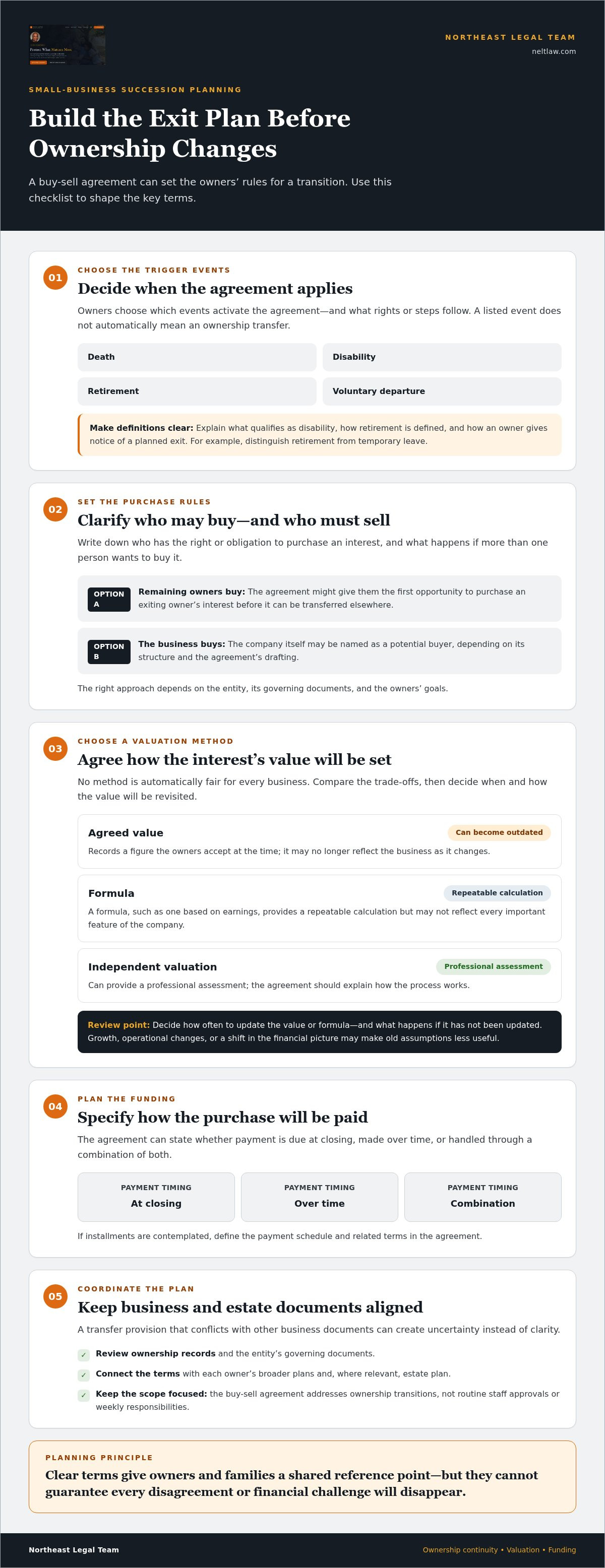
Owners can decide which events should activate the agreement. Common possibilities include death, disability, retirement, or voluntary departure. The wording matters: the agreement can explain what qualifies as disability, how retirement is defined, and how an owner gives notice of a planned exit. A listed event doesn’t necessarily mean an automatic transfer. The document should state what rights, choices, or steps follow.
For example, two co-owners might want the remaining owner to have a chance to buy an interest if the other retires, but not to force a sale whenever an owner takes temporary leave. Defining the trigger and process helps distinguish those situations. Owners should focus on scenarios that fit their business rather than assume every event needs the same response.
Why small-business co-owners may plan before a transition
Written expectations give owners and their families a shared reference point during an already difficult change. Without agreed terms, people may have different assumptions about whether an ownership interest can pass to an heir, whether the remaining owners can purchase it, or how a departure should be handled. Those unanswered questions can complicate conversations when clarity matters.
A buy-sell agreement is a continuity plan that sets the owners’ agreed rules for transferring business ownership when specified events occur. It can’t settle every future disagreement, but discussing the terms early gives co-owners time to make informed choices before a transition puts those choices under pressure.
The Buy-Sell Terms That Shape an Owner’s Exit
Once owners identify the situations they want to plan for, they can work through how an exit would happen. The agreement should say who may buy an ownership interest, who must sell, and what process applies if more than one person wants to purchase it. These details turn a general intention to keep the business stable into instructions owners can follow.
For example, an agreement might give the remaining owners the first opportunity to buy an exiting owner’s interest. Another structure may have the business itself purchase that interest. The right approach depends on the entity, its governing documents, and the owners’ goals. Massachusetts owners can use the state’s Massachusetts Small Business Law resource as a starting point for small-business legal information. The agreement itself should be tailored to the business and its owners.
How should owners address business valuation?
Owners generally need a method for setting the interest’s value when a triggering event occurs. An agreed value records a figure the owners accept at the time, but it can become outdated as the business changes. A formula, such as one based on earnings, provides a repeatable calculation, though the result may not reflect every important feature of the company. An independent valuation process can provide a professional assessment, but the agreement should explain how that process works.
No method is automatically fair for every business. Owners should decide how often to revisit the value or formula, and what happens if they haven’t updated it. Growth, a major operational change, or a shift in the business’s financial picture may make old assumptions less useful. Legal and financial guidance can help owners assess an approach suited to the company.
Who buys the interest, and how is the purchase funded?
The agreement can identify the remaining owners or the business as potential buyers, subject to the entity’s structure and careful drafting. It should also explain how a purchase is paid for, including whether payment is due at closing, over time, or through a combination. If installments are contemplated, the terms should address the schedule and what happens if a payment is missed.
Funding might come from available business or owner resources, an agreed payment arrangement, or insurance, such as life or disability coverage. These options have different practical and tax considerations. Insurance can help provide funds, but coverage, proceeds, and timing aren’t guaranteed. Who owns a policy and who receives its proceeds can also matter, so owners should coordinate the funding design with legal and financial guidance.
A workable buyout connects three decisions: who can buy, how the interest is valued, and where the purchase funds will come from. If one part is vague, the other terms may be harder to use when a transition occurs. For a buy-sell agreement for small business MA owners, review these choices alongside the company’s entity documents and ownership records rather than treating them as stand-alone clauses.
Owners bringing these decisions into a broader transition plan can explore business succession planning with Northeast Legal Team.
Buy-Sell Agreement vs. Trust: Which Tool Fits the Ownership Goal?
A co-owner’s departure can raise two separate questions: who may own the business interest next, and how should that interest fit into the owner’s estate plan? A buy-sell agreement and a trust can each contribute to planning, but they address different goals. Neither automatically replaces the other, and having one document doesn’t necessarily answer every question addressed by the other.
| Planning tool | Main question it addresses | Potential role |
|---|---|---|
| Buy-sell agreement | How can a business interest be transferred under agreed circumstances? | Sets purchase rights, transfer rules, and steps for a defined ownership transition. |
| Trust | How should property held in or directed through the trust be managed or distributed under the estate plan? | Can support personal estate-planning goals, which may include planning around business interests. |
Think of the agreement as a roadmap for a particular ownership change, and the trust as one part of a person’s broader estate plan. The details matter: how an interest is owned, the company’s structure, the owners’ wishes, and the language in related documents can affect how the plans fit together. A buy-sell agreement for small business MA owners consider should be reviewed in that wider context, not treated as a stand-alone answer to every business or family concern.
When is a buy-sell agreement more directly relevant?
A buy-sell agreement is especially relevant when co-owners want agreed rules for a defined transition, such as an owner’s retirement or departure. Depending on the drafting and business structure, the terms may give other owners a purchase right or limit how an interest can be transferred. Owners should first clarify their goals: do they want to preserve ownership among current participants, provide a path for a buyer, or set another transition process?
The agreement’s terms should work with the entity’s governing documents and the owners’ intended roles. A transfer restriction or purchase right that doesn’t reflect those goals may not provide the practical clarity owners expect. The right provisions are specific to the business, not a one-size-fits-all checklist.
How can a trust fit alongside business-transition planning?
A trust is an estate-planning tool that can help address how property is managed or distributed under an individual’s plan. It doesn’t automatically establish the company’s buyout process or settle the rights of co-owners. For example, an owner may want an estate plan to address family priorities while a separate agreement sets out how the business interest can transfer if a specified event occurs.
Coordinating the documents can connect personal wishes with business-continuity goals. Consider the ownership records, agreement, and estate-planning documents together, and revisit them as circumstances change. For broader context on planning a transition and protecting a business legacy, see the Massachusetts business succession planning guide.
A Practical Massachusetts Roadmap for Planning and Reviewing the Agreement
A useful agreement starts with the owners’ real priorities, then translates them into terms that fit the business. The steps below can prepare co-owners for a focused planning conversation and help identify questions about their circumstances and documents.
- Discuss goals. Decide what continuity means for the business and its owners. Would the remaining owners prefer to keep ownership among themselves, or should a departing owner have flexibility to transfer an interest? Discuss family considerations and the kind of transition each owner hopes to support.
- Map ownership. Record who owns what interest and how ownership is held. Gather the company’s formation and governance documents, current ownership records, and any agreements that already address transfers. Accurate records help compare proposed terms with the business’s existing documents.
- Identify scenarios. Talk through possible events such as an owner’s retirement, death, disability, or voluntary departure. Decide which situations the agreement should address and what choices or process should follow each one. A short list of realistic scenarios can make the drafting discussion more productive.
- Draft the terms. Work through who may buy or must sell, how the interest will be valued, and how payment could be handled. Discuss possible funding approaches and practical limits. The agreement should express the owners’ decisions clearly and fit the business’s entity structure.
- Review the documents together. Compare the draft with the company’s governing documents, ownership records, and each owner’s existing estate-planning documents. Legal guidance can address applicable requirements, entity-specific drafting questions, and tax considerations based on the business’s circumstances.
What should co-owners prepare before legal drafting?
Before drafting begins, owners can align on continuity priorities, potential buyers, and how family interests may fit into the plan. Gather current formation, governance, and ownership records, along with relevant estate-planning documents. It also helps to discuss valuation expectations and potential funding approaches candidly. Owners don’t need to resolve every disagreement in advance, but identifying differences early gives the planning conversation a clear starting point.
When should a Massachusetts agreement be revisited?
Review the agreement after an ownership change, meaningful business growth, a change in business structure, or a shift in an owner’s personal goals. Any of these may affect whether the existing terms still reflect what the owners intend. Have the agreement reviewed in light of current law and the entity’s needs rather than relying on assumptions about its continued fit.
Thoughtful succession planning can connect ownership decisions with broader business and personal goals. For additional context, explore the Massachusetts business succession planning guide. If you’re ready to discuss a buy-sell agreement for small business MA owners can tailor to their transition goals, discuss business succession planning with Northeast Legal Team.
How Northeast Legal Team Can Help Small-Business Owners Plan Ahead
Planning an ownership transition often raises questions beyond the agreement itself. How might a co-owner’s departure affect the business? Do the company’s documents reflect the owners’ current goals? How should business plans fit alongside personal estate planning? Northeast Legal Team provides business consulting and business succession planning to help business owners in Middlesex County and Worcester County, Massachusetts, bring these questions into a deliberate planning conversation.
Guidance can be tailored to your business structure, ownership arrangements, and priorities. Business consulting may address entity-structure selection and compliance guidance, while succession and estate planning can help connect business-transition goals with personal plans. This integrated perspective can help you identify which documents and decisions belong in the conversation, without assuming one plan fits every owner or business.
What to expect from a planning conversation
You can describe how the business is structured, how you and your co-owners work together, and which transitions concern you most. You don’t need to have every answer. The discussion can help clarify questions to address, such as how ownership might change, what continuity means to you, and how the business plan relates to family and estate-planning priorities.
Northeast Legal Team can provide guidance based on your circumstances and goals. Topics may include:
- Whether your current business documents align with your ownership plans.
- Which transition questions belong in business succession planning.
- How business decisions may connect with your existing estate plan.
- What legal or entity-specific questions need further consideration.
A planning conversation can help you understand possible paths and identify next steps. It doesn’t promise a particular legal outcome, tax result, or level of protection. The goal is to help you make informed decisions about the business and the people connected to it.
Take a calm, informed next step
A free consultation offers an opportunity to discuss your situation, share your concerns, and consider how business consulting, succession planning, and estate planning may fit together. You can bring questions about a buy-sell agreement for small business MA owners may be considering, along with relevant ownership or entity documents if available. Starting the conversation can make a complex topic feel more manageable, one decision at a time.
For client convenience, Online bill pay for your convenience is available through Neltlaw.com, where clients can enter an invoice number and payment details. To discuss your planning goals, call 978‑406‑5409 or schedule a free consultation with Northeast Legal Team.
Turn Your Ownership Goals Into a Plan
You don’t need to have every future decision settled before planning can begin. Start by identifying what you want to preserve, where you feel uncertain, and which conversations with co-owners would help you move forward. Those priorities can shape a focused discussion about a buy-sell agreement for small business MA owners can tailor to their circumstances.
Northeast Legal Team brings business consulting, business succession planning, and estate planning into a broader conversation about your business and personal goals. A free initial consultation gives you space to explain your situation and consider a practical next step, without assuming there’s one approach for every business.
Schedule a free consultation to start that conversation. Thoughtful planning can help you move ahead with greater clarity.
Frequently Asked Questions
Is a buy-sell agreement legally binding in Massachusetts?
A buy-sell agreement is intended to create enforceable contractual rules, but whether particular terms can be enforced depends on the wording, how the agreement was executed, the circumstances, and applicable law. For example, unclear language about when a purchase right applies could raise questions later. The agreement should be reviewed alongside the company’s entity documents. This article offers general information, not legal advice about any specific agreement.
Can a small business with one owner use a buy-sell agreement?
A traditional buy-sell agreement usually involves multiple parties and a transfer between potential buyers and sellers. A sole owner may still need a succession plan, but a co-owner agreement may not fit the situation. The appropriate documents depend on the business structure, who the owner hopes will succeed them, and personal goals. An owner in Middlesex County or Worcester County can discuss those details with Northeast Legal Team as part of a planning conversation.
Does a buy-sell agreement replace a will or trust?
No. One document shouldn’t be assumed to replace the other. A buy-sell agreement can address the terms for a specified transfer of a business interest, while a will or trust can express broader personal and family planning wishes. For example, an owner may want an estate plan to address family needs while business documents address ownership arrangements. Coordinated review can help identify conflicting instructions and clarify what each document is intended to do.
Can a buy-sell agreement be changed after it is signed?
Owners may want to revisit an agreement as ownership, business circumstances, or personal goals change. Whether and how it can be amended depends on the agreement’s terms, the parties involved, and applicable law. A conversation among owners alone shouldn’t be treated as a formal amendment. Review the existing document and record any agreed changes in the appropriate way so the written plan reflects the owners’ current intentions.
How is a business valued in a buy-sell agreement?
Owners may use an agreed value, a stated formula, or a process for obtaining a valuation, but no single method suits every business. The document should explain how the chosen method works and when owners will review it. A formula based on past financial performance, for instance, may not reflect later changes in operations or growth. Tailored legal and financial guidance can help owners assess which approach fits their circumstances without assuming a particular result.
What happens if a small business has no buy-sell agreement?
Without agreed transfer terms, an ownership transition may be harder to predict, particularly if owners haven’t addressed purchase rights, valuation, or payment arrangements. The outcome depends on the business’s entity documents, applicable law, and the event involved, so no single result can be assumed. Owners in Middlesex County or Worcester County can start by gathering current ownership and governance records, then discuss a written plan with Northeast Legal Team before a transition becomes urgent.


