

Your family could owe Massachusetts estate tax even if no federal estate tax is due. In 2026, the Massachusetts estate-tax threshold is $2 million, while the federal exemption is $15 million. For families focused on minimizing Massachusetts estate tax 2026, identifying which assets may count is a practical first step.
It’s understandable to feel unsure about the rules. Real estate, financial accounts, life insurance, and certain lifetime gifts may affect the state calculation, and Massachusetts rules don’t simply mirror federal rules. A trust or gift may be worth considering, but the right approach depends on your assets, family priorities, and the consequences of each option.
This guide explains the basic Massachusetts rules for 2026, how state and federal systems differ, and which details may affect your estate. You’ll also find practical steps for organizing records and comparing planning tools before making decisions. With a clearer picture of your assets and goals, you can take a thoughtful next step toward protecting the legacy you intend for your family.
Key Takeaways
- Understand how Massachusetts estate tax differs from inheritance tax, and why the distinction matters to your family.
- Build a complete asset inventory before estimating your estate. A home is only one part of the picture.
- Compare gifts, trusts, charitable plans, and spouse planning by their purpose, timing, and effect on control before deciding what merits legal review.
- Use a step-by-step review to clarify your goals and options, and distinguish lifetime planning from an executor’s later responsibilities.
- For minimizing Massachusetts estate tax 2026, consider how tailored estate planning with Northeast Legal Team can coordinate wills, trusts, and long-term goals. A free consultation is a place to begin.
What Massachusetts Estate Tax Means for Families in 2026
Estate tax and inheritance tax are not interchangeable. Massachusetts has an estate tax, but it doesn’t have an inheritance tax. Estate tax is considered at the estate level before beneficiaries receive property. An inheritance tax, where one applies, is generally assessed on the person receiving an inheritance.
The Massachusetts Department of Revenue describes estate tax as a tax on the transfer of property from a deceased person to heirs or beneficiaries. In practical terms, the tax is calculated at the estate level before assets are distributed. A beneficiary’s relationship to the deceased doesn’t, by itself, determine whether an estate owes tax. The estate’s value and the rules that apply on the date of death matter.
For deaths in 2026, the state threshold is $2 million. Reaching that figure doesn’t determine the final tax by itself. The calculation depends on the applicable Massachusetts rules and the details of the estate. Minimizing Massachusetts estate tax 2026 starts with identifying the rules that apply, then reviewing the estate as a whole.
Estate tax versus inheritance tax: what Massachusetts families should know
With an estate tax, the tax is calculated and paid by the estate before distribution. An inheritance tax, by contrast, may be imposed on an individual beneficiary based on what they receive. Massachusetts doesn’t impose an inheritance tax, so families shouldn’t assume a beneficiary’s relationship determines the state estate-tax result. The Estate tax in the United States overview provides broader context on state and federal estate taxes.
Why the 2026 Massachusetts rules need a current-source check
The Massachusetts DOR reports computation changes for estates of people who died on or after August 1, 2025. Because the date of death can affect which calculation applies, use current DOR instructions to verify thresholds, filing guidance, and the tax computation rather than relying on an older summary. This helps distinguish what applies to a particular estate from what needs further review.
Massachusetts estate-tax rules are distinct from federal estate-tax rules. Federal rules don’t determine whether a Massachusetts estate may need to file or owe state tax, and state rules don’t settle federal obligations. The systems have separate thresholds and calculations, so an estate’s federal status alone isn’t enough to establish its Massachusetts position. Consider each system separately before discussing planning choices.
A current-source review is a sensible first step. Once you know which rules apply, you can assess the assets and family goals that matter to your plan.
How to Assess Which Assets May Affect Massachusetts Estate Tax
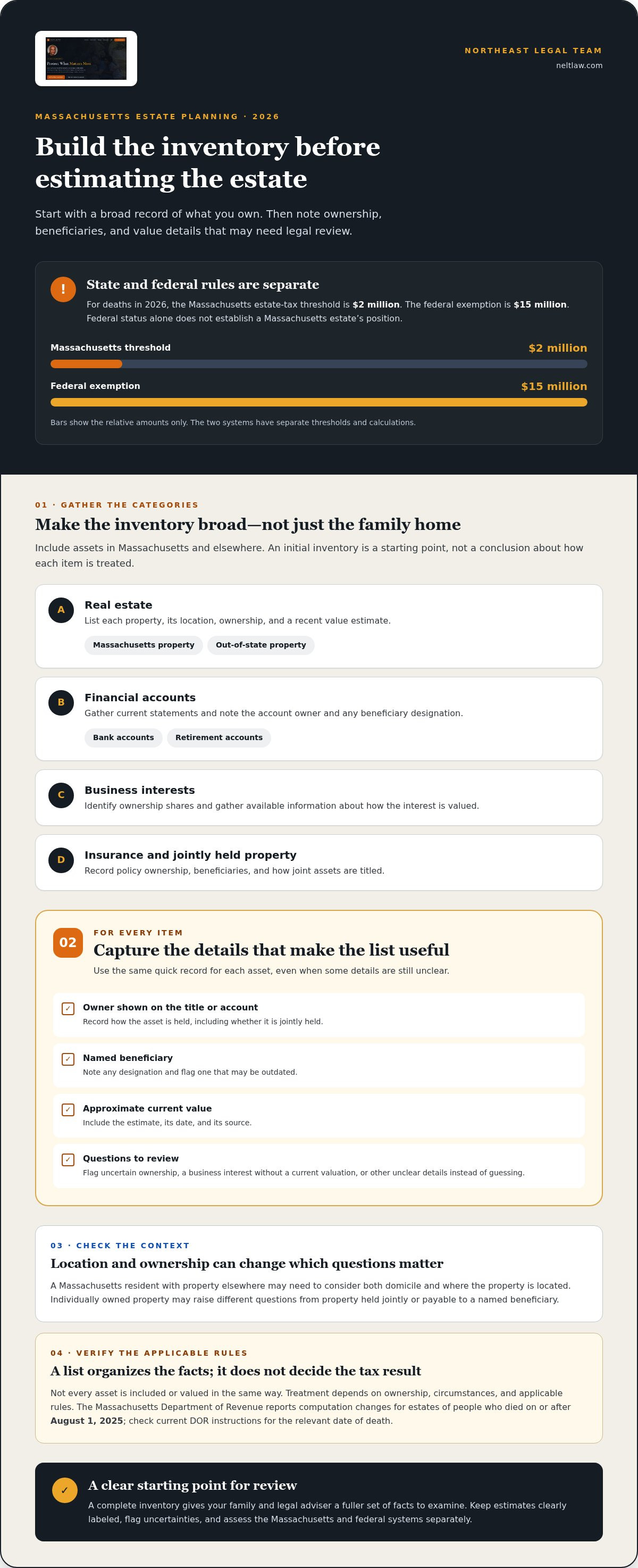
Start an estate-tax review with a complete inventory, not a quick estimate based only on the family home. Property may be held in different ways, and a recent statement may not explain how an asset is treated for tax purposes. First gather a reliable picture of what you own, then identify questions for legal review.
A gross-estate review inventories property and interests that may be relevant to the estate-tax calculation, with each item assessed under the rules that apply to its ownership and circumstances. That doesn’t mean every asset is included or valued in the same way. Keep the initial inventory broad, then review the details.
Build a practical estate inventory before choosing a strategy
List assets by category. Include Massachusetts and out-of-state real estate, financial accounts, business interests, life insurance, and jointly held property. For each item, record the owner shown on the title or account, any named beneficiary, and an approximate current value with the date and source of your estimate. This gives a legal review of minimizing Massachusetts estate tax 2026 a useful starting point.
- Real estate: Record each property’s location, ownership, and a recent estimate of its value.
- Financial accounts: Gather current statements and note account owners and beneficiary designations.
- Business interests: Identify ownership shares and gather available information about how the interest is valued.
- Insurance and jointly held property: Record policy ownership, beneficiaries, and how joint assets are titled.
Flag unclear details instead of guessing. A deed that doesn’t match your understanding of ownership, a business interest without a current valuation, or an outdated beneficiary designation can all signal a question for review. An estimate helps organize the records, but it doesn’t determine how the law treats an asset.
Check how location, ownership, and family circumstances affect the review
Location and ownership shape which questions matter. A Massachusetts resident with property elsewhere may need to consider both domicile and where the property is located. An individually owned asset may raise different questions from one held jointly or payable to a named beneficiary. The treatment depends on the facts and applicable rules, so don’t assume a title or beneficiary form settles every tax question.
For example, a homeowner in Middlesex County might list the residence, retirement and bank accounts, an out-of-state vacation property, and any business interest. That inventory doesn’t establish a tax result. It gives the family and its legal adviser a fuller set of facts to examine, including ownership details and how values were estimated.
Gather deeds, account statements, insurance records, business documents, and beneficiary forms in one place. If you’d like help relating those records to your broader estate plan, personalized estate planning guidance can help clarify which questions and planning choices deserve attention.
Which Estate-Planning Strategies May Help Minimize Massachusetts Estate Tax?
Planning tools serve different purposes, and none should be treated as a guaranteed way to reduce tax. Compare each option by what it is meant to accomplish, how much control you keep, when action may be needed, and how it fits with your documents and assets. A useful discussion about minimizing Massachusetts estate tax 2026 starts with your family’s goals and a review of both state and federal tax consequences.
A will or revocable trust can help direct how assets are managed or distributed, but having one doesn’t automatically reduce estate tax. The effect of any strategy depends on asset ownership, document terms, and the rules that apply. Review current Massachusetts and federal tax treatment before acting.
Lifetime gifts, charitable plans, and trust planning
Lifetime gifts may be worth considering, but first review the asset, timing, ownership, and possible tax consequences. Massachusetts has no state gift tax, though certain lifetime gifts may still be relevant to the estate-tax calculation. Charitable planning should begin with a genuine desire to support a cause, then consider how a proposed gift fits your financial and estate plans. An irrevocable trust may serve specialized goals, but it can involve meaningful trade-offs in control and flexibility.
- Lifetime gifts: Consider the purpose and timing of a gift, and how it may affect your finances and later estate review.
- Charitable intentions: Start with the causes you want to support, then review how a gift should be structured and coordinated.
- Trust planning: Compare the management or distribution terms you want with the control and flexibility you may give up.
These are planning topics, not one-size-fits-all recommendations. A choice that supports one family priority may complicate another, so weigh practical effects alongside tax questions.
Married-couple planning and the portability misconception
Spouses should review their plans together, but state and federal rules don’t necessarily work the same way. Federal portability may allow a surviving spouse to use a deceased spouse’s unused federal estate-tax exclusion if applicable requirements are met. Massachusetts does not provide the same portability under the current rules discussed here, so don’t assume one spouse’s unused state exemption transfers automatically. Confirm current state rules before relying on a particular plan.
Coordinated planning also means reviewing who owns each asset, how beneficiary designations work, and whether each spouse’s documents reflect shared goals. A will or trust may address distribution and management, but it doesn’t resolve every tax or ownership issue by itself.
Quick comparison by planning purpose
- Gifts: Explore timing and ownership, then review the effect on control and tax treatment.
- Charitable giving: Align a gift with genuine charitable priorities and coordinate its structure with the rest of the plan.
- Trusts: Match the trust type to the goal, considering control, flexibility, and administration.
- Spouse coordination: Align documents and ownership, and verify state and federal rules separately.
Before implementing a strategy, review its legal and tax effects in the context of your full estate. A tailored estate plan can help connect planning choices with family priorities without promising a particular tax result.
A Step-by-Step Massachusetts Estate-Tax Planning Review
A step-by-step review turns a complicated question into manageable tasks. Work through the steps in order and note anything that needs closer attention. This process supports lifetime planning, which is separate from an executor’s duties after a death.
- Inventory the assets. Gather deeds, account summaries, insurance information, business ownership records, and existing wills or trust documents. Include property and interests held in different ways, and note known ownership and beneficiary designations.
- Verify values and flag questions. Record how and when each value was estimated. If a business interest, property, or jointly owned asset is difficult to value, or its title is unclear, mark it for review instead of relying on a guess.
- Identify family goals. Write down who you hope to provide for, any charitable intentions, and how much control or flexibility matters to you. Consider whether your current documents reflect those priorities.
- Compare possible options. Review potential approaches by purpose, timing, control, and coordination needs. Consider Massachusetts and federal consequences separately, and don’t treat a particular document or strategy as an automatic tax solution.
- Revisit the plan. Update your inventory and review the plan when family circumstances, assets, ownership, or applicable law change. A plan is more useful when it reflects your current situation.
What to bring to a planning conversation: Gather the records above, then add a short list of intended beneficiaries, family priorities, concerns about control, and questions about valuations or ownership. Note recent changes, such as a new inheritance or business transition. You don’t need to resolve every uncertainty before seeking guidance. Identifying the questions is a useful start.
Keep lifetime planning separate from estate administration. While you’re living, the focus is on understanding your assets and considering choices that fit your goals. After a death, the executor may need to determine whether a Massachusetts estate-tax return is required and handle filing and payment responsibilities. Massachusetts uses Form M-706. The Department of Revenue’s current instructions state that the return is due nine months after the date of death. An executor should verify the filing rules and calculation for the specific estate.
For 2026 planning, use current Massachusetts DOR instructions rather than relying on an older article, especially for filing and computation details. DOR guidance identifies computation changes for deaths on or after August 1, 2025, so the date of death can affect which instructions apply.
There’s no single review schedule that fits every family. Revisit the plan after a marriage, divorce, inheritance, move, business change, or another event that could affect your assets or wishes. A legal review can help connect those updates to your estate-planning documents and broader goals.
If you’re ready to organize your records and discuss planning choices, schedule a free estate-planning consultation with Northeast Legal Team. A tailored review can help identify what needs attention as you consider minimizing Massachusetts estate tax 2026, without assuming any particular tax outcome.
How Northeast Legal Team Can Guide Massachusetts Estate-Tax Planning
Estate-tax planning isn’t only about choosing a document or trying to reduce a future bill. It means understanding how your assets, family responsibilities, and long-term wishes fit together. Northeast Legal Team provides tailored estate-planning services, including wills, trusts, powers of attorney, and healthcare directives, to help clients consider those pieces as part of a coordinated plan.
An attorney can review the information you’ve gathered, clarify questions about ownership and family priorities, and discuss planning choices for further consideration. That guidance can help you understand how a will or trust fits with your broader goals. It doesn’t guarantee tax savings or a particular legal outcome. Tax rules can change, and the result depends on the details of your circumstances.
What to discuss in a free estate-planning consultation
A free consultation is a comfortable place to begin. Bring an asset inventory, current estate-planning documents, and questions about who you want to provide for, how assets should be managed, or what level of control matters to you. You don’t need to have every detail resolved before the conversation.
Discuss your goals, possible planning tools, and issues that may need closer review under current tax rules. If you have a business interest, jointly owned property, or an older trust, note what you’d like to understand about how it fits your overall plan. A focused conversation can help identify what deserves attention next without assuming one strategy suits every family.
A clear next step for families in Middlesex and Worcester Counties
Families and business owners in Middlesex and Worcester Counties may be balancing property, business interests, and plans for loved ones. Personalized estate-planning guidance can bring those priorities into one discussion, whether you’re creating a plan or reviewing documents after a life change. Northeast Legal Team’s office is in Burlington, Massachusetts.
If you’re considering minimizing Massachusetts estate tax 2026, the next step is a thoughtful review of your situation, not a one-size-fits-all promise. A free consultation with Northeast Legal Team gives you a chance to discuss your questions and how estate-planning choices relate to your long-term goals. Bring the records you have, including documents you’re unsure about. Unanswered questions are a useful starting point.
For existing clients, online bill pay is available for convenience. Visit Neltlaw.com to enter your invoice number and payment details. Whether you’re beginning a plan or revisiting one, a calm, individualized conversation can help you move forward with greater clarity about your family’s legacy.
Take the Next Step Toward a Clearer Plan
You don’t need to solve every tax question before moving forward. Start with the concern that matters most to your family, whether that’s how your assets are arranged, how your wishes will be carried out, or whether your current plan still fits. A focused legal conversation can help turn that concern into a practical question and identify what deserves attention next.
Planning for minimizing Massachusetts estate tax 2026 is personal. The right approach depends on your circumstances and goals, and no planning tool can promise a particular tax result. You can make informed choices with a clearer understanding of how each option fits your family’s future.
Northeast Legal Team offers a free initial consultation to discuss your estate-planning questions. Schedule a free consultation about your Massachusetts estate plan or call 978‑406‑5409 to take a thoughtful first step toward a plan that reflects what matters to you. Your family’s legacy deserves careful attention, and you can begin one conversation at a time.
Frequently Asked Questions
Does Massachusetts have an estate tax in 2026?
Yes. Massachusetts has a state estate tax, separate from federal estate tax. Whether an estate must file or owes tax depends on its value, applicable rules, and the date of death. The Massachusetts Department of Revenue reports computation changes for deaths on or after August 1, 2025. If you’re reviewing an estate connected to Middlesex or Worcester County, use current DOR guidance rather than assuming an older calculation still applies.
What is the Massachusetts estate tax threshold in 2026?
The Massachusetts threshold is $2 million for estates of people who die in 2026. Current guidance says estates valued at or below that amount generally aren’t required to file a Massachusetts estate tax return or pay the tax. Certain lifetime gifts can affect the threshold calculation, so an asset total alone may not settle the question. Review current DOR instructions and the estate’s circumstances before making a planning decision.
Is Massachusetts estate tax different from federal estate tax?
Yes. Massachusetts and the federal government apply separate estate-tax rules, thresholds, and calculations. For 2026, the federal exemption is $15 million per individual, while Massachusetts uses its own $2 million threshold. As a result, an estate may need a Massachusetts review even if federal estate tax isn’t expected. Assess each system independently, using current Massachusetts DOR guidance and federal sources for the relevant date of death.
Can a living trust reduce Massachusetts estate tax?
A living trust doesn’t automatically reduce Massachusetts estate tax. It can help manage assets and direct their distribution, but the tax effect depends on the trust’s terms, how assets are titled, and the family’s circumstances. For example, transferring an account into a trust may affect management and distribution without necessarily changing its tax treatment. Review the trust alongside your full estate plan before relying on it as a tax strategy.
Does Massachusetts estate tax apply to a family home?
A family home may contribute to the estate’s value. Being a primary residence doesn’t automatically exclude it from consideration. Ownership, location, valuation, and applicable rules all matter. For example, a jointly owned home may raise different questions from a home owned solely by the person who died. Keep the deed and a recent value estimate with the estate records, then confirm how the property should be handled in the calculation.
When is a Massachusetts estate tax return due?
A Massachusetts estate tax return, Form M-706, is generally due nine months after the date of death. The executor should consult current DOR instructions to confirm whether a return is required, what documents are needed, and whether any extension rules apply. Keep records of asset values and ownership details together, since gathering them can take time. The executor’s filing responsibilities are separate from planning decisions made during the person’s lifetime.
What happens if a Massachusetts estate is below the filing threshold?
If the estate’s value, including certain lifetime gifts considered under Massachusetts rules, is at or below the $2 million threshold, a Massachusetts estate tax return generally isn’t required and no estate tax is due. Executors should still confirm the calculation under current DOR guidance rather than relying on a rough estimate. For families considering minimizing Massachusetts estate tax 2026, an accurate inventory can help identify whether an asset or gift needs closer review.


