

What if the safest way to manage a trust isn’t making quick decisions, but following a steady process? If you’ve been named trustee, it’s natural to wonder what you’re expected to do and how to avoid a costly mistake. The duties of a trustee in Massachusetts begin with the trust document and applicable law. Carrying them out also calls for careful records, clear communication, and impartial judgment.
You may feel responsible for protecting family assets while keeping beneficiaries informed and treating them fairly. That balance can be difficult, especially when the trust’s instructions seem unclear or beneficiaries disagree. Taking time to understand your role before making decisions can help you administer the trust with greater confidence.
This guide explains a Massachusetts trustee’s core responsibilities: protecting and managing trust property, documenting decisions, communicating with beneficiaries, and making distributions according to the trust’s terms. It also covers common risks and practical steps for organizing administration. If you’re unsure how the trust document or Massachusetts law applies to a decision, Northeast Legal Team offers a free consultation to discuss your questions and possible next steps.
Key Takeaways
- Understand the duties of a trustee in Massachusetts by starting with the trust document and the rules that apply to its administration.
- Keep trust property separate from personal finances, and document decisions so you can explain how they serve the trust.
- Use a consistent process to identify assets, organize records, communicate with beneficiaries, and review distributions.
- Pause before acting when terms are unclear, interests conflict, or a decision could significantly affect the trust or its beneficiaries.
- A free consultation with Northeast Legal Team can help you discuss trust terms and questions about your responsibilities.
Trustee Roles and Responsibilities in Massachusetts
Being named trustee can feel like an honor and a heavy responsibility at the same time. The role gives you authority to manage trust property, but that authority exists to carry out the trust’s purpose, not to treat its assets as your own. The duties of a trustee in Massachusetts depend on the trust document, the circumstances of the administration, and applicable Massachusetts law. Take time to understand your role before making decisions.
A trustee controls and manages trust property for the trust’s beneficiaries, but doesn’t personally own that property. That distinction guides everyday choices: handle trust funds for the trust’s purposes, and make distributions according to the document and applicable law. Being appointed doesn’t give you permission to use assets freely or make decisions based on personal preference. It gives you responsibility to act within defined limits.
How the trust document shapes a trustee’s authority
Read the complete trust document before taking action, rather than relying on a summary or a family member’s recollection. Identify the beneficiaries, when and how distributions may be made, who can act if you can’t continue, and whether you have discretion over particular decisions. Note instructions about managing property and carrying out the trust’s purpose. These provisions help you understand which choices are allowed and what conditions apply.
Discretion doesn’t mean unlimited freedom. For example, a trustee may be able to decide whether a beneficiary’s request meets a standard in the document, but that doesn’t necessarily permit changing the standard or favoring someone for personal reasons. If a provision seems unclear, pause before acting. Don’t assume you have authority beyond what the document and applicable law allow.
Who may be affected by the trustee’s decisions?
Beneficiaries are the people or organizations the trust is intended to benefit. Some may be entitled to receive distributions now; others may have interests that come into play later. Those interests can differ. A current beneficiary may need support, while a future beneficiary may depend on preserving trust property for a later distribution.
That can make family disagreements especially difficult. A relative’s request may sound urgent, while another beneficiary worries that a payment will reduce what remains. Your task is not to take sides or resolve old family conflicts. Instead, consider the trust’s terms, the interests it is meant to serve, and the information relevant to the decision. A consistent approach can help you explain your reasoning without promising every beneficiary the outcome they want.
The phrase “Massachusetts trust” can also refer to a particular business structure, not simply a trust administered in the state. The Massachusetts Business Trust is a distinct historical and business concept, so it shouldn’t be confused with the terms governing an individual family trust. For a trustee, the practical starting point is the specific document and the law that applies to its administration.
What fiduciary duties must a Massachusetts trustee understand?
A trustee’s authority comes with a duty to use it for the trust’s purposes and the beneficiaries’ interests, not for personal advantage. In practical terms, the duties of a trustee in Massachusetts call for decisions grounded in the trust document and applicable law, made carefully and supported by clear records.
“The trust document and applicable law are a trustee’s primary guides; personal preference is not a substitute for either.” A trustee’s obligations depend on the trust’s wording and the circumstances. Massachusetts law also has specific rules and exceptions, so a general description may not answer every trust-specific question.
Loyalty, impartiality, and conflicts of interest
The duty of loyalty means administering the trust for its beneficiaries rather than using your role to benefit yourself. A possible conflict can arise if you have a personal or financial interest in a transaction, or if a decision could benefit you at a beneficiary’s expense. Recognizing the issue early gives you a chance to pause and seek guidance before acting.
Impartiality means giving fair consideration to the beneficiaries whose interests are affected. It doesn’t necessarily mean giving everyone the same distribution or treating current and future beneficiaries identically. For example, the trust may authorize a payment to meet one beneficiary’s needs while requiring you to consider the effect on assets intended for others. Follow the document’s standards, and don’t let family pressure, personal loyalties, or assumptions replace a careful review.
Disclosure, consent, and conflict-resolution rules can depend on the facts and applicable law. Don’t assume that telling beneficiaries about a conflict, or getting their agreement, automatically resolves it. The Secretary of the Commonwealth’s Massachusetts Fiduciary Duty Regulations provide information about fiduciary duties in their regulatory context. Trust-specific questions may require separate legal analysis.
Prudent care, trust terms, and beneficiary information
Prudent administration means giving decisions the care the trust’s purpose and circumstances call for. Before buying, selling, or retaining an asset, consider how the decision fits the trust’s objectives and the needs it is meant to serve. A choice that suits one trust may not suit another. If a decision is substantial or uncertain, document your reasoning and get appropriate advice before proceeding.
Good records are a practical safeguard. They help you track trust property, explain decisions, and respond clearly when beneficiaries ask reasonable questions. Keep organized copies of the trust document, account statements, transaction records, correspondence, and notes explaining significant decisions. The trust terms and Massachusetts law may set particular requirements for information, reporting, or records, so confirm what applies rather than treating a general checklist as the legal rule.
Communicate in a timely, respectful way while protecting private information and following the trust’s terms. If you’re unsure how a provision affects disclosure or a decision, a free consultation with Northeast Legal Team offers an opportunity to discuss the trust and your questions with an estate-planning attorney.
What trustee mistakes create the most uncertainty or risk?
A common source of trouble is treating trust property as if it belongs to the trustee personally. Even if you manage the money or hold title to an asset, that doesn’t make it yours to use freely. Personal spending, informal loans, or transfers between trust and personal accounts can blur the record of what belongs to whom and make later questions harder to answer.
If a decision feels unclear or consequential, pause and review the trust terms before acting. This gives you time to understand the instructions, gather relevant information, and seek legal guidance when needed. The duties of a trustee in Massachusetts don’t require you to guess your way through difficult choices.
When a trustee faces a conflict or difficult family decision
Hypothetical example: One beneficiary asks for an immediate distribution to cover an urgent expense, while another worries that the payment will reduce what remains for future beneficiaries. Neither request alone tells you what the trust allows. Review the distribution language and any conditions it sets, then consider the interests the document directs you to weigh. The right analysis depends on the trust’s terms and circumstances, so one response won’t fit every family.
Avoid promising a payment before you understand the rules that apply. When explaining your decision, refer to the trust’s language and relevant facts rather than taking sides in a family disagreement. If the wording is ambiguous or you have a personal interest in the outcome, get guidance before committing trust assets.
Why poor records and rushed distributions can cause trouble
Informal administration can leave everyone uncertain. If you pay a trust expense from your personal account without keeping a receipt, for example, it may be harder to show what the payment covered or how reimbursement was calculated. Mixing trust funds with personal funds can create similar confusion, even if you intended to keep everything straight.
As a practical safeguard, maintain an organized file with account statements, receipts, distribution records, and brief notes explaining significant decisions. These records help you reconstruct what happened and respond to questions. They’re useful recordkeeping practices, not a substitute for checking which duties the trust document and applicable law impose in your situation.
Before making a distribution, read the relevant provision carefully. Check who may receive it, what conditions apply, and whether the document gives you discretion. Rushing because a beneficiary is distressed or pressing for an answer can lead to misunderstandings about what was authorized. If something doesn’t fit neatly, hold off on moving the assets until you understand the issue.
Personal liability isn’t automatic whenever a beneficiary disagrees with a trustee’s choice. Whether a trustee may be responsible for a loss depends on the facts, the trust’s terms, and applicable law. Careful documentation won’t guarantee a particular outcome, but it can help clarify the reasons behind a decision and support orderly administration.
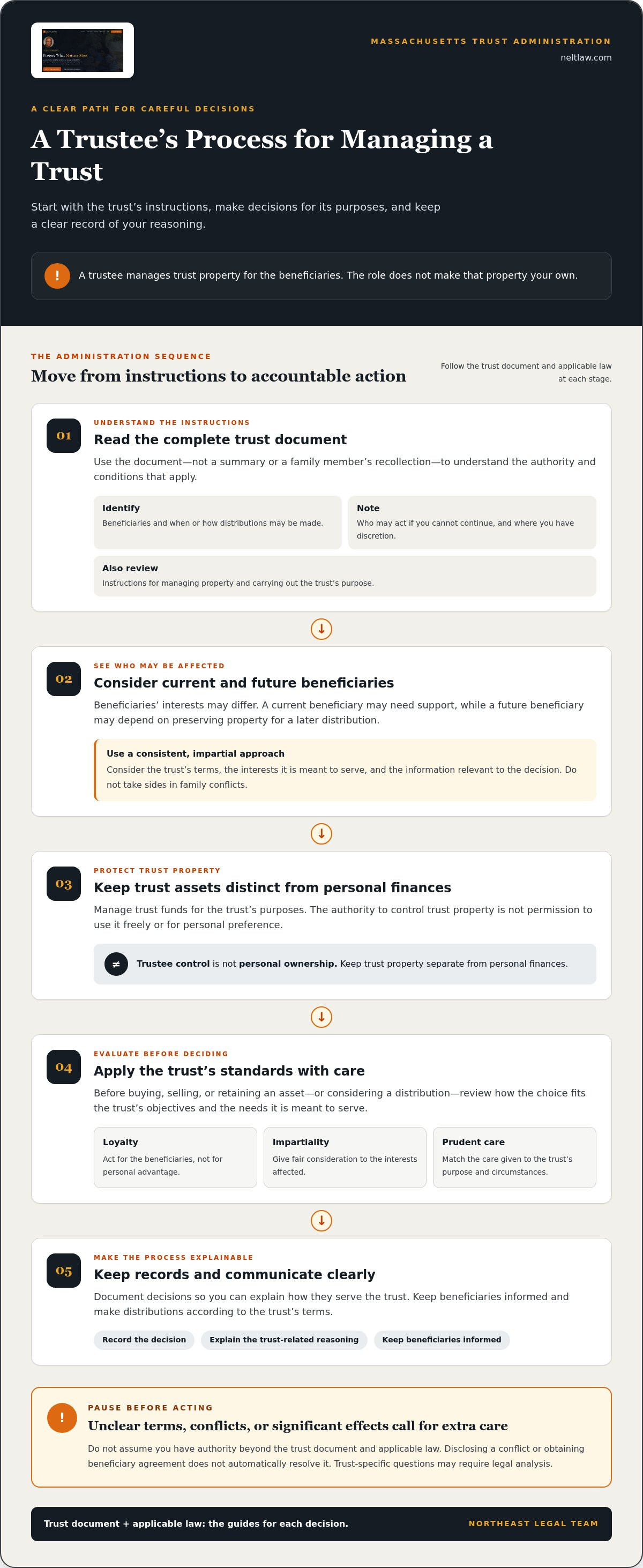
How can a trustee organize trust administration step by step?
A repeatable process can make trust administration feel more manageable and help you identify questions before they lead to rushed decisions. The duties of a trustee in Massachusetts vary with the trust and its circumstances, so use these steps as an organizing framework, not a substitute for trust-specific legal or tax advice.
First steps after learning you have been named trustee
Start by gathering the trust document and the records already available. Then complete an initial review before making consequential changes or distributions:
- Read the full trust document. Note the beneficiaries, distribution instructions, successor trustee provisions, and the decisions the document allows you to make.
- Identify trust property. Create an inventory of known accounts, investments, real estate, and other property. Compare it with available statements or ownership records, and don’t assume every intended asset was transferred into the trust correctly.
- Gather existing records. Collect account statements, prior correspondence, transaction documents, and information about ongoing expenses. Note where each item came from and what it relates to.
- Write down open questions. Separate questions about the trust’s meaning from financial or tax questions. Before acting on an unclear instruction or significant decision, identify what guidance you need.
If the trust document raises planning questions, legal guidance can help connect its terms to the decisions you face as trustee. For broader context on how planning and legal guidance fit together, Northeast Legal Team’s estate planning attorney flat-fee guide discusses estate-planning legal costs.
A steady routine for records and beneficiary communication
Once you’ve established what needs attention, create a simple routine for tracking activity. A dedicated digital folder or paper file can keep trust records together, while a separate task list helps you follow up consistently. Use the trust document and guidance specific to the trust to determine what information must be shared and when.
- Keep together: trust-related statements, receipts, transaction records, correspondence, and notes explaining important decisions.
- Track each open item: record the question, who needs to respond, what action is pending, and whether it has been completed.
- Communicate clearly: note beneficiary questions and your responses, and avoid making promises before you understand the trust’s instructions.
- Review upcoming obligations: verify which notices, accountings, or tax filings apply to this trust and its circumstances, including any relevant timing requirements.
Set a regular time to review new statements, unfinished tasks, and upcoming decisions. This habit can help you catch missing records or unanswered questions while there’s still time to address them. For help understanding how the trust terms and applicable law affect your next steps, schedule a free consultation with Northeast Legal Team.
When should a Massachusetts trustee seek legal guidance?
You don’t need to wait for a dispute to ask for help. Guidance can be useful before you act if a trust provision is unclear, beneficiaries have competing interests, or a decision could significantly affect trust property. It can also help when you’re unsure what information to provide, whether a distribution is permitted, or how a responsibility in the document fits with applicable Massachusetts law.
Pausing to clarify an issue before taking action can be a practical choice. The duties of a trustee in Massachusetts depend on the trust’s terms and circumstances, so advice grounded in the specific document may help you understand your responsibilities without assuming that one answer applies to every trust.
Questions worth discussing with an estate-planning attorney
Bring the trust document and a concise description of the decision you’re facing. You might ask how a distribution provision applies to a beneficiary’s request, what steps to take when two beneficiaries’ interests differ, or how to handle a conflict between your personal interests and your role as trustee. Clear questions can focus the conversation on what the document says and what rules may apply.
If the trust is part of longer-term planning, the reason it was created may also matter to how you understand its terms. For background on one planning tool, Northeast Legal Team’s Medicaid asset protection trust guide discusses trusts intended for long-term planning. Legal guidance can help clarify responsibilities and possible next steps, but it can’t promise a particular result.
Northeast Legal Team provides estate planning services, including wills, trusts, and long-term healthcare decisions. A free consultation offers a low-pressure way to discuss the trust terms and questions you’re weighing. Prepare by writing down the provision involved, any decision deadline, and relevant beneficiary concerns. That can make it easier to identify what needs further review.
A calm next step for trustees in Middlesex or Worcester County
If you’re administering a trust in Middlesex County or Worcester County, Massachusetts, and aren’t sure how to proceed, schedule a free consultation about trust questions with Northeast Legal Team. Bring your questions, even if you’re still sorting through the details. A conversation can help you understand how the trust document and applicable law relate to your situation, so you can consider your next steps with greater clarity.
For clients who need to pay an invoice, Online bill pay for your convenience lets you visit Neltlaw.com and enter your invoice number and payment details. That practical option is separate from the initial step of discussing what your trustee role requires.
Move forward with confidence in your trustee role
Trust administration is an ongoing responsibility, and a question that seems small today may matter more as circumstances change. Revisit an issue when new information arises or a beneficiary’s needs shift. A thoughtful pause is not a failure to act. It can help you make decisions with greater care and confidence.
The duties of a trustee in Massachusetts can feel weighty, especially when family relationships and financial decisions overlap. You don’t have to resolve every uncertainty alone. A conversation about the trust’s language and your specific concerns can help you identify a sensible next step without assuming the same answer fits every situation.
Northeast Legal Team offers a free initial consultation to discuss trust questions and related estate-planning needs. If you’re ready to talk through what’s on your mind, schedule a free consultation or call 978‑406‑5409. You can take the process one question at a time and move forward with a clearer sense of direction.
Frequently Asked Questions
What are the main duties of a trustee in Massachusetts?
A trustee’s main duties are to carry out the trust’s instructions, protect and manage its property, and make decisions for beneficiaries under applicable law. The duties of a trustee in Massachusetts can differ from one trust to another. A trust holding a home may raise maintenance and insurance questions, while one holding investments may call for careful review of account activity. Check the trust document and get advice about specific legal requirements.
Can a trustee use trust money for personal expenses?
No. Trust money shouldn’t be treated as a personal spending account. If you think an expense may belong to the trust, keep its receipt and determine whether the trust authorizes payment or reimbursement before transferring funds. For example, don’t use a trust debit card for a household purchase and plan to sort it out later. If a transaction is already unclear, preserve the records and seek advice about how to address it.
Is a trustee personally liable for mistakes in Massachusetts?
Not necessarily. Whether a trustee may be personally responsible depends on what happened, the trust’s terms, applicable law, and the circumstances. A missing record isn’t automatically the same as an unauthorized distribution, and a general FAQ can’t determine liability in a specific situation. Preserve relevant documents, don’t alter or backdate entries, and discuss a serious concern with Northeast Legal Team before responding to beneficiaries or taking corrective action.
How often must a trustee update beneficiaries in Massachusetts?
There isn’t one communication schedule that fits every trust. Applicable law, the trust document, and the circumstances may affect what information must be shared and when. Don’t rely only on informal family updates. Record what you send, to whom, and when, and keep copies of responses. If a beneficiary requests information, check the trust’s terms and applicable requirements before deciding how to respond rather than ignoring the request or assuming an informal answer is enough.
Can a trustee be a beneficiary of the same trust?
Yes, some trust arrangements name a person as both trustee and beneficiary. That role alone doesn’t determine whether a particular decision is appropriate. A distribution to yourself, for example, may raise questions about your authority and the interests of other beneficiaries. Review the provisions governing your benefit and decision-making powers, and seek legal advice before acting on a choice that could directly affect your own share.
What records should a trustee keep?
Keep enough detail to reconstruct the trust’s activity, including asset information, statements, expense receipts, distribution records, correspondence, and notes explaining decisions. For a distribution, record its date, amount, recipient, and the trust provision involved, then file the supporting documents together. Keep trust materials separate from personal financial records. The trust’s terms and applicable Massachusetts requirements determine whether additional records or a formal accounting are needed.
Can a trustee resign in Massachusetts?
A trustee may be able to resign, but the trust document and applicable law govern the process. Before stepping away, review who may take over, whether notice or court involvement may apply, and what property or records need to be transferred. Don’t simply stop responding or close accounts, since an orderly handoff may be needed for ongoing administration. A free consultation with Northeast Legal Team can help clarify the steps for your particular trust.


