

A will doesn’t avoid probate in Massachusetts: it must go through the Probate and Family Court to take legal effect. The cost of avoiding probate in Worcester depends on how assets are owned and whether they pass through a trust, joint ownership, or a beneficiary designation. A will remains useful, but it doesn’t keep assets out of probate by itself.
It makes sense to consider ways to reduce court involvement and make transfers easier for the people you care about. This article explains how probate avoidance works in Massachusetts, which expenses probate may involve, and how ownership choices affect the transfer of each asset. You’ll also learn how a trust may help preserve privacy, when beneficiary designations or survivorship ownership may work, and what a will still contributes to your plan. Understanding these distinctions can help you see which choices fit your goals and where probate may remain part of the process.
Key Takeaways
- A will directs how assets should be handled, but it does not keep an estate out of Massachusetts probate.
- Trusts, beneficiary designations, and certain ownership arrangements can help assets transfer outside probate.
- Joint ownership may simplify a transfer, but adding an owner can expose property to that person’s creditors.
- Probate costs and timing depend on the estate and the work involved, so ownership choices can affect what beneficiaries receive and when.
- Review how each asset is titled and who is named to receive it to see where your estate plan may need attention.
Does a Will Avoid Probate in Massachusetts?
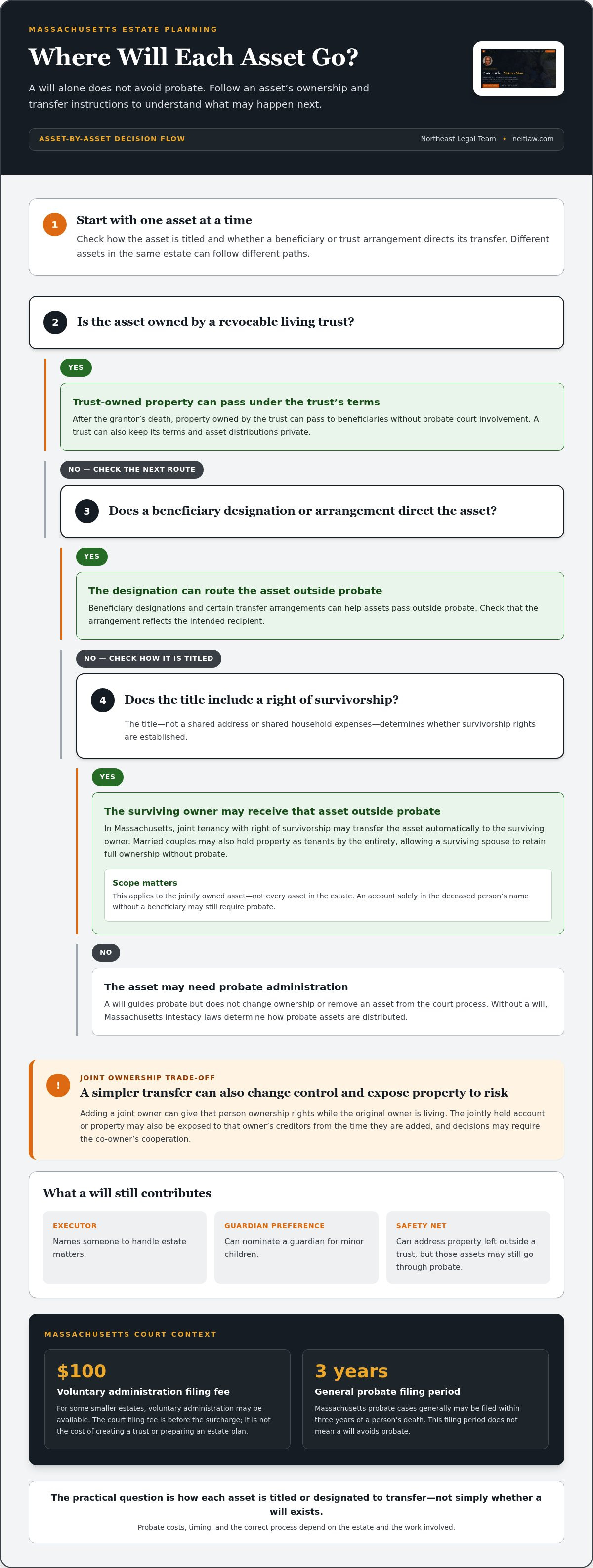
No. In Massachusetts, a will does not avoid probate. It must be filed with the Probate and Family Court to take legal effect, whether it names an executor or explains who should inherit. The court process validates the document and authorizes estate administration. Without a will, probate still applies, but Massachusetts intestacy laws determine how probate assets are distributed instead of a will’s instructions.
A will still serves important purposes. It can name an executor to handle estate matters and nominate a guardian for minor children. For example, a parent can use a will to express a guardian preference while arranging separately how property will transfer. The will guides probate, but it does not change ownership or remove assets from the court process.
A revocable living trust works differently. The person who creates it, known as the grantor, can generally change or revoke it while living. To use a trust to avoid probate, the grantor transfers selected assets into it. After the grantor’s death, property owned by the trust can pass to beneficiaries without probate court involvement. A trust can also keep its terms and asset distributions private, unlike a will filed with the court.
Ownership is the key step. If a Worcester homeowner signs a trust but keeps the home solely in their own name, the trust does not automatically control it. If the home is properly transferred into the trust, a successor trustee can manage or distribute it under the trust’s terms. The same principle applies to other assets: the trust must own them, or a relevant beneficiary arrangement must direct them to the trust.
A will can still serve as a safety net alongside a revocable trust. It can address property left outside the trust and name an executor to handle probate assets. That backup role does not keep those remaining assets out of probate. An estate planning attorney can help coordinate the will, trust documents, beneficiary designations, and ownership records with the person’s wishes.
Some smaller estates may use voluntary administration rather than a standard probate filing. Massachusetts Probate and Family Court sets the voluntary administration filing fee at $100 before the surcharge. This is a court filing fee, not the cost of creating a trust or preparing an estate plan. The correct process depends on the estate and the property that needs administration.
Timing can matter when a will has not been filed. The Massachusetts General Court says probate cases generally may be filed within three years of a person’s death. That filing period does not mean a will avoids probate; it describes when a case may be filed. For the cost of avoiding probate in Worcester, the practical question is whether assets are titled or designated to transfer outside court, not simply whether a will exists.
Joint ownership with rights of survivorship
Joint ownership can change how a particular asset transfers after an owner dies. In Massachusetts, property held in joint tenancy with right of survivorship may pass automatically to the surviving owner, outside probate. Depending on how the asset is titled, it may pass to the surviving co-owner rather than under the will. This applies to the jointly owned asset, not every asset in the deceased person’s estate.
Consider a Worcester home titled to two owners as joint tenants with right of survivorship. If one owner dies, the survivor may receive full ownership without the property going through probate. The survivor may then need to update records to reflect the change in ownership. Other property, such as an account held only in the deceased person’s name without a beneficiary, follows its own transfer rules and may still require probate.
Married couples in Massachusetts may also hold property as tenants by the entirety. This form of ownership allows a surviving spouse to retain full ownership without probate. It applies to married couples, while joint tenancy can be used by co-owners who aren’t spouses. The title matters: sharing an address or paying household expenses together does not establish survivorship rights.
Joint accounts or property can transfer a deceased co-owner’s share to surviving co-owners upon death without probate court involvement. This may simplify the transfer for beneficiaries, but it also changes control during the original owner’s lifetime. A person added to an account or property may gain ownership rights before the other owner dies. The arrangement should reflect the owners’ intentions, not just a desire to simplify future paperwork.
There’s an important risk: adding a joint owner can expose the account or property to that owner’s creditors from the time they are added. For example, if a parent adds an adult child to a bank account, the child’s financial difficulties could affect the jointly held asset while the parent is still living. The parent may also need the co-owner’s cooperation on decisions affecting jointly owned property.
Joint ownership is therefore an asset-by-asset choice, not a complete estate plan. A personal representative may still need to manage probate assets that were not jointly titled or otherwise arranged for transfer. A revocable trust offers another approach: assets transferred into it can pass under trust terms, while the creator retains the ability to change or revoke it. If survivorship ownership doesn’t fit your wishes, explore how a Living Trust may address the transfer of selected assets.
Probate-related delays and legal fees
In Massachusetts, probate can delay asset transfers while the court process moves forward. The filing fee and other estate expenses are only part of the practical impact on beneficiaries.
Delays in Distributing Assets
Delays in distributing assets are the time beneficiaries wait while estate matters are handled before property can pass to them. Massachusetts probate typically takes 12-18 months when there is no litigation. During that period, a personal representative may need to secure property, identify assets, notify creditors, and address claims. A Worcester beneficiary counting on inherited funds may therefore wait while these responsibilities are completed.
Probate Fees and Delays
Probate fees are expenses paid from estate assets for court filings and administration, while delays affect when beneficiaries receive what remains. Massachusetts Probate and Family Court sets the filing fee for formal or informal probate at $375 before the surcharge. Other expenses may include attorney and executor fees, appraisals, asset valuation, publication, and document costs. The work required, not simply the estate’s size, can affect both the total expense and pace.
The court appointment is an important point in the timeline. Under M.G.L. 190B § 3-301, a personal representative cannot act until officially appointed by the court. Before that appointment, heirs may be unable to complete tasks that require formal authority, such as managing estate property or handling financial matters on the estate’s behalf. Once appointed, the representative can begin addressing the estate’s obligations and administration.
Creditor claims and questions about assets can add work. The representative may need to identify property, arrange appraisals, review bills, and pay valid debts before distributing what remains. If a home needs valuation or personal property requires review, beneficiaries may wait for those steps. A will dispute or creditor claim can also complicate administration and extend the time before the estate is ready for distribution.
Probate costs are generally paid from estate assets before beneficiaries receive their shares. A delay can affect more than the distribution date: ongoing property expenses, professional fees, or unresolved obligations may reduce what remains. For example, if an estate includes a Worcester home, carrying costs may continue while the personal representative handles the property and court requirements.
Some Massachusetts probate cases cost thousands of dollars in legal and court fees, and complex cases can reach tens of thousands. The total depends on factors such as court filings, attorney involvement, executor work, appraisals, creditor matters, and disputes. A straightforward estate with organized records may require different administration from one involving multiple properties or contested claims. That is why a filing fee alone cannot represent the full cost of probate.
Ways to transfer assets outside probate
In Massachusetts, joint ownership and beneficiary designations can transfer specific assets directly to survivors or named recipients. The key is to match each asset’s ownership or account instructions to the transfer you intend.
Assets That Can Avoid Probate
Assets with a valid transfer route can pass outside probate even if other estate property must go through court. For example, life insurance with a named beneficiary can transfer directly, while property held solely in the deceased person’s name without a beneficiary may require probate. Massachusetts has no minimum estate value required for probate, so review ownership asset by asset.
A revocable trust can hold property and direct its distribution after the grantor dies. For the trust to control an asset, ownership generally needs to be transferred to it during the grantor’s lifetime. A Worcester resident might place a home or investment account in a trust, then name a successor trustee to manage distribution under its terms. Assets left outside the trust may need another transfer method or probate.
Beneficiary designations provide a direct transfer route for certain financial assets. Life insurance, annuities, brokerage accounts, pensions, and retirement accounts can pass to the named beneficiary when the account holder dies. A payable-on-death designation on a bank account names who receives its funds. Stocks, brokerage accounts, and bonds may use transfer-on-death designations. Each designation applies to that specific account or policy.
Joint Ownership and Beneficiary Designations
Joint ownership with survivorship rights directs an asset to its surviving co-owner, while a beneficiary designation names who receives a particular account or policy. These arrangements can let assets transfer without court involvement instead of waiting for an executor to distribute probate property. Titles and account records determine the intended route, so outdated instructions may direct an asset to someone other than the person you currently wish to benefit.
Gifting property or money during life can reduce the estate’s size and may help avoid probate expenses. A gift also transfers control immediately, unlike naming someone to inherit an account after death. For example, a person who gives an asset to a family member no longer owns it. That choice may affect their access to the asset and the recipient’s ability to manage it.
Review the deed, account title, and beneficiary record for each major asset. A home, bank account, and retirement plan may each use a different transfer method. Coordinating those records helps prevent gaps, such as a trust plan that overlooks an account still titled solely to its owner.
What estate size or assets can avoid probate in Massachusetts?
Massachusetts has no minimum estate value required for probate. The transfer method depends more on how each asset is titled and whether it has a beneficiary than on the estate’s total value. A modest bank account held solely in one person’s name may need probate, while a larger retirement account with a valid beneficiary designation may pass directly to that person.
Massachusetts also has a small estate procedure for estates below a specified value threshold. This may offer a different route for qualifying estates, but it does not mean every small estate avoids court administration. The property involved and the procedure’s eligibility rules matter. For a Worcester family, reviewing account titles, the deed, and beneficiary records helps show which assets may need a court process.
Assets that may transfer outside probate include property held in a revocable trust, jointly owned property with survivorship rights, and accounts with payable-on-death or transfer-on-death instructions. Life insurance, annuities, brokerage accounts, pensions, and retirement accounts may also pass to named beneficiaries. Each method applies only to the asset arranged under it, so a beneficiary designation on one account does not determine who receives a separately titled home.
Real estate ownership deserves particular attention. Massachusetts property held in an individual’s sole name without a beneficiary may need probate to transfer it to heirs. Joint ownership or a transfer-on-death deed may provide another route for specific real estate, while a trust can hold property and direct its later distribution. The deed and ownership records show which arrangement applies to a Worcester home.
For example, imagine an estate with a home titled solely to the deceased, a bank account with a payable-on-death beneficiary, and a retirement account naming a recipient. The two designated accounts may pass directly to their named beneficiaries, while the home may need probate. Reviewing each record separately gives heirs a clearer picture than relying on the estate’s overall value.
Estate size can matter for taxes, but tax rules and probate rules answer different questions. Massachusetts imposes an estate tax on estates over $2 million; that threshold doesn’t establish whether a particular asset must go through probate. A house, account, or investment may have its own transfer path regardless of whether estate tax applies.
To understand your family’s likely transfer process, gather the deed and recent account statements, then note each owner and beneficiary. You can map your assets’ transfer paths and identify which property may still require probate.
Joint ownership, beneficiary designations, and transfer-on-death deeds for real estate are alternatives to trusts that can avoid probate for specific assets in Massachusetts. Each option concerns the particular asset arranged under it, so reviewing ownership and designation records remains useful when identifying possible transfer routes. Massachusetts will requirements are outlined in M.G.L. c. 190B, §§ 2-501 et seq.
Northeast Legal Team: Wills & Estate Plans
Northeast Legal Team helps individuals and families align estate documents with their wishes for managing and transferring assets. If you’re considering probate avoidance, its attorneys can help you assess whether a will, living trust, or coordinated plan fits your property and goals. A trust can direct assets placed in it, while a will can address property left outside the trust. Power of Attorney and Healthcare Directives can also document who may act on your behalf during your lifetime.
If your ownership records, beneficiary designations, and estate documents don’t seem to work together, this is a useful time to review them. Contact Northeast Legal Team to discuss your estate planning options.
Make Your Estate Plan Work as One
Your next step is to consider your estate plan as a connected set of choices, not a stack of separate documents. The cost of avoiding probate in Worcester is only one part of the decision. Consider what you want to happen to each major asset, who should manage your affairs if you can’t, and whether your current documents still reflect your wishes.
Northeast Legal Team offers Wills & Estate Plans, Living Trusts, and Power of Attorney to help individuals and families coordinate these choices. A conversation can help identify questions about asset ownership, intended beneficiaries, and the role each document should play. You can discuss those questions at your own pace during a free consultation.
Contact Northeast Legal Team to discuss your estate planning needs and take a thoughtful next step toward protecting the people and priorities that matter to you.
Frequently Asked Questions
What Are You Actually Paying For?
You’re paying for the work involved in preparing, administering, and transferring property. Probate expenses can include court filings, legal guidance, executor work, asset appraisals, and notices or document handling. Avoidance planning may also involve preparing documents and updating ownership records. For example, transferring a home can require deed work, while an investment account may need updated beneficiary instructions. The estate’s assets and any disputes affect which tasks arise.
How can a revocable living trust avoid probate in Massachusetts, and what does it cost?
A revocable living trust can avoid probate for assets transferred into the trust during the grantor’s lifetime. The cost of avoiding probate in Worcester depends on the work involved, such as preparing trust documents and transferring real estate or financial assets. The price depends on the case and is provided after a quote request; factors include asset types, ownership, and plan complexity. Northeast Legal Team offers a free consultation to discuss estate planning needs.
What steps and documents are needed to avoid probate in Massachusetts?
Start by listing your assets and checking each title, deed, and beneficiary record. Gather property deeds, recent account statements, insurance and retirement account details, and existing estate documents. Then identify which assets may need a trust, survivorship ownership, or a beneficiary designation. In Worcester County, a home deed and a bank account may require different changes. Keep copies of updated records with your estate plan so the people handling your affairs can locate them.


