

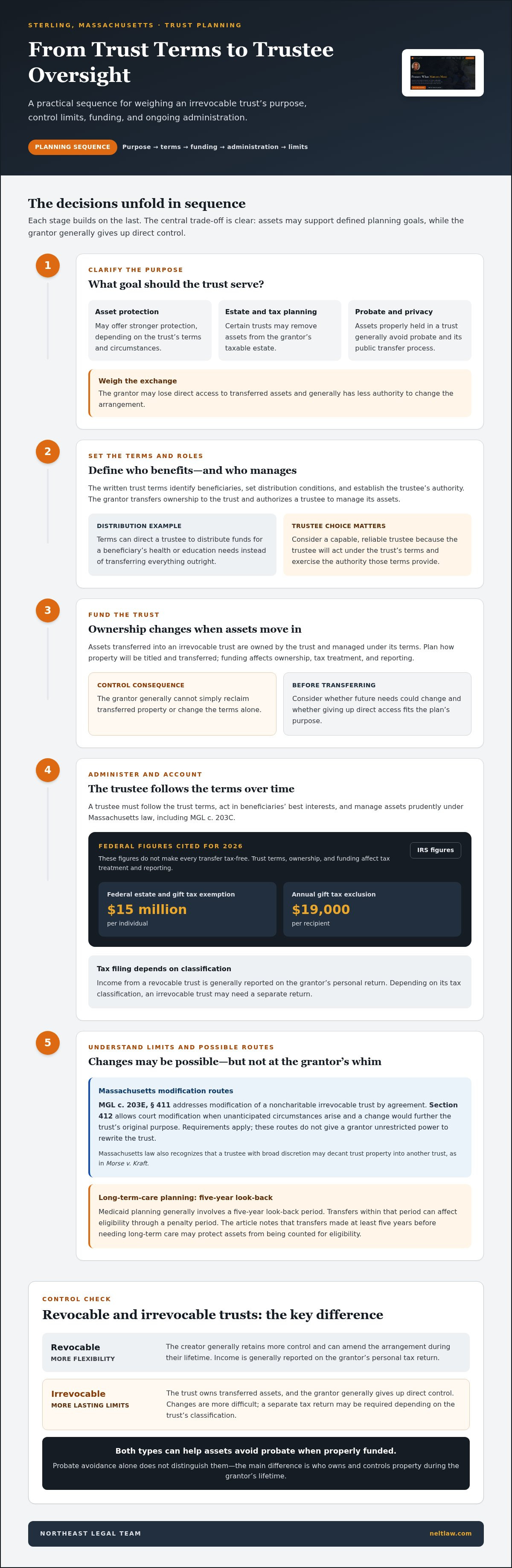
The strongest reason to consider an irrevocable trust may also be its biggest tradeoff: giving up direct control of assets. Under irrevocable trust rules in Sterling, MA, assets transferred into the trust are managed by a trustee under its terms, and changing the arrangement can be difficult. People may consider this structure for asset protection, estate tax planning, or to keep assets out of probate.
It’s reasonable to want to protect your family while understanding who controls your property. An irrevocable trust can support specific planning goals, but it isn’t simply a revocable trust under another name: the grantor’s authority and ability to make changes are generally more limited.
This guide explains why people consider irrevocable trusts, how they compare with revocable trusts, and what grantor control, funding, and trustee administration involve. Understanding these tradeoffs can help you decide whether an irrevocable trust fits your priorities and what to consider before transferring assets.
Key Takeaways
- Consider whether asset protection, estate planning, or privacy goals outweigh the loss of direct control that can come with an irrevocable trust.
- Compare the flexibility of a revocable trust with the ownership and change limits of an irrevocable trust before choosing a structure.
- Understand how transferring property into a trust affects your authority, the trustee’s role, and potential tax responsibilities.
- Plan funding and administration carefully so assets are titled appropriately and managed according to the trust’s terms.
Why Consider an Irrevocable Trust?
An irrevocable trust can support asset protection, estate planning, or privacy goals, but it limits the grantor’s control. Assets properly held in a trust generally avoid probate, keeping their transfer outside the public probate process. The trust document determines who benefits, when distributions occur, and what authority the trustee holds. For example, it can direct a trustee to distribute funds for a beneficiary’s needs instead of transferring everything outright.
Tax planning is another possible reason to consider this structure. The Internal Revenue Service states that the federal estate and gift tax exemption is $15 million per individual beginning in 2026. The Internal Revenue Service also sets the annual gift tax exclusion at $19,000 per recipient in 2026. These figures do not make every transfer tax-free; the trust’s terms, ownership, and funding affect tax treatment and reporting. Certain trusts may also remove assets from the grantor’s taxable estate.
Trust flexibility matters because an irrevocable arrangement can be difficult to change after funding. Massachusetts General Court identifies Massachusetts General Laws chapter 203E, § 411 as addressing modification of a noncharitable irrevocable trust by agreement. Massachusetts General Laws chapter 203E, § 412 also allows court modification when unanticipated circumstances arise and a change would further the trust’s original purpose. These routes depend on the trust and applicable requirements; they do not give a grantor unrestricted control to rewrite the document.
What are the Massachusetts rules for changing or terminating an irrevocable trust? Section 411 addresses modification by agreement, while section 412 provides a court route for qualifying unanticipated circumstances. Massachusetts law also recognizes that a trustee with broad discretion may decant trust property into another trust, as in Morse v. Kraft.
What are the Medicaid look-back and penalty rules for irrevocable trusts in Massachusetts? Medicaid planning generally involves a five-year look-back period. Transferring assets at least five years before needing long-term care may protect them from being counted for eligibility; transfers within the look-back period can affect eligibility through a penalty period.
Before creating a trust, weigh the loss of direct access to transferred assets, trustee control over distributions, administration, and possible tax filings. A trustee must follow the trust terms, act in beneficiaries’ best interests, and manage assets prudently under Massachusetts law, including MGL c. 203C. Choose a capable, reliable trustee and consider whether the grantor’s needs could change. Understanding irrevocable trust rules in Sterling, MA means weighing these duties and limits against the plan’s purpose.
Revocable and irrevocable trust differences
In Massachusetts, the main difference is control. A revocable trust generally offers its creator flexibility over the arrangement during their lifetime. With an irrevocable trust, the trust owns assets transferred into it, and the grantor usually gives up direct control. These differences shape how each trust fits into an estate plan.
For example, someone who places a home in a revocable trust can generally amend the plan if family circumstances change. Someone who transfers property to an irrevocable trust generally can’t simply take it back or revise the terms alone. The trust document sets the trustee’s authority, beneficiaries’ rights, and distribution conditions. This tradeoff can make an irrevocable trust more suitable for a defined protection or tax-planning goal, while a revocable trust offers more flexibility.
Both types of trusts can help assets avoid probate when properly funded, so probate avoidance alone doesn’t distinguish them. The key question is who owns and controls the property during the grantor’s lifetime. A revocable trust generally offers little protection from the grantor’s own creditors while the grantor is alive. An irrevocable trust may provide stronger protection, depending on its terms and circumstances, but the grantor accepts meaningful limits in exchange.
Tax treatment also differs. Income from a revocable trust is generally reported on the grantor’s personal tax return. Depending on its tax classification, an irrevocable trust may need a separate return. This affects financial administration, not just the wording of an estate planning document. Review ownership, trustee discretion, and reporting responsibilities together before choosing either structure.
How does an irrevocable trust compare with a revocable trust in Massachusetts? A revocable trust preserves greater grantor control and flexibility; an irrevocable trust transfers ownership to the trust and generally makes changes more difficult. Both can avoid probate, but their effects on asset protection and taxes differ.
If flexibility is your priority, a revocable trust may be a better fit; if you’re considering an irrevocable structure, weigh the lasting control limits against its purpose. Reviewing estate planning options can help you see how each trust fits alongside your other planning documents.
Irrevocable trust definition and grantor control
An irrevocable trust is a legal arrangement that holds assets for named beneficiaries under written terms. The person creating it, the grantor, transfers ownership to the trust and authorizes a trustee to manage those assets. For example, a grantor might place investments in trust for a child, with distributions limited to education and health needs. The grantor generally can’t reclaim the property or change the terms alone.
Tax treatment depends partly on whether the trust is classified as a grantor or non-grantor trust. With a grantor trust, income is generally reported on the grantor’s personal return. A non-grantor trust may file separately. According to the Internal Revenue Service, in 2026, a non-grantor irrevocable trust reaches the 37% federal income tax bracket when taxable income exceeds $16,000. The classification affects reporting and tax planning.
At the grantor’s death, the trustee follows the document’s distribution instructions. It might direct a lump-sum payment to one beneficiary or hold assets and distribute them over time. A child’s beneficial interest can therefore differ from outright ownership. The trustee must apply the stated conditions consistently and manage any remaining property for the named beneficiaries.
Capacity and intent matter when creating a trust. Before signing, the grantor should understand which assets will be transferred, who will serve as trustee, and what control they will give up. The document should clearly state its purposes, beneficiaries, distribution terms, and trustee powers. An attorney can help shape these provisions around the grantor’s goals, including asset protection, while explaining the lasting limits.
Medicaid planning also requires care. Massachusetts applies a five-year look-back period to certain irrevocable trust transfers when determining long-term-care eligibility. A transfer made too close to an application can affect eligibility through a penalty period. The trust terms, transferred assets, and timing all matter. The grantor should weigh this planning goal against giving up direct access and control.
Trust funding and administration
Signing an irrevocable trust document establishes its terms, but funding gives it property to manage. Start by listing the assets intended for the trust, such as a bank account, investments, or real estate. Then complete the transfer for each asset type: change the account registration or retitle the property in the trust’s name. An asset left outside the trust generally remains outside the trustee’s authority.
Real estate requires particular care. Massachusetts law requires a trustee’s certificate to be recorded in the Registry of Deeds when a trustee transfers real estate, under MGL c. 184, § 35. A deed must identify the property and reflect the intended ownership transfer. If a home has a mortgage, the federal Garn-St Germain Act protects some residential transfers into trusts, but an irrevocable trust transfer may not be protected when the borrower isn’t a beneficiary.
Once funded, the trustee holds legal title and manages trust property according to the document. This includes investing assets, keeping records, and making distributions only under the stated terms. For example, if the trust permits education distributions, the trustee evaluates a beneficiary’s request against that purpose. Massachusetts law addresses prudent investment by trustees under MGL c. 203C, and trustees have fiduciary duties to act for beneficiaries’ interests.
Administration also involves tax and recordkeeping tasks. The trustee of an irrevocable trust must file IRS Form 1041 annually, and the trust needs its own Employer Identification Number for tax purposes. Keep account statements, receipts, distribution records, and trust decisions organized. This paper trail helps the trustee explain how assets were handled and whether each payment followed the trust’s intent. Federal and Massachusetts tax treatment can depend on the trust’s terms and income.
Before transferring property, review which assets belong in the trust, how each transfer will be completed, and who will handle ongoing administration. Plan your trust funding with guidance that connects the trust document to the assets it is meant to hold.
Northeast Legal Team: Wills & Estate Plans
Northeast Legal Team helps individuals and families shape Wills & Estate Plans around their priorities, including decisions about trusts, authority, and future care. If you’re considering an irrevocable trust, a thoughtful review can clarify how its terms fit into your broader estate plan and support the people you want to protect.
Depending on your needs, planning may also include a Living Trust, Power of Attorney, or Healthcare Directives. These documents address different concerns, from managing property to identifying who may act or make healthcare decisions. Reviewing them together can clarify how each part supports your wishes and where an irrevocable trust’s lasting limits matter.
If you’re ready to discuss your estate planning needs, contact Northeast Legal Team.
Choose a Plan That Fits Your Priorities
Before deciding, consider what you want your estate plan to accomplish and which choices matter most. Think about who should benefit, whom you trust to make decisions, and how much flexibility you want to retain. These priorities can frame a practical discussion about irrevocable trust rules in Sterling, MA and how a trust might fit into your wider plan.
You can also prepare questions about your goals, concerns, and the assets you may want the trust to hold. A focused conversation can help you understand the tradeoffs and how your planning documents work together. The right next step should leave you clearer about your choices, not rushed into a decision.
Contact Northeast Legal Team to discuss your options. A thoughtful plan can begin with a calm conversation about what matters to you.
Frequently Asked Questions
What is an irrevocable trust and how does it work in Massachusetts?
An irrevocable trust can be created during the grantor’s life or through a will that takes effect after death. In either form, a trustee follows written terms to manage property and make distributions for named beneficiaries. For example, a testamentary trust can hold an inheritance for a child instead of transferring it outright, while a living trust begins during the grantor’s lifetime.
What are the Massachusetts legal requirements for creating an irrevocable trust?
Massachusetts trust law includes MGL c. 203 and the Uniform Trust Code, MGL c. 203E. The trust document should clearly record the grantor’s intent, identify the trustee and beneficiaries, and describe the property and distribution terms. For example, specify whether the trustee may use funds for a beneficiary’s education or health. Clear terms give the trustee direction for administration and help connect the arrangement to its purpose.
How do you create and fund an irrevocable trust in Sterling, MA?
Start by defining the trust’s purpose, beneficiaries, trustee powers, and distribution instructions in the document. Then identify each asset intended for the trust and complete the appropriate ownership transfer. For example, a brokerage account requires registration changes, while real estate requires a deed transfer. Review each asset afterward to ensure it is titled consistently with the trust and that the trustee can manage it under the written terms.
How are irrevocable trusts taxed in Massachusetts and federally?
Tax treatment depends on whether the trust is classified as a grantor or non-grantor trust. Income from a grantor trust is generally reported by the grantor, while a non-grantor trust may have separate federal filing duties. Massachusetts also taxes income; most Massachusetts income is taxed at 5%. The trust’s income sources, tax classification, and distributions help determine what the trustee reports and which returns apply.
How can an irrevocable trust affect Massachusetts estate taxes and probate?
Assets properly titled in a trust can generally pass without probate, but probate avoidance and estate tax are separate questions. Whether an estate owes tax depends on its circumstances and applicable tax rules. Whether trust property is included in a taxable estate can depend on the grantor’s retained rights and the trust’s terms. Review ownership and control provisions, rather than assuming that placing property in a trust automatically removes it from estate tax calculations.
Can an irrevocable trust protect assets from creditors or nursing home costs in Massachusetts?
An irrevocable trust may help protect assets, but the terms and timing of transfers matter. Medicaid planning generally uses a five-year look-back period, so transfers closer to an application can affect eligibility. In Guilfoil v. Secretary of Health and Human Services, 486 Mass. 788, the court explained that retaining a life estate in a primary residence did not make the property countable for the applicant in that case.


