

A living will can express your wishes, but it doesn’t appoint someone to make medical decisions for you. In Massachusetts, a health care proxy is the legally recognized document for naming that decision-maker; a living will records care preferences. If you’re considering a healthcare proxy attorney in Lunenburg, MA, understanding this difference is a practical first step.
It’s natural to want your family and medical team to understand what matters to you, especially if you can’t speak for yourself. According to the Massachusetts Legislature, a competent adult aged 18 or older can appoint a health care agent by signing a written proxy in the presence of two adult witnesses. This article explains how a proxy differs from a living will, when an agent can act, and how medical directives fit into elder law and estate planning. You’ll also learn how these documents can work together to share your wishes and give someone you trust a clear role in important decisions.
Key Takeaways
- A health care proxy appoints someone to make medical decisions for you, while a living will records the care you want.
- Understand what needs to happen before your chosen agent can act, and how your decision-making authority returns if you regain capacity.
- Choose an agent who understands your values and can handle decisions that your written care preferences may not address.
- Coordinate health care documents with your broader estate plan, including your power of attorney and any HIPAA release.
- Learn how witness requirements, notarization, and medical directives affect the way your wishes are communicated.
How Does a Health Care Proxy Differ from a Living Will in Massachusetts?
A health care proxy appoints a decision-maker, while a living will records care preferences. In Massachusetts, both can help communicate your wishes if you cannot speak for yourself.
Appointing a Massachusetts Health Care Agent
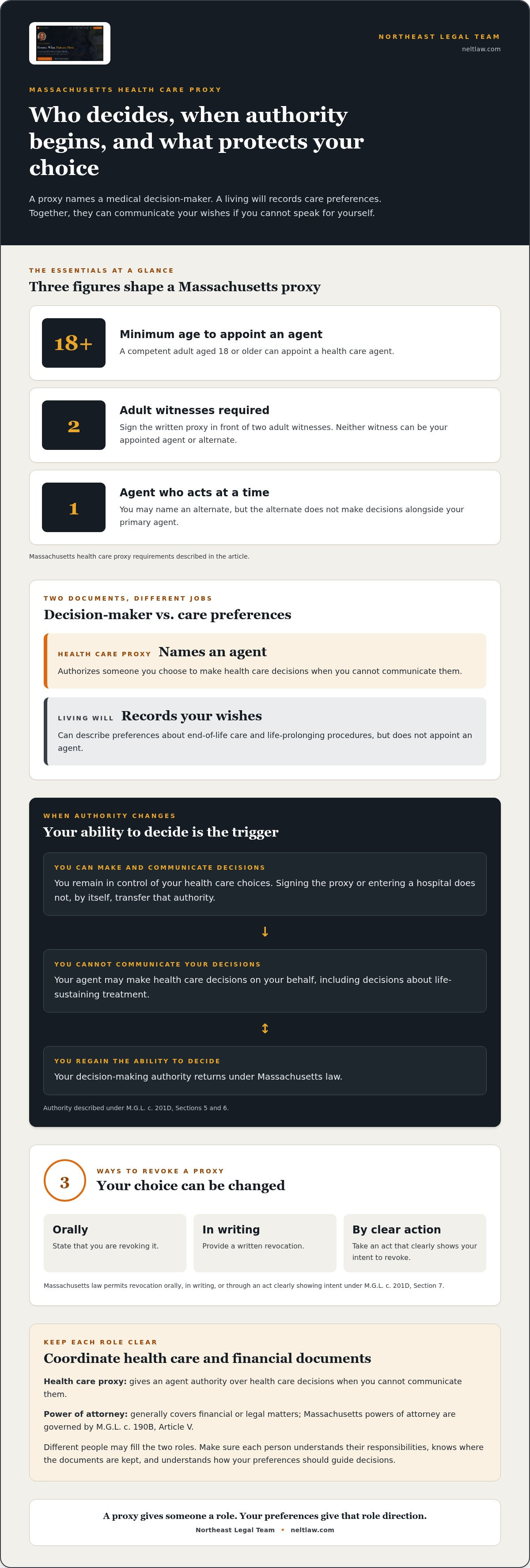
According to the Massachusetts Legislature, a competent adult aged 18 or older can appoint a health care agent by signing a written health care proxy in the presence of two adult witnesses. The document identifies you and your chosen agent, and shows your intent to authorize that person to make health care decisions. The witnesses cannot be your appointed agent or alternate.
Choose someone who understands your values and can make important decisions promptly. A spouse, adult child, sibling, or trusted partner may be a suitable choice. Consider whether they can listen to medical information, communicate with family, and follow your wishes in a difficult situation. The role calls for sound judgment, not simply a close relationship.
Massachusetts allows you to name an alternate agent to step in if your primary agent cannot serve. A health care proxy names one agent at a time, so the alternate does not make decisions alongside your first choice. Discuss the role with both people before completing the document.
Agent Instructions and Authority During Incapacity
A health care agent may make any health care decision you could make, including decisions about life-sustaining treatment under M.G.L. c. 201D, Section 5. The agent’s authority applies when you cannot communicate your decisions. For example, if an illness leaves you unable to explain your treatment preferences, your agent can make decisions on your behalf.
Specific instructions can help your agent apply your values to real medical choices. You might describe what quality of life means to you, which treatments concern you, or what spiritual practices matter during care. A living will can record preferences about end-of-life care and life-prolonging procedures, while the proxy gives an agent authority to address situations your written guidance does not anticipate.
Your proxy does not take away your decision-making role while you can make health care decisions. If you regain that ability, your authority returns under M.G.L. c. 201D, § 6. Keeping your agent informed about your priorities can help them distinguish your wishes from their own views when an unexpected choice arises.
You can revoke a Massachusetts health care proxy orally, in writing, or through an act clearly showing your intent to revoke it, under M.G.L. c. 201D, § 7. To update your choices, prepare a new proxy that identifies your current agent and alternate, then make sure the people involved have the updated document.
When a health care proxy takes effect
A Massachusetts health care proxy takes effect when you cannot communicate your health care decisions. Until then, you remain in control of those choices. This lets you appoint someone in advance without giving up authority while you can speak for yourself.
For example, if an illness leaves you unable to explain your treatment preferences, your agent can make medical decisions on your behalf. If you regain the ability to decide, your authority resumes under Massachusetts law. The proxy depends on your ability to make and communicate health care decisions, not simply on signing the document or entering a hospital.
A health care proxy and a power of attorney cover different decisions. The proxy authorizes an agent to handle health care decisions when you can’t communicate them. A power of attorney generally gives an agent authority over financial or legal matters. Massachusetts powers of attorney are governed by M.G.L. c. 190B, Article V, and are generally durable unless the document says otherwise. A living will records care preferences; it doesn’t appoint an agent.
Coordinate your documents by confirming that each names the right person for its distinct role. You might choose one person to manage finances under a power of attorney and another to make medical decisions under your proxy. Tell both people where the documents are kept and discuss how your preferences should guide their decisions. This can help hospitals and family members find the right document when needed.
You can prepare a health care proxy without a lawyer by completing a written document that identifies you and your chosen agent, states your intent to authorize that person, and meets Massachusetts signing requirements. The Massachusetts Legislature requires two adult witnesses, neither of whom can be the appointed agent or alternate. Read each provision carefully, confirm names and contact details, and give copies to your agent and health care providers.
Adding the proxy to an estate plan gives you a chance to consider medical and financial authority together. A consultation with a healthcare proxy lawyer near Lunenburg, MA can help you review who should make each kind of decision and whether your documents express your intentions. Reviews can offer personal perspectives, while a consultation gives you a setting to discuss your own circumstances. Bring existing documents and note any changes in your chosen agents or care preferences.
If you’re organizing health care and financial documents together, explore estate planning guidance as a next step.
Elder law and estate planning
A health care proxy is one part of an estate plan, not a substitute for every other document. It names an agent for medical decisions, while a power of attorney covers financial or legal matters. Planning for both roles helps clarify who should act and which decisions each person can handle.
Massachusetts powers of attorney are governed by M.G.L. c. 190B, Article V. They’re generally durable unless the document states otherwise. That means the authority can continue during the principal’s incapacity, depending on the document’s terms. A health care proxy serves a different purpose: it authorizes a health care agent to make medical decisions when the person can’t communicate them.
Consider how those roles would work in practice. If an illness prevents you from discussing treatment, your health care agent can address medical choices. If you also cannot manage bills or other financial matters, the person named in your power of attorney may handle those tasks within the document’s authority. One trusted person can fill both roles, but each document should clearly assign the responsibilities.
Estate planning also gives you a place to record your wishes and make them easier for family members to understand. Write down the values that should guide medical choices, such as the importance of comfort or particular spiritual practices. Then discuss those wishes with your health care agent. Written preferences provide guidance, while a conversation can offer context that a document alone may not convey.
Consider access as well as authority. A HIPAA release can allow people other than your health care agent to communicate with medical personnel without giving them decision-making power. You might want a sibling to receive updates while your chosen agent retains authority over treatment decisions. Defining these roles can help family members understand what each person may do.
Review your plan after a major change, such as a serious illness, a move, or a change in relationships. Massachusetts generally enforces an out-of-state health care proxy if it was executed under the other state’s law, subject to limited exceptions related to health care facility policies. If you move, keep the document accessible and review whether your choices still reflect your wishes.
Without a proxy, a spouse, adult child, or parent cannot automatically make decisions for an incapacitated adult; a court may need to appoint a guardian. Massachusetts can appoint someone when a person lacks a proxy and cannot make decisions. Planning ahead lets you name someone you trust, coordinate medical and financial authority, and give family members clearer direction before a crisis.
Medical directives and living wills
A living will gives family members and medical personnel written guidance about your care preferences. In Massachusetts, a living will or medical directive does not have the force of law. A health care proxy is the legally recognized document for appointing someone to make medical decisions. The documents serve different purposes: one records your wishes, while the other names a decision-maker.
Use a living will to describe the treatment you would or would not want if you became unable to communicate. You might address life-prolonging procedures or the conditions that matter most to you. Clear language helps your agent understand your priorities when a medical decision arises. Rather than relying on a brief phrase, explain what the preference means to you.
A proxy and a living will can work together. Your proxy gives your agent authority to make choices, including in circumstances your written guidance does not anticipate. Your living will can help your agent understand your views on treatment, comfort, and life-sustaining care. Give copies to your doctor, family, and attorney, and tell your agent where the current documents are kept.
Some medical orders serve a different purpose. A Massachusetts do-not-resuscitate order is signed by a doctor or other authorized medical professional, not by the patient. It is described as being put in place for people who are terminally ill or otherwise near the end of life. A Medical Order for Life Sustaining Treatment, or MOLST, is also a medical order. A medical professional signs it after consulting with the patient about health care wishes.
Do not confuse these orders with a living will. A living will communicates preferences; a DNR or MOLST gives medical personnel an applicable medical order. Discuss the distinction with your care team, especially if your wishes involve resuscitation or other life-sustaining treatment. This conversation can connect your written guidance with medical decisions about your care.
To make your wishes easier to find and understand, take practical steps:
- Write specific preferences about treatment and life-prolonging procedures.
- Share the living will with your doctor, family, and attorney.
- Tell your health care agent where the documents are stored.
- Review the wording if your views or health circumstances change.
The National Hospice and Palliative Care Organization provides advance directive forms for all 50 states and the District of Columbia. A form can help organize your preferences, but Massachusetts law still distinguishes written guidance from the legally recognized health care proxy. Keeping both documents accessible helps your family and medical team see your wishes and identify who has authority to make decisions.
Does a Massachusetts healthcare proxy need witnesses or notarization?
Yes, Massachusetts requires two adult witnesses when you sign a health care proxy. According to the Massachusetts Legislature, neither witness can be your appointed agent or alternate. Notarization is not required. These rules distinguish the people who witness your signature from the person authorized to make medical decisions.
Before signing, check that the document identifies you and your chosen health care agent. Under M.G.L. c. 201D, § 4, it must show your intent to authorize that agent to make health care decisions. If you name an alternate, make sure the document identifies that person clearly too. The alternate does not serve as a second co-agent.
Choose witnesses who can observe the signing and are not named as your agent or alternate. If you appoint your adult child and name your sibling as alternate, for example, neither should witness your signature. Ask two other adults to witness it. This separation helps make each person’s role clear on the completed document.
Notarization and witnessing are different steps. A notary verifies a signature, while witnesses attest to the signing under the proxy’s requirements. Massachusetts does not require a notary for a health care proxy, so notarization does not replace the two witnesses. Focus on completing the written proxy and signing it in front of eligible witnesses.
After signing, make the document practical to use. Give a copy to your health care agent and alternate, and share one with your doctor. Keep your own copy where family members can find it. If you’re admitted to a hospital, tell staff that you have a proxy and where to find the current copy.
Review the document if you change your agent, alternate, or care preferences. A new proxy should reflect your current choices and meet the signing requirements. Massachusetts law allows a person with capacity to revoke a proxy orally, in writing, or through an act that clearly shows intent to revoke it. If you replace a document, give the updated version to everyone who received the earlier copy.
Massachusetts generally bars a health care facility’s administrator, operator, or employee from serving as a patient’s agent, unless that person is a blood relative, spouse, or adoptive relation. Keep this restriction in mind when choosing someone connected to a care facility. A trusted family member or friend outside the facility may be a more appropriate choice.
For help preparing or reviewing your Massachusetts healthcare directives, take the next step with guidance tailored to your estate plan and chosen agent.
Northeast Legal Team: Wills & Estate Plans
Northeast Legal Team helps individuals and families include health care choices in a broader estate plan. If you’re choosing an agent, updating a proxy, or coordinating medical and financial decision-making, the firm’s attorneys can help prepare Wills & Estate Plans, Healthcare Directives, and Powers of Attorney. Living Trusts may also form part of an estate plan, depending on your goals.
Consider this support when your chosen agent has changed, your care preferences have shifted, or your documents need to work together clearly. Reviewing those choices as one plan can help you communicate your wishes and clarify each person’s role.
Contact Northeast Legal Team to discuss your planning needs, or visit neltlaw.com.
Make Your Wishes Easier to Follow
Planning ahead gives the people close to you a clearer path when a difficult decision arises. Consider whether your chosen decision-makers still reflect your wishes and understand the roles you’ve entrusted to them. A thoughtful conversation now can make your plan more personal and easier for loved ones to follow.
If you’re looking for a healthcare proxy attorney in Lunenburg, MA, Northeast Legal Team can help you consider how health care choices fit into your broader estate plan. The firm offers Wills & Estate Plans, Living Trusts, and Power of Attorney services, helping individuals and families plan for different needs through coordinated documents.
You don’t have to sort through every planning question at once. Start with the decisions that matter most to you, then take the next step at a pace that feels manageable. Contact Northeast Legal Team to discuss your estate planning needs and move forward with greater clarity.
Frequently Asked Questions
Can I name the same person as both my health care agent and my attorney-in-fact?
Yes, you can choose the same trusted person for both roles. Your health care agent makes medical decisions under your proxy, while your attorney-in-fact acts under your power of attorney, often for financial matters. Read each document’s authority carefully. Someone who can discuss treatment with a hospital, for example, may need separate authority to manage bills or access financial accounts.
What happens to my health care proxy if I later regain capacity?
Your health care decision-making authority returns if you regain the ability to make those decisions. Your agent’s authority under the proxy then no longer applies while you can decide and communicate your choices. Let your agent and medical team know when you’ve recovered that ability, so they understand you’re directing your care again. The proxy does not permanently transfer control.
Who Makes Medical Decisions If I’m Incapacitated and Have No Health Care Proxy?
Without a proxy, Massachusetts medical providers look to state law to determine who may make decisions. A spouse, adult child, or parent cannot automatically decide for an incapacitated adult; a court may need to appoint a guardian. This can leave family members uncertain about who should act. Naming an agent in advance lets you choose who speaks for you and guides medical decisions.
How can a healthcare proxy attorney in Lunenburg, MA help?
A healthcare proxy attorney in Lunenburg, MA can help you prepare a proxy that names your chosen agent and clearly expresses your intent. Legal guidance can also help you consider how the proxy fits with your other estate-planning documents. Before a discussion, write down questions about who should act, what values should guide decisions, and whether an existing document needs updating.
What does a Massachusetts healthcare proxy do?
A Massachusetts health care proxy names someone to make medical decisions for you if you cannot communicate your choices. For instance, your agent could speak with clinicians about treatment while you’re unable to respond. The proxy gives that person decision-making authority; a separate written statement can explain your care preferences. Tell your agent where the document is kept and whom to notify.
How do I create a valid healthcare proxy in Massachusetts?
To create a proxy, prepare a written document identifying you and your chosen agent, and show your intent to authorize that person. According to the Massachusetts Legislature, a competent adult aged 18 or older can appoint an agent by signing before two adult witnesses. Neither witness can be the appointed agent or alternate. Give copies to your agent and medical providers after signing.
Can I use a free Massachusetts healthcare proxy form without an attorney?
Yes, you can use a form without hiring an attorney, provided you complete it carefully and follow Massachusetts signing requirements. The National Hospice and Palliative Care Organization provides advance directive forms for all 50 states and the District of Columbia. Review the wording so it reflects your choices, then identify your agent clearly. A form can organize your wishes, but your decisions should guide what you write.
How do I choose a healthcare agent and alternate in Massachusetts?
Choose someone who understands your values, can communicate with medical staff, and can make difficult decisions under pressure. A spouse, adult child, sibling, or trusted partner may be suitable. Consider who can be reached and who will respect your preferences, even if family members disagree. Name an alternate in case your first choice cannot serve, and discuss both roles before signing.


