

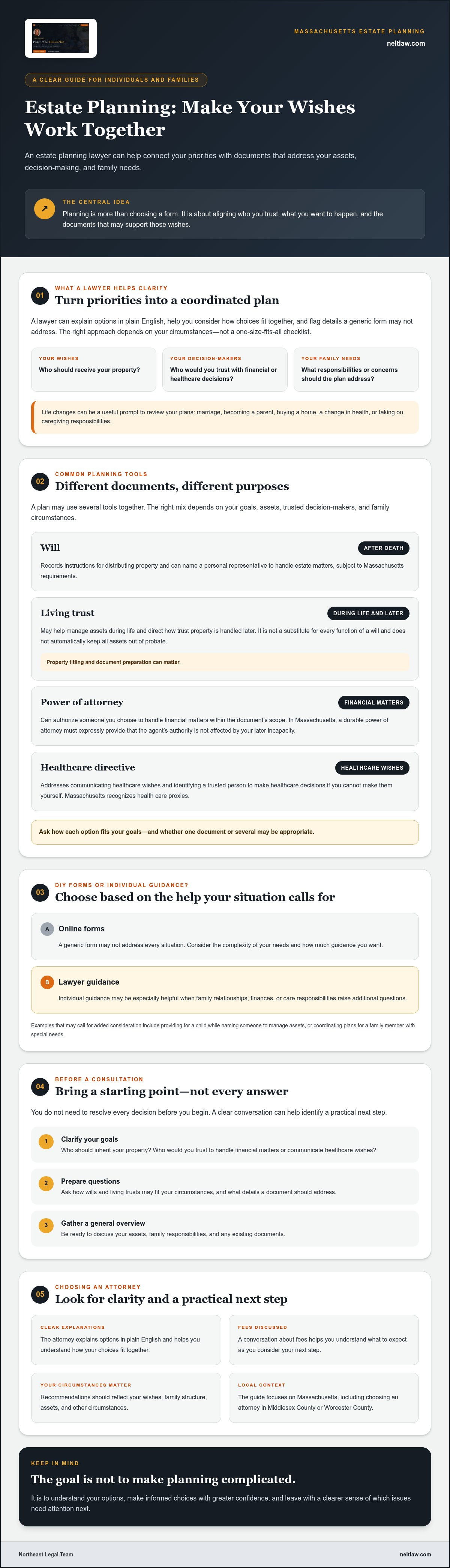
What if the easiest estate plan to download isn’t the one that protects your wishes? If you’re unsure which documents you need, or whether a generic online form fits your family and finances, you’re not alone. An estate planning lawyer can help turn your priorities into a coordinated plan, explain your options in plain English, and flag details a template may not address. The goal isn’t to make planning feel complicated. It’s to help you make informed choices with greater confidence.
This guide explains what an estate planning lawyer can help with in Massachusetts and what to look for when choosing an attorney in Middlesex County or Worcester County. You’ll learn about common planning tools, including wills, living trusts, powers of attorney, and healthcare directives, and how they may support your wishes and the people who matter to you. We’ll also cover questions to ask during a consultation and information to bring. You don’t need every answer before you begin. A clear conversation can help you identify a practical next step.
Key Takeaways
- An estate planning lawyer can help connect your wishes with documents that address your assets, decision-making, and family needs.
- Wills and living trusts serve different purposes, so ask how each option may fit your circumstances.
- Online forms may not address every situation. Consider the complexity of your needs and how much guidance you want.
- Before a consultation, clarify your goals, prepare questions, and gather a general overview of your assets, family responsibilities, and existing documents.
- Look for an attorney who explains options clearly and discusses fees so you can understand your next step with confidence.
What an Estate Planning Lawyer Does for Massachusetts Individuals and Families
An estate planning lawyer helps translate your wishes into legal documents that can guide what happens to your property and who can make important decisions if you’re unable to speak for yourself. Your plan may address who receives assets, who manages them, and how to provide for children or family members who rely on you. The right approach depends on your circumstances, not a one-size-fits-all checklist.
If you’re new to the subject, this neutral overview of what estate planning is introduces common tools such as wills, trusts, and powers of attorney. A lawyer can help you decide which tools may fit your goals and how they work together. Planning ahead is different from probate and estate administration, which involve handling a person’s affairs after death. A plan may address some concerns in advance, while probate assistance may be needed later.
When should you consider hiring an estate planning lawyer?
Life changes can be a useful prompt to review your plans. Marriage, becoming a parent, buying a home, a change in health, or taking on caregiving responsibilities may affect who you want to protect and who you trust to act for you. You don’t have to wait until you’re older or have substantial wealth to think through those choices.
Individual guidance may be especially helpful when family relationships, finances, or care responsibilities raise additional questions. For example, you may want to provide for a child while naming someone to manage assets on their behalf, or coordinate plans for a family member with special needs. An attorney can discuss options and trade-offs, but can’t promise a particular result in every situation.
What should an estate planning lawyer help you clarify?
A productive conversation starts with your priorities. Who should inherit your property? Who would you trust to handle financial matters or communicate healthcare wishes if you couldn’t? Are there family responsibilities or concerns that a document should address? Your answers help shape recommendations. The documents depend on your wishes, family structure, assets, and other circumstances.
An estate planning lawyer helps coordinate your wishes, decision-makers, and documents into a plan tailored to your circumstances. That means looking beyond a single form to consider how your choices fit together. You should leave the discussion with a clearer understanding of which issues need attention and what questions to resolve next, even if you’re not ready to make every decision at once.
Which Estate Planning Documents Might a Massachusetts Lawyer Recommend?
Documents serve different purposes, and a plan may use several together. The right mix depends on what you want to happen to your property, who you trust to help, and your family’s needs. A Massachusetts estate planning lawyer can explain how each document works and review state-specific requirements. For general reference, see Massachusetts law about wills and estates. For advice about how the rules apply to you, discuss your circumstances with an attorney.
How do wills and living trusts differ?
A will records instructions for distributing property after death and can name a personal representative to handle estate matters, subject to Massachusetts requirements. A living trust is a separate arrangement that may help manage assets during life and direct how trust property is handled later. It isn’t a substitute for every function of a will, and it doesn’t automatically keep all assets out of probate. How property is titled and how the documents are prepared can matter, so ask an attorney to review those details.
Think of them as different tools, not competing versions of the same document. Before deciding, ask how your goals, assets, and family circumstances affect whether one or both may be appropriate.
Why include powers of attorney and healthcare directives?
Planning can also prepare for a time when you’re alive but can’t make or communicate decisions independently. A power of attorney can authorize someone you choose to handle financial matters within the document’s scope. In Massachusetts, a durable power of attorney must expressly provide that the agent’s authority isn’t affected by your later incapacity. Ask counsel to explain the language, authority, and signing requirements before relying on a form.
A healthcare directive addresses a different need: communicating healthcare wishes and identifying a trusted person to make healthcare decisions if you can’t make them yourself. Massachusetts recognizes health care proxies, while a standalone “living will” isn’t legally binding under state law, though it may help communicate your wishes. For a closer look at this distinction, read the Massachusetts living will attorney guide.
Documents may need review as your wishes, relationships, or circumstances change. Before signing or updating anything, discuss who should act, what authority they should have, how the documents should be executed, and when to revisit them. If you’d like help understanding which documents may fit your situation, learn about estate planning guidance from Northeast Legal Team.
DIY Forms or an Estate Planning Lawyer: How to Decide What Fits
Online forms offer a self-guided way to organize basic instructions. Working with an estate planning lawyer gives you an opportunity to discuss how your choices fit together and ask questions as they arise. Neither option is automatically right for everyone. Consider the complexity of your circumstances, how much customization you need, and whether you want legal guidance when preparing and signing documents.
A signature alone doesn’t prove that an online form suits your needs or meets the requirements that apply to it. Massachusetts rules can vary by document, and relevant details may depend on your circumstances. The state’s Massachusetts law about wills and estates is a useful starting point, but it can’t determine which choices are right for you. If you’re unsure about the form, its wording, or how it should be signed, get qualified legal guidance before relying on it.
When might a basic plan need closer legal review?
Some situations raise questions a generic form may not be designed to address. A blended family may need to consider how to provide for a current spouse and children from an earlier relationship. Parents of minor children may want to think carefully about who should care for them and how their needs should be supported. Business interests, special needs, caregiving responsibilities, or different types of assets can also affect planning choices.
None of these factors automatically calls for a particular document or strategy. Instead, they’re reasons to look closely at how your goals connect. An attorney can ask about your priorities, identify gaps or unanswered questions, and explain possible options without assuming one plan fits every family.
How can you evaluate an attorney's fit and fees?
Clear communication matters. Ask how the lawyer reached their recommendations, what the quoted fee covers, whether any services may be separate, and how document signing and execution are handled. Find out how you can request updates if your wishes or circumstances change. These answers help you assess both the scope of the work and whether the process is understandable.
Some firms offer fixed-fee drafting and execution for estate planning documents, though the scope and fee can depend on the matter. Ask whether the fee covers preparation, execution, and an explanation of how the documents work. For more on what to ask about fee structures, see this estate planning flat-fee guide. You can also use this estate attorney selection checklist to compare communication, services, and practical fit. A useful conversation should leave you clearer about your options, not pressured to choose a plan before you understand it.
How to Prepare for an Estate Planning Lawyer Consultation in Massachusetts
A little preparation can make your first conversation clearer and more useful. Start by identifying what you want your plan to address, such as providing for family, choosing someone to handle financial matters, or documenting healthcare wishes. Then write down questions and gather a general overview of your assets, family responsibilities, and existing planning documents. You don’t need every detail or answer in advance.
What information should you gather before the meeting?
Bring copies of documents you already have, if available, and make a note of people and responsibilities you want to discuss. This checklist can help you get started:
- Existing wills, trusts, powers of attorney, and healthcare directives
- Relevant business documents, if you own or have an interest in a business
- People you may want to name as decision-makers or beneficiaries
- Dependents or family circumstances that may affect your wishes
- Questions about how your assets and responsibilities fit together
A general inventory is enough to begin. Don’t post account numbers, private records, or other sensitive details online. Before sending documents, ask the firm how to share confidential information securely and what materials it needs for the meeting.
Which questions can help you assess the lawyer?
Use the conversation to understand both the recommendations and the process. You might ask:
- How will you tailor recommendations to my goals and circumstances?
- Who will prepare the documents and explain how they work?
- How will signing and execution be handled?
- What does the quoted fee cover, and could anything be separate?
- What is the expected timing, and what would the next steps be?
Ask how the attorney approaches Massachusetts requirements and probate questions relevant to Middlesex County or Worcester County. Don’t assume information you found for another state applies here. Counsel can help identify which local details matter to your situation and explain them before you decide how to proceed.
You can request a free estate planning consultation with Northeast Legal Team to discuss your goals and questions. Bring what you have, and use the conversation to clarify what to address next.
Choose an Estate Planning Lawyer Who Makes Your Next Step Clear
Choosing an estate planning lawyer is about more than selecting documents. Start with your goals, then ask which tools may fit your circumstances. Pay attention to how the attorney listens, explains options, and answers questions. Before deciding to move forward, make sure you understand the scope of the work, what the fee covers, and what will happen next.
What makes an estate planning relationship feel workable?
You should be able to describe what matters to you and understand how the lawyer’s recommendations connect to those priorities. Clear explanations help you compare options without feeling rushed. A workable relationship also leaves room for questions about who will prepare your documents, how signing will be handled, and what support is included.
Ask the attorney to explain the scope of representation in plain language. If an issue falls outside that scope, it’s helpful to know early. Look for a process that lets you make informed choices, not a promise of a particular result or a plan that assumes every family has the same needs.
How can Northeast Legal Team help you begin?
Northeast Legal Team serves clients in Middlesex County and Worcester County, Massachusetts. Its estate planning services include wills and estate plans, living trusts, powers of attorney, healthcare directives, special needs planning, asset protection, and business succession planning. The firm also provides probate and estate administration assistance. Not every person needs every service; a conversation can help identify which topics are relevant to your goals.
The firm offers fixed-fee drafting and execution for estate planning documents, with the scope and fee depending on the matter. Its free consultation or assessment can help you discuss your circumstances and receive personalized recommendations without an obligation to proceed.
If you’re ready to talk through your questions, schedule a free consultation with Northeast Legal Team. Begin with a general overview of what you hope to protect or plan for, then decide on a next step with a clearer understanding of your options.
Take a Clear First Step Toward Protecting Your Wishes
A thoughtful estate plan starts with your goals, not a stack of forms. The right documents depend on your family, assets, and the decisions you want trusted people to make. An estate planning lawyer can help you understand your options, tailor the plan to your circumstances, and clarify how the documents work together.
Before choosing an attorney, consider whether they listen closely, explain recommendations in plain language, and make the scope and fees clear. You don’t need every answer before asking questions. A conversation can help you identify what matters most and decide what to address next.
Northeast Legal Team offers a free, no-obligation consultation or assessment with personalized recommendations. Fixed-fee services are available for certain estate planning documents; ask the firm what’s included and what applies to your situation. Schedule a free estate planning consultation to talk through your goals. One clear conversation can be a practical beginning, and you can move forward at a pace that feels right for you.
Frequently Asked Questions
What does an estate planning lawyer do?
An estate planning lawyer helps you turn your wishes into legal documents and a coordinated plan. They can discuss how you want property handled, who you trust to make financial or healthcare decisions if you can’t act independently, and what your family may need. The lawyer explains options based on your circumstances, prepares relevant documents, and can help you understand what to review as your life changes.
Do I need an estate planning lawyer in Massachusetts?
Not everyone needs the same level of legal help, but advice can be useful if you’re unsure which documents fit your situation or have complex family, financial, or caregiving needs. Marriage, parenthood, property ownership, or a change in health may prompt a review. If you live in Middlesex County or Worcester County, ask an attorney how Massachusetts requirements may affect your planning.
What documents should I discuss with an estate planning lawyer?
Ask about a will, living trust, power of attorney, and healthcare directive, then discuss which tools match your goals. A will and trust serve different purposes, so they aren’t interchangeable in every plan. You may also want to raise business succession, special needs planning, or asset protection if relevant to your circumstances. An attorney can explain how the documents work together and what requirements apply in Massachusetts.
Is an online will valid in Massachusetts?
An online will isn’t automatically valid or suitable just because you completed and signed it. Whether a document meets applicable Massachusetts requirements can depend on how it was prepared and executed, as well as the circumstances involved. A generic form may also miss instructions important to your family or assets. If you’re relying on an online will, have a qualified Massachusetts attorney review its wording and execution before assuming it will serve your wishes.
Can an estate planning lawyer help me avoid probate?
An attorney can explain planning options that may affect whether particular assets go through probate, including whether a living trust fits your goals. A trust doesn’t automatically avoid probate for every asset; how property is titled and whether it is properly transferred can matter. Other property may still be subject to probate. Ask the lawyer to review your assets and explain the likely process under Massachusetts law rather than relying on a general promise.
How often should I update my estate plan?
Review your plan after major changes, such as marriage, a new child, a death in the family, a change in health, or a significant shift in your assets or responsibilities. These events may affect your chosen decision-makers or the people you want to benefit. If nothing has changed, a periodic review can still help confirm that your documents reflect your current wishes and remain appropriate under applicable Massachusetts law.
What should I bring to an estate planning consultation?
Bring any existing wills, trusts, powers of attorney, healthcare directives, and relevant business documents. Prepare a general overview of your assets, family responsibilities, intended beneficiaries, and questions you want answered. You don’t need to send sensitive details online before speaking with the firm; ask how to share private information securely. A clear list of goals can help the attorney understand what matters most and discuss practical next steps.


