

Elder law services in Petersham, MA can help older adults and families plan for future care, protect their finances, and document their wishes. In Massachusetts, planning may involve wills, trusts, powers of attorney, and health care proxies, along with questions about financial exploitation, veterans’ benefits, MassHealth eligibility, and Medicaid planning. The right approach depends on the person’s needs, resources, and family goals.
It’s understandable to be unsure where to begin, especially when health decisions and financial security are closely connected. Thoughtful planning can clarify who may help and make important wishes easier to follow. This article explains Massachusetts elder law planning tools, benefits and asset protection considerations, and when legal guidance can help bring those issues together.
Key Takeaways
- Use a will or trust to clarify how assets should pass, and review existing documents when family, financial, or health circumstances change.
- Make sure trusted decision-makers have clear authority to help with financial and medical matters if you can’t act for yourself.
- Learn how to recognize possible financial exploitation and which Massachusetts reporting resources can help you take a next step.
- MassHealth and veterans’ benefits have eligibility rules; planning around your finances and care needs can help you understand the options.
- Compare estate and Medicaid planning choices with your family goals, then consider legal help to put appropriate documents in place.
Wills, trusts, powers of attorney, and health care proxies
Massachusetts elder law planning connects future care needs with decisions about money, property, and medical treatment. The documents that fit depend on your priorities, family circumstances, assets, and possible need for long-term care.
Wills and Trusts
A will can direct how assets pass after death and name the people you want to benefit. A trust can specify how assets should be managed or distributed. To compare your options, list your property, intended beneficiaries, and family circumstances that may affect your wishes, such as a relative who needs ongoing support.
For long-term care and asset protection, Massachusetts has no single document that guarantees eligibility for public benefits or shields every asset. MassHealth provides community and institutional benefits to eligible individuals, and eligibility depends on program rules and a person’s circumstances. Massachusetts law provides homestead protection for elderly or disabled persons under MGL c. 188, § 2. A planning review can consider how property, care needs, and estate goals fit together.
Review your documents when your finances, family relationships, or care needs change. Regular review can help keep your beneficiaries and instructions aligned with your current priorities.
Powers of Attorney and Health Care Proxies
A power of attorney authorizes someone you choose to make financial decisions if you become unable to manage them yourself. A durable power of attorney is designed to remain effective during incapacity. A health care proxy appoints someone to make medical decisions if you can’t communicate. Choose people you trust, discuss your wishes with them, and make sure they understand their roles.
When looking for an elder law attorney serving Petersham, consider experience with Massachusetts estate documents, long-term care planning, and MassHealth eligibility. Before a meeting, gather existing wills, trusts, powers of attorney, and health care proxies, along with a basic outline of your assets and care concerns. Ask how the attorney will explain your options and align documents with your goals.
These documents may help families assess existing authority before seeking a guardian or conservator. Massachusetts law also provides for designating a caregiver to receive patient health information and a discharge plan under MGL c. 111, § 236. Ask how that designation relates to your proxy and care preferences.
Good planning starts with clear questions. Write down your concerns about care options, who can act, and how assets may affect benefits. Then review each document’s purpose with an attorney. The discussion can clarify what a will, trust, power of attorney, or proxy does, and whether separate long-term care planning is needed.
Financial exploitation protections
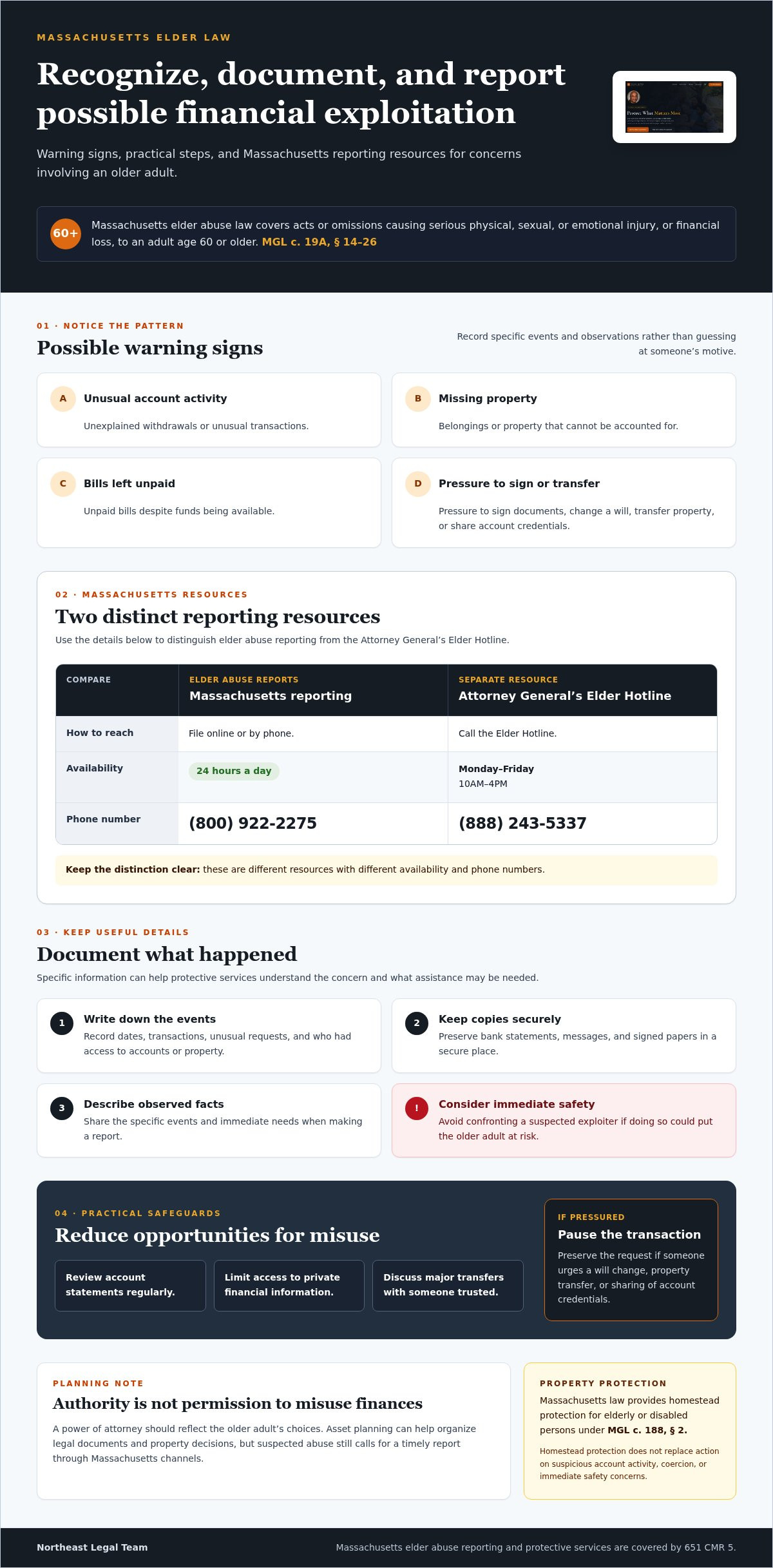
Financial exploitation can involve misuse of money, property, or a trusted relationship. Massachusetts elder abuse law covers acts or omissions that cause serious physical, sexual, or emotional injury, or financial loss, to an adult age 60 or older under MGL c. 19A, § 14-26. A senior or family member who notices unexplained withdrawals, missing belongings, unpaid bills despite available funds, or pressure to sign documents should record the concern and seek appropriate support.
Preserve useful details if you suspect financial exploitation. Record dates, transactions, unusual requests, and who had access to accounts or property. Keep copies of bank statements, messages, and signed papers in a secure place. Families can share this information when making a report, helping protective services understand what happened and what assistance may be needed. Avoid confronting a suspected exploiter if doing so could put the older adult at risk.
Massachusetts elder abuse reports can be filed online or by phone 24 hours a day, and the reporting phone number is (800) 922-2275. The Massachusetts Attorney General’s Office says its Elder Hotline is available Monday through Friday from 10AM to 4PM, at (888) 243-5337. These are distinct reporting resources. Keep the details of the concern ready so the report can clearly describe the suspected harm and immediate needs.
Massachusetts regulation 651 CMR 5 covers elder abuse reporting and the protective services program. Protective services focus on concerns involving older adults and can help assess reported abuse or neglect. If a family member is uncertain whether a pattern warrants action, describing the specific events, rather than making assumptions about motive, can help clarify the situation.
Home protection is another planning consideration. Massachusetts law provides homestead protection for elderly or disabled persons under MGL c. 188, § 2. Because asset ownership and family circumstances affect planning choices, review property records and existing estate documents together. A homestead protection is not a substitute for addressing suspicious account activity, coercion, or immediate safety concerns.
Prevention can start with practical habits: review account statements regularly, limit access to private financial information, and discuss major transfers with someone trusted. If someone pressures an older adult to change a will, transfer property, or share account credentials, pause the transaction and preserve the request. A power of attorney should reflect the older adult’s choices, not be treated as permission to misuse their finances.
For families considering broader safeguards, asset protection planning can help organize legal documents and property decisions around the person’s goals. The focus is on understanding who can act, what authority documents provide, and how property is held. Planning can support protection, but suspected abuse still calls for a timely report through Massachusetts channels.
Veterans' benefits and MassHealth eligibility
Veterans’ benefits and MassHealth may help address care needs, but each program has its own eligibility process. Massachusetts elder law attorneys can advise individuals about eligibility and obtaining or maintaining benefits. Start by listing the care needed, current income and assets, living arrangements, and benefits already received. This information helps an attorney identify questions about how long-term care planning may interact with applications.
MassHealth provides community and institutional benefits to eligible individuals in Massachusetts. Eligibility depends on program rules and the applicant’s circumstances, so organize financial and care records before considering options. Gather bank and investment statements, property information, income records, insurance details, and notices from existing benefit programs. If an older adult is considering moving from home to a care facility, note the expected care setting and current support needs. These details help focus the MassHealth questions to address.
Veterans and their families can prepare in a similar way. Collect military service records, benefit correspondence, care information, and a list of current expenses. An attorney can discuss whether a veteran may qualify for veterans’ benefits and how to apply for or maintain eligibility. Keep copies of submitted forms and follow-up letters together. If a spouse or family member helps manage paperwork, note that person’s role and the veteran’s preferences for sharing information.
Medicare, MassHealth, and veterans’ benefits are separate programs, so don’t assume one application answers questions about another. For example, a person receiving Medicare can still ask how MassHealth eligibility applies to community or institutional care. Keep each program’s notices in a separate folder and record requests for additional documents. A lawyer can help identify records relevant to care, finances, and eligibility, and explain how a change in living arrangements may affect planning.
Include Social Security and Supplemental Security Income, or SSI, in your benefits review. Gather benefit statements and notices with other income records, then compare them with current care expenses and household arrangements. Don’t rely on an old estimate if income or living circumstances have changed. Note what changed and ask how it may affect the person’s overall eligibility picture. An organized review helps families prepare focused questions before applying, responding to a notice, or making long-term care decisions.
Keep a simple benefits record with each program’s name, application status, requested documents, and next step. For example, note that MassHealth paperwork needs updated account statements while veterans’ benefits records need service documentation. This practical record does not replace each program’s application process. Bringing organized records to a lawyer can make the discussion more useful and help clarify the steps involved in obtaining and maintaining benefits.
Estate and Medicaid planning
An elder law attorney serving Petersham can connect estate planning with MassHealth and Medicaid eligibility concerns. A review can take your assets, care needs, family goals, and the potential effect of planning choices on benefits into account.
Estate Planning Options
Estate planning can direct how assets pass and support goals such as treating family members fairly. An attorney can review wills, trusts, and property arrangements in light of your priorities. List intended beneficiaries, assets, and family needs that may affect distributions. Then consider whether your documents reflect those goals and account for possible nursing care.
MassHealth and Medicaid Planning
MassHealth provides community and institutional benefits to eligible Massachusetts residents. Legal guidance can help you understand eligibility, prepare an application, and maintain eligibility as circumstances change. Bring current financial records, care information, and existing estate documents to your planning discussion. These materials help identify questions about resources, care arrangements, and how estate goals fit with benefits planning.
Estate and Medicaid planning should be considered together. A strategy intended to benefit heirs may affect access to care resources, while a care decision can change what remains in an estate. Ask an attorney to explain the trade-offs in light of your goals. For example, discuss whether equal inheritances remain a priority if one family member provides substantial support or has special needs.
Trusts require careful attention in Medicaid planning. In Guilfoil v. Secretary of Health and Human Services, the Massachusetts Supreme Judicial Court discussed nominee trusts and how they differ from traditional trusts, as reported in 486 Mass. 788 (2021). The distinction matters because trust structures can have different purposes. Don’t assume that every trust offers the same planning effect; review its terms and role with an attorney.
Tax considerations can also shape decisions for heirs. An elder law attorney can help families consider whether strategies align with their goals, including reducing estate or income taxes payable by heirs. The best fit depends on the family’s assets, intended beneficiaries, and care priorities. Write down those aims before comparing options, so each can be measured against the same goals.
Review an estate plan periodically, especially after changes in laws, finances, or family circumstances. A new care need, changed beneficiary relationship, or altered financial picture may make old instructions less suitable. A Bank of America industry survey found that 86% of estate planning professionals recommend updates to estate and trust structures. Use that as a reminder to revisit the plan, not as a substitute for evaluating your own circumstances.
Keep a planning folder with current documents, asset information, benefit correspondence, and questions for your attorney. During a review, ask which choices support your care needs, preserve your wishes, and may need to change as circumstances shift. This organized process connects long-term care planning with the legacy you want to leave.
Which elder law attorneys serve Petersham and nearby towns?
People seeking elder law services in Petersham, MA should look for an attorney familiar with Massachusetts estate planning, benefits, and long-term care issues. Local relevance matters, as does experience with the specific decision at hand. A family preparing a power of attorney needs different guidance from someone addressing probate or MassHealth planning. Start by identifying your main concern and seeking legal support serving Petersham and nearby Worcester County communities.
For residents of Petersham and nearby communities in Worcester and Middlesex counties, elder law planning should reflect local needs and each family’s circumstances. Consider who needs to take part, where important records are kept, and whether the older adult needs support reviewing documents. These details help focus the discussion on the family’s concerns and decisions ahead.
Before choosing an attorney, write down your most important legal questions. Your family may need to update a will, understand authority under a power of attorney, or plan for changing care needs. Bring relevant documents and a brief outline of family priorities. A focused discussion can clarify the work involved and whether the attorney’s approach fits the issue.
Use these practical points to prepare:
- Identify the need. Separate estate documents, benefits questions, probate, and care planning.
- Gather records. Collect existing legal papers, benefit notices, and financial information relevant to the concern.
- Include decision-makers. Invite the older adult and any trusted person whose role relates to the issue.
- Write down priorities. Note wishes about property, care, family responsibilities, and who should make decisions.
Families in the same community can have very different needs. One person may be planning ahead, while another needs help understanding an existing document or responding to a recent change. A useful discussion connects the legal question with the person’s wishes and circumstances. If care, property, and inheritance issues overlap, list them together so the attorney can consider how they interact.
For Petersham residents, the next step is to organize the concern and arrange a conversation about the relevant planning issue. A clear starting point helps an attorney understand which decisions are pending and which documents matter. Discuss your estate planning needs with a Massachusetts legal practice serving residents in the area.
Northeast Legal Team: Wills & Estate Plans
Northeast Legal Team helps individuals and families put important wishes into clear legal documents. If you’re ready to plan how assets should pass or who can act on your behalf, its Wills & Estate Plans, Living Trusts, Power of Attorney, and Healthcare Directives can address those needs. These documents can help organize decisions about property, finances, and medical care around your priorities. Bring existing paperwork and note any questions about family responsibilities or future planning. A focused conversation can help you understand which documents fit your goals and what steps may follow. For help with your planning, contact Northeast Legal Team or visit neltlaw.com.
Take the Next Step Toward a Clear Plan
Planning can feel more manageable if you start with one question: what do you most want your family to understand or be able to do? Write down that priority, note any changes in your circumstances, and gather the documents you already have. This creates a useful starting point for a focused conversation about your next steps.
For families seeking elder law services in Petersham, MA, Northeast Legal Team can help shape Wills & Estate Plans, Living Trusts, and Power of Attorney around personal goals. These tools can clarify how assets should be handled and who may act on your behalf. You don’t need to resolve every concern before seeking guidance; begin with the question that matters most today.
Contact Northeast Legal Team to discuss your planning needs. A thoughtful first step can help you move forward with greater clarity and care.
Frequently Asked Questions
What Does Elder Law Cover in Massachusetts?
Massachusetts elder law addresses legal concerns affecting older adults, from planning and benefits to protection from abuse. State law defines an older adult as someone age 60 or older under MGL c. 19A, § 14. The field can also involve decisions about who may manage finances or make personal choices when someone needs help. A family can begin by identifying whether its immediate concern involves care, property, benefits, or decision-making authority.
What elder law services are available in Petersham, MA?
Planning options for families in the Petersham area include wills and estate plans, living trusts, powers of attorney, healthcare directives, probate assistance, special needs planning, and asset protection. Northeast Legal Team serves clients in Worcester and Middlesex counties. To prepare for a discussion, identify your main goal, such as naming someone to handle financial matters or organizing instructions for family members. Bring any existing documents related to that goal.
What does an elder law attorney do for estate planning, wills, and trusts?
An elder law attorney can help align estate documents with a person’s wishes and family circumstances. For example, someone who wants to provide for a relative with ongoing support needs can discuss how the estate plan may address that goal. An attorney can also help organize beneficiary choices and document roles. Before meeting, write down who you want to benefit, whom you trust to help, and any concerns about fairness among relatives.
How can families arrange guardianship, conservatorship, or powers of attorney in Massachusetts?
First review any existing power of attorney or health care proxy, since these documents may already authorize assistance. In Massachusetts, a conservatorship may address help with an older adult’s assets, while a guardianship may address personal decisions such as residence or medical care. These court arrangements remove some legal rights. Compare the person’s needs with existing authority before considering court involvement, and discuss the specific decision requiring help with an attorney.
What legal options help protect older adults from financial abuse in Massachusetts?
Massachusetts elder abuse law covers financial loss affecting an adult age 60 or older, under MGL c. 19A, § 14-26. Protective services rules appear in 651 CMR 5. If a family notices an unfamiliar transfer or pressured request to sign papers, preserve relevant statements and messages, record what happened, and report the concern. Specific dates, transactions, and people involved can help explain the situation clearly when seeking assistance.


