

A will contest deadline is too important to estimate. The statute of limitations for contesting a will in Stow, MA depends on the rules that apply to the probate proceeding, so a general deadline for a different type of legal claim may not answer your question. The relevant probate filings and dates are central to understanding which time limits may apply.
It’s understandable to want one clear date, especially when a family is already managing loss and uncertainty. But focusing only on when the person died or when you learned about the will may leave out important legal context. A careful review of the proceeding helps put the timeline in perspective.
This article explains how statutes of limitations relate to court proceedings, which details matter when assessing a will contest, and why acting promptly can help protect your options. It also outlines how probate and estate administration support can bring clarity to the next steps.
Key Takeaways
- Identify which probate proceeding applies and how its filings may affect the timeline for challenging a will.
- Understand why a person’s age or other circumstances may affect how a legal deadline is calculated.
- Learn which concerns, including possible undue influence or lack of capacity, may support a will contest.
- See how estate planning can help clarify wishes and support a more orderly probate process.
How statutes of limitations work
A statute of limitations sets a time limit for starting a court case. In a will dispute, the key question is which legal deadline applies to the claim and proceeding. The date of death alone does not answer that question. A filing connected with probate may follow different rules from a separate civil claim. Those distinctions matter before assuming a deadline has passed.
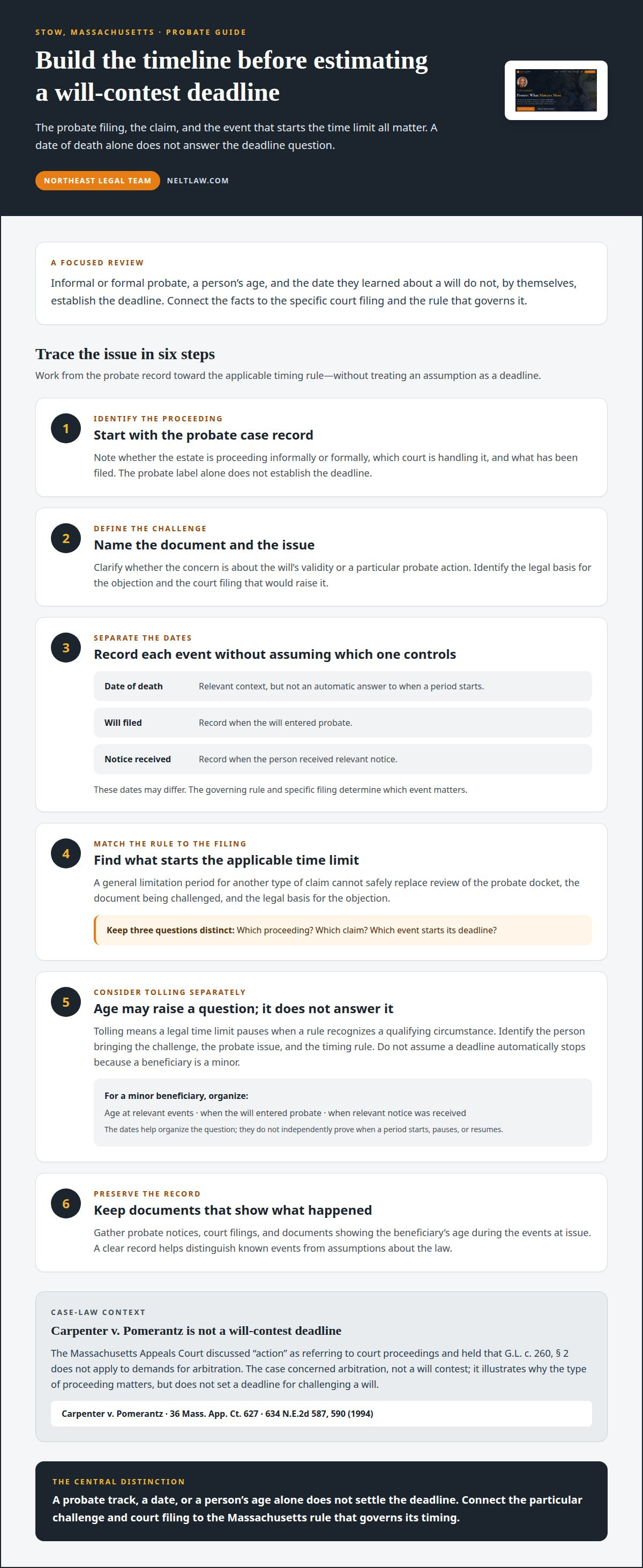
Massachusetts case law helps explain what “action” means. In Carpenter v. Pomerantz, the Massachusetts Appeals Court cited the term as referring to court proceedings: 36 Mass. App. Ct. 627, 634 N.E.2d 587, 590 (1994). That distinction matters because a statute written for court actions may not automatically govern another process. Carpenter concerned arbitration, not a will contest, so it does not set a deadline for challenging a will.
The same case held that G.L. c. 260, § 2 does not apply to demands for arbitration. That ruling illustrates why the type of proceeding matters. A demand for arbitration and a court filing are different steps, even when they involve a dispute over the same underlying matter. For a will challenge, the relevant question is whether the claim must be brought in court and which probate rules govern it.
Consider a beneficiary who questions a signature after probate begins. The concern may involve the will’s validity, but the person still needs to identify the proper court filing and applicable timing rule. A general limitation period for another type of claim cannot safely replace that analysis. The probate docket, the document being challenged, and the legal basis for the objection help define the issue.
When assessing the statute of limitations for contesting a will in Stow, MA, separate three points: the proceeding, the claim, and the event that starts its deadline. Massachusetts law’s treatment of “actions” in Carpenter clarifies the court-proceeding concept, but not the specific timing rule for every will dispute. Keeping these questions distinct makes the next review more focused.
Tolling and minors
Tolling means a legal time limit pauses when a rule recognizes a qualifying circumstance. For a will dispute in Stow, the key question is whether a Massachusetts rule applies to that claim and person. A person’s age may prompt review, but age alone doesn’t establish that a probate deadline paused. Both the applicable proceeding and the legal basis matter.
For example, imagine a minor beneficiary learns that a will leaves them out. That fact raises a question about how the relevant deadline applies, but doesn’t answer it by itself. The analysis must identify the person bringing the challenge, the probate issue, and the rule governing its timing. Don’t assume a deadline automatically stops because the beneficiary is young.
Keep the possible tolling question separate from the underlying deadline. First identify the court filing that would raise the objection. Then determine which timing rule governs that filing and whether it recognizes a pause for the circumstances involved. This helps prevent a general idea about minors from being mistaken for a Massachusetts probate rule.
Dates still matter. Record when the will entered probate, when the beneficiary received relevant notice, and the beneficiary’s age at those events. These dates help organize the question, but don’t independently prove when a period starts, pauses, or resumes. The governing rule supplies that connection.
For a Stow estate, preserve relevant records, including probate notices, court filings, and documents showing the beneficiary’s age during the events at issue. A clear timeline helps distinguish what happened from what someone assumes the law requires. It also provides a focused starting point for evaluating whether tolling applies.
In Middlesex County, a minor beneficiary’s circumstances should be considered alongside the specific will challenge and its court record. Avoid calculating a deadline based only on age or the date someone learned of the will. The next step is to connect those facts to the Massachusetts rule governing the particular filing.
Does the deadline differ for informal and formal probate in Massachusetts?
In Massachusetts, the probate track alone does not establish a deadline for contesting a will. “Informal” and “formal” describe how an estate proceeds through probate, but those labels do not answer which timing rule governs a particular challenge. For a Stow estate, the filing and legal basis for the objection matter alongside the probate process.
Start with the case record. Note whether the estate is proceeding informally or formally, which court is handling it, and what documents have been filed. Then identify the precise challenge: for example, whether someone disputes the will’s validity or objects to a particular probate action. These distinctions help frame the deadline question without treating the process label as the answer.
Keep each important date separate. The date of death, the date a will was filed, and the date a person received notice may all differ. Do not assume one automatically starts the applicable period. The governing rule and specific filing determine which event matters when calculating a deadline.
For example, imagine a Stow estate begins through informal probate, and a beneficiary later questions the will. If the case then involves a court filing about the will’s validity, the earlier probate label does not, by itself, settle the timing issue. The key is to identify the claim and the rule that applies to the filing.
A formal probate proceeding also needs a focused review. The court record can show what has been filed and how the matter has progressed. Those details help distinguish a challenge to the will from a disagreement about administration. The distinction matters because different issues may involve different procedures and timing considerations.
So, does the deadline differ? The probate label alone cannot establish that it does or does not. A useful review connects the proceeding type, the challenged document or action, and the relevant dates. This gives a Massachusetts analysis a clear foundation without relying on assumptions about informal or formal probate.
What are the grounds for contesting a will in Massachusetts, such as undue influence or lack of capacity?
A concern about a will needs to connect to a specific problem with its creation or execution. Two common concerns are undue influence and lack of capacity. These describe different questions. Undue influence focuses on pressure affecting the person’s choices. Capacity focuses on the person’s ability to understand the will when it was made. Neither a family disagreement nor an unexpected inheritance, by itself, explains what happened.
For an undue influence concern, build a timeline around the person who made the will. Note who arranged meetings, communicated with the person, or participated in preparing the document. For example, a relative’s involvement may prompt questions if the will changed soon afterward. That sequence is a reason to examine the circumstances, not proof that improper pressure occurred.
A capacity concern calls for attention to the person’s condition and understanding when the will was signed. Useful details may include the signing date, communications about the person’s wishes, and records describing their condition near that event. A diagnosis alone does not explain what the person understood while making that particular will.
Other concerns may involve whether the document reflects the person’s wishes or whether required signing steps were followed. A signature dispute, for example, raises a different issue from an allegation that a relative pressured the person. Keeping each concern distinct helps clarify what evidence may be relevant.
Organize records by event: earlier wills, the challenged document, communications, and relevant medical or caregiving records. Note who created each record and when. This gives a clearer account than relying only on family recollections. It also helps separate firsthand observations from conclusions drawn after the will’s provisions became known.
For a Stow will dispute, the facts behind each allegation matter alongside the probate timeline. An unusual gift, illness, or close relationship does not alone establish a valid challenge. A focused review can connect the concern and supporting records to the specific document or signing event at issue.
Northeast Legal Team: Wills & Estate Plans
Northeast Legal Team helps individuals and families plan for the future and manage estate matters through probate. If you’re reviewing a possible will challenge, its probate and estate administration support can help organize your questions. The relevant court filing, timeline, and concern about the will remain central to understanding next steps.
For future planning, Northeast Legal Team prepares wills and estate plans, living trusts, powers of attorney, and healthcare directives. These tools can record your wishes and help organize decisions for the people you trust. Planning ahead can also help families understand how their estate documents fit together.
If you’re weighing an estate concern or want to put your own wishes in writing, contact Northeast Legal Team for a free consultation about your situation.
Choose a Clear Next Step
A careful review can turn uncertainty into focused questions about the will, the probate record, and your concerns. The statute of limitations for contesting a will in Stow, MA depends on the circumstances and applicable Massachusetts rules, so avoid relying on assumptions when deciding what to do next.
Northeast Legal Team can help you consider your estate planning needs as well. Its offerings include Wills & Estate Plans, Living Trusts, and Power of Attorney. If you’re ready to discuss your situation or plan for the future, contact Northeast Legal Team. A thoughtful conversation can help you move forward with greater clarity.
Frequently Asked Questions
What is the deadline to contest a will in Massachusetts?
The deadline depends on the specific probate challenge and case record, so a single number cannot safely be applied to every will dispute. Identify the filing that would raise the objection and the relevant probate dates before calculating time. A deadline for another type of civil claim may not answer the question. For a Stow estate, the actual proceeding and claim are essential.
When does the will contest limitations period begin in Massachusetts?
The triggering event depends on the rule governing the particular claim. The date of death, the date probate begins, and the date someone learns of a concern are separate events, and none should automatically be treated as the start date. For example, a beneficiary who receives notice after a filing should preserve that notice and the court record while identifying which event the applicable rule uses.
What Massachusetts laws govern will contests and probate deadlines?
The applicable Massachusetts probate statutes and court rules depend on the type of objection and filing. Carpenter v. Pomerantz discusses whether a limitation period for court actions applies to arbitration; it does not establish a deadline for contesting a will. Avoid using that arbitration ruling as a probate deadline. The will, court docket, and specific challenge help identify the relevant legal framework.
Can the deadline be extended or tolled in Massachusetts, and in what circumstances?
Tolling depends on whether a Massachusetts rule pauses the time limit for the specific claim and circumstances. A beneficiary’s age may raise a question for review, but it does not, by itself, establish that a probate deadline is paused. Likewise, don’t assume late notice or delayed discovery extends the deadline. The governing rule and the person’s circumstances must be considered together.
What steps and forms are required to contest a will in Massachusetts?
Identify the probate proceeding, the specific will-related objection, and the court filing that would raise it. Review the probate docket and preserve relevant notices, filings, the will, and records related to the concern; the material does not identify required forms.


