

What if the person who knows your family best isn’t the person best equipped to manage your trust over time? Choosing between a corporate trustee vs individual trustee can feel like a choice between personal understanding and professional continuity. It’s reasonable to want someone you trust, while also considering whether the role could strain family relationships or become difficult to manage as circumstances change.
The right choice depends on the trust, the people involved, and the support beneficiaries may need in the years ahead. A corporate trustee may offer continuity and established administration processes. An individual trustee may bring personal knowledge of your family and its priorities. Each option also has responsibilities and tradeoffs. Compare the trust’s assets and expected duration with each candidate’s availability, experience, communication style, and fees. This article explains what to consider and offers questions to discuss with a Massachusetts estate planning attorney, so you can make a choice that fits your family and the future you have in mind.
Key Takeaways
- Start with the trust document: its terms and applicable Massachusetts law shape the trustee’s responsibilities, not just whether the trustee is a person or an organization.
- Compare continuity, family knowledge, administrative capacity, and communication preferences when weighing a corporate trustee vs individual trustee.
- Assess the trust’s assets, expected duration, and beneficiaries’ needs before deciding what skills and availability the role requires.
- Review potential candidates and succession provisions so there’s a plan if the first trustee can’t or doesn’t want to continue.
- Revisit the trustee choice when family or financial circumstances change, and discuss how it fits the broader estate plan with a Massachusetts estate planning attorney.
Corporate Trustee vs. Individual Trustee: What Does Each One Do?
A trustee is the person or organization responsible for managing and administering trust property according to the trust’s terms. The role includes practical work, such as keeping records and handling assets, as well as following the trust’s instructions. For a foundational overview of the trustee role, you can start with this general reference. Choosing a corporate trustee vs individual trustee determines who takes on those responsibilities, not whether the responsibilities exist.
What does an individual trustee do?
An individual trustee is a person chosen to administer the trust. That might be a relative who understands the family’s circumstances or a trusted adviser familiar with the trust creator’s priorities. The trustee follows the document’s terms, manages trust property, keeps appropriate records, and makes decisions within the authority provided. Personal knowledge of the family can offer useful context, but it doesn’t remove the trustee’s legal responsibilities.
What does a corporate trustee do?
A corporate trustee is an organization that provides trust administration and accepts the role under the trust’s terms. Its personnel handle the work through the organization’s procedures and recordkeeping systems. This differs from an individual professional, such as an adviser or attorney, who serves personally as trustee rather than through an organization. Not every financial institution offers trust administration, and an organization may need to review a trust before agreeing to serve.
The trustee’s title doesn’t, by itself, define the job. The trust document sets out the trustee’s authority, instructions, and any specific limits. Applicable law matters, too. In Massachusetts, the Massachusetts Uniform Trust Code, found in Chapter 203E of the General Laws, is a relevant legal framework for trust administration. How its provisions apply can depend on the trust and the circumstances, so the document and current law should be reviewed together.
In practice, a trustee may need to track income and expenses, safeguard trust property, communicate with beneficiaries, and make decisions the trust permits. The work varies. A trust holding a home and a few accounts may require different day-to-day administration than one with multiple assets or continuing distributions. Both an individual and an organization must understand the trust’s instructions and be prepared to carry them out. Compare each candidate’s availability, experience, and approach with the work the trust actually requires.
Trustee Duties in Massachusetts: What Both Choices Must Handle
A family member and a trust company may organize their work differently, but neither choice alone determines what the trustee must do. Responsibilities depend on the trust document and the laws that apply. In Massachusetts, the Massachusetts Uniform Trust Code, found in M.G.L. c. 203E, is a key legal framework for trust administration. The corporate trustee entry from Cornell Law School’s Legal Information Institute offers helpful background, but it doesn’t replace reviewing the Massachusetts statute and the specific trust.
How does Massachusetts law relate to trustee responsibilities?
Read the trust’s instructions alongside applicable law. The document may address how assets are managed, what decisions the trustee can make, and how information is shared. Chapter 203E also sets rules relevant to trustees and beneficiaries. How particular provisions apply can depend on the trust’s terms and circumstances. Don’t assume a clause automatically removes a legal duty or that the same rule applies in every situation. Confirm the current statute and any relevant exceptions with a Massachusetts trusts and estates attorney.
For both an individual and a corporate trustee, practical administration may involve:
- Keeping records: Tracking trust property, transactions, income, and expenses in a way that supports clear administration.
- Communicating with beneficiaries: Clarifying who receives updates, account information, or explanations, and how those communications are handled.
- Administering assets: Understanding what the trust authorizes and arranging appropriate help when asset management or other professional advice is needed.
These are topics to confirm for the specific trust, not a complete list of legal duties. Massachusetts law generally includes beneficiary information and reporting responsibilities, but the details and application should be checked against current law and the trust’s provisions.
What questions should beneficiaries and trustees clarify?
Clear expectations can prevent avoidable confusion. Ask who will provide beneficiaries with trust updates and account information, who will explain decisions, and how often the parties expect to communicate. Establish who will coordinate outside professional advice or asset management if the trustee needs support. If the trust’s wording is unclear, beneficiaries disagree about what it means, or a potential conflict arises, get advice before treating an assumption as a legal answer.
The corporate trustee vs individual trustee decision doesn’t determine what a person is entitled to receive or what a trustee must do. Those questions call for a close look at both the document and applicable law. A Massachusetts estate planning attorney can help connect those requirements to your family’s circumstances. Massachusetts estate planning guidance may help you consider trustee responsibilities as part of the broader plan.
Corporate vs. Individual Trustee: Compare Continuity, Cost, and Family Fit
Neither option is automatically more dependable, affordable, or suitable for your family. Compare actual candidates and service arrangements, not just the labels. Consider how long the trust may last, what needs administering, how beneficiaries prefer to communicate, and whether the trustee can remain available.
| Factor | Individual trustee | Corporate trustee |
|---|---|---|
| Continuity | Availability may change with health, work, or personal circumstances. Ask about a successor and how a handoff would work. | An organization may provide continuity through its team, but personnel, services, and acceptance policies can change. |
| Personal knowledge | A relative or trusted adviser may understand family history and the grantor’s priorities. | Staff may need time and clear documentation to understand the family’s context and the trust’s purpose. |
| Administrative capacity | Capacity depends on the person’s experience, time, and access to appropriate professional support. | An organization may have established processes and staff, but confirm that it can handle this trust and its assets. |
| Communication preferences | Family familiarity may make conversations feel more personal, though expectations should be agreed on. | Ask who will be the main contact, how updates are provided, and how questions are handled. |
Compare costs directly, too. Ask each candidate how compensation is set, what services are included, whether there are minimum charges, and whether additional expenses may apply. A relative may choose to waive compensation, but don’t assume the role takes no time or has no cost. Look at the full arrangements rather than relying on a general impression.
When might an individual trustee be a better fit?
An individual may suit a trust where personal knowledge of the grantor’s values or family circumstances is especially useful. Before choosing a relative, discuss whether they’re willing, have time for the role, and can remain available. Consider how beneficiaries may view the choice. Existing tension or concerns about favoritism can make a family appointment harder, even when the person is trusted.
When might a corporate trustee be worth considering?
An organization may be worth exploring if administration could continue for years or involve assets that require sustained attention. Ask how the account would be staffed and what happens if the assigned contact changes. Service models vary, so confirm directly whether the organization accepts this trust, what services it provides, how it communicates, and what fees or minimum requirements apply.
The corporate trustee vs individual trustee decision is about fit, not a promise of better results. A corporate trustee may feel impersonal, but ask about its communication practices before ruling it out. A relative may seem simpler, but weigh the time, skills, and family relationships the role will involve. Comparing real candidates can clarify the choice and help set expectations from the start.
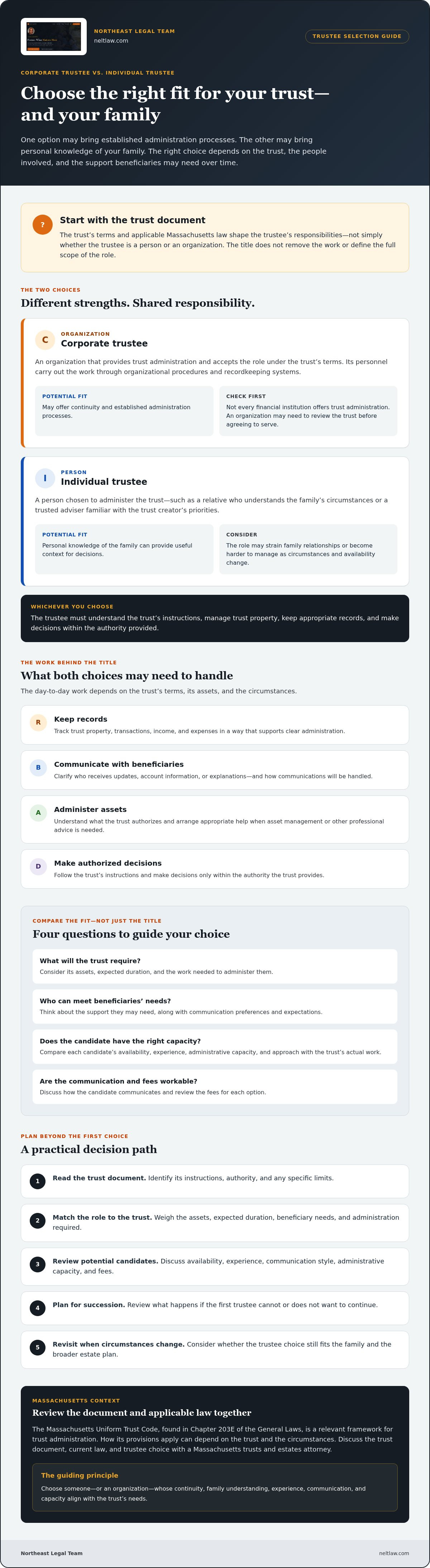
How to Choose a Trustee: A Practical Decision Checklist
Start with the work the trust requires, then determine whether a person or organization is ready to take it on. Use this sequence to narrow your options and identify questions to resolve before naming someone.
- Review the trust. Identify its purpose, instructions, limits on trustee authority, and any existing successor provisions. If wording is unclear, flag it for legal review rather than relying on assumptions.
- Assess the trust’s demands. Consider its assets, how complex they may be to administer, how long the trust could continue, and what beneficiaries may need. Think about how often and in what way they’ll want information.
- Compare candidates. Ask whether each person or organization is willing, available, and equipped for the expected work. Consider relevant experience, possible conflicts, communication style, and the time needed to keep records and respond to beneficiaries.
- Discuss succession. Decide what the trust says should happen if the first choice can’t or won’t continue. Review whether the named backup is willing and whether the transition process is clear.
Questions to ask before naming a trustee
Would this candidate understand the trust’s purpose and follow its terms? Can they manage the expected recordkeeping and communicate respectfully with beneficiaries, even if questions or disagreements arise? Are there personal, financial, or family conflicts to consider? Ask directly about willingness and future availability. A candidate who agrees today may not be able to serve throughout a trust that lasts for years.
Clarify who would coordinate professional advice if the trust’s assets or decisions call for added expertise. Don’t assume a corporate trustee accepts every kind of asset or that an individual has unlimited time to manage it. The corporate trustee vs individual trustee decision should reflect the trust’s actual needs, not simply a preference for an institution or a familiar face.
How should business or complex assets affect the choice?
List assets that may require specialized attention, such as an ownership interest in a closely held business. Confirm that a proposed trustee has relevant experience or can coordinate with qualified advisers, and ask any corporate trustee directly whether it accepts and administers that type of asset. If business interests are part of the trust, consider how the trustee’s role would fit with business partners and the broader transition plan. Our guide to business succession planning in Massachusetts offers related planning context.
Trustee selection is one part of a broader estate plan. For another planning perspective, see this Massachusetts estate planning attorney flat-fee guide. To discuss how a trustee choice fits your trust and family circumstances, talk with an estate planning attorney.
Make Your Trustee Choice Part of a Clear Massachusetts Estate Plan
A trustee choice works best when it fits the trust’s purpose, terms, assets, and intended beneficiaries. A person who understands your family may be a strong candidate, while an organization may suit a trust that calls for ongoing administration. Neither choice guarantees a particular result. The goal is to name someone prepared to carry out the trust and make the arrangement clear within your broader Massachusetts estate plan.
What should a trustee discussion with an attorney cover?
Bring the current trust document, a useful overview of its assets, and your questions about the proposed trustee. Ask how the document addresses decision-making, administration, and successor trustees. Review each provision rather than assuming a standard rule applies. Share relevant family tensions, special circumstances, or business interests, too. Those details may affect how the trust works in practice and what qualities matter in a trustee.
An attorney can help explain the document’s language and identify Massachusetts-specific questions to address. Legal guidance can support your decision, but it can’t promise a particular outcome or replace your priorities. The final choice should reflect the people involved and the responsibilities the trust creates.
When is it time to review an existing trustee choice?
Consider reviewing the named trustee and succession provisions after a major change in family relationships, finances, health, or business interests. A person who was once available may no longer be able to serve, or the trust’s assets and needs may have changed. Ask an attorney whether the document sets out a process for resignation, replacement, or succession. Changing a trustee isn’t always simple; the trust’s terms and applicable law matter.
Reviewing your plan doesn’t mean you need to start over. It can help you confirm whether your current trustee and backup still fit your wishes and beneficiaries’ needs. If you’re weighing the corporate trustee vs individual trustee options or want help reviewing your trust, you can request a free estate planning consultation with Northeast Legal Team.
Choose a Trustee With Your Family’s Future in Mind
The choice isn’t determined by whether the trustee is an organization or someone you know. In the corporate trustee vs individual trustee decision, weigh the trust’s terms and assets alongside continuity, the candidate’s capacity, and the way your beneficiaries need to communicate. A familiar person may understand family context, while an organization may offer established administration processes. Verify the fit rather than assuming either option is right.
Trustee selection also belongs within your broader estate plan. Review the trust and its successor provisions when family, financial, health, or business circumstances change. If you’re uncertain how the document addresses trustee authority or succession, a Massachusetts estate planning attorney can help you understand the options without taking the decision out of your hands. This can be especially useful for families in Middlesex County and Worcester County who want to consider trustee arrangements as part of their Massachusetts estate plans.
Northeast Legal Team provides living trust and estate planning services, including wills, trusts, powers of attorney, and healthcare directives. If you’d like to talk through your trustee options and broader plan, schedule a free estate planning consultation.
Frequently Asked Questions
What is the difference between a corporate trustee and an individual trustee?
A corporate trustee is an organization that administers a trust through its personnel and processes. An individual trustee is a person appointed to do that work. Either may be responsible for managing assets, following the trust’s terms, keeping records, and communicating with beneficiaries. When comparing a corporate trustee vs individual trustee, consider each candidate’s capacity, continuity, and fit with the trust rather than assuming one type is always better.
Is a corporate trustee better than a family member?
Not necessarily. A family member may understand the grantor’s wishes and family context, while an organization may have administrative systems and staff. Neither is automatically more reliable or a better fit. Consider the trust’s length and complexity, the proposed trustee’s willingness and availability, and how beneficiaries may respond to the appointment. Ask any organization about its services and acceptance requirements, and discuss potential family tensions before choosing a relative.
Can an individual trustee be paid for serving?
Yes. The trust document may specify whether and how an individual trustee is compensated. If it doesn’t address compensation, Massachusetts General Laws chapter 203E, section 708 provides for compensation that is reasonable under the circumstances. A family member may choose to waive compensation, but shouldn’t assume the role requires no time or effort. Review the trust’s terms and clarify how compensation and expenses will be handled with a Massachusetts attorney.
Can a corporate trustee and an individual serve together?
They may be able to serve as co-trustees if the trust document and applicable law allow that arrangement. Review how the document addresses co-trustee decisions, division of responsibilities, beneficiary communications, and disagreements. Before naming both, confirm that each candidate is willing and understand how the arrangement would work in practice. An attorney can help assess whether the trust’s language supports the proposed structure.
What happens if an individual trustee can no longer serve?
Start by checking the trust document for a named successor and instructions for a trustee’s resignation, replacement, or inability to act. The next step depends on those terms and applicable Massachusetts law, so don’t assume a family member can simply take over. If no successor is named or the instructions are unclear, consult a Massachusetts trusts and estates attorney about how to proceed and protect the trust’s ongoing administration.
How do I choose a trustee for a trust in Massachusetts?
Review the trust’s purpose and terms, then consider its assets, expected duration, and beneficiaries’ needs. Compare candidates for willingness, availability, relevant experience, recordkeeping ability, communication style, and potential conflicts. If you live in Middlesex County or Worcester County, Massachusetts, a local estate planning attorney can help you consider how the document and Massachusetts law apply to your circumstances. Choose a trustee who fits the trust, not just your personal preference.
Does a corporate trustee charge fees?
Typically, yes, though charges vary by organization and trust. SimplyTrust Estate Planning’s March 2026 overview reports that corporate trustee fees in Massachusetts commonly range from 1% to 2% of trust assets annually, with minimums that may be $3,000 to $10,000 or more. These are reported typical ranges, not a quote. Ask the organization to explain its fee schedule, minimums, included services, and additional charges before making a decision.


