

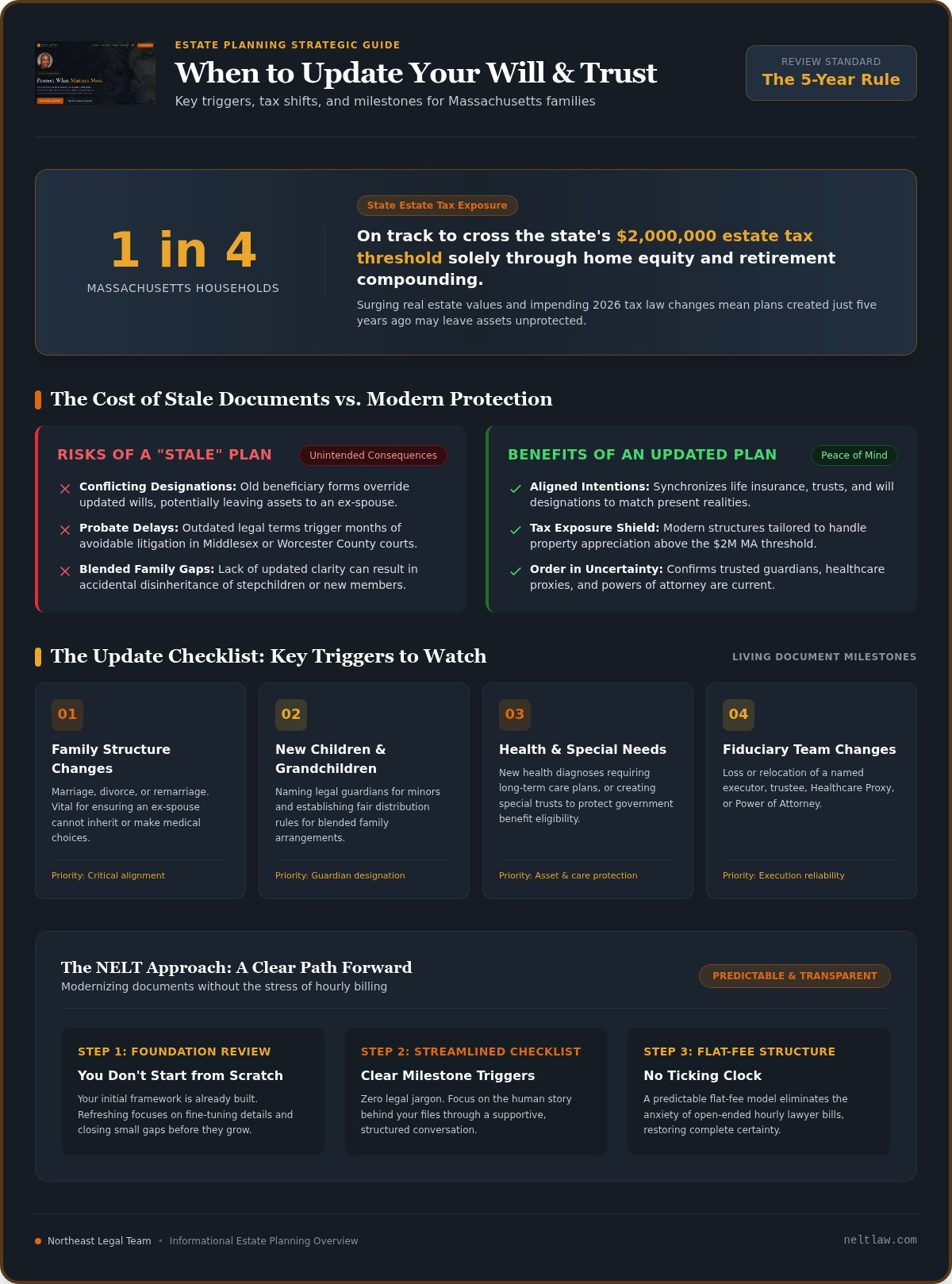
Did you know that roughly one in four Massachusetts households is now on track to cross the state's $2,000,000 estate tax threshold just through home equity and retirement compounding? It's a startling figure that leaves many local families vulnerable to unexpected taxes and avoidable legal hurdles. You might feel like your estate plan is a "one-time transaction," but knowing when to update your will and trust is the difference between a lasting legacy and a stressful burden for your loved ones. Life moves fast. A plan that worked five years ago might not offer the protection you need in 2026.
It's completely normal to feel a bit of hesitation about revisiting these documents, especially if you're worried about confusing tax laws or high hourly fees. You deserve to feel certain that your assets are safe without the "ticking clock" of a lawyer's bill hanging over your head. We've created this guide to show you exactly which life milestones and legal changes require action. You'll get a clear checklist of triggers for an update and a look at how a simple, flat-fee process can modernize your plan and restore your peace of mind.
Key Takeaways
- Understand why your estate plan is a living document and how outdated instructions can lead to unintended probate delays for your family.
- Identify the specific family milestones, such as welcoming new grandchildren or changes in marital status, that signal exactly when to update your will and trust.
- Learn how surging Massachusetts real estate values and the 2026 tax law changes could leave your assets exposed if your plan isn't refreshed.
- Explore the "five-year rule" for professional reviews to ensure your legacy remains protected against shifting state and federal regulations.
- Discover a predictable, flat-fee path to modernize your documents and replace legal anxiety with lasting peace of mind.
Why Your Estate Plan Needs Regular Maintenance
Think of your estate plan as a snapshot of your life on the day you signed it. It captured your family structure, your financial goals, and your deepest wishes at that specific moment. However, life in Massachusetts moves quickly. Families grow, assets change, and tax laws evolve. If your documents haven't moved with you, they can become a source of confusion rather than a shield of protection. Understanding when to update your will and trust is about ensuring that your legal "photograph" always reflects the reality of your life today.
When legal documents sit on a shelf for a decade, they become "stale." This isn't just a matter of old dates; it's a matter of functional utility. A stale plan often fails to account for the complexities of modern life, leading to unnecessary delays in the probate courts of Middlesex or Worcester counties. By choosing a path of proactive stewardship, you can replace the nagging worry of "what if" with a genuine sigh of relief. You aren't just managing paperwork. You're securing your family's future peace of mind.
The Risk of Inaction
One of the most common pitfalls involves outdated beneficiary designations. These legal instructions are powerful; they often override whatever you've written in your current will. If an ex-spouse or a deceased relative is still listed on an old trust or life insurance policy, your assets may not end up where you intended. This is particularly sensitive for blended families, where a lack of clarity can lead to the unintended disinheritance of stepchildren or new family members.
Stale documents are outdated legal instruments that no longer align with your family's current needs or state laws, frequently triggering months of avoidable litigation and gridlock during the probate process. Without a regular review, you might accidentally leave your loved ones with a puzzle they can't solve. For a broader look at how these tools function together, you can read this overview of estate planning to see why coordination is so vital.
A Reassuring Path Forward
The good news is that refreshing your plan is much simpler than creating it from scratch. You've already built the foundation. Now, it's just about fine-tuning the details. Working with a compassionate mentor helps you identify the small gaps before they become large problems. At Northeast Legal Team, we use a streamlined checklist to help families determine when to update your will and trust without the stress of complicated legal jargon. We focus on the human story behind your files, making the update process feel like a supportive conversation rather than a clinical chore.
Major Life Milestones: The Family Update Checklist
Life events are the most common signals for when to update your will and trust. Marriage is a joyful new beginning, but it requires legal alignment to ensure your spouse is properly protected. Conversely, divorce is a critical time to review your documents. In many cases, an ex-spouse might still be legally entitled to inherit your assets or make medical decisions for you if you don't proactively change your designations. Taking a moment to refresh these details ensures your plan matches your current life story.
The loss of a loved one who was named as an executor or trustee also creates an immediate need for a review. If your "first choice" is no longer able to serve, your plan could stall just when your family needs it most. Similarly, a significant health diagnosis for yourself or a family member might require a shift toward long-term care or special needs planning. These moments are emotionally heavy, but updating your plan provides a sense of order and security during uncertain times.
Protecting the Next Generation
Welcoming children or grandchildren into the family is a beautiful reason to refresh your legacy. For young parents, naming guardians is the most critical update you can make; it's the only way to ensure your children are cared for by the people you trust most. If you're part of a blended family, a thoughtful update can help you balance the needs of your current spouse and children from a previous relationship fairly. For those with a loved one who has special needs, establishing a specific trust is essential to protect their inheritance without jeopardizing their eligibility for vital government benefits.
Selecting Your Protective Team
Your estate plan is only as strong as the people you choose to lead it. It's wise to review your Healthcare Proxy and Power of Attorney choices every few years. People move, life circumstances change, and someone who was a perfect fit five years ago might no longer be able to take on the responsibility. Following IRS estate and gift tax guidance, staying current with federal regulations ensures your team has the right tools to manage your assets efficiently as tax thresholds shift.
A living will attorney can help you refine your medical directives to reflect your current wishes, providing clarity for your doctors and family. If your primary Trustee has retired or moved out of state, naming a successor ensures your plan remains functional. If you're wondering if your current team is still the best fit for your goals, you can request a free assessment to discuss your options with a supportive advocate.
Financial Shifts and Massachusetts Property Changes
Financial growth is a positive milestone, but it often changes the math of your estate. In Massachusetts, the state-level estate tax threshold remains a critical factor for local families. If your gross estate, which includes your home equity, retirement accounts, and life insurance payouts, exceeds $2,000,000, your heirs could face a significant tax bill. For homeowners in Middlesex and Worcester counties, surging property values mean reaching this limit is more common than you might think. Consulting the Massachusetts Estate Tax Guide can help you understand how these credits are calculated and applied. Knowing when to update your will and trust becomes essential as your net worth climbs toward or beyond this mark.
Receiving an inheritance or a sudden windfall also requires a strategy refresh. These new assets need to be integrated into your existing plan to ensure they're protected from creditors or unnecessary taxes. Similarly, buying or selling real estate is a major trigger for an update. If you move from a starter home to a larger property, the deed must be updated to reflect your trust's ownership. This simple step ensures the property bypasses probate and benefits from the updated $1,000,000 Homestead Act protection currently available to Massachusetts homeowners. Life moves fast. Your plan should keep pace.
Funding Your Living Trust
A common mistake many families make is creating a trust but failing to "fund" it properly. This results in an "empty trust" that holds no actual assets. When you acquire new bank accounts, investments, or real estate, they must be titled in the name of your trust. If these assets remain in your individual name, they may still be subject to the probate process you worked so hard to avoid. Working with an estate planning attorney flat fee model ensures you can get the help you need to align your assets without worrying about hourly billing for every deed update or phone call.
Business and Professional Updates
If you own a company, your estate plan must account for your professional legacy as well as your personal one. Starting, selling, or preparing to retire from a business are all clear signals for a review. You need to ensure a smooth transition of leadership and protect your practice from personal liability. For a deeper look at these specific strategies, exploring business succession planning in Massachusetts can provide the clarity needed to secure your company's future. Proactive planning keeps your business running smoothly even during difficult life transitions.
Legal and Regulatory Triggers: Why 2026 is Different
Even if your family life hasn't changed, the rules governing your assets might have. We often recommend the "Five-Year Rule" for our clients in Burlington and across the Commonwealth. This means scheduling a professional review every five years to ensure your documents still comply with the latest court preferences and legislative shifts. It's a simple way to practice proactive stewardship rather than waiting for a crisis. Knowing when to update your will and trust involves staying aware of these regulatory shifts, especially if you've recently moved to Massachusetts from another state. Our local probate laws and the $2,000,000 estate tax threshold are unique; a will drafted in Florida or California may not provide the specific protections your family needs here.
The 2026 Tax Landscape
The passage of the One Big Beautiful Bill Act in 2025 provided some stability by locking the federal exemption at $15,000,000, but 2026 brings other significant hurdles. New IRS regulations effective this year have changed the way retirement accounts, such as IRAs, must be distributed to your heirs. If your trust was written before these rules were finalized, your children could be forced to pay much higher taxes on their inheritance than you intended. In plain English, the 2026 tax landscape acts as a reset for retirement planning, requiring most families to adjust their trust language to avoid pushing their heirs into the highest possible tax brackets.
A "wait and see" strategy is particularly risky for families near the state tax threshold. With surging home values in Middlesex County, more households are finding themselves in taxable territory. Taking action now allows you to utilize state-specific planning tools that can save your heirs tens of thousands of dollars in avoidable costs.
Modernizing Your Documents
Modern estate planning also requires a shift into the digital world. Your plan should now include clear instructions for digital assets like cryptocurrency, social media accounts, and online financial portals. Without these updates, your family could be locked out of important accounts or lose access to digital legacies during a crisis. We also focus on ensuring your Medicaid asset protection trust meets the specific 2026 standards for long-term care planning in Massachusetts. By moving from a paper-only mindset to a digital-ready plan, you ensure your legacy is accessible and protected in the modern age.
If it's been more than five years since you last signed your documents, now is the perfect time to schedule a legal review with Northeast Legal Team to ensure your family remains safe.
The NELT Approach: Simple, Flat-Fee Updates
The decision of exactly when to update your will and trust shouldn't be weighed down by the fear of open-ended legal bills. At Northeast Legal Team, we believe that protecting your family is a fundamental necessity, not a luxury reserved for those who can afford hourly surprises. Our flat-fee model is designed to remove the "ticking clock" from our conversations. This allows us to focus entirely on your story, your worries, and your goals. By providing localized support specifically for residents of Middlesex and Worcester counties, we ensure your plan is tailored to the specific nuances of our local probate courts. We transform what often feels like a heavy legal chore into a profound sense of completion and safety.
Many families hesitate to call a lawyer because they don't want to be "sold" something they don't need. We've built our practice on the opposite idea. If your current plan is still solid and protective, we'll tell you. Our goal is to be a steady hand and a supportive ally, helping you move from a state of concern to a state of resolution. When you have a clear, modern plan in place, you can stop worrying about the "what ifs" and get back to enjoying the life you've built.
Your Free Estate Plan Assessment
Starting the process is as simple as a conversation. We offer a free initial assessment to help you identify exactly when to update your will and trust based on your specific situation. During this review, we look at your existing documents through the lens of current 2026 regulations and your modern family dynamics. We call this identifying "legal landmines," those small gaps in language or outdated beneficiary choices that could cause big problems later. David E. Walker and his team follow a "listen-first" philosophy. We want to understand the human side of your estate before we ever look at the technical side. There's no obligation to move forward; our goal is simply to provide the clarity you need to make an informed decision for your loved ones.
Next Steps to Security
If we find that your plan needs a refresh, our process for executing updates is streamlined and transparent. We handle the heavy lifting of drafting and deed retitling, so you don't have to worry about the logistics. If you're currently dealing with the loss of a loved one whose plan wasn't updated in time, we also provide support as a flat fee probate attorney. This ensures your family has predictable support during a difficult transition. Whether you're looking to prevent future chaos or need help resolving a current estate issue, we're here to act as your protective advocate. Don't leave your legacy to chance or outdated laws. Schedule your free estate plan assessment today.
Take the Next Step Toward Lasting Security
Your estate plan is more than just a set of legal documents; it's a promise to the people you love most. By staying mindful of when to update your will and trust, you ensure that promise remains strong through every life change and regulatory shift. Whether you've recently welcomed a new grandchild, crossed the Massachusetts $2,000,000 estate tax threshold, or simply realized it's been five years since your last review, taking action today prevents future chaos. Refreshing your plan is a gift of clarity for your heirs.
Northeast Legal Team brings over 14 years of local experience to every consultation. We've replaced the stress of hourly billing with a transparent, flat-fee pricing model for all updates. This allows you to focus on your family's needs without worrying about a ticking clock. We provide compassionate, plain-English guidance to ensure you feel confident in every decision you make.
Secure your family’s future with a free estate plan assessment at Northeast Legal Team.
You've worked hard to build your legacy. Let's work together to make sure it's protected with a plan that truly reflects your life today. We are here to help you find peace of mind.
Frequently Asked Questions
How often should I realistically review my will and trust?
You should realistically review your estate plan every three to five years or immediately after a major life milestone. This "Five-Year Rule" ensures your documents stay aligned with current Massachusetts laws and your family's evolving needs. Regular check-ins prevent your plan from becoming a "stale" snapshot of a life you no longer live. By staying proactive, you can identify small gaps before they turn into complex legal hurdles for your loved ones.
Do I need to update my will if I move to Massachusetts from another state?
Yes, you definitely need a local review if you move to Massachusetts from another state. While your out-of-state will might be technically valid, it won't account for our unique $2,000,000 estate tax threshold or specific Homestead Act protections. Moving to Middlesex or Worcester County means your plan needs to speak the "legal language" of our local probate courts. A quick update ensures your legacy remains protected under the specific statutes of the Commonwealth.
Can I just write changes on my existing will by hand?
You should never write changes on your existing will by hand. In Massachusetts, handwritten alterations can lead to the entire document being challenged or invalidated in probate court. These "home-made" updates often cause confusion and family conflict during an already difficult time. To ensure your wishes are legally binding, any changes must be executed with the same formal requirements as the original document, including proper witnessing and notarization.
What happens if I forget to update my trust after buying a new house?
If you forget to update your trust after buying a new house, that property will likely be forced through the probate process. This is a common mistake known as an "empty trust." For your new home in Middlesex County to be protected, the deed must be retitled in the name of your trust. Taking this simple step ensures the property bypasses the court system and remains under the protection of your established estate plan.
Is a codicil better than writing a completely new will?
A completely new will is generally safer and clearer than a codicil. While a codicil is a legal amendment to an existing will, having multiple documents can create confusion or lead to lost pages. In 2026, most families find that a fresh document is the best way to ensure there is no ambiguity. This approach provides a clean slate and a "sigh of relief" that your instructions are easy for your executor to follow.
How much does it typically cost to update an estate plan in MA?
The cost of an update varies based on the complexity of your family's needs and the number of assets involved. Northeast Legal Team uses a flat-fee pricing model to provide total transparency and remove the worry of hourly billing. This means you'll know exactly what to expect before we begin any work. We focus on providing predictable, plain-English guidance so you can make decisions based on your family's safety rather than a ticking clock.
Do I need to update my plan if my children are now adults?
You should absolutely review your plan once your children reach adulthood. While you no longer need to name guardians for them, you may want to update their inheritance structures to include asset protection or special needs planning. This is also a perfect time to consider when to update your will and trust to name your adult children as successor trustees or healthcare proxies if they are now ready for those responsibilities.
Can a flat-fee attorney help me if my trust was originally drafted by someone else?
Yes, a flat-fee attorney can certainly help you even if your trust was originally drafted by a different firm or an online service. We frequently review existing documents to identify "legal landmines" and ensure they meet current 2026 standards. Whether your original plan was signed ten years ago or in another state, our team can help you modernize your protections and secure your family's future with a supportive, listen-first approach.


