

What if the hardest part of losing a loved one wasn't the grief, but the sudden weight of legal responsibility on your shoulders? If you've been named an executor in Massachusetts, you're likely feeling the pressure of the Massachusetts Uniform Probate Code (MUPC) and the fear of making a costly mistake. Partnering with a compassionate probate administration lawyer can transform this overwhelming burden into a structured, manageable path. You shouldn't have to worry about personal liability or family disputes while you're still mourning.
We know that the thought of hourly legal fees draining your family’s inheritance only adds to your anxiety. It's a common worry, but it doesn't have to be your reality. This article provides a clear roadmap of the probate timeline and explains how to protect the estate from creditor claims. You'll discover how a predictable flat-fee model offers the certainty you need in 2026, ensuring that your legal costs are transparent from the very start. Let’s move from a state of worry toward a place of order and peace of mind together.
Key Takeaways
- Understand the step-by-step requirements of the Massachusetts probate process, from filing the initial petition to receiving your official Letters of Authority.
- Learn why partnering with a probate administration lawyer who offers flat-fee pricing eliminates the stress of unpredictable hourly billing while protecting estate assets.
- Gain insights into the specific procedural nuances of the Middlesex and Worcester Probate and Family Courts to ensure your filings move forward without unnecessary delays.
- Discover how to shield yourself from personal liability and manage creditor claims effectively while fulfilling your duties as a Personal Representative.
- Explore how a compassionate, "listen-first" legal approach provides the steady hand needed to navigate complex family dynamics and legal hurdles with confidence.
What is Probate Administration and Why is a Lawyer Necessary?
Probate is often described as a cold legal hurdle, but at its heart, it's a journey of stewardship. The probate administration process is the court-supervised system used to validate a person's will, pay their final debts, and distribute what remains to their heirs. In Massachusetts, this is governed by the Massachusetts Uniform Probate Code (MUPC). While the law is designed to create order, the rules are strict. Even a small clerical error can lead to rejected filings or months of delay. Working with an experienced probate administration lawyer ensures these technical details are handled correctly, protecting you from unnecessary stress and legal friction.
The Vital Role of the Personal Representative
If you've been named a "Personal Representative," you might recognize the older term, "Executor." Massachusetts updated this language to reflect the broad responsibility you now hold. You have a fiduciary duty, which is a high legal standard requiring you to act in the best interests of the heirs and creditors. It's a heavy mantle to wear, especially while you're still mourning. Many people try to handle this alone to save money, but DIY probate often leads to personal liability if a creditor isn't paid or an heir feels slighted. You don't have to carry this legal burden by yourself. A probate administration lawyer acts as your steady hand, guiding you through every signature and deadline while keeping the family peace.
When is Probate Required in Massachusetts?
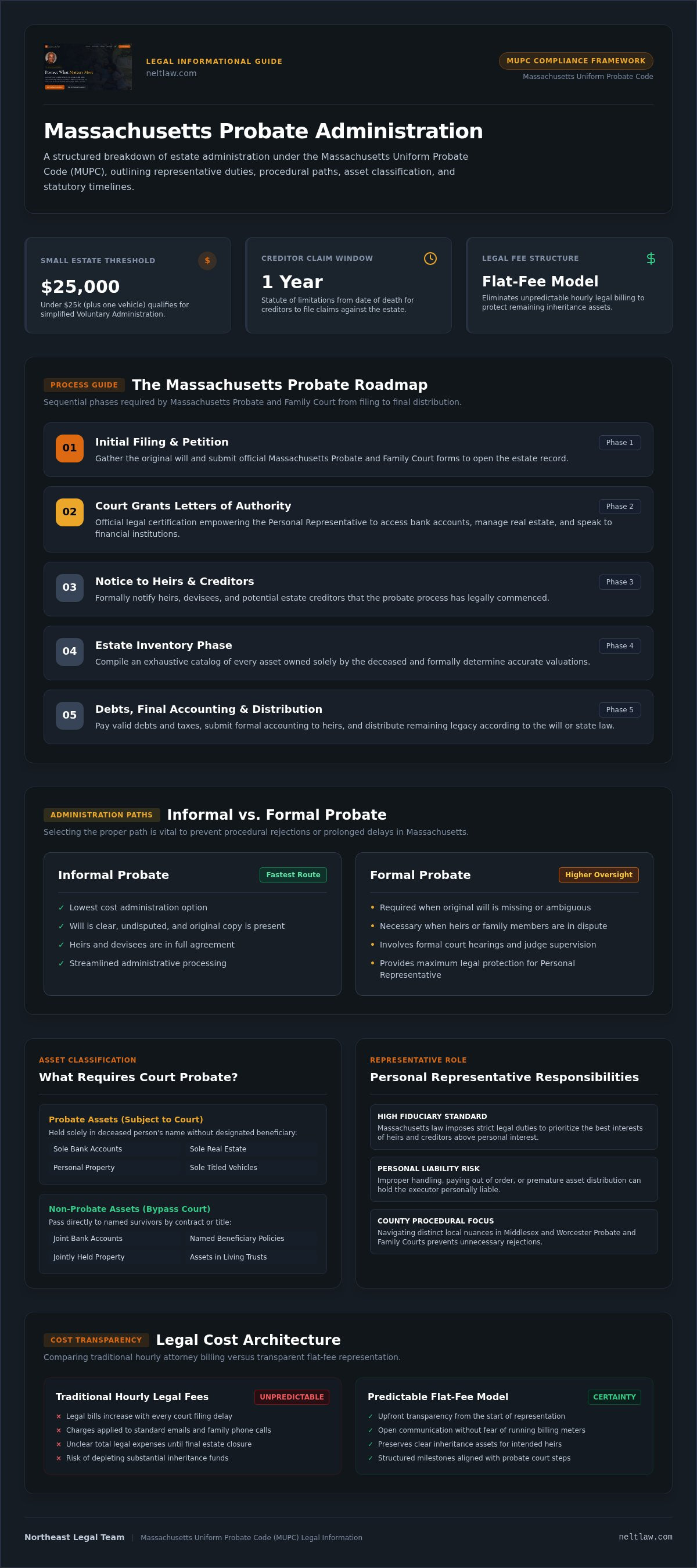
Not every piece of property needs to go through court. Probate is generally required for "probate assets," which are items held solely in the deceased person's name without a designated beneficiary. This includes individual bank accounts, real estate without a joint owner, or personal belongings. In contrast, "non-probate assets" like joint bank accounts or life insurance policies with named beneficiaries usually pass directly to the survivors. If the total value of the estate is under $25,000 (plus one vehicle), Massachusetts offers a simplified "voluntary administration" process. However, for larger estates, the process is more involved. Many families find that living trusts would have allowed them to avoid this entirely, but if you're already in the middle of it, we're here to help you find the simplest path forward.
The Massachusetts Probate Process: A Step-by-Step Roadmap
Settling an estate isn't a single event. It's a series of deliberate milestones that ensure a loved one's final wishes are honored correctly. The process begins with gathering the original will and submitting the correct Massachusetts Probate and Family Court official forms to the court. This initial filing signals the start of your legal journey. Once the court reviews your petition, you'll receive your Letters of Authority. This document is your legal passport; it allows you to access bank accounts, sell real estate, and speak with financial institutions on behalf of the estate.
After you have the authority to act, your focus shifts to transparency and organization. You'll need to notify heirs, devisees, and potential creditors that the probate process has begun. Next comes the inventory phase, where you'll list every asset the deceased owned and determine its value. Finally, after all valid debts are paid and taxes are settled, you'll provide a final accounting to the heirs and distribute the remaining legacy. If you feel unsure about these timelines, reaching out to the Northeast Legal Team can help you move forward with certainty.
Formal vs. Informal Probate: Which Path is Right?
Massachusetts offers two primary paths for administration. Informal probate is typically the fastest and least expensive route. It's designed for estates where the will is clear, the heirs are in agreement, and no major disputes are expected. However, if a will is missing or family members are at odds, a probate administration lawyer will likely recommend formal probate. This path involves more court oversight and provides a higher level of protection for you as the Personal Representative. Choosing the wrong path can lead to months of wasted time, so getting it right the first time is vital.
Handling Creditors and the One-Year Rule
One of the most stressful parts of probate is dealing with debt. In Massachusetts, creditors have a one-year statute of limitations from the date of death to file a claim against the estate. This is a critical window to monitor. Distributing assets to heirs too early can be a costly mistake; if a valid creditor emerges later, you might be held personally liable for that debt. A probate administration lawyer ensures that professional notice is given to all potential claimants, allowing you to wait out this period safely. This protective step ensures that when the legacy is finally shared, it stays in the family.
Flat-Fee vs. Hourly Legal Fees: Understanding the Cost
One of the biggest sources of stress for a Personal Representative is the financial uncertainty of the legal process. Traditional law firms often use hourly billing, which can create a sense of "billable minute" anxiety every time you pick up the phone. When you're trying to understand how probate works and what to expect, you shouldn't have to worry about the cost of asking a simple question. This traditional model often places the lawyer's interest in conflict with yours; the longer the process takes, the more they earn. It's a system that rewards complexity rather than resolution.
Choosing a flat-fee probate attorney Massachusetts families trust changes that dynamic completely. With a flat-fee model, our goals are perfectly aligned with yours: we want the process to be as efficient and smooth as possible. You receive total clarity from the start, knowing exactly what the legal investment will be regardless of how many emails are exchanged or forms are filed. This approach allows us to focus on the human story behind the file rather than the clock. A typical probate administration lawyer using this model includes:
- Preparation and filing of all court petitions and required forms.
- Guidance on inventorying and valuing various estate assets.
- Assistance with required legal notices to heirs, devisees, and creditors.
- Preparation of final accounting documents to facilitate the distribution of assets.
The Hidden Costs of "Cheap" Legal Help
Some firms offer what looks like a low-cost initial quote, only for the price to balloon later with "extra" hourly charges for every phone call or minor court delay. This bait-and-switch approach makes it impossible to budget for the estate's needs accurately. We believe you deserve unlimited access to your attorney without a running clock in the background. Flat-fee probate is a way to preserve the estate’s value for heirs. It ensures that more of your loved one's legacy stays with the family rather than being consumed by unpredictable legal fees that no one saw coming.
Predictability for the Personal Representative
As the person in charge of the estate, you're responsible for the final accounting and answering to the heirs. Knowing the exact legal cost upfront is essential for this task; it allows you to provide clear, honest answers to other family members about the estate's finances. This transparency reduces friction and prevents the disputes that often arise when legal bills are high and unexplained. Northeast Legal Team prioritizes this transparency for every client, ensuring you feel safe and supported throughout the entire journey. You can focus on your family's healing while we handle the legal mechanics for a single, agreed-upon price.
Navigating Probate in Middlesex and Worcester Counties
While the Massachusetts Uniform Probate Code provides a statewide framework, the actual experience of filing paperwork can vary significantly between counties. If you're dealing with the Middlesex Probate and Family Court, you're interacting with one of the busiest court systems in the Commonwealth. Each registrar's office has its own specific preferences for how documents are organized and submitted. A probate administration lawyer who frequently works in these specific hallways knows these unwritten rules. This local familiarity prevents the common back-and-forth that happens when a clerk rejects a filing for a minor formatting issue, saving your family weeks of unnecessary waiting.
Worcester County has its own unique dynamics. The court staff there values precision and adheres strictly to local standing orders, which are specific rules issued by the court to manage its caseload. A local probate administration lawyer stays updated on these orders, ensuring your case doesn't get stuck in a backlog. Whether you're dealing with a complex estate in Shrewsbury or a simple filing in Worcester, having someone who knows the local registrars by name provides a level of reassurance that out-of-town firms simply can't match. They understand the local rhythm and can anticipate the needs of the court before they become obstacles.
Filing in the Right Jurisdiction
Determining exactly where to file is your first logistical hurdle. Jurisdiction is based on where the deceased person had their primary residence at the time of their death. In Middlesex County, the system is split to better serve the large population. Middlesex South cases are typically handled in Cambridge, while Middlesex North cases go to the courthouse in Lowell. If your loved one lived in Worcester County, you'll likely be heading to the main probate location on Main Street in Worcester. Getting this right from day one is essential; filing in the wrong location results in an immediate dismissal of your petition and a loss of your filing fees.
The Local Legal Partner Advantage
The logistics of gathering death certificates, original wills, and asset valuations are much simpler when your legal team is just down the road. Searching for estate planning law firms near me isn't just about convenience; it's about finding a partner who understands the local landscape. David E. Walker, Esq. has spent over 14 years helping families in these specific communities, building a reputation for clarity and reliability. We act as your local guide, ensuring your documents meet every standing order and local requirement. If you're feeling overwhelmed by court locations and filing deadlines, contact Northeast Legal Team today for a free probate assessment to find your way forward.
How Northeast Legal Team Simplifies Your Probate Journey
At Northeast Legal Team, we believe that being a probate administration lawyer is about more than just filing forms; it's about providing a steady hand when life feels uncertain. David E. Walker, Esq. has spent over 14 years helping Massachusetts families move through the probate process with dignity and clarity. We've seen firsthand how a little compassion can lower the defensive barriers that often arise during these sensitive times. Our philosophy is simple: we listen first and plan second. This ensures that the legal strategy we build is rooted in your family's unique story and long-term well-being.
We've stripped away the intimidating jargon that usually fills law offices. By using plain English, we ensure you feel empowered and in control of every decision. Our goal is to transform a potentially overwhelming journey into a series of manageable, safe steps that prioritize family peace above all else.
Starting with a Free Probate Assessment
Your journey begins with a conversation, not a bill. During your free probate assessment, we'll take the time to understand the specifics of the estate and your current concerns. To make this first meeting as productive as possible, it's helpful to gather a few key items: the original will (if one exists), a certified copy of the death certificate, and a general list of the deceased person’s known assets and debts. After evaluating these details, we provide a clear, predictable flat-fee quote. You'll leave this meeting with a roadmap and a firm understanding of the legal costs, allowing you to move forward without the fear of the "hourly surprises" we discussed earlier.
Your Legacy, Our Priority
Our mission as your probate administration lawyer is to provide more than just legal services; we provide peace of mind. We understand that you're protecting a legacy that took a lifetime to build. By acting as your protective advocate, we help you transition from the initial chaos of loss into a state of order and tranquility. We're here to ensure that your family continuity remains intact and that the distribution of assets is handled with the respect it deserves. If you're ready to lower the legal burden and focus on your family's healing, we're here to guide you every step of the way.
Schedule your free probate assessment today to begin your journey toward resolution.
Moving Toward Order and Resolution
Honoring a loved one’s legacy shouldn't feel like a legal battle. You've learned that the Massachusetts probate process, while detailed, becomes manageable with a clear roadmap and the right support. By choosing a predictable flat-fee model, you protect the estate’s assets and eliminate the anxiety of hourly surprises. Whether your case sits in the Middlesex or Worcester Probate and Family Court, local expertise ensures your filings meet every specific requirement without unnecessary delays. Partnering with an experienced probate administration lawyer allows you to step out of the legal confusion and back into your role as a supportive family member.
With over 14 years of dedicated experience in Massachusetts estate law, David E. Walker, Esq. provides the compassionate, mentor-led guidance your family deserves during this difficult season. You don't have to carry this weight alone. We're here to help you move from chaos to a place of tranquility and certainty. Ease the burden of probate with a Free Estate Assessment from Northeast Legal Team. You've taken the first step by educating yourself; now, let us help you finish the journey with confidence.
Frequently Asked Questions
How long does the probate process typically take in Massachusetts?
In Massachusetts, the probate process generally takes between nine months and one year at a minimum. This timeline is largely dictated by the one-year statute of limitations for creditors to file claims against the estate. While informal probate can often be completed more quickly, more complex estates or those involving family disputes can stretch well beyond a year. Your probate administration lawyer will help you manage these deadlines to ensure the final distribution happens as efficiently as possible.
Can I be held personally liable for the estate’s debts as a Personal Representative?
Yes, a Personal Representative can be held personally liable if they fail to follow the correct legal procedures. This most often happens if you distribute assets to heirs before the one-year creditor claim period has expired or if you fail to pay valid debts and taxes. By working with a probate administration lawyer, you receive the protective guidance needed to fulfill your fiduciary duties. This ensures you aren't left on the hook for the estate's financial obligations.
What is the difference between formal and informal probate administration?
Informal probate is a simplified administrative process designed for estates where there is a clear will and no expected family conflict. It is generally faster and requires less court involvement. Formal probate is a judicial process involving court hearings and is required if there are disputes, missing heirs, or if an original will cannot be found. Choosing the right path depends on your specific family dynamics and the clarity of the estate’s legal documents.
Do all assets have to go through probate in Middlesex County?
No, only assets held solely in the deceased person's name must go through probate in Middlesex County. Assets such as joint bank accounts, life insurance policies with named beneficiaries, and property held in a living trust pass directly to the survivors outside of the court system. We often help families distinguish between these categories during our initial assessment. This clarity helps you understand exactly which parts of the legacy require court supervision and which do not.
How much does a probate administration lawyer cost in MA?
The cost varies depending on the firm’s billing model. Many traditional firms charge hourly rates, which can lead to unpredictable total costs and "billable minute" anxiety for the family. At Northeast Legal Team, we provide transparent flat-fee pricing for our probate services. This means you'll know the exact legal investment upfront after we evaluate the estate's complexity. This model aligns our goals with yours, focusing on efficiency and family peace rather than the clock.
What happens if a family member contests the will during administration?
If a family member contests the will, the case typically moves into the formal probate process to allow a judge to resolve the dispute. This can lead to delays and increased legal costs as the court examines the validity of the document or the decedent’s state of mind when it was signed. Our role is to act as a steady hand during these high-pressure moments, focusing on mediation and clear communication to protect the estate and minimize family friction.
What are "Letters of Authority" and why do I need them?
Letters of Authority are official documents issued by the Probate and Family Court that prove you have the legal right to act for the estate. You'll need these to perform essential tasks like closing bank accounts, selling real estate, or paying final bills. Without these letters, financial institutions and government agencies won't recognize your authority. Obtaining these is one of the first major milestones we help you achieve so you can begin settling the estate’s affairs.
Can a flat-fee lawyer help if the estate has complex business assets?
Yes, a flat-fee model can still be applied to estates involving business interests. At Northeast Legal Team, we have extensive experience with business succession planning and can incorporate the administration of these assets into our service plan. We'll evaluate the complexity of the business holdings during your free assessment and provide a clear quote. This ensures that even complex legacies receive the benefit of predictable pricing and professional stewardship without any hidden hourly surprises.


