

Did you know that without a specific plan in place, your private family finances and your final wishes could become a matter of public record for anyone in Massachusetts to see? It's an unsettling thought. Most families we talk to in Middlesex and Worcester counties feel a deep sense of anxiety when they think about the slow, expensive probate process. You've worked hard to build your legacy; the idea of your home or savings being tied up in court for months is understandably frustrating. We believe you deserve a path that feels manageable and safe.
Understanding the revocable living trust benefits MA offers is the first step toward protecting what matters most. In this guide, we'll show you how a trust can help your family avoid the public eye, bypass the probate court entirely, and ensure your assets transition smoothly to the next generation. We'll strip away the confusing legal jargon surrounding the Massachusetts Uniform Trust Code (MUTC) and replace it with a clear, predictable strategy. By the end, you'll have a practical roadmap to secure your family's future and finally achieve total peace of mind.
Key Takeaways
- Learn why bypassing the slow and public probate court is one of the most significant revocable living trust benefits MA families can enjoy.
- Understand the distinct roles of Grantor, Trustee, and Beneficiary so you can maintain control over your assets while you're alive and well.
- Discover why a trust provides immediate protection for your legacy, unlike a will which only becomes effective after the probate process begins.
- Avoid the common "Empty Bucket" mistake by learning how to properly fund your trust with your home and bank accounts.
- Find out how a transparent, flat-fee approach removes the anxiety of unpredictable legal costs for families in Middlesex and Worcester counties.
What is a Revocable Living Trust in Massachusetts?
Think of a revocable living trust as a protective vessel for your home, savings, and legacy. In Massachusetts, this is a legal agreement where you place your assets for your own benefit while you're healthy and active. This structure is built on the foundations of U.S. Trust Law, but it's specifically tailored to meet the unique requirements of the Commonwealth. It's a living document because it's created while you're alive, and it's revocable because you have the absolute right to change or cancel it at any time.
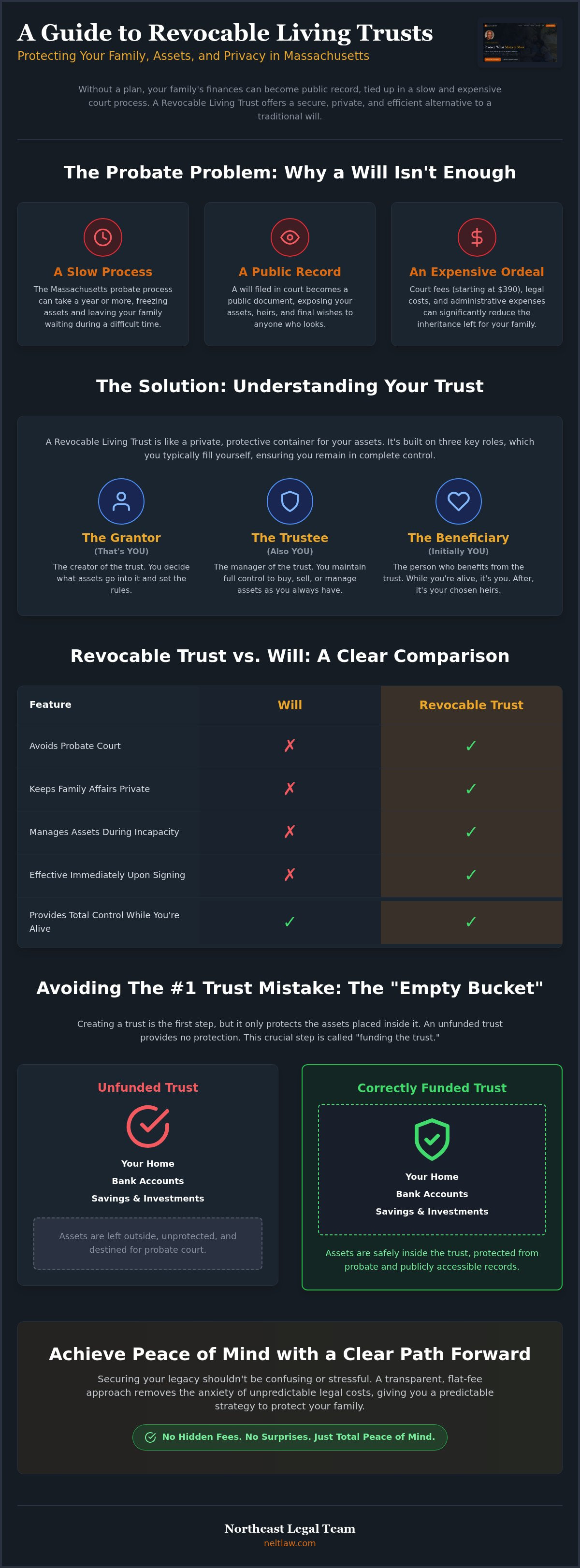
To understand how this works, you just need to know three simple roles, which often start with the same person: you. One of the primary revocable living trust benefits MA families appreciate is the seamless way these roles function together:
- The Grantor: This is you. You're the creator of the trust and the person who provides the assets.
- The Trustee: This is the person who manages the trust. Most people choose to be their own trustee so they keep total control.
- The Beneficiary: This is the person who enjoys the assets. While you're alive, you're the primary beneficiary. Your heirs become the beneficiaries later.
The Massachusetts Uniform Trust Code (MUTC) Explained
The MUTC is the rulebook that governs how trusts operate in our state. It provides a standard framework that protects your rights as a trust creator. For instance, Section 603 of the MUTC is particularly reassuring for many residents. It states that as long as you have the capacity to manage your affairs, the trustee's duties are owed exclusively to you. This means your interests always come first. Professional drafting ensures your trust meets these strict state standards, providing a reliable safety net that won't fail when your family needs it most.
Control and Flexibility: You Are Still in Charge
A common myth we hear in Middlesex and Worcester counties is that putting a house into a trust means losing ownership. That simply isn't true. The reality is that you manage your assets exactly as you did before. You can sell your home, spend your money, or move accounts whenever you wish. You're still the one making the decisions.
Life evolves, and your plan should too. Because the trust is revocable, you can update it as your family grows. Whether you're welcoming a new grandchild or buying a vacation home on the Cape, your trust can be amended to reflect your current life. This flexibility is essential for maximizing the revocable living trust benefits MA law provides, ensuring your legacy stays protected through every season of life.
4 Primary Benefits of a Revocable Living Trust for MA Families
Choosing the right plan is about more than just paperwork. It's about ensuring your family isn't left with a legal mess during an already difficult time. While many people start with a simple will, they often discover that a trust offers a much softer landing for their loved ones. To truly maximize the revocable living trust benefits MA offers, it helps to look at how this tool works in the real world.
The most immediate advantage is probate avoidance. In Massachusetts, the court filing fee to open an informal probate case is $390, but the financial cost is only part of the burden. Probate is a slow, bureaucratic process that can take a year or more to resolve. During this time, your assets may be frozen, leaving your family unable to sell a home or access the funds they need for daily expenses. A trust bypasses this entire system, allowing for a smooth and immediate transfer of property.
The 'Privacy Shield': Keeping Your Business Private
When a will is filed in a Massachusetts probate court, it becomes a public document. This means anyone, from curious neighbors to aggressive solicitors, can view the details of your assets and who is receiving them. Families in Middlesex and Worcester counties often find this level of exposure deeply uncomfortable.
A trust functions like a private contract. It never needs to be filed with the court, so your financial details stay exactly where they belong: within your family. This discretion doesn't just protect your privacy; it also helps prevent family disputes and unwanted outside interference. If you're curious about how this might look for your specific situation, you might consider a free assessment to explore your options.
Managing Incapacity Without a Court Battle
We often focus on what happens after we pass away, but understanding the revocable living trust benefits MA residents rely on also means planning for health crises. If you become ill and cannot manage your affairs, someone needs to step in. Without a trust, your family might be forced to go through a "conservatorship" process. This is a public, expensive, and often stressful court proceeding where a judge decides who will manage your life.
With a trust, you've already chosen a Successor Trustee. This person can step in immediately, without a single day in court, to pay your bills and manage your property. It provides a clear, compassionate roadmap for your family, ensuring you are cared for by the people you trust most. This seamless transition provides the ultimate peace of mind, knowing that your family's future is secure no matter what happens tomorrow.
Revocable Living Trust vs. Will: A Massachusetts Comparison
When you compare a will to a revocable living trust, the biggest difference is timing. A will is like a set of instructions that stays sealed in an envelope until you pass away. It has no power to help you during your lifetime. One of the key revocable living trust benefits MA residents value is that the trust is active and protective from the moment you sign it. It's a living tool that works for you today, tomorrow, and long after you're gone.
We often see families choose a will because it feels like the simpler path. While a will is a necessary starting point, it's often the minimum requirement for an estate plan. A trust is the comprehensive choice. It handles the logistics of your legacy in advance so your family doesn't have to manage them during a time of grief. At Northeast Legal Team, we don't just choose one or the other. We integrate both into a complete plan, using a "Pour-Over Will" as a safety net to ensure every asset eventually finds its way into your trust.
Speed and Efficiency in Asset Distribution
The timeline for settling an estate is where the difference becomes most visible. If you rely solely on a will, your family must wait for the Massachusetts Probate Court to grant them authority. This process typically takes between 12 and 18 months. During this long wait, your loved ones might struggle to pay for your home's upkeep or access necessary funds.
A trust operates on a much faster track. Because the trust already owns the assets, your successor trustee can often begin distributions within weeks rather than months. This removes the heavy emotional burden of waiting for court approval. For those who find themselves already facing the court system, working with a Flat Fee Probate Attorney Massachusetts can help provide predictable support during a slow process.
Cost Considerations: Upfront vs. Backend Expenses
It's natural to think about the initial investment. A will is generally less expensive to create, but it often leads to significant "backend" costs. Between court filing fees and attorney fees for probate, which often range from $2,500 to $5,000 for straightforward cases, the total cost can climb quickly.
A revocable living trust requires more work upfront, but it's designed to save your family thousands of dollars in the long run. By spending a bit more now, you eliminate the need for expensive court proceedings later. Families in Worcester and Middlesex counties appreciate this predictability. You can learn more about how we structure these investments in our guide to Estate Planning Attorney Cost. Choosing a trust is a gift of clarity and savings for the people you love most.
Avoiding the #1 Trust Mistake: Funding and Maintenance
Imagine buying a high-quality safe to protect your family's most precious heirlooms, but then leaving the jewelry sitting on the kitchen counter. The safe is sturdy and secure, but it can't do its job if it's empty. This is the "Empty Bucket" analogy often used in estate planning. To enjoy the revocable living trust benefits MA law provides, you must actually put your assets inside the trust. Funding is the process of retitling assets into the name of the trust.
If you leave your bank accounts or your home in your individual name, those assets will still have to go through the probate court after you pass away. The trust only controls what it "holds." While we always include a "Pour-Over Will" in our plans to catch any forgotten assets and "pour" them into the trust, relying on that safety net still requires a court process. The goal is to fund the trust now so your family avoids that hurdle later.
Funding Your Massachusetts Real Estate
For most families in Middlesex County, the home is their most significant asset. Protecting it requires recording a new deed at the local Registry of Deeds that transfers the property from your name to the name of your trust. This step is critical because it officially removes the property from your probate estate. While a revocable trust is excellent for probate avoidance, some families also look into more specialized tools for long-term care planning. You can explore the Medicaid Asset Protection Trust Cost if you're interested in strategies for nursing home protection.
The Northeast Legal Team Approach to Funding
We've seen many people walk away from law firms with a thick binder of papers but no idea how to actually use them. We take a different path. We provide clear, step-by-step checklists to help you coordinate with your financial advisor and bank. We believe our role is to act as your compassionate mentor, ensuring your bucket is full and your legacy is secure.
Life changes, and your trust should stay current with those changes. We recommend a quick review of your trust every 3 to 5 years, or whenever you experience a major life event like buying a new property or a change in your family structure. If you're ready to ensure your plan is actually ready to perform when it's needed most, you can schedule a conversation with our team today. We'll help you verify that every asset is properly titled, giving you the confidence that your family is truly protected.
Starting Your Legacy with Flat-Fee Peace of Mind
Planning for the future is a deeply personal journey. It's about more than just legal clauses; it's about the people you love and the life you've built. We've seen how the complexity of state laws can create a barrier to action for many residents. Our goal is to lower those barriers. By focusing on the specific revocable living trust benefits MA law provides, we help you move from a state of worry to one of absolute certainty. We believe that every family deserves a steady hand to guide them through these sensitive decisions.
The transition from chaos to tranquility begins when you have a clear, simplified path forward. We don't just hand you a stack of documents. We act as a compassionate mentor, ensuring you understand how each part of your plan works to protect your home and your heirs. Our team is dedicated to making the complex feel manageable, transforming a potentially overwhelming process into a source of lasting relief.
Predictable Costs, No Surprises
Legal fee anxiety is a common hurdle for families in Middlesex and Worcester counties. Many firms still use hourly billing, which can make you feel like every phone call or question is an extra expense. We chose a flat-fee model because we believe you deserve transparency and predictability. This approach eliminates the fear of the "ticking clock" during our consultations. You can speak freely about your concerns, knowing that the cost is clear from the start.
Our comprehensive trust packages are designed to provide total coverage for your estate. We include everything from the trust document itself to the necessary safety nets like pour-over wills and power of attorney. If you're currently evaluating your options, our Best Estate Attorney Near Me Checklist can help you identify the qualities that matter most in a legal partner. We want you to feel empowered in your decision-making process.
Your Compassionate Guide in Massachusetts
David E. Walker and our team bring over 14 years of experience to every plan we create. We've dedicated our practice to serving families throughout Middlesex and Worcester County with a "listen-first" philosophy. We know that your story is unique, and your estate plan should reflect that. By choosing to work with a team that understands the nuanced revocable living trust benefits MA families need, you're taking a proactive step toward order and safety.
You don't have to carry the weight of "what if" any longer. The path to protecting your legacy is shorter than you might think. When you're ready to replace anxiety with a sense of security, we're here to help. We invite you to Schedule your free estate planning assessment today. Let's work together to ensure your family's future is secure, private, and entirely under your control.
Your Path to a Protected Legacy
Choosing to plan for the future is one of the most compassionate gifts you can give your family. You've seen how a trust keeps your financial details private and ensures your loved ones aren't left waiting for the probate court's permission to move forward. By properly funding your trust today, you're making sure that the protective vessel you've built is actually ready to safeguard your home and your legacy. It's about replacing the "what if" with a solid, reliable plan.
Understanding the revocable living trust benefits MA law provides is the first step toward true peace of mind. With over 14 years of local experience, David E. Walker, Esq. and our team are here to act as your steady hand. We believe in total transparency, which is why we offer flat-fee pricing so you can plan with confidence and without surprises. You don't have to navigate these complex decisions alone.
When you're ready to move from worry to a state of tranquility, we're ready to listen. Secure your family's future with a free estate planning assessment. It's time to feel certain that your family is protected, your assets are secure, and your final wishes will be honored exactly as you intended.
Frequently Asked Questions
Is a revocable living trust public in Massachusetts?
No. Unlike a will, which must be filed in probate court and becomes public record, a trust is a private document. This privacy is one of the core revocable living trust benefits MA families value most. Your assets and beneficiaries remain confidential. Only the trustee and beneficiaries typically see the document. This discretion protects your family from unwanted solicitations or public scrutiny during a sensitive time.
Do I still need a Will if I have a revocable living trust?
Yes, you need a specific type called a "Pour-Over Will." This document acts as a safety net. If you forget to fund an asset into your trust, the Pour-Over Will ensures it "pours" into the trust after probate. It also allows you to name guardians for minor children, which a trust cannot do. We integrate both into a comprehensive plan to ensure no piece of your legacy is left behind.
Can a revocable living trust protect my assets from nursing home costs in MA?
No, a revocable trust does not provide MassHealth protection. Because you maintain control and can revoke it, the state considers these assets available for your care. To protect a home from the five-year look-back period, you would typically need a properly drafted irrevocable trust instead. It's vital to understand this distinction if long-term care costs are a primary concern for your family in Middlesex or Worcester counties.
How much does it cost to maintain a trust after it is set up?
Ongoing maintenance costs are generally minimal. You don't usually need to pay annual fees to an attorney just to keep the trust active. However, you must ensure any new assets you acquire, like a new home in Middlesex County, are titled in the trust's name. We recommend a professional review every 3 to 5 years to account for life changes, ensuring your plan remains a reliable shield for your family.
Who should I choose as my successor trustee in Massachusetts?
Most people choose a responsible adult child, a trusted family member, or a professional fiduciary. Your successor trustee should be someone who is organized and capable of following the legal instructions you've left. Since they will handle your affairs if you become incapacitated or pass away, choose someone who understands your family's unique dynamics. It's often helpful to name an alternate person just in case your first choice is unable to serve.
What happens to my revocable living trust if I move out of Massachusetts?
Your trust remains valid, but you should have it reviewed by an attorney in your new state. While trust laws share common foundations, state-specific rules regarding taxes and real estate can vary. Moving is a major life event that requires updating your plan to ensure it still meets your goals in your new home. A quick update ensures your trust continues to function exactly as you intended under the new state's laws.
Can I sell my house if it is in a revocable living trust?
Yes, you have total flexibility to sell, refinance, or move your property. You simply sign the closing documents as the trustee of your trust. Being in a trust doesn't change your ability to manage your real estate in Worcester or Middlesex counties. It just ensures the property avoids probate if you still own it later. You keep full control while gaining the peace of mind that your home is protected for your heirs.
How long does it take to set up a trust with a flat-fee attorney?
The process typically takes between four and six weeks from your initial assessment to the final signing. We focus on a methodical, unhurried pace that allows you to absorb the information and feel in control. Using a flat-fee model ensures we can take the time needed to answer all your questions without you worrying about an hourly clock. This timeline ensures your plan is drafted with care and meets your specific needs.


