

What if the Commonwealth of Massachusetts already wrote a will for you, but you never got to approve the terms? It's a heavy thought to realize that without your own plan, the state uses a "one-size-fits-all" formula to decide who inherits your home, your savings, and even who cares for your minor children. If you're feeling a bit anxious about state interference or potential family conflict, you aren't alone. Most people assume their loved ones will just "figure it out," but the reality of what happens if you die without a will in Massachusetts is often much more complex and expensive than families expect.
You deserve to know that your legacy is protected by your choices, not by a rigid court hierarchy. This guide will show you exactly how Massachusetts intestacy laws distribute assets in 2026, from the surviving spouse's share to the rights of children from previous relationships. We'll break down the specific probate fees, such as the $390 filing cost for formal petitions, and explain the steps you can take today to keep your family out of the courtroom. By the end of this article, you'll have a clear roadmap to replace uncertainty with a sense of lasting peace for those you love most.
Key Takeaways
- Understand that "intestacy" is simply the state's default plan for your assets, which may not align with the unique needs or values of your family.
- Discover the specific legal hierarchy that determines what happens if you die without a will in Massachusetts, including how assets are split between a spouse, parents, and children.
- Learn why a court-mandated probate process without a will often leads to higher costs and mandatory surety bonds that can burden your grieving loved ones.
- Identify the critical risks for unmarried partners and minor children who lack automatic legal protections under the rigid Massachusetts Uniform Probate Code.
- Explore how a proactive estate plan can help you avoid the "intestacy maze" and provide your family with a predictable, stress-free path forward.
Understanding Intestacy: When the Commonwealth Decides Your Legacy
When someone passes away without a valid legal document to guide their wishes, the law describes them as having died "intestate." This status immediately triggers a set of rigid rules that dictate exactly what happens if you die without a will in Massachusetts. Instead of a plan reflecting your personal values, your legacy enters a standardized legal process where the Commonwealth makes the final decisions on your behalf.
This process is overseen by the Probate and Family Court, most often in Middlesex or Worcester County depending on where you lived. While many people fear the state will simply seize their bank accounts, that's rarely the case. The Commonwealth doesn't want your property; it wants to find your "closest" legal kin. However, the state's definition of who should inherit might look very different from your own, especially if you have a blended family or an unmarried partner.
What is the Massachusetts Uniform Probate Code (MUPC)?
In 2012, Massachusetts overhauled its probate laws by adopting the MUPC to make the process more predictable and efficient. Before this update, the system was often fragmented and confusing for grieving families. Today, the MUPC acts as a standardized template for asset distribution when there's no personal plan in place. If you're wondering what happens if you die without a will in Massachusetts, the court's primary goal under these rules is to identify heirs based on strict biological or legal relationships. It's a mechanical approach that prioritizes bloodlines over the nuances of human connection.
Probate Assets vs. Non-Probate Assets
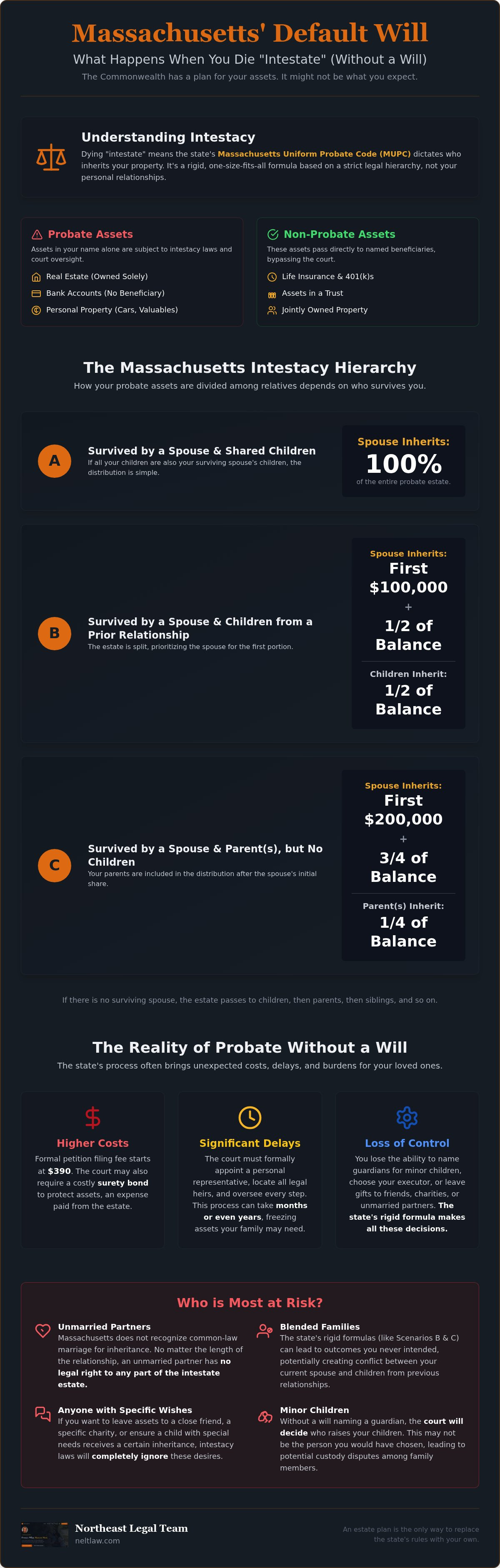
Not every piece of property you own is subject to the state's default rules. Assets with designated beneficiaries, like life insurance policies or 401(k) accounts, typically bypass the court entirely. These are known as non-probate assets because they transfer directly to a person you've already named in a contract.
Probate assets are those held in the decedent's name alone. If you own a home in your name only, it will likely end up in probate even if you have a surviving spouse. This can lead to unexpected delays and costs, as the court must formally verify the next legal owner before the property can be sold or transferred. Understanding this distinction is the first step in protecting your family from the stress of a court-mandated process.
The Massachusetts Intestacy Hierarchy: Who Inherits What?
The law follows a specific bloodline hierarchy when someone passes away without a plan. While many assume a surviving spouse automatically receives everything, the reality of what happens if you die without a will in Massachusetts is more nuanced. The state uses a system designed to provide for your closest relatives, but it does so through a rigid lens that doesn't account for the emotional depth of your relationships.
If there's no surviving spouse, the estate moves to your descendants (children or grandchildren) using a method called "per stirpes" distribution. This essentially means the estate is divided by family branch. If a child has passed away before you, their share typically moves down to their own children. If you leave behind no spouse or children, the hierarchy continues to your parents, then your siblings, and finally to more distant relatives, sometimes called "laughing heirs" because they may not have known you well enough to grieve.
It's vital to understand that Massachusetts does not recognize "common law" marriage or domestic partnerships for inheritance. No matter how many decades you've shared a home or a life, an unmarried partner has no legal right to your intestate estate. This often leaves surviving partners in a precarious financial position during an already devastating time.
Distribution Scenarios: A Clear Breakdown
The Massachusetts Uniform Probate Code (MUPC) uses specific dollar thresholds and percentages to divide assets. Here is how the math usually works in 2026:
- Scenario A: If you leave behind a spouse and all your children are also your spouse's children, your spouse inherits the entire estate.
- Scenario B: If you have children from a prior relationship, your spouse inherits the first $100,000 of the intestate property, plus half of the remaining balance. Your children inherit the rest.
- Scenario C: If you have no children but your parents are still living, your spouse receives the first $200,000 plus three-quarters of the remaining balance. Your parents receive the rest.
The Blended Family Trap
Intestacy is particularly dangerous for blended families. In Massachusetts, step-children have no legal right to inherit from a step-parent unless they've been formally adopted. This can lead to painful situations where a step-child you raised as your own is legally excluded from your legacy. Conversely, the "spouse first" rules in second marriages can sometimes lead to the unintended disinheritance of biological children from a first marriage. If your spouse inherits the bulk of your estate and then passes away without their own plan, those assets may move to their family line, bypassing your children entirely.
These rigid rules often create friction during an already emotional season. You can choose a different path by creating one of our Wills & Estate Plans, ensuring your assets go exactly where you intend rather than following a state-mandated formula.
The Reality of Probate Without a Will: Costs, Delays, and Complexity
When a loved one passes away, the last thing a family wants to focus on is a stack of legal paperwork. However, the administrative weight of the court process becomes much heavier when there is no plan in place. Understanding what happens if you die without a will in Massachusetts starts with recognizing that the court must step in to oversee every major decision, from who pays the final bills to who receives the remaining assets.
This oversight isn't just a formality; it's a structured legal journey that can take significant time. In 2026, families in Middlesex and Worcester counties are finding that the probate process often lasts between nine and eighteen months. Without a will to streamline the path, the court must move methodically to ensure all legal heirs are identified and protected, which inevitably adds to the emotional and financial cost for those left behind.
Appointing a Personal Representative
In Massachusetts, the individual responsible for managing an estate is known as the Personal Representative (PR). If you haven't named someone you trust in a will, the court follows a priority list to decide who is "in charge." This often creates tension if multiple family members feel they are best suited for the role. Serving as a PR is a significant burden, especially without the specific powers and waivers typically granted in a will. For instance, without a will to waive the requirement, the court almost always requires the PR to purchase a surety bond. This is an insurance policy that protects the heirs from potential mismanagement, but the premium is an additional expense that drains the estate's value before anyone receives their inheritance.
Administrative Hurdles and Court Oversight
When someone dies intestate, the family often faces "Formal" probate rather than the simpler "Informal" version. Formal probate requires more court hearings, more official notices, and stricter judge oversight. This increased level of supervision is meant to prevent conflict, but it also leads to higher filing fees and more hours spent in the courtroom. For example, the standard filing fee for a formal petition in 2026 is $390, but the true cost lies in the administrative delays and potential for litigation among heirs who disagree on the "closest" kin.
To help families manage these complexities, we offer clear guidance through our Flat Fee Probate Attorney Massachusetts: Predictable Support for Your Family. By choosing a flat-fee approach, you can remove the fear of the "billable hour" and focus on what truly matters: finding a sense of resolution and peace during a difficult season. This predictable support ensures that the estate's value is preserved for the family rather than being consumed by open-ended legal costs.
Why Intestacy Often Conflicts with Your Actual Wishes
The laws of the Commonwealth are designed to be fair, but they are also impersonal. When we look at what happens if you die without a will in Massachusetts, we see a system that prioritizes legal definitions over personal relationships. This can lead to heartbreaking results for those who don't fit into the traditional "spouse and biological children" mold. If you've spent twenty years building a life with an unmarried partner, the state doesn't recognize that bond. Without a legal document, that partner could be forced to leave the home you shared because they have no legal right to inherit your property.
Similarly, the state has no provision for the people or causes that might be closest to your heart. Close friends, long-term companions, and even your favorite local charities are completely excluded from the distribution process. The law only looks for blood relatives or legal spouses. If your closest living relative is a cousin you haven't spoken to in decades, the state will prioritize them over the best friend who has been by your side every day.
The Guardianship Gap
For parents of minor children, the stakes of intestacy are at their highest. If both parents pass away without a plan, a judge must decide who will raise your children. Without your input, the court will do its best to find a suitable relative, but this often leads to painful family custody battles. Different family branches may have competing ideas about what's best for the children, leading to long, public courtroom disputes that only add to a child's trauma. In Massachusetts, only a Will can legally nominate a guardian for your minor children. This single document is the only way to ensure your voice is heard in the courtroom when it matters most.
Asset Protection and Creditor Claims
An intestate estate is a matter of public record, which unfortunately invites unwanted attention. Because the probate process is transparent, creditors and debt collectors have a clear window into your assets. They can file claims against the estate, often draining the funds intended for your heirs. There is also the significant risk of Medicaid recovery. If you received certain state benefits during your life, the Commonwealth may seek to reimburse itself from your estate before your family receives a dime.
Proactive planning can shield your family from these public hurdles. You can explore the Understanding Medicaid Asset Protection Trust Cost in Massachusetts (2026) to see how specific tools can preserve your legacy. To start building a plan that reflects your actual values, reach out to Northeast Legal Team today for a flat-fee consultation that puts your family first.
Taking Control: Moving from Uncertainty to Peace of Mind
Realizing what happens if you die without a will in Massachusetts can feel like a heavy burden, but it doesn't have to stay that way. The complexity of the probate court and the rigid rules of the Commonwealth are simply the default path; they aren't your only option. By taking a proactive step today, you can replace that sense of looming uncertainty with the quiet confidence that comes from a well-crafted plan. We view ourselves as compassionate mentors, guiding you away from the "intestacy maze" and toward a future where your family is protected from unnecessary stress and conflict. A simple will acts as a vital insurance policy for your family's harmony, preventing the custody battles and administrative delays that often follow an unplanned estate.
The Power of a Flat-Fee Estate Plan
One of the biggest barriers to planning is the fear of the unknown cost. We've removed that hurdle by offering a clear, Estate Planning Attorney Flat Fee: A Guide to Transparent Legal Costs in 2026. This transparent approach ensures you know exactly what your investment is from the very beginning. Our comprehensive plans typically include:
- Last Will and Testament: To nominate guardians and distribute your assets according to your values.
- Power of Attorney: To ensure someone you trust can manage your financial affairs if you're unable to do so.
- Healthcare Directives: To provide clear instructions for your medical care and name a representative to speak for you.
When you choose a flat-fee model, you can finally breathe that "sigh of relief" we promise. You're no longer watching a clock or worrying about billable hours; instead, you're focusing on the protection of your legacy and the continuity of your family's well-being.
Your Next Steps Toward Tranquility
Moving forward is simpler than you might think. To prepare for your first consultation with David E. Walker, Esq., we recommend gathering a simple "legacy list." This isn't a complex legal document; it's just a starting point for our conversation. Think about your major assets and the people you want to care for. Who would you trust to manage your affairs? Who should raise your children? Having these thoughts ready allows us to move efficiently toward a solution that feels right for you.
Our firm brings over 14 years of experience to families across Middlesex and Worcester counties. This local expertise ensures your plan follows every specific Massachusetts requirement while remaining entirely accessible and easy to understand. It's time to move from worry to order. You can Schedule your free estate planning assessment today and take the first step toward true tranquility.
Secure Your Family's Future Today
Leaving your legacy to the default rules of the Commonwealth can lead to unintended consequences, especially for blended families and unmarried partners. Understanding what happens if you die without a will in Massachusetts is about more than just legal codes; it's about protecting the people you love from court delays, public filings, and emotional friction. By choosing to plan now, you ensure that your voice remains the final authority on your assets and the care of your children.
At Northeast Legal Team, we bring over 14 years of local experience and a compassionate, plain-English approach to every family we serve. We believe that legal protection should be accessible and predictable, which is why we offer flat-fee pricing for all of our estate plans. You don't have to navigate the "intestacy maze" alone. Take the first step toward true tranquility and schedule your free estate planning assessment with Northeast Legal Team today. You've already done the hard work of learning the risks; now it's time to experience the relief of a plan that puts your family first.
Frequently Asked Questions
Is a will required in Massachusetts?
No, a will isn't legally required, but it's the only way to keep the state's default rules from taking over your legacy. Without one, your estate enters a process called "intestacy" under the Massachusetts Uniform Probate Code. This means a judge in Middlesex or Worcester County follows a rigid formula to distribute your property. While you aren't forced to have a will, choosing to create one protects your family from the stress and uncertainty of a court-mandated distribution.
Does a surviving spouse automatically inherit everything in MA?
Not always, as the outcome depends on whether you have surviving parents or children from a previous relationship. For example, if you have children from a prior marriage, your spouse only inherits the first $100,000 plus half of the remaining balance. If you have no children but a surviving parent, your spouse receives the first $200,000 and three-quarters of the rest. Understanding what happens if you die without a will in Massachusetts is crucial for protecting a spouse's financial security.
How long does probate take in Massachusetts without a will?
Probate for an intestate estate typically takes between nine and eighteen months to complete in the Middlesex and Worcester Probate Courts. Without a will to provide clear instructions, the court must move through more formal hurdles to verify heirs and settle debts. This timeline can stretch even longer if family members disagree on who should lead the estate. A well-crafted plan helps your loved ones avoid these lengthy administrative delays and find resolution much sooner.
Can step-children inherit if there is no will?
No, step-children have no legal right to inherit from a step-parent under Massachusetts intestacy laws unless they've been formally adopted. The court only recognizes biological children or those legally joined to the family through adoption. If you want to provide for a step-child you've raised, you must specifically name them in a will. Without this document, the state's "one-size-fits-all" plan will completely exclude them from your legacy, regardless of your personal bond. Knowing what happens if you die without a will in Massachusetts helps you protect every child you love.
What happens to my house if I die without a will in Massachusetts?
Your home becomes a probate asset that is distributed according to the state's legal hierarchy if it's held in your name alone. The court must formally appoint a Personal Representative before the property can be sold or transferred to your heirs. This often leads to significant delays for families in Worcester or Middlesex counties. If you own the house jointly with a spouse as "tenants by the entirety," it typically passes directly to them, bypassing the probate process entirely.
Who is the Personal Representative if I don't have a will?
The court appoints a Personal Representative based on a priority list established by state law since you haven't named one yourself. A surviving spouse usually has the first priority, followed by other legal heirs. If there's a dispute among family members about who should serve, the court may have to hold a formal hearing to decide. This person carries the heavy burden of managing your debts and assets under strict court supervision without the powers usually granted in a will.
How much does it cost to probate an estate with no will in MA?
The costs are generally higher than if you had a will, starting with a $390 filing fee for a formal petition. In an intestate estate, the court almost always requires a surety bond, which is an additional premium paid out of the estate's value. Because these cases often require "Formal" probate, legal fees and administrative expenses can quickly add up. We provide flat-fee probate administration to help families manage these costs with total transparency and no hidden surprises.
Can I avoid probate entirely without a will?
You can only avoid probate for specific assets that have direct beneficiary designations or joint ownership. This includes life insurance policies, retirement accounts like 401(k)s, and bank accounts with "payable on death" instructions. However, any property held solely in your name still requires a court process. While these tools are helpful, a comprehensive estate plan is the most reliable way to ensure your entire legacy bypasses the complexities and public nature of the probate court.


