

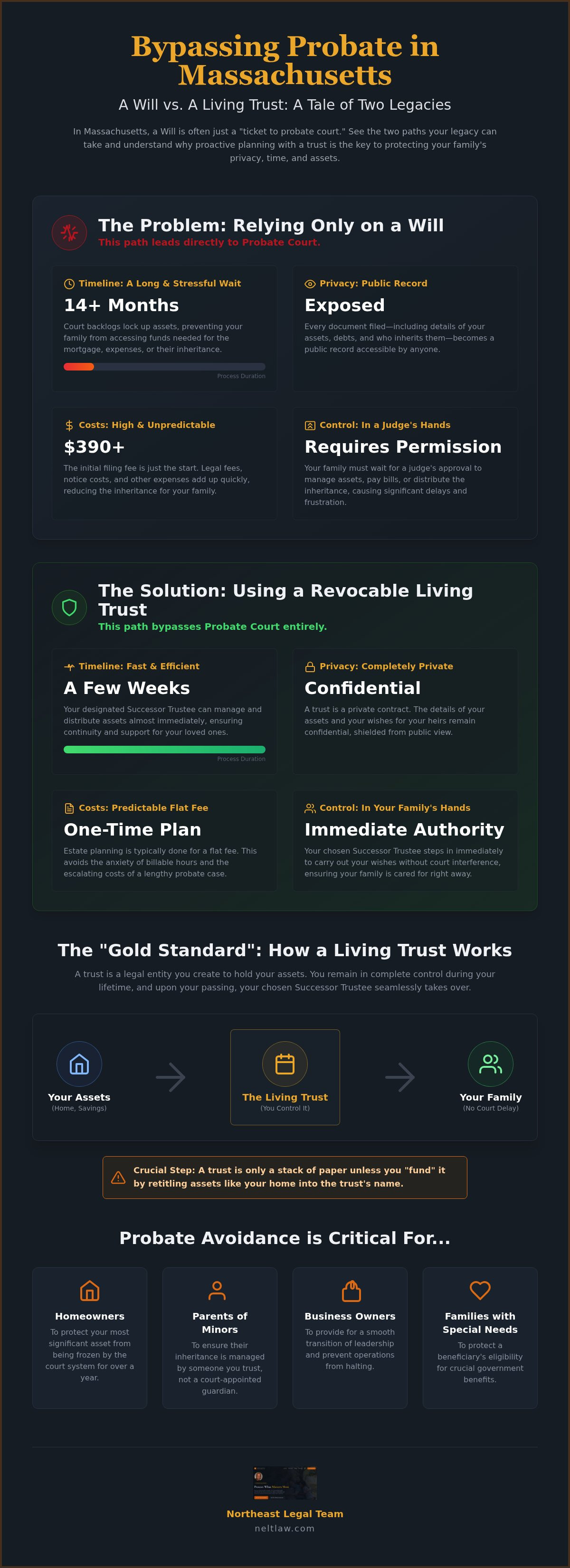
In Massachusetts, a Will is often just a "ticket to probate court" rather than the final word on your legacy. Many families believe a Will keeps them out of the legal system, but it actually triggers a public process that can lock up your home and savings for fourteen months or longer. If you want to ensure your family avoids the stress of public filings and high court fees, you need proactive probate avoidance strategies Massachusetts families can rely on today. It's about more than just paperwork; it's about making sure your loved ones have immediate access to the resources they need during a time of grief.
We understand the anxiety that comes with wondering if your home is truly protected or if your private affairs will become a matter of public record. You've worked hard for what you have, and you deserve a plan that offers certainty instead of legal hurdles. This guide provides a clear roadmap to bypassing the probate process using proven, state-specific tools like living trusts and strategic asset retitling. We'll explore how these methods provide privacy, speed, and predictable legal costs so you can focus on your family's future instead of court dates.
Key Takeaways
- Learn why a Revocable Living Trust is the "gold standard" for Massachusetts homeowners who want to maintain control and keep their family's business private.
- Discover how specific probate avoidance strategies Massachusetts residents use can reduce a fourteen-month court timeline to just a few weeks.
- Identify the hidden risks of "simple" DIY fixes like adding children to deeds, which can trigger unexpected taxes and creditor issues.
- Understand how appointing a Successor Trustee ensures your loved ones have immediate access to funds without waiting for a judge’s permission.
- See how a flat-fee planning process removes the anxiety of billable hours, providing a clear and predictable path toward a protected legacy.
Why Families Seek Probate Avoidance Strategies in Massachusetts
Probate is the court-supervised process of validating a Will and distributing assets to heirs. While it sounds like a straightforward legal requirement, it's often a source of deep stress for families during an already difficult time. A common misconception exists that having a Last Will and Testament keeps your family out of court. In reality, a Will is essentially a letter to a judge; it's a request for the court to oversee the transfer of your belongings. If you want to protect your home and your family's privacy, understanding probate avoidance strategies Massachusetts families use is the first step toward peace of mind.
Certain triggers make probate unavoidable without a specific plan. If you own real estate in your name alone, or have bank accounts with values exceeding $25,000 that lack named beneficiaries, your estate will likely need court intervention. By 2026, court backlogs in Middlesex and Worcester counties have grown significantly, often delaying inheritance for 12 to 18 months. This wait can be agonizing for families who need access to funds to maintain a home or pay for ongoing expenses.
The True Cost of Probate in MA
The financial burden of probate starts early in the process. Filing fees for an informal probate petition currently sit at $390, but that's only the beginning of the expenses. You'll also face mandatory legal notice costs to inform potential creditors and heirs of the court proceedings. There's a "time tax" that's hard to ignore as well. Massachusetts law includes a mandatory one-year period where creditors can file claims against the estate. This means your family could be waiting for a significant amount of time before they can fully close the estate and move forward. Beyond the money, there's the loss of privacy. Every document filed in probate court becomes a public record that anyone can access, including details about your assets and your family's inheritance.
When is Probate Avoidance Most Critical?
For many, the decision to seek out probate avoidance strategies Massachusetts residents trust is about protecting specific people. Homeowners with significant equity in their property are at the highest risk for a long, complicated probate process. If you have minor children or beneficiaries with special needs, probate can complicate their care and financial support when they need it most. Small business owners also face unique risks; without a plan, operations can grind to a halt while the court decides who has the authority to sign checks or manage employees. Many families choose to create a legal relationship through a trust to bypass these hurdles entirely. This proactive step ensures your legacy stays in your family's hands rather than in a public file.
The Revocable Living Trust: Your Primary Shield Against Probate
A revocable living trust is often called the "gold standard" of estate planning for a reason. It allows you to move your assets into a separate legal entity while you keep total control as the trustee. You're still the one making the decisions, but for legal purposes, the trust owns the property. This structure is supported by Massachusetts nonprobate transfer law, which allows assets to pass directly to your heirs without court interference. It's a proactive way to ensure your wishes are followed without the oversight of a judge.
One of the most significant benefits is the "Successor Trustee" advantage. In a standard probate case, your family might wait over a year to access funds. With a trust, your hand-picked successor steps in immediately upon your passing. They don't need a judge's signature to pay the mortgage or distribute inheritance. This speed is matched by a high level of privacy. While a Will becomes a public document once filed, a trust is a private contract. Your neighbors and the general public won't know what you owned or who received it. We often include a "Pour-Over Will" as a safety net to catch any forgotten assets, ensuring everything eventually finds its way into your trust's protection.
The Vital Step of Funding Your Trust
A trust is only effective if it actually holds your property. An empty trust is just a stack of expensive paper that won't help your family avoid court. Funding involves the physical process of retitling your assets. For most homeowners, this means signing a new deed that transfers their Massachusetts real estate into the trust's name. You'll also need to link your bank accounts and brokerage funds to this new structure. It's a methodical process, but it's the only way to ensure your probate avoidance strategies Massachusetts plan actually works when it matters most. Skipping this step is the most common reason estate plans fail to achieve their goals.
Flexibility and Control
Life changes, and your estate plan should change with it. Revocable trusts are designed to be flexible. You can update your beneficiaries or change your successor trustee as your family grows or your priorities shift. This tool also serves as a vital disability planning instrument. If you become incapacitated, your successor trustee can manage your affairs without the need for a court-appointed guardianship. To make this process even more accessible, many families look for a living trust attorney flat fee model to ensure their costs are predictable from the start. If you're ready to secure your family's future, the Northeast Legal Team is here to help you build a plan that lasts.
Non-Trust Strategies: Titling, Beneficiaries, and Life Estates
While trusts are a powerful choice, they aren't the only way to protect your legacy. Other probate avoidance strategies Massachusetts homeowners often use involve how you title your property or who you name on your accounts. Joint Tenancy with Right of Survivorship is the simplest path for many married couples. When one spouse passes, the other automatically becomes the sole owner without needing a judge's permission. For bank accounts, you can use Payable on Death (POD) or Transfer on Death (TOD) designations. These simple forms tell the bank exactly who should receive the funds, keeping that money out of the public court system.
It's vital to be careful with national advice you find online. Many general websites suggest using a Transfer on Death deed for your home, but Massachusetts law doesn't currently recognize these documents for real estate. Following incorrect advice can lead to a legal mess for your heirs. Instead, we look toward established Massachusetts law about wills and estates to find tools that actually work in our local courts. Since the state estate tax threshold is $2 million as of 2026, some families also choose lifetime gifting to reduce their taxable estate, though this requires careful balance to ensure your own financial needs are met first.
The Massachusetts Life Estate Explained
A Life Estate is a deed-based probate avoidance tool common in MA. This legal arrangement allows you to transfer your home to your children or other heirs, known as "remaindermen," while you retain the legal right to live there for the rest of your life. Upon your passing, the property transfers to them automatically without any court involvement. However, this strategy comes with specific risks. Since your heirs technically own a portion of the home now, their creditors could potentially place a lien on your property. You also lose total control over selling or refinancing the house, as you'll need the remaindermen's signatures to move forward with any major changes.
Beneficiary Designations on Retirement and Life Insurance
Your 401(k), IRA, and life insurance policies typically bypass probate by default because they are contract-based assets. As long as you have a living person named as a beneficiary, the money goes straight to them upon your death. The biggest danger here is naming "The Estate" as your beneficiary. Doing so pulls those funds back into the probate process, subjecting them to court delays and creditor claims. We recommend reviewing these designations after every major life event, such as a birth, death, or divorce, to ensure your plan remains accurate and protective of the people you love most.
The Risks of 'Simple' Probate Avoidance: Why DIY Can Backfire
It's natural to look for the easiest path when protecting your family. Many people think they've found a shortcut by simply adding a child's name to their house deed or bank account. While these appear to be quick probate avoidance strategies Massachusetts residents can use, they often carry hidden dangers that only surface when it's too late to fix them. A "simple" fix today can lead to a legal nightmare tomorrow. These shortcuts often trade a relatively small probate problem for a much larger tax or litigation crisis.
The most common trap is adding a child to your home's deed. Once their name is on that title, your home is legally tied to their personal life. If they face a divorce, a lawsuit, or a bankruptcy, your house could be at risk from their creditors. Similarly, joint bank accounts often spark sibling litigation. If one child is on the account for convenience, other heirs may feel slighted if that child claims the entire balance after you're gone. Even a well-intended trust can fail if it isn't fully funded; this is the leading reason estates still end up in the Middlesex or Worcester probate courts despite the owner's best intentions.
Tax Implications of Improper Planning
Gifting your home during your lifetime might seem helpful, but it often robs your children of a "step-up in basis." When heirs inherit a home, their tax basis is usually the property's value at the time of your death. If you gift it now, they keep your original purchase price as their basis. This could lead to a massive capital gains tax bill when they eventually sell the property. You also need to navigate the 2026 Massachusetts estate tax threshold of $2 million. For those with a family company, integrated business succession planning massachusetts ensures your hard work doesn't get drained by avoidable taxes or court delays during a transition.
The Value of Professional Oversight
Online templates rarely account for the specific nuances of the Massachusetts Uniform Probate Code (MUPC). These forms might look official, but they often lack the language required by local court customs. Working with the best estate attorney near me provides a layer of protection that a website cannot offer. A professional ensures your Power of Attorney and Healthcare Proxy work in harmony with your overall plan. If you're ready to build a strategy that actually holds up in court, the team at Northeast Legal Team is ready to guide you through a personalized assessment.
Implementing Your 2026 Estate Plan: The Northeast Legal Team Approach
Choosing the right path for your family's future shouldn't feel like a transaction. At Northeast Legal Team, we believe that effective probate avoidance strategies Massachusetts families trust are built on a foundation of empathy and clear communication. We've seen how the traditional legal model, with its unpredictable billable hours, can create a barrier between families and the protection they need. That's why we've pioneered a flat-fee model. It removes the stress of the ticking clock, allowing us to focus entirely on your story and your specific goals. You deserve the time to ask questions and feel certain about every decision without worrying about an unexpected bill in the mail.
Our role is that of a compassionate mentor and protective advocate. We don't just hand you a folder of documents and send you on your way. Instead, we provide proactive stewardship. This means we walk beside you to ensure your plan actually works when your family needs it most. With over 14 years of experience in Massachusetts estate law, our local expertise allows us to navigate the specific customs of Middlesex and Worcester county courts with confidence. We treat your legacy as if it were our own, providing the steady hand you need to turn worry into a sense of lasting resolution.
Our Step-by-Step Planning Process
We start every journey with a Free Initial Assessment. This isn't a high-pressure sales pitch; it's a conversation designed to identify your specific probate triggers, such as solely owned real estate or accounts without beneficiaries. Once we understand your needs, we customize your "Probate Shield." This might range from a simple estate plan to a comprehensive Living Trust, depending on what best protects your loved ones. Crucially, our support doesn't end when the ink is dry. We provide ongoing guidance to ensure your trust remains funded and relevant as your life changes, preventing the common pitfalls that send estates back to probate court.
Take the First Step Toward Peace of Mind
If you haven't reviewed your plan recently, 2026 is the perfect time to audit your current family protections. Laws and family dynamics change, and a plan that worked five years ago might leave gaps today. If you're currently facing a situation where a loved one has already passed, a flat fee probate attorney massachusetts can provide predictable support during a difficult time. Don't let uncertainty linger. Schedule your no-obligation assessment today and discover how simple it can be to secure your legacy and provide your family with the gift of a clear, private path forward. Let us help you find that sigh of relief you've been looking for.
Securing Your Family's Future with Confidence
Protecting your legacy is about more than just paperwork; it's about providing your loved ones with a sense of security and a clear path forward. By implementing the right probate avoidance strategies Massachusetts families rely on, you ensure that your home and savings pass privately and quickly to the people you love. We've explored how tools like revocable living trusts offer far more protection than a simple Will alone, and why avoiding common DIY traps is essential for preserving your family's wealth.
With over 14 years of dedicated Massachusetts experience, our team is here to act as your supportive guide. We provide compassionate, non-judgmental legal guidance through a process designed to be easy and transparent. Our flat-fee pricing for all estate packages means you never have to worry about a ticking clock or hidden costs. You deserve a plan that offers certainty instead of legal hurdles.
Schedule Your Free Probate Avoidance Assessment with Northeast Legal Team
Taking this small step today provides the peace of mind that lasts for generations. You've worked hard for everything you have, and you deserve a partner who is just as committed to protecting it as you are.
Frequently Asked Questions
Does a Last Will and Testament avoid probate in Massachusetts?
A Will doesn't avoid probate; it actually guarantees a trip to court. Think of it as a set of instructions for a judge to follow. Because the court must validate the document and oversee the distribution of assets, your family will still face the standard fourteen month timeline. If your goal is to keep your affairs private and fast, you'll need to look beyond a Will toward trust based probate avoidance strategies Massachusetts families use to stay out of the legal system.
Can I avoid probate in MA without setting up a living trust?
You can bypass the court through joint tenancy or beneficiary designations on your financial accounts. These methods are often called "poor man’s probate avoidance" because they're free to set up. However, they lack the comprehensive protection of a trust. While they might work for a simple bank account, they often fail to protect your home from a child's creditors or ensure that minor children are cared for according to your specific wishes.
Are Transfer on Death (TOD) deeds for real estate legal in Massachusetts in 2026?
No, Transfer on Death (TOD) deeds for real estate are not legally recognized in Massachusetts as of 2026. While many other states allow you to name a beneficiary on a deed, our local laws require different tools to pass property outside of probate. If you see this suggested on a national website, it's likely inaccurate for our jurisdiction. Instead, Massachusetts homeowners typically use living trusts or life estates to ensure their property transfers smoothly to heirs.
How much does it typically cost to set up a probate avoidance plan?
The cost of your plan depends entirely on your family's unique goals and the complexity of your assets. We believe in total transparency, which is why we offer flat fee pricing for our estate planning packages. This removes the anxiety of billable hours and ensures you know exactly what you're investing in your family's future. By choosing a predictable model, you can focus on the quality of your plan rather than watching the clock during our meetings.
What happens if I own property in two different states?
Owning property in two different states often leads to a "double probate" situation known as ancillary probate. This means your family might have to hire two different attorneys and pay court fees in two separate jurisdictions. A revocable living trust is the most efficient way to solve this problem. By retitling both properties into the name of your trust, you consolidate your entire legacy into one private, manageable structure that avoids court interference in both states.
Is joint ownership the best way to avoid probate for my home?
Joint ownership is a common shortcut, but it's rarely the best long term solution. When you add someone to your deed, you're giving them a current legal interest in your home. This means if they face a lawsuit or a divorce, your house could be at risk. It also often results in a higher tax bill for your children later because they lose the "step up in basis" that usually comes with an inherited property.
How long does the probate process take in Middlesex County?
In Middlesex County, a straightforward informal probate typically takes between nine and fourteen months to complete. However, court backlogs in 2026 can sometimes push this timeline toward eighteen months if any complications arise. During this time, your assets are often "locked up," making it difficult for your family to pay for property taxes or maintenance. This lengthy delay is one of the primary reasons many families choose to implement proactive probate avoidance strategies Massachusetts requires for faster asset transfers.
Can a small estate avoid the full probate process in MA?
Yes, Massachusetts offers a simplified process called Voluntary Administration for very small estates. This is available if the personal property is valued at $25,000 or less and the estate includes no real estate. While this is faster and less expensive than traditional probate, most homeowners won't qualify because their property value exceeds this limit. If you own a home, you'll likely need a more comprehensive plan to ensure your family avoids the full probate court process.


