

What if the most overwhelming part of settling a loved one's estate wasn't the actual paperwork, but the persistent fear of a shrinking inheritance? If you're feeling a heavy weight of responsibility as a Personal Representative, you aren't alone. It's completely natural to worry about hidden legal bills or wonder exactly how much does probate cost in massachusetts when you're simply trying to do right by your family. You want to honor your loved one's legacy, but the confusion surrounding court mandates can make the process feel like a maze without an exit.
This guide provides a clear, supportive roadmap to help you understand every mandatory expense and predictable legal fee you'll encounter in 2026. We'll strip away the complex jargon to reveal the tangible costs of moving through the court system. You'll gain a better understanding of specific filing fees in Middlesex and Worcester counties, the vital difference between hourly and flat-fee legal services, and how to manage the process efficiently. Our goal is to replace your current anxiety with a sense of certainty, ensuring you have the tools to protect the estate while finding your own much-needed peace of mind.
Key Takeaways
- Understand the difference between Formal and Informal probate under the Massachusetts Uniform Probate Code and how this choice affects your total expenses.
- Get a clear breakdown of mandatory 2026 court filing fees and publication costs to understand how much does probate cost in massachusetts at a foundational level.
- Discover why flat-fee legal services offer a "sigh of relief" compared to the anxiety of traditional hourly billing.
- Identify hidden costs like real estate appraisals and surety bonds so you can protect the estate's assets with confidence.
- Learn how local expertise in Middlesex and Worcester counties ensures your role as a Personal Representative is handled with professional care and empathy.
Understanding the Costs of Probate in Massachusetts
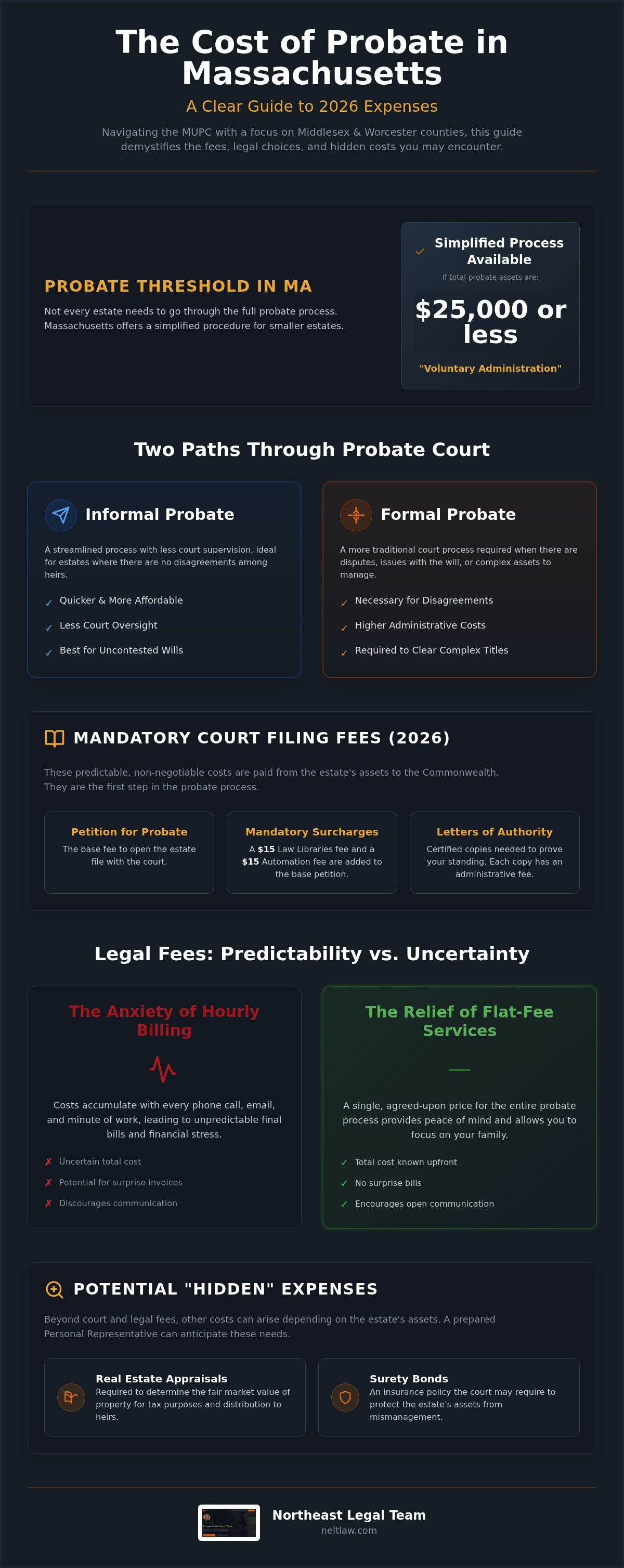
Losing a loved one is a profound experience, and the last thing you need is a stack of confusing legal forms. In our state, the Probate process follows the Massachusetts Uniform Probate Code (MUPC). This framework was designed to simplify estate administration, but it still leaves many families asking: how much does probate cost in massachusetts? The answer often depends on the specific path the estate must take through the court system. If you choose Informal probate, the process is typically quicker and more affordable because it requires less court oversight. Formal probate is necessary when there are disagreements among heirs or complex titles to clear, which requires more court time and higher administrative costs.
The financial burden isn't the only concern for families in Middlesex and Worcester counties. There's a significant emotional cost when you're unsure if you're following the law correctly. This uncertainty can strain family relationships during an already sensitive time. By engaging in proactive planning, such as creating a living trust, you can often protect your family from these expenses and delays. It's about ensuring a smooth transition so you can focus on your family's healing rather than tracking court dates and filing deadlines.
What Exactly Are You Paying For?
It's helpful to distinguish between government filing fees and professional service fees. Government fees are mandatory payments to the Commonwealth to process your paperwork and maintain court records. Professional fees include the support of an attorney who ensures your filings are accurate and timely. As a Personal Representative, you act as the steward of the estate's resources. It's a role that carries significant weight, but you don't have to carry it alone. Our team acts as a protective guide, helping you manage the mandatory notices to creditors and heirs. Massachusetts filing requirements are often more detailed than in other states, which is why local expertise is so valuable to avoid costly errors.
The Threshold for Probate in MA
Not every estate requires a long, drawn-out court process. If the assets are valued at $25,000 or less, you might qualify for a Small Estate affidavit. This is a simplified process called Voluntary Administration that is much faster and less expensive. You should remember that only probate assets count toward this total. Items like joint bank accounts or retirement plans with named beneficiaries usually pass outside of court. Even for smaller estates in Worcester or Middlesex, seeking a professional assessment can provide a sigh of relief. It ensures you aren't overpaying or missing a critical legal step that could cause trouble for the family later.
Mandatory Filing Fees and Court Costs in 2026
Families often worry they'll have to pay for court costs out of their own savings while waiting for the estate to settle. You can breathe a sigh of relief knowing that these expenses are typically paid directly from the estate's assets. When you're trying to determine how much does probate cost in massachusetts, the mandatory court fees are the most predictable part of the equation. These are the "tickets" required to enter the court system and receive the legal authority you need to manage your loved one's affairs. It's a structured process designed to ensure every debt is settled and every heir is protected.
Breakdown of Common Probate Court Fees
The base fee for filing a Petition for Probate, whether formal or informal, is the first expense you'll encounter at the courthouse. However, the total cost at the clerk's window includes specific surcharges that are sometimes missed in early estimates. According to the Massachusetts Probate and Family Court fee schedule, you'll need to account for both a Law Libraries surcharge and an Automation surcharge. These small additions are mandatory for nearly every filing in the Commonwealth and help fund the infrastructure of our legal system.
- Petition for Probate: This is the standard entry fee for the court to open the file and begin the administration process.
- Mandatory Surcharges: A $15 Law Libraries fee and a $15 Automation fee are added to the base petition cost.
- Letters of Authority: You'll likely need several certified copies of these documents to prove your legal standing to banks, utility companies, and insurance firms. Each certified copy carries its own administrative fee.
- Inventory and Accounts: If the estate requires a formal accounting or an inventory filing later in the process, the court may charge additional fees based on the nature of the filing.
Publication and Notice Requirements
The law requires you to provide public notice to potential heirs and creditors. This is done by publishing a "Citation" in a local newspaper in the county where the deceased resided. If you're handling an estate in Worcester, this notice might appear in the Worcester Telegram & Gazette. For Middlesex County, it could be a publication like the Lowell Sun or MetroWest Daily News. These newspapers set their own rates for legal notices, which can vary significantly depending on the publication's reach. Timely publication is vital. If a notice is missed or delayed, you might have to re-file paperwork, which adds unnecessary costs and stretches out the timeline for the entire family. If you're feeling pressured by these technical deadlines, our team offers predictable support for your family to ensure every requirement is met without the stress of hidden surprises.
Legal Fees: Hourly vs. Flat-Fee Probate Representation
While court fees are fixed by law, legal fees often feel like a moving target. This uncertainty is where much of the anxiety for Personal Representatives begins. Traditionally, law firms charge by the hour, which means every phone call, email, and court appearance adds a new line to your bill. This model can create a defensive barrier between you and your legal advocate. You might hesitate to ask a vital question because you're worried about the cost of a ten-minute conversation. When calculating how much does probate cost in massachusetts, families often focus on the Probate and Family Court filing fees, but the professional support you choose has a much larger impact on the final total.
To understand the value of professional help, it's useful to see what an attorney actually does. They don't just fill out forms; they act as a steady hand through a complex system. Your attorney manages creditor claims, ensures heirs receive proper notice, and navigates the specific procedural quirks of the Middlesex or Worcester courts. A Flat Fee Probate Attorney Massachusetts provides a different experience by removing the "billable hour" from the relationship. This approach aligns the attorney's goals with your own: getting the estate settled efficiently and correctly.
The Pitfalls of Hourly Billing in Probate
Every simple phone call or quick email response can inflate an estate's legal bill under the hourly model. This structure doesn't always reward speed or efficiency. In fact, if an attorney is disorganized, the estate pays for their lack of focus. Families in Worcester and Middlesex are increasingly moving away from this model because they want to know exactly how much of the inheritance will be preserved for the heirs. Choosing a lower hourly rate might seem like a way to save money, but if the attorney takes twice as long to complete the work, the final bill will be much higher than expected.
Why Flat Fees Represent the 'Plain English' of Legal Costs
Choosing a flat fee allows you to breathe a sigh of relief. You'll know the total cost of legal representation before the first document is ever filed with the court. This model covers the essential steps of probate administration, from the initial petition to the final distribution of assets. It creates a partnership where you can reach out for guidance whenever you feel overwhelmed without checking your watch. This predictability transforms a stressful legal obligation into a manageable process, giving you the peace of mind that the estate's resources are being protected for the next generation.
Hidden Expenses: Appraisals, Bonds, and Taxes
When families ask how much does probate cost in massachusetts, they usually look at the court's website for filing fees. However, the true financial picture includes several "hidden" expenses that often catch Personal Representatives by surprise. These aren't just administrative hurdles; they're essential steps to protect the estate and ensure every heir receives their fair share. Managing these costs requires a steady hand and a clear understanding of what the court expects from you. By identifying these expenses early, you can avoid the stress of unexpected bills during an already difficult time.
Valuing the Estate's Assets
One of your first tasks is to determine the "date of death" value for all property. If your loved one owned a home in Middlesex County or a business in Worcester, you'll likely need a professional appraisal. This isn't just for the court's benefit. It's a critical requirement for IRS compliance and helps establish the "stepped-up basis" for heirs. This tax benefit can save your family significant money on capital gains taxes if the property is sold later. While you might be tempted to use a simple online estimate, the probate court typically requires a certified valuation from a qualified professional. This ensures the inventory you file is accurate and protects you from future disputes with heirs or creditors.
Fiduciary Bonds and Insurance
In many cases, the court requires the Personal Representative to post a "Surety Bond." Think of this as a form of financial insurance that protects the heirs and creditors if the estate's assets are mishandled. The premium for this bond is an estate expense, but the cost depends on the total value of the assets being managed. If your loved one had a well-drafted will, it might include a clause that waives this requirement. This provides an immediate sigh of relief for the family. Without that waiver, you'll need to work with an insurance provider to secure the bond before the court issues your Letters of Authority. Managing these details is a key part of your responsibility to the estate.
Finally, don't forget the day-to-day costs of keeping the estate running. If a house sits empty during the probate process, you must continue paying for utilities, property insurance, and basic landscaping to preserve its value. You may also need to hire a CPA for the final income tax return or a specialized estate tax return. These professional fees are part of the broader answer to how much does probate cost in massachusetts. If you find these moving parts overwhelming, our team at Northeast Legal Team is here to act as your protective guide, ensuring every expense is handled with transparency and care.
Navigating Probate with Predictability: The Northeast Legal Team Approach
Taking on the mantle of a Personal Representative is a significant act of love and service, but it shouldn't feel like a second full-time job. When you're trying to figure out how much does probate cost in massachusetts, the real answer isn't just a number on a court receipt. It's the cost of your time, your stress, and your family's harmony. At Northeast Legal Team, we believe you deserve more than a clinical legal service. You deserve a partner who sees the human story behind the legal file. We provide unhurried, empathetic guidance through the Middlesex and Worcester courts, ensuring you never feel like just another case number on a crowded docket.
Our firm is built on a "listen-first" philosophy. This means we take the time to understand your family's unique dynamics before we ever suggest a legal path. We've seen how financial uncertainty can build defensive barriers between siblings and heirs. To lower those barriers, we've extended our flat-fee estate planning philosophy directly into our probate administration services. This approach offers a sigh of relief for families who want to know how much does probate cost in massachusetts without the fear of a ticking clock every time they call their attorney for support.
A Supportive Ally in a Difficult Time
Moving from a state of chaos and worry toward order and tranquility is a journey you don't have to take alone. With over 14 years of experience in Massachusetts estate law, David E. Walker, Esq. has helped countless families avoid the common, costly mistakes that often derail the probate process. We prioritize "Plain English" over intimidating legalese because we want you to feel empowered and in control of every decision. If you're worried about missing a deadline or miscalculating a filing fee, we act as your protective guide to ensure the estate is handled with professional stewardship and care.
Your Path to a Resolved Estate
Working with us follows a methodical, deliberate progression designed to give you peace of mind. We handle the heavy lifting of court filings, mandatory creditor notices, and the complex paperwork required by the MUPC. This allows you to focus on your family's healing while we manage the technical mechanics of the law. Each step is organized to lead you toward a natural conclusion, ensuring the transition from a state of concern to a state of resolution feels manageable and safe. If you're ready to move forward with a clear roadmap, we invite you to schedule your free probate assessment today. Let us provide the steady hand you need to protect your loved one's legacy and your family's future.
Moving Toward Peace of Mind and Resolution
You've seen that the answer to how much does probate cost in massachusetts involves more than just a single court receipt. It's a combination of mandatory filing fees, hidden costs like appraisals, and the professional support you choose to guide you. By separating fixed court mandates from predictable legal expenses, you can transform a complex legal maze into a clear, manageable roadmap. You don't have to carry the weight of financial uncertainty while you're trying to honor a loved one's memory.
At Northeast Legal Team, we bring over 14 years of local expertise in Middlesex and Worcester courts to help you navigate this transition. Our flat-fee pricing model provides total transparency, while our mentor-led approach ensures you always have a steady hand to rely on. It's about moving from chaos toward order with a partner who values your family's story as much as you do. Secure your family's legacy with a free probate assessment today. You've taken the first step by getting informed; let us help you finish the journey with confidence and tranquility.
Frequently Asked Questions
Is probate always required in Massachusetts?
Probate isn't always mandatory for every estate in the Commonwealth. If a loved one's assets are valued at $25,000 or less and don't include real estate, you may qualify for a simplified process called Voluntary Administration. Assets held in a living trust or those with designated beneficiaries also bypass the court system entirely. Understanding these thresholds is a key part of determining how much does probate cost in massachusetts for your specific family situation.
How long does the probate process take in Middlesex County?
Most families should expect the process to take between nine and twelve months from start to finish. In Middlesex County, the court system is thorough, and Massachusetts law provides creditors with a full year to bring claims against an estate. While certain administrative tasks happen quickly, the estate usually cannot be fully closed until that one-year creditor window has passed. This timeline ensures every debt is settled and every heir is protected.
Can I avoid probate costs with a living trust?
Yes, a properly funded living trust is one of the most effective ways to protect your family from the expenses and delays of the court system. Assets held within a trust pass directly to your beneficiaries without the need for a probate filing or mandatory court fees. This proactive step provides a sigh of relief for your loved ones, as it keeps your private family matters out of the public record and reduces administrative burdens.
Who is responsible for paying the probate attorney's fees?
The estate itself is responsible for paying all reasonable legal fees and court costs. As a Personal Representative, you don't have to use your own savings to cover these expenses. Instead, these costs are considered administrative expenses and are paid out of the estate's assets before the final inheritance is distributed to the heirs. This structure ensures that the burden of settling the estate doesn't fall unfairly on the person doing the work.
What is the difference between formal and informal probate costs?
Informal probate is generally less expensive because it requires less court involvement and fewer hearings. It's often the best path for estates where there are no disputes among heirs. Formal probate is necessary when the court needs to resolve specific legal issues or clear a complex title, which leads to higher costs due to additional filings and attorney time. Choosing the right path is vital for managing how much does probate cost in massachusetts effectively.
Are probate fees tax-deductible in Massachusetts?
Many administrative expenses, including court filing fees and legal costs, can be deducted from the estate's taxable value. These deductions are typically taken on the Massachusetts Estate Tax Return or the Fiduciary Income Tax Return. Because tax laws are complex, it's helpful to work with a professional who understands how to apply these deductions. This ensures you're preserving as much of the inheritance as possible for the beneficiaries while staying compliant with the law.
What happens if the estate doesn't have enough cash to pay for probate?
If an estate lacks liquid cash, it's considered insolvent, and the law sets a strict priority for who gets paid first. Administrative costs, including probate fees and attorney support, are usually at the top of that list. You may need to sell estate property, such as a vehicle or real estate, to generate the funds needed to cover these mandatory expenses. We can help you navigate these difficult decisions with a protective and steady hand.
How much does a surety bond cost for a Massachusetts executor?
The cost of a surety bond depends on the total value of the assets you're managing. These bonds act as insurance for the heirs and creditors, and the premium is paid directly from the estate's funds. You can often avoid this expense entirely if the deceased person's will specifically waives the requirement for a bond. This is one reason why unhurried, thoughtful estate planning is so valuable for the family members left behind.


