

What if the honor of being named an executor feels less like a tribute and more like a heavy weight on your shoulders? It's completely natural to feel overwhelmed when you're grieving a loss while trying to decipher complex legal terms and court requirements. You likely worry about making a mistake that leads to personal liability for estate debts, or perhaps you're anxious about how to handle family tensions during the asset distribution process. Understanding the specific executor of will duties Massachusetts requires is the first step toward finding your footing and protecting the legacy left behind.
We believe that fulfilling a loved one's final wishes should be an act of stewardship, not a source of constant stress. This guide provides the clarity you need to move forward with confidence and a steady hand. You'll learn the practical difference between being an "Executor" and a "Personal Representative" under current 2026 rules. We will also outline a clear roadmap for your responsibilities, helping you avoid common legal pitfalls in the Middlesex and Worcester court systems. By the end of this guide, you'll have a manageable path to ensure the estate is settled correctly while your peace of mind remains intact.
Key Takeaways
- Understand the transition from "Executor" to "Personal Representative" under the Massachusetts Uniform Probate Code and what this role means for your family legacy.
- Get a clear, step-by-step checklist for the executor of will duties Massachusetts mandates, including the critical 30-day window for filing the original Will.
- Learn how to navigate the mandatory one-year creditor period and the unique challenges of selling probate real estate within the Middlesex or Worcester court systems.
- Discover the standards for "reasonable compensation" and why maintaining a detailed time log protects you from potential disputes with beneficiaries.
- See how a flat-fee partnership removes the stress of the "ticking clock," providing you with predictable legal costs and a steady hand throughout the probate process.
What is an Executor? Understanding the 'Personal Representative' in MA
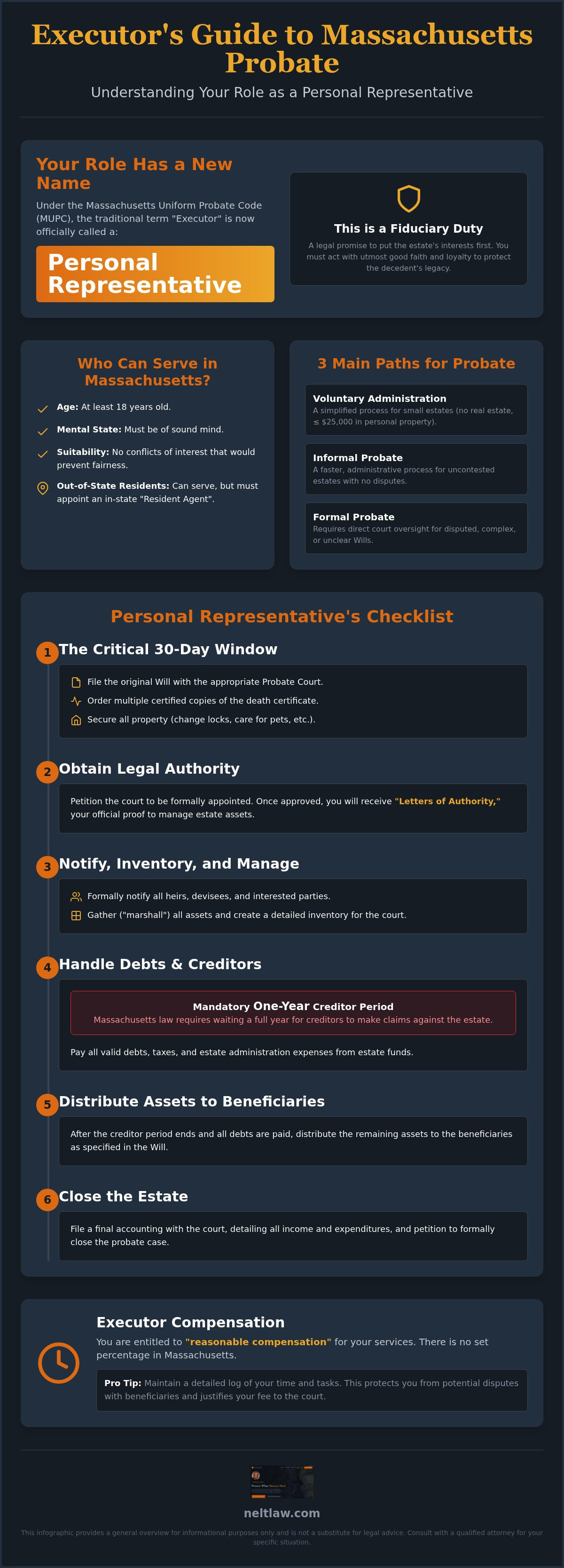
If you've been named in a loved one's will, you might be looking for a clear definition of What is an Executor? and how it applies to your specific situation. In Massachusetts, the legal terminology changed significantly in 2012 with the adoption of the Massachusetts Uniform Probate Code (MUPC). While many people still use the traditional term, the court now officially refers to this role as a "Personal Representative." This change was designed to create a more consistent process across the state, but the core executor of will duties Massachusetts residents must fulfill remains focused on protecting the decedent's legacy with integrity.
Stepping into this role means you're accepting a fiduciary duty. This isn't just a fancy legal term; it's a promise to put the estate's needs before your own. You're responsible for managing assets, paying valid debts, and ensuring beneficiaries receive what they were promised. Under the Massachusetts Uniform Probate Code, a Personal Representative is a fiduciary who must observe the standards of care applicable to trustees, acting with the utmost good faith and loyalty to settle and distribute the estate as expeditiously and efficiently as is consistent with the best interests of the estate and its beneficiaries.
Different Types of Probate Appointments
Whether you're filing in the Middlesex or Worcester Probate and Family Court, your specific path depends on the complexity of the estate and whether family members agree on the will's validity. Informal probate is often a faster, administrative process for uncontested estates where no one expects a fight. If there are disputes or unclear language in the will, you may need formal probate, which involves more direct court oversight and "supervised" administration. For very small estates with no real estate and personal property valued at $25,000 or less, you might qualify for Voluntary Administration, a simplified process that avoids many of the standard hurdles.
Who Can Serve as an Executor in Massachusetts?
To serve as a Personal Representative, you must be at least 18 years old and of sound mind. The court also looks for "suitability," ensuring you don't have personal conflicts that would prevent you from being fair to all parties involved. If you live outside of Massachusetts, you can still serve, but you must appoint a "Resident Agent" who lives in the state to receive official legal documents on your behalf. This ensures the court has a reliable point of contact within the Commonwealth.
Sometimes, a will names co-executors to share the burden of administration. While sharing the executor of will duties Massachusetts requires can provide emotional support, it also means you must work in lockstep with another person on every major decision. Whether you are acting alone or with a partner, the court expects the same level of diligence and care throughout the process.
Step-by-Step Checklist of Executor Duties in Massachusetts
Taking on the role of a Personal Representative can feel like starting a second job while you are still processing a personal loss. It's helpful to view the executor of will duties Massachusetts requires as a series of small, manageable steps rather than one giant hurdle. By breaking the process down into a logical sequence, you can ensure you're protecting the estate and staying in compliance with the law without becoming overwhelmed by the scope of the task.
The Initial 30-Day Window: Critical Deadlines
The first month is often the most active. Massachusetts law requires you to locate the original Will and file it with the Probate Court within 30 days of the decedent's death. Even if you aren't ready to start the full probate process, filing the document is a necessary legal protection. During this time, you should also secure the decedent's property. This might mean changing the locks on a home in Worcester, ensuring pets are cared for, and stopping the mail. You will also need to order several certified copies of the death certificate, as banks and insurance companies will require these to grant you access to accounts.
Once the Will is filed, your next step is petitioning the court for "Letters of Authority." This document is your official "badge" that proves you have the legal right to act. After the court grants this, you must notify all heirs, devisees, and potential creditors. This transparency is vital; it prevents future disputes and ensures everyone with a stake in the estate is aware of the proceedings. If the paperwork feels daunting, professional probate administration support can provide the guidance needed to navigate these filings accurately.
Inventory and Appraisal: Determining the Estate's Value
Your third major task is creating a complete inventory of everything the decedent owned. You will use Form MPC 961, the official Massachusetts Inventory form, to list probate assets like bank accounts, vehicles, and personal belongings. It is important to distinguish these from non-probate assets, such as life insurance policies with named beneficiaries, which generally pass outside of the court process. For real estate located in Middlesex or Worcester County, you should hire professional appraisers to establish a fair market value as of the date of death.
Finally, you must manage the estate's financial obligations. This includes paying valid debts, funeral expenses, and taxes. Keep in mind that for deaths in 2026, the Massachusetts estate tax threshold remains at $2 million. You must also respect the one-year creditor claim period, which means you typically shouldn't make final distributions to beneficiaries until a full year has passed since the date of death. This waiting period protects you from personal liability if an unexpected debt surfaces later.
Navigating the Legal and Financial Hurdles of Probate
Once the initial paperwork is filed, the middle phase of probate often brings the most complex financial challenges. This is where your role shifts from an administrator to a protector of the estate's resources. You'll need to balance the expectations of beneficiaries who are eager for their inheritance with the strict legal timelines designed to protect creditors. Managing these executor of will duties Massachusetts requires patience, as many of the most important steps simply cannot be rushed without creating personal risk for you.
One of the most significant hurdles is the mandatory waiting period for debts. Under Massachusetts law, creditors have exactly one year from the decedent's date of death to file a claim against the estate. If you distribute assets to family members before this window closes, you might find yourself personally responsible for paying a legitimate debt that surfaces later. It's often helpful to explain this "one-year rule" to beneficiaries early on so they understand that the delay isn't a result of your inaction, but a necessary legal shield for everyone involved.
Selling real estate in Middlesex or Worcester County adds another layer of complexity. Whether it's a family home in Cambridge or a property in the center of Worcester, you must ensure you have the specific "power of sale" granted by the Will or a separate license from the court. You'll also need to coordinate with the Department of Revenue if the estate exceeds the $2 million threshold to obtain a release of the automatic estate tax lien. Filing the final federal and Massachusetts estate tax returns (Form M-706) within nine months of the date of death is a critical task that ensures the title to the property remains clear for future owners.
Local Nuances: Middlesex and Worcester Probate Courts
The experience of filing can vary depending on which court you visit. The Middlesex Probate and Family Court, with locations in Cambridge and Lowell, is one of the busiest in the Commonwealth. It's often beneficial to double-check every form for even minor errors before submission, as the high volume of cases can lead to longer processing times for corrected filings. In contrast, the Worcester Probate and Family Court has its own unique administrative culture. Local executors often find that building a polite, professional relationship with the court clerks can help you understand specific local preferences for how documents should be organized, which can lead to smoother approvals.
Handling Debts and Insolvency
What happens if the estate has more debt than assets? This is known as an "insolvent" estate, and it requires a very specific order of priority for payments. Under Massachusetts law, you must pay administrative expenses, funeral costs, and taxes before addressing general credit card debts or personal loans. If the estate is "upside down," you shouldn't pay any creditors until you've confirmed the full list of claims. By following the legal hierarchy of payments, you protect yourself from liability and ensure that the limited resources are distributed exactly as the law requires.
Managing Executor Fees and Beneficiary Expectations
One of the most sensitive parts of settling an estate is the financial side, particularly when it comes to your own compensation and the expectations of those waiting for their inheritance. Balancing the executor of will duties Massachusetts requires you to be transparent about costs and your own time. When beneficiaries understand the process, it lowers the defensive barriers that often lead to family friction. Open dialogue is your best tool for ensuring the decedent's wishes are honored without damaging relationships.
In Massachusetts, the law doesn't set a fixed percentage for what you can be paid. Instead, under Massachusetts General Laws Chapter 206, Section 16, you're entitled to "reasonable compensation." This flexibility is helpful but can also create uncertainty. To protect yourself and the estate, it's vital to keep a meticulous time log of every task you perform. Whether you're spending an hour at the bank or a morning at the Worcester Probate Court, documenting your effort provides a clear justification for your fee if a beneficiary ever questions it.
Predictability is key during this emotional time. Traditional hourly legal billing can feel like a "ticking clock," adding to your anxiety every time you have a question. Choosing flat-fee probate administration ensures that the estate's bottom line is protected from surprise bills, allowing you to focus on your duties with a sense of relief and certainty.
Calculating Your Fee as an Executor
When determining what's "reasonable," the court looks at the time you spent, the complexity of the assets, and the final outcome you achieved. If you're managing a straightforward estate with a few bank accounts, your fee will look different than if you're handling a complex business succession or a contested property sale in Middlesex County. Keep in mind that executor fees are considered taxable income by the IRS. While many family members initially choose to waive their fee out of love, it's important to consider the significant time commitment involved before making that decision final.
Dealing with Difficult Beneficiaries
Transparency acts as a powerful shield against misunderstandings. Providing regular, written updates to heirs keeps everyone on the same page and prevents the feeling of being "left in the dark." Before you make any final distributions, it's standard practice to use a "Release and Assent" form. This document confirms that the beneficiaries agree with your accounting and protects you from future legal challenges. If tensions rise, having an experienced partner can serve as a vital buffer, providing calm, non-judgmental mediation to resolve family disputes before they reach a courtroom.
How Northeast Legal Team Simplifies the Probate Journey
Managing the executor of will duties Massachusetts requires of you shouldn't feel like a solitary burden. Many families find that the most stressful part of probate isn't the paperwork itself, but the uncertainty of legal costs. Traditional hourly billing can create a "ticking clock" feeling, where every phone call or question adds to your financial anxiety. Northeast Legal Team removes this barrier by offering a flat-fee model. This approach ensures that you have access to professional guidance without the fear of surprise bills, allowing you to focus on your family's healing rather than a mounting legal invoice.
With over 14 years of experience, David E. Walker, Esq., and our compassionate team provide a steady hand for families in Middlesex and Worcester Counties. We understand the local nuances of the Cambridge, Lowell, and Worcester courts, which helps us ensure your filings are handled correctly the first time. This local expertise reduces the risk of administrative delays and gives you the certainty that you are fulfilling your duties with complete legal integrity. We act as your protective advocate, transforming a potentially overwhelming process into one that feels manageable and safe.
Our Flat-Fee Probate Process
Our process begins with an initial assessment to understand the unique scope of the estate. This step is about listening first, ensuring we understand the human story behind the legal file. We don't believe in high-pressure sales; instead, we offer a supportive environment where you can ask questions and gain clarity. Once we have a clear picture, we provide predictable pricing so you know the total cost of our support upfront. For a deeper look at how this model protects your family, you can read more about a Flat Fee Probate Attorney Massachusetts: Predictable Support for Your Family. This transparency transforms a complex legal journey into a predictable path forward.
Your Next Steps Toward Peace of Mind
Taking the first step toward resolving an estate is often the hardest, but it's also the moment where relief begins. You can schedule a free probate assessment to discuss the estate's needs and receive a clear roadmap of your responsibilities. When you're ready for your first consultation, try to bring the original Will, a death certificate, and a general list of known assets. Having a professional advocate by your side means you don't have to worry about missing a deadline or making a costly mistake in the Middlesex or Worcester court systems. We are here to guide you from the initial filing of the petition to the final accounting, ensuring the decedent's legacy is handled with the care and dignity it deserves.
Honoring a Legacy with a Steady Hand
Settling an estate is a journey that requires both legal precision and emotional resilience. By now, you understand that the executor of will duties Massachusetts requires aren't just about filing paperwork; they're about stewardship and honoring a loved one's final wishes. Whether you're navigating the busy Middlesex Probate Court or coordinating an appraisal in Worcester County, you don't have to carry this weight alone. We've seen how a clear roadmap and predictable, flat-fee pricing can transform an overwhelming process into one that feels manageable and safe.
With over 14 years of estate planning and probate experience, our team is here to provide the protective advocacy you deserve. You can fulfill your responsibilities with confidence, knowing that every legal hurdle is being handled with a steady hand. If you're ready to move from a state of worry toward order and tranquility, we're here to help. Schedule your free probate assessment with Northeast Legal Team today. Let us handle the complexities so you can focus on what truly matters: your family and your peace of mind.
Frequently Asked Questions
How long does an executor have to settle an estate in Massachusetts?
A straightforward probate process in Massachusetts typically takes between 9 and 18 months to complete. This timeline is largely influenced by the mandatory one-year creditor claim period, which requires the estate to remain open to address potential debts. If the estate involves contested assets or complex real estate holdings in Worcester County, the process can extend to two years or longer. Working with an experienced guide helps you manage these expectations while ensuring every legal requirement is met efficiently.
Can an executor be held personally liable for the decedent's debts in MA?
You aren't personally responsible for the decedent's debts unless you fail to follow specific legal protocols. For example, if you distribute assets to beneficiaries before the one-year creditor period expires, you could be held liable if a valid debt later surfaces. Understanding the executor of will duties Massachusetts mandates is your best protection against this risk. We focus on providing a steady hand to ensure you avoid these common legal pitfalls during administration.
What is the difference between an Executor and a Personal Representative in Massachusetts?
There is no functional difference between the two terms in the Commonwealth today. Massachusetts officially adopted the title "Personal Representative" in 2012 to standardize language across different types of estate cases. While older Wills may still use the word "Executor," the court will issue Letters of Authority that designate you as the Personal Representative. This modern terminology covers the same fiduciary responsibilities of managing assets, paying valid debts, and distributing the remaining inheritance to heirs.
Does every will in Massachusetts have to go through probate?
Not every estate requires a full probate proceeding to settle a loved one's affairs. If the decedent’s assets were held in a living trust or as joint tenants with right of survivorship, those items pass directly to beneficiaries. Additionally, estates with personal property valued at $25,000 or less and no real estate can often use a simplified Voluntary Administration process. We can help you determine if the estate qualifies for these streamlined paths during an initial assessment.
How much can an executor charge for their services in Massachusetts?
Massachusetts law allows you to receive "reasonable compensation" rather than a fixed percentage of the estate's value. The court determines what is reasonable by looking at the time you spent, the complexity of the executor of will duties Massachusetts requires, and the results achieved. It's essential to keep a detailed log of your hours to justify your fee. Many family members choose to waive this payment, but you should consider the significant time commitment first.
Can an executor sell a house in Massachusetts without all beneficiaries agreeing?
You can sell a house without the consent of all beneficiaries if the Will specifically grants you a "power of sale." If the Will is silent on this matter, you must petition the court for a "license to sell" real estate. While you have the legal authority to proceed, keeping beneficiaries informed about the sale of a family home in Middlesex County is a wise way to prevent disputes and maintain family harmony throughout the process.
What happens if a person dies without a will in Massachusetts?
When someone dies without a Will, the estate is considered "intestate," and Massachusetts law determines who inherits the property. The court will appoint a Personal Representative, usually a spouse or close family member, to manage the estate according to state-mandated priority. This process can sometimes lead to family anxiety or disputes over assets. Having a protective advocate helps ensure the legal hierarchy is followed correctly while providing a calm path forward for the grieving family.
How do I start the probate process in Middlesex or Worcester County?
You start the process by filing a petition for probate at the Probate and Family Court in the county where the decedent lived. For residents of Middlesex County, this means filing in Cambridge or Lowell, while Worcester residents use the Worcester court. You'll need to submit the original Will, a death certificate, and the initial $390 filing fee. Our flat-fee support ensures your petition is accurate from the start, helping you avoid the stress of administrative delays.


