

What if the most difficult part of building your company wasn't the decades of grit, but the simple act of stepping away? You've poured your life into your work, yet the thought of retirement often brings more anxiety than relief. It's common to worry about whether your family will stay united once you're gone or how the $2,000,000 Massachusetts estate tax threshold might impact what you leave behind. Engaging in proactive business succession planning Lowell MA is the most effective way to replace that uncertainty with a sense of total control.
We understand that you want a transition that's as smooth as the business you've built. In this guide, you'll discover how to protect your legacy and maintain family harmony without the fear of unpredictable legal bills. We'll walk through how to value your life's work, shield your assets from partner disputes, and use flat-fee planning to create a clear roadmap for your future. By the end, you'll see exactly how to move from a state of worry into a season of well-deserved tranquility.
Key Takeaways
- Learn why business succession planning Lowell MA is essential for protecting your family legacy and ensuring a smooth transition of leadership.
- Understand how Buy-Sell Agreements and Operating Agreements act as shields against partner disputes and unwanted ownership changes.
- Discover the three primary methods for valuing your business so you can feel confident in the worth of your life's work.
- Gain clarity on the "Equal vs. Equitable" debate to prevent family conflict and ensure every heir feels valued and respected.
- See how a flat-fee model removes the anxiety of unpredictable legal costs, giving you a clear, fixed-price roadmap to retirement.
What is Business Succession Planning and Why Does Lowell Need It?
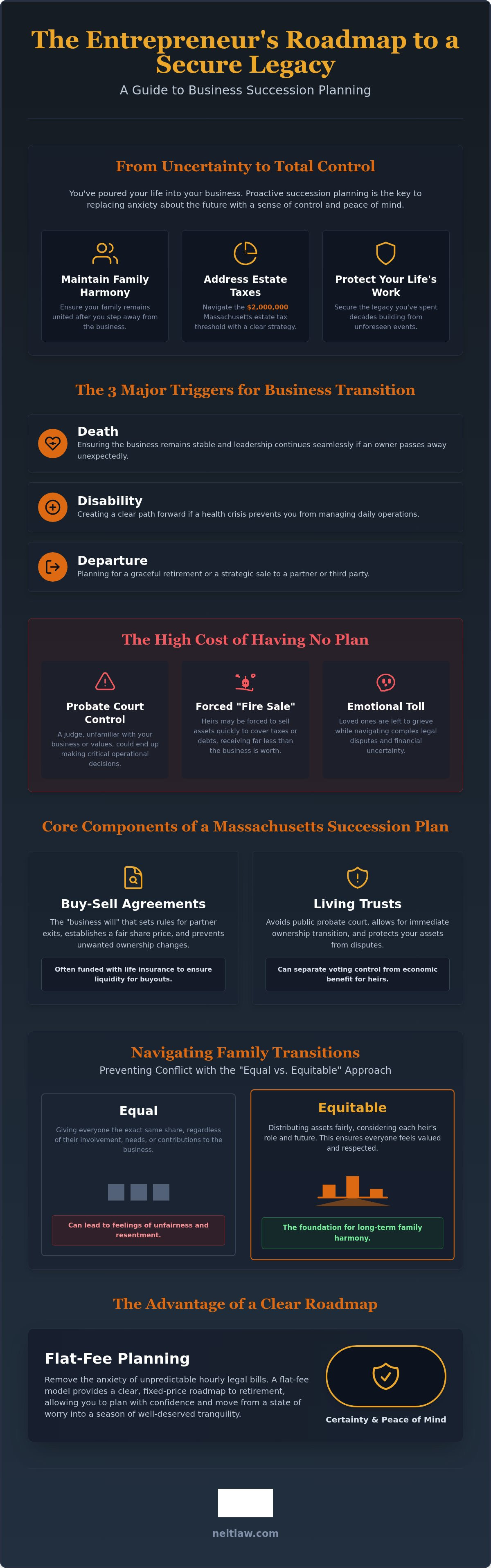
You've spent years building something special in the Merrimack Valley. Whether you're running a multi-generational manufacturing firm near the Hamilton Canal or a scaling tech startup in the city's downtown, your business is more than just a source of income; it's your legacy. What is Business Succession Planning? At its heart, it's the strategic process of deciding exactly how leadership and ownership will transition when you decide to step away. For local entrepreneurs, business succession planning Lowell MA isn't just a legal checklist. It's a way to ensure that the three major triggers for transition don't dismantle everything you've worked to create:
- Death: Ensuring the business remains stable if the owner passes away unexpectedly.
- Disability: Creating a clear path forward if a health crisis prevents you from managing daily operations.
- Departure: Planning for a graceful retirement or a strategic sale to a partner or third party.
Our city has a unique business landscape. We have a beautiful blend of old-school family service companies and modern innovation. This mix requires local expertise because the needs of a family-run plumbing company differ greatly from a software firm. The ultimate goal is simple: your business should thrive under new leadership while your family stays united and financially secure.
The Consequences of Inaction for Lowell Owners
If you don't have a plan in place, you're essentially leaving your company's fate to the state of Massachusetts. Without a clear roadmap, your business could end up in probate court. This means a judge who doesn't know your employees or your values could be making decisions about your daily operations. In many cases, the lack of a plan forces a "fire sale." This happens when heirs are forced to sell assets quickly to cover taxes or debts, often receiving far less than the business is actually worth. The emotional toll on your loved ones is often even heavier than the financial loss. They're left to grieve while simultaneously navigating complex legal disputes and financial uncertainty.
Moving from Anxiety to Order
Choosing to plan today is a proactive gift to your employees, your partners, and your heirs. It's the difference between leaving behind a crisis and leaving behind a legacy of peace. Instead of forcing your family into "crisis management" mode during a difficult time, you provide them with a strategy rooted in certainty. Effective business succession planning Lowell MA acts as a protective shield for a Lowell entrepreneur’s life work, ensuring that your vision continues long after you've retired.
The Core Components of a Massachusetts Succession Plan
A solid foundation for business succession planning Lowell MA starts with the understanding that your company doesn't exist in a vacuum. It's deeply connected to your family, your partners, and your personal financial health. To keep these parts moving in harmony during a transition, you need a specific set of legal tools that work together. These components act as a safety net, ensuring that your business remains a source of stability rather than a source of conflict when leadership changes hands. By addressing these elements now, you're building a bridge toward a secure retirement and a protected legacy.
Buy-Sell Agreements: The "Business Will"
Think of a Buy-Sell Agreement as a "business will" for your company. It sets the rules of the road for what happens if a partner wants to leave or if an owner passes away. These agreements prevent unwanted outsiders from entering the business and establish a fair price for shares before a crisis occurs. Funding is a critical part of this process. Many Lowell owners use life insurance to fund these buyouts. This ensures that the remaining partners have the liquidity to pay the departing owner's family without draining the company's bank accounts. For a deeper look at how these tools protect your future, you can read about Business Succession Planning in Massachusetts: Securing Your Legacy and Peace of Mind.
The Role of Trusts in Business Continuity
A Living Trust is one of the most effective ways to avoid the "cold" and public nature of probate court. When your business interests are held within a trust, the transition of ownership can happen almost immediately. This allows you to separate voting control from economic interest. For example, you might want one child to manage the daily operations while ensuring all your children benefit from the company's profits. Trusts also provide a layer of protection, shielding the business from a beneficiary's personal liabilities or legal disputes. It's a way to ensure the business stays in the family and continues to thrive.
Beyond agreements and trusts, you must also consider Operating Agreements and "Key Person" protection. An Operating Agreement dictates who makes the big decisions if you're suddenly unable to lead. Key Person insurance provides a financial cushion to help the business recover if a vital leader is lost. Finally, your business plan must be perfectly aligned with your personal estate plan. If they aren't working together, you might solve a professional problem while creating a personal tax headache. If you're feeling unsure about where to start, speaking with a supportive legal guide can help you see the path forward with clarity.
Business Valuation and Transfer Strategies
How do you put a price tag on decades of grit, late nights, and community trust? In business succession planning Lowell MA, valuation is more than just a calculation; it's the cornerstone that makes every other decision possible. If you don't know what your company is worth today, you can't accurately plan for your family's future or your own retirement. We typically look at three primary ways to find that number:
- Asset-Based Approach: This is common for Lowell manufacturing or equipment-heavy firms. It totals the value of everything you own, from the building to the machinery.
- Market-Based Approach: This compares your business to similar companies that have sold recently in the Merrimack Valley or similar markets.
- Income-Based Approach: This is often best for service-based companies or tech startups, as it focuses on your projected future earnings and cash flow.
One common mistake is putting a "fixed price" in your legal documents. A business worth $1 million today might be worth $3 million in five years. Instead, we use a valuation formula. This ensures the price stays fair and accurate as your company grows, preventing future disputes between departing and remaining partners.
Transferring to Family vs. Key Employees
Deciding who takes the reins is often an emotional crossroads. Keeping the business "in the family" preserves your name and legacy, but it can create friction if one child works in the business while others don't. This "sweat equity" versus "inheritance" conflict is a leading cause of family disputes. Alternatively, a management buyout or an Employee Stock Ownership Plan (ESOP) rewards the people who helped you build the company. When identifying a successor, ask yourself:
- Does this person have the respect of our long-term employees?
- Are they financially literate enough to manage the company's debt and cash flow?
- Do they actually want the responsibility, or do they just feel obligated?
- Can they maintain their composure during a market downturn?
Minimizing the Massachusetts Estate Tax Hit
In 2026, the Massachusetts estate tax exemption remains at $2,000,000. While that sounds like a lot, it includes your home, your savings, and the full value of your business. Because Massachusetts does not allow for "portability" between spouses, a successful Lowell business can easily trigger a tax bill of 7.2% to 16%. In Massachusetts, your business value can quickly push an estate into tax territory without proper trust structuring. Since our state has no gift tax, gifting small portions of business interests to your heirs now can be a powerful way to reduce your taxable estate while you're still here to mentor the next generation.
Avoiding Common Pitfalls in Lowell Family Transitions
The greatest risk to your legacy isn't usually a market crash or a bad hire; it's often the conversations that never happen. Many entrepreneurs fall into the trap of waiting too long to begin business succession planning Lowell MA, assuming they'll have plenty of time to "figure it out" later. Unfortunately, waiting until a health crisis or a partner dispute arises forces you into reactive mode. When you're in a rush, you're more likely to make emotional decisions that can lead to years of family friction and legal headaches. Starting early allows you to mentor your successor and test the plan while you're still there to provide a steady hand.
Another common mistake is the "Equal vs. Equitable" trap. You love your children equally, so your first instinct might be to split the business ownership 50/50. However, if one child has worked in the company for a decade and the other has never stepped foot in the office, an equal split can lead to resentment and paralysis. If the active child feels their hard work is simply increasing the value of their sibling's inheritance, motivation can vanish. We often help families find equitable solutions, perhaps using life insurance or other assets to provide for the non-active heirs while leaving the business to the one who will actually lead it.
It's also tempting to use "DIY" online documents to save on costs. While these templates seem convenient, they often fail to account for specific Massachusetts laws or the unique nuances of your specific industry. A plan that isn't legally sound under our state's requirements is essentially just a piece of paper. Finally, remember that your plan isn't a "set it and forget it" document. As your business grows and your family dynamics change, your strategy must evolve. Regular reviews ensure that your protection remains as strong as the day you first signed the paperwork.
The Human Side: Managing Stakeholder Ambitions
Succession is as much about hearts as it is about charts. Facilitating family meetings is essential to reduce friction before it starts. These gatherings provide a safe space for "silent" partners or family members not involved in daily operations to voice their concerns and feel heard. When everyone understands the roadmap, the chance of a dispute drops significantly. If you need help finding a professional who can lead these sensitive discussions, check out this Best Estate Attorney Near Me: A Comprehensive Checklist for 2026 to find a mediator-style advocate who prioritizes family harmony.
Legal Compliance and Local Regulations
Maintaining your corporate records is a vital part of protecting your transition. In Middlesex County, ensuring your corporate minutes and "Doing Business As" (DBA) certificates are current is a basic but often overlooked step. Massachusetts-specific labor and tax laws also play a massive role in how you transfer ownership. Having a local Lowell presence matters because your legal counsel needs to understand the local business environment and the specific expectations of the Secretary of the Commonwealth’s office. If you're ready to move from uncertainty to a clear, protected future, you can request a free initial assessment to start your journey toward peace of mind.
The Northeast Legal Team Advantage: Flat-Fee Succession Planning
Most business owners hesitate to start the planning process because they've had frustrating experiences with traditional law firms. The billable hour model often creates a barrier between you and your attorney, making you feel like every quick question or phone call is a drain on your company's bottom line. At Northeast Legal Team, we've intentionally moved away from that "cold" industry standard. By offering predictable, flat-fee business succession planning Lowell MA, we ensure that you can focus on your legacy rather than a ticking clock on the wall. This transparency allows us to build a relationship based on trust and open communication, which are the most important ingredients for a successful transition.
David E. Walker, Esq., brings over 14 years of experience to his role as a "Compassionate Mentor" for local entrepreneurs. He understands that behind every cap table and operating agreement is a human story of hard work and family dreams. Our approach is to listen first, ensuring we understand your specific goals before we ever suggest a legal instrument. Whether you're looking to retire in five years or simply want a safety net for the unexpected, we position ourselves as your long-term partner in the Lowell community. We're here to provide the steady hand you need to move from a state of worry into a season of resolution.
Why Predictable Pricing Matters for Your Bottom Line
When you know exactly what your legal investment will be from the start, you're more likely to engage deeply in the process. Flat fees encourage the kind of thorough, unhurried conversations that complex business transitions require. You shouldn't have to treat your succession plan like a financial "black hole" where costs spiral out of control. For a more detailed look at how this model benefits your planning, you can read our Estate Planning Attorney Flat Fee: A Guide to Transparent Legal Costs in 2026. This approach ensures that we can explore every strategy, from gifting interests to trust structuring, without the anxiety of billing surprises.
Your Next Steps Toward a Secure Legacy
The journey toward a protected future begins with a simple, no-obligation conversation. We invite you to an initial assessment where we'll help you identify your "Succession Gap"—the space between where your business is today and where it needs to be for a safe transfer. We remain deeply committed to the families and business owners of Middlesex and Worcester counties, providing the local expertise that national templates simply can't match. Business succession planning Lowell MA is about more than just paperwork; it's about providing you with a clear, calm roadmap for the years ahead. You’ve built your business with care; let us help you protect its future with the same dedication.
Securing Your Legacy and Your Family's Future
You've spent a lifetime building your company, and now you have the tools to protect it. We've explored how proper valuation, clear buy-sell agreements, and trust structures can keep your company thriving while maintaining family harmony. By starting business succession planning Lowell MA today, you ensure that your transition happens on your terms. You can avoid the common pitfalls of "Equal vs. Equitable" distributions and shield your assets from the $2 million Massachusetts estate tax threshold.
Northeast Legal Team believes legal guidance should be a source of relief, not a financial burden. David E. Walker, Esq., uses his 14 years of experience to provide compassionate, plain-English advice that cuts through the jargon. With our predictable flat-fee pricing, you can plan with confidence knowing there won't be any billing surprises. Take the first step toward a secure retirement and a lasting legacy today.
Schedule Your Free Business Succession Assessment with Northeast Legal Team
You don't have to navigate this transition alone. We're here to be your steady hand, turning your years of hard work into a protected future for those you love most.
Frequently Asked Questions
How much does business succession planning cost in Massachusetts?
While many firms charge by the hour, we prioritize a flat-fee model to provide you with total cost predictability. The total investment depends on the complexity of your company and the specific legal instruments needed, such as buy-sell agreements or living trusts. By choosing a fixed price, you eliminate "billing anxiety" and ensure you can have open conversations without the clock ticking. This allows you to focus on the quality of your plan rather than the cost of each phone call.
What is the difference between an exit strategy and a succession plan?
An exit strategy is your high-level goal for leaving the business, such as selling it for a specific profit or passing it to your heirs. A succession plan is the detailed roadmap that makes that exit possible. It includes the legal documents, leadership training, and valuation formulas required for a smooth transition. Think of the exit strategy as your destination and the succession plan as the turn-by-turn directions that ensure you and your family arrive safely.
Can I use my existing will for business succession?
A standard will is rarely enough to protect a complex company. While a will dictates who inherits your assets, it doesn't provide the operational instructions or legal authority needed to run a company during the probate process. Without specific business succession planning Lowell MA, your company could face months of uncertainty in court. Using a Living Trust or an Operating Agreement ensures that leadership transitions happen immediately, keeping your business stable and your employees secure during a difficult time.
What happens to my Lowell business if I die without a succession plan?
If you pass away without a plan, your business enters the Massachusetts probate court system. This often leads to a public legal process where a judge, rather than your family, makes critical decisions about your company's future. It can trigger "fire sales" to pay for taxes or debts, significantly devaluing your life's work. Most importantly, it often creates intense family conflict as heirs struggle to manage the business without a clear roadmap or a defined leadership structure.
Does a Buy-Sell Agreement need to be funded with insurance?
Funding a Buy-Sell Agreement with life insurance is a highly effective way to ensure liquidity when it's needed most. If a partner passes away, the insurance payout provides the remaining owners with the cash needed to buy out the deceased partner's shares from their heirs. This protects the business from being drained of operating capital and ensures the family receives a fair price immediately. While not strictly required, insurance is the most common tool used to prevent financial strain.
How often should I update my business succession plan?
You should review your plan every two to three years or whenever a significant life event occurs. Changes in Massachusetts tax laws, such as shifts in the $2,000,000 estate tax exemption, or major changes in your business's value can make your current strategy outdated. Marriage, divorce, or a new partner entering the business are also critical triggers for an update. Regular reviews ensure your protection remains as strong as the day you first signed your legal documents.
Is business succession planning only for large corporations?
Succession planning is actually more critical for small and family-owned businesses than for large corporations. Large companies often have boards and deep management layers to handle transitions. For a Lowell entrepreneur, the business is often the family's largest asset. Without business succession planning Lowell MA, the loss of a single owner can cause the entire operation to collapse. Planning is a protective shield that ensures your small business survives and continues to support your family and employees.
How do I choose between a family member and a key employee as a successor?
Choosing a successor requires looking beyond personal relationships to evaluate objective leadership skills. A family member might preserve your name and legacy, but they must have the passion and competence to lead. A key employee often brings deep operational knowledge and the respect of the staff. We suggest a "listen-first" approach, having honest conversations with both parties to see who truly wants the responsibility. Sometimes, a hybrid model where family owns the shares while an employee manages operations is the best solution.


