

Imagine the legacy you've spent decades building suddenly becoming a source of conflict for your children rather than a gift. It's a heavy thought, but for many local business owners, the lack of a formal transition plan turns a lifetime of hard work into a legal tangle. You want to ensure your employees are taken care of and your family remains united, yet the complexity of the $2 million Massachusetts estate tax threshold and the fear of open-ended legal fees often keep these vital conversations on the back burner.
By partnering with a dedicated business succession planning attorney massachusetts, you can replace that underlying anxiety with a clear, mentor-led strategy that protects your assets and your peace of mind. This isn't just a transaction; it's a commitment to the people who depend on you. This guide explores how to navigate the 2026 tax landscape, avoid common pitfalls in ownership transfers, and secure a predictable, flat-fee path toward a lasting family legacy.
Key Takeaways
- Understand why waiting for a health or financial crisis to plan can diminish your company’s value and leave your family facing avoidable legal hurdles.
- Explore how a business succession planning attorney massachusetts uses Buy-Sell Agreements and Trusts to provide a clear, legally binding roadmap for ownership transitions.
- Evaluate the practical differences between transitioning your business to family members, employees, or third-party buyers to find the best fit for your legacy.
- Learn the essential steps of a professional valuation and "health check" to ensure your business is financially and operationally prepared for its next chapter.
- Discover the peace of mind that comes with a transparent, flat-fee model, allowing you to focus on your transition strategy without the stress of hourly billing.
Why Business Succession Planning is Essential for Massachusetts Owners
Succession planning is essentially a legal and financial roadmap that dictates how ownership and leadership of your company will be transferred when you decide to step away. It's about more than just paperwork; it's about ensuring the dream you built doesn't dissolve the moment you aren't there to steer the ship. If you don't have a plan, you're leaving your legacy to chance.
Waiting for a crisis, like a sudden illness or an unexpected passing, often forces a business into a tailspin. Without a clear plan, the value of your business can plummet overnight as uncertainty takes hold among clients, vendors, and lenders. A proactive business succession planning attorney massachusetts helps you avoid this chaos by establishing clear protocols long before they're needed.
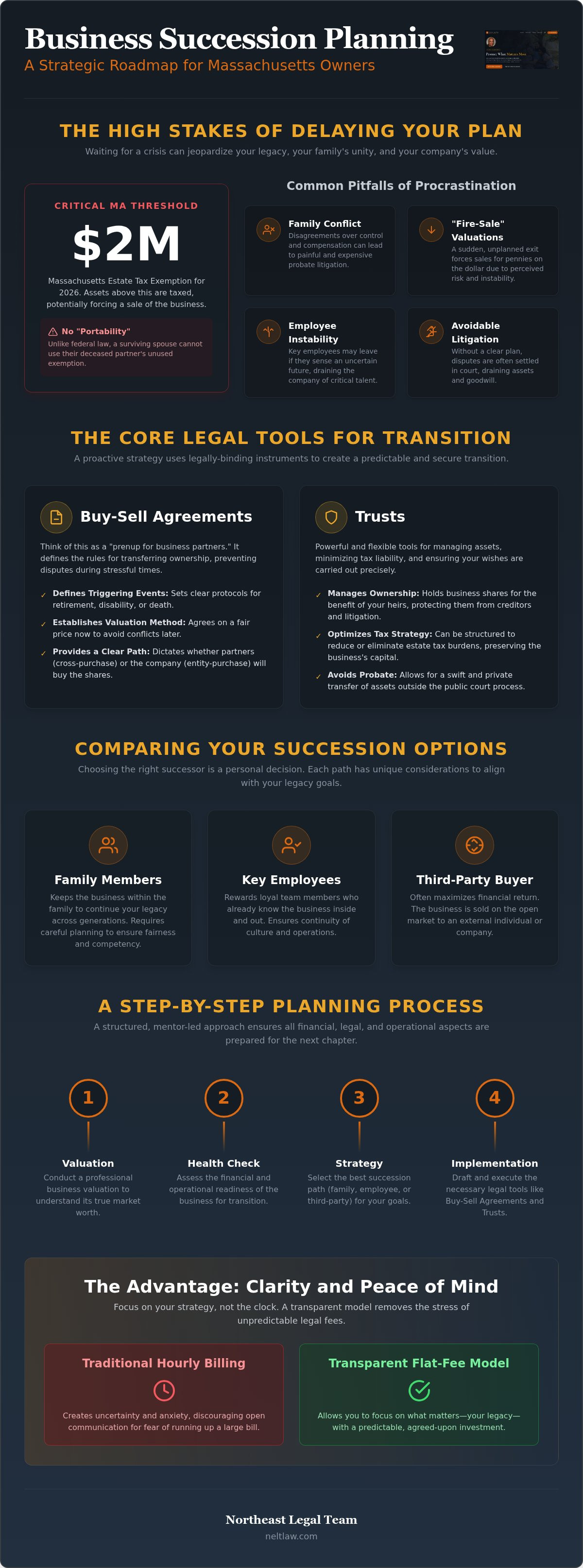
In Massachusetts, the stakes are particularly high due to our unique tax laws. For 2026, the state's estate tax exemption is set at $2 million. Unlike federal law, Massachusetts doesn't allow "portability," which means a surviving spouse can't automatically use their deceased partner's unused exemption. For many closely-held businesses, the value of the company alone can push an estate over this limit, potentially forcing heirs to sell the business just to pay the tax bill. When you lack a legally sound strategy, your family and business partners are often left to resolve disagreements through avoidable and expensive probate litigation.
The Emotional and Financial Stakes of Your Legacy
Many business owners face what we call the "founder's dilemma." It's incredibly difficult to imagine your business operating without you, and that emotional weight often leads to procrastination. However, failing to act can spark painful family infighting in Middlesex County probate courts, where siblings or partners may clash over control and compensation. True business continuity means your company remains stable, profitable, and harmonious even during a major leadership transition. It gives you the freedom to retire with the knowledge that your family's financial security is locked in.
Protecting the Value You’ve Built
A sudden exit without a strategy often leads to "fire-sale" valuations. In these scenarios, your life's work is sold for pennies on the dollar because of the perceived risk of a leaderless company. You also need to consider your key employees. These individuals need to know their jobs are secure, or they might look for work elsewhere the moment they sense instability. Working with a business succession planning lawyer in Massachusetts allows you to approach this as a mentored process. A skilled business succession planning attorney massachusetts acts as a protective advocate, helping you navigate these complex choices with clarity rather than just handing you a stack of documents you don't understand.
The Core Legal Tools for a Successful Business Transition
Transitioning your business is a deeply personal journey. It's about moving from active leadership to a new chapter of life while ensuring your hard work continues to thrive. To do this safely, you need a collection of legal tools designed to protect both the company and your family. If you're looking for a structured approach to these concepts, resources like this Succession Planning Toolkit can help you visualize the steps ahead. A business succession planning attorney massachusetts will help you select the right instruments for your specific situation, ensuring every document reflects your unique goals.
Buy-Sell Agreements: The Foundation of Control
Think of a Buy-Sell Agreement as a prenuptial agreement for your business partners. It sets the ground rules for what happens when someone leaves the company. These agreements are activated by triggering events, which usually include death, permanent disability, or a planned retirement. By deciding on a fair valuation method now, you prevent emotional conflicts later when stress levels are high. You might choose a cross-purchase agreement, where partners buy each other out directly, or an entity-purchase agreement, where the business itself repurchases the shares. Setting these terms today ensures that a sudden change doesn't lead to a messy legal battle over the company's worth.
Using Trusts to Manage Ownership and Taxes
Trusts are powerful allies in your succession strategy. A well-structured trust can provide financial support for your spouse while keeping the actual management of the business in the hands of your chosen successor. This separation of economic interest and control is often the key to maintaining family harmony. When considering your options, you might look into the asset protection trust cost and how those structures might fit into your broader financial plan. Using trusts also allows your business interests to pass privately, helping your family avoid the public and often expensive probate process in Worcester County.
Life insurance often acts as the fuel that makes these plans work. It provides the liquidity needed to fund a buy-out without draining the company's cash reserves. This ensures your family receives the full value of your share immediately, while your partners can continue operations without a heavy debt burden. Finally, it's vital to integrate these business arrangements with your personal will and testament. If your personal and professional plans aren't aligned, they can contradict each other, leading to confusion and delays. Taking the time to coordinate these documents now is a gift of clarity to your loved ones. If you're ready to start building this roadmap, you can request a personalized assessment to see which tools fit your legacy best.
Comparing Your Succession Options: Family, Employees, or Third Parties
Deciding who will take the reins of your business is perhaps the most personal choice you'll make as a founder. It's a decision that balances your financial needs with the desire to see your hard work continue. Whether you're looking at your own children, your loyal staff, or an outside buyer, each path has distinct legal and tax consequences. A business succession planning attorney massachusetts helps you evaluate these options through a lens of long-term stability and family harmony.
Passing the Torch to the Next Generation
Many owners dream of their children running the company one day. However, this often creates a dilemma when some heirs are active in the business and others are not. If you give equal shares to everyone, you might accidentally create a situation where the working child feels resentful of the "passive" child's influence or dividends. To avoid this, we often use equalization strategies. This might involve leaving the business to the active child while providing other assets, like life insurance proceeds or real estate, to the siblings who aren't involved in daily operations. A best estate attorney near me facilitates these difficult family conversations to ensure everyone feels heard and respected.
Selling to Key Employees or External Buyers
If family isn't the right fit, you might consider an Employee Stock Ownership Plan (ESOP) or a management buyout. These options allow your legacy to stay with the people who helped you build it. Management buyouts are often structured over several years, allowing your team to pay for the business out of its future profits while you gradually reduce your involvement. If you choose an external buyer instead, the process shifts toward rigorous due diligence. You'll need to prepare your "legal books" by ensuring all contracts, licenses, and financial records are spotless. During this transition, non-compete and non-solicitation agreements become vital tools to protect the company's value as you step away.
The tax impact of these choices varies significantly under Massachusetts law. For instance, a third-party sale might trigger capital gains taxes and the state's 8.00% corporate income tax rate. In contrast, a family transfer focuses more on navigating the $2 million estate tax exemption. Choosing the right path requires looking at the numbers and the people involved. It's about finding the solution that lets you sleep well at night, knowing your employees and family are secure. A business succession planning attorney massachusetts provides the steady hand you need to make these transitions feel manageable and safe.
A Step-by-Step Planning Process for Massachusetts Owners
Protecting your business requires a methodical approach that transforms your vision into a legally binding reality. This isn't a one-time event but a mentored journey that ensures every detail is accounted for. Working with a business succession planning attorney massachusetts allows you to move through these steps with confidence, knowing that your family’s financial security is the top priority. The process typically follows five essential stages:
- Step 1: The Health Check. We begin with a current business valuation. Since only 8% of small business owners feel fully prepared for a transition according to 2026 Chase data, knowing exactly what your company is worth today is the vital first step.
- Step 2: Successor Development. Once you identify your successor, whether it's a family member or a key employee, we help you outline a training and transition timeline.
- Step 3: Drafting Legal Instruments. This is where we create the formal Buy-Sell Agreements, Trusts, and Powers of Attorney that provide the legal structure for the transfer.
- Step 4: Tax Coordination. We work closely with your CPA to navigate the 8.00% Massachusetts corporate income tax and the $2 million estate tax exemption, ensuring your plan minimizes the "death tax" bite.
- Step 5: Ongoing Review. As your business grows or tax laws change, we revisit the plan to ensure it still protects your interests.
The Local Advantage: Planning for Middlesex and Worcester Counties
Every county has its own rhythm when it comes to probate administration. In Worcester and Middlesex, the courts can be backed up, meaning a poorly drafted plan could leave your business in limbo for months. Working with a local estate attorney in Massachusetts ensures your documents are compliant with state-specific statutes and local court preferences. We prioritize a "Plain English" review of every document. You shouldn't need a law degree to understand how your own business will be handed over to the next generation.
Coordinating Business and Personal Estate Plans
A business succession plan is incomplete if it doesn't talk to your personal estate plan. For instance, if you become incapacitated, a business Power of Attorney (POA) allows a trusted individual to make operational decisions so the company doesn't grind to a halt. Similarly, a living will ensures your healthcare wishes are respected, preventing family members from having to make impossible choices during a crisis. This fully integrated legacy strategy provides the peace of mind that comes from knowing every base is covered. If you're ready to secure your company's future, request a personalized assessment today to start your roadmap.
The Northeast Legal Team Advantage: Transparent, Flat-Fee Succession
Choosing a business succession planning attorney massachusetts is a decision that impacts the future of your company and the harmony of your family for years to come. At Northeast Legal Team, we believe this process shouldn't feel like a cold corporate transaction. David E. Walker, Esq. brings over 14 years of local experience to his role as a compassionate mentor, helping families in Middlesex and Worcester counties navigate the complexities of legacy protection. We don't just draft documents; we provide a steady hand to guide you through the emotional and legal hurdles of stepping away from the business you've built.
Our firm operates on a "plain English" philosophy. We've stripped away the intimidating jargon and the exclusionary language often found in the legal world. Instead, we focus on functional tools that offer tangible protection for your employees and loved ones. By acting as a proactive steward, we help you prevent crises before they happen, moving you from a state of worry toward order and tranquility. This supportive approach transforms a potentially overwhelming process into one that feels manageable and safe.
Why Predictable Pricing Matters for Business Owners
Most business owners are wary of the "ticking clock" of hourly legal fees. When you're worried that every phone call or question will result in a surprise invoice, you're less likely to communicate openly. Our flat-fee model removes that barrier entirely. Unlike the unpredictable probate attorney costs often associated with traditional firms, our pricing is transparent and agreed upon upfront. This encourages thorough planning and ensures that no detail is overlooked because of budget concerns. Our "Free Assessment" process is the first step toward this tranquility, giving you a risk-free way to explore your options without any financial pressure.
Your Next Steps Toward a Secure Future
It's easy to fall into the "I’ll do it later" cycle when it comes to succession planning. However, the best time to build your exit strategy is while your business is thriving and you have the clarity to make wise decisions. Waiting for a health scare or a financial downturn only adds unnecessary pressure to an already sensitive topic. By starting today, you ensure that your legacy is protected on your terms rather than being dictated by a crisis. Schedule your free business succession assessment with Northeast Legal Team today and take the first step toward a secure, predictable future for your family and your firm.
Taking the First Step Toward Your Lasting Legacy
Your business is more than just a financial asset; it's the culmination of your life's work and a vital part of your family's future. By choosing a proactive path today, you ensure that your company remains a source of stability rather than a cause of conflict. As we've discussed, a clear roadmap supported by tools like Buy-Sell agreements and Trusts can help you navigate the complexities of Massachusetts tax laws and avoid the public delays of probate court.
Finding the right business succession planning attorney massachusetts means choosing a partner who values your personal story as much as the legal documents. With over 14 years of local expertise and a commitment to transparent, flat-fee pricing, David E. Walker, Esq. provides the compassionate, mentor-led guidance you need to move from uncertainty to a state of resolution. You don't have to navigate these sensitive choices alone.
Secure your business legacy with a free, no-obligation assessment from Northeast Legal Team. Taking this step now is a profound gift of clarity for your employees and your loved ones. Let's work together to transform your hard work into a secure, protected legacy that lasts for generations.
Frequently Asked Questions
What is business succession planning?
Business succession planning is the process of creating a legally binding roadmap for the future transfer of your company’s ownership and leadership. It ensures that if you retire, become disabled, or pass away, the business continues to operate smoothly. This strategy involves identifying successors, valuing the company, and drafting instruments like buy-sell agreements. It's about protecting your employees and ensuring your family’s financial security remains intact throughout the transition.
How much does a business succession planning attorney cost in Massachusetts?
The cost varies depending on the complexity of your business and the specific legal tools required for the transfer. Northeast Legal Team offers transparent flat-fee pricing for our succession plans, which allows you to plan without the stress of hourly billing or surprise invoices. This model encourages open communication between you and your attorney. You can start with a free personalized assessment to understand the scope of work needed for your specific situation.
Do I need a succession plan if I only have one partner?
Yes, a succession plan is vital even with a single partner to prevent legal stalemates if one of you leaves the business. Without a clear agreement, the surviving partner might end up co-owning the firm with the deceased partner’s heirs, who may lack the expertise to run it. A business succession planning attorney massachusetts helps you establish buy-sell provisions that dictate how shares are purchased, ensuring the business remains in capable hands while the departing family is fairly compensated.
What is the difference between a buy-sell agreement and a succession plan?
A buy-sell agreement is a specific legal contract that handles the transfer of ownership interests, while a succession plan is a broader strategy. The succession plan includes leadership training, tax-minimization efforts, and the integration of your business goals with your personal estate. Think of the buy-sell agreement as a foundational tool within the overall plan. Together, they create a comprehensive shield that protects the company’s operational continuity and its long-term market value.
How does Massachusetts estate tax affect my business transfer?
For 2026, the Massachusetts estate tax exemption is $2 million per individual. If the value of your business and personal assets exceeds this threshold, your estate could face significant taxes that might force a sale of the company to pay the bill. Because Massachusetts does not allow "portability" between spouses, careful planning is required to maximize exemptions. We use trusts and other legal structures to minimize this tax burden and keep your legacy intact.
Can I use a flat-fee attorney for business succession?
You can certainly choose a firm that utilizes a flat-fee model for these services. Northeast Legal Team specializes in providing predictable, fixed-rate pricing for business succession and estate planning in Middlesex and Worcester counties. This approach removes the "ticking clock" of traditional legal fees, allowing you to ask questions and refine your strategy without fear of extra costs. It creates a collaborative environment where the focus remains on your family’s long-term protection.
What happens to my business if I die without a succession plan?
If you pass away without a plan, your business interests will likely go through the public probate process in Middlesex or Worcester County. This can lead to lengthy delays, family disputes over control, and a significant loss of business value as clients and lenders lose confidence. Your heirs may be forced into a "fire-sale" situation to settle estate taxes or debts. A business succession planning attorney massachusetts prevents this by ensuring a private, orderly transfer of authority.
How do I value my business for a succession plan?
Valuing your business involves a professional assessment of your assets, income, and market position. Common methods include the "multiplier" approach based on annual earnings or an asset-based valuation. It's important to set these values or formulas while you are healthy and the business is thriving to avoid conflicts during a transition. We coordinate with financial experts to ensure your valuation is fair, defensible, and aligned with current Massachusetts tax regulations and industry standards.


