

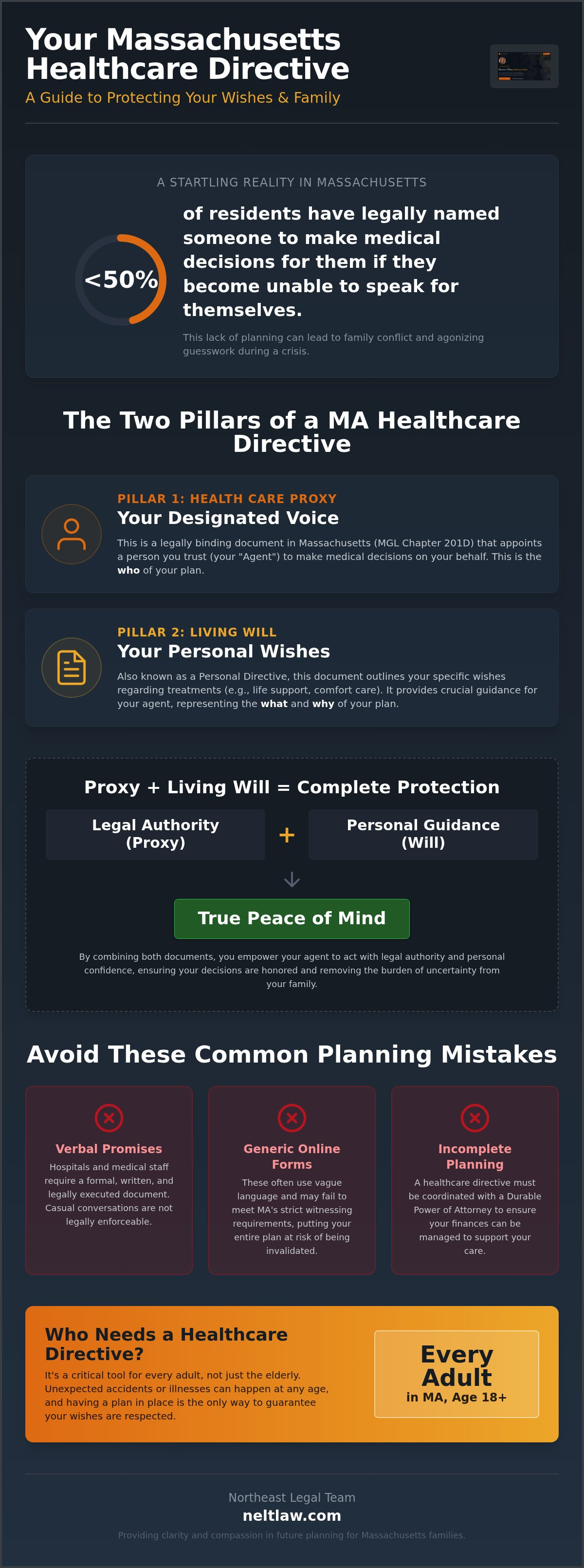
Did you know that less than half of Massachusetts residents have actually named a person to make medical decisions for them if they're unable to speak for themselves? It's a startling figure, especially when you consider how much weight that single decision carries. Most of us naturally feel a bit uneasy when thinking about end-of-life care or sudden medical crises. You might worry about being kept on life support against your wishes, or feel a deep concern that your spouse or children might argue over your care during an already emotional time.
We believe that planning for the future shouldn't feel like a cold legal transaction, but rather a final gift of clarity for the people you love. By creating a legally sound healthcare directive massachusetts residents can ensure their dignity remains intact while lifting the heavy burden of guesswork off their family's shoulders. You don't have to navigate these sensitive choices alone, and you don't have to let confusion over legal terms stand in your way.
This 2026 guide will walk you through the essential role of the Health Care Proxy, clarify why a Living Will works differently in our state, and prepare you for the upcoming shift to electronic medical orders. You'll learn how to build a plan that provides your family with a clear, compassionate path forward, giving everyone the peace of mind and certainty they deserve.
Key Takeaways
- Learn how a healthcare directive massachusetts acts as a comprehensive roadmap to protect your dignity and prevent family conflict during a medical crisis.
- Understand the different roles of a Health Care Proxy and a Living Will, and why having both provides the most complete protection for your future.
- Discover why your closest relative might not be the best choice for your healthcare agent and what specific traits actually matter most for the role.
- Gain the tools to define your quality of life thresholds, helping your loved ones make difficult decisions with confidence and peace of mind.
- Explore how working with a compassionate legal mentor using flat-fee pricing can make the planning process feel manageable, safe, and predictable.
Understanding the Role of a Healthcare Directive in Massachusetts
Think of a healthcare directive in Massachusetts as a compassionate roadmap for your future medical care. It isn't just a set of instructions; it's a way to ensure your voice remains loud and clear even if you're physically unable to speak. When you create this document, you're effectively protecting your loved ones from the trauma of having to guess what you would want during a crisis. Instead of carrying the weight of uncertainty, your family can act with the confidence that they're honoring your specific wishes and values. This clarity is a profound gift that provides peace of mind for everyone involved.
It's a common misconception that these plans are only for the elderly or those facing chronic illness. In reality, every adult in Massachusetts over the age of 18 needs a directive. Life is unpredictable. Whether it's a sudden accident or an unexpected medical event, having a plan in place ensures that your medical team and your family aren't left in a legal limbo. It shifts the focus from "what should we do?" to "what would they want?" which is a much gentler space for families to inhabit during stressful times.
A healthcare directive works best when it's integrated into your broader Massachusetts estate plan. While your directive handles medical choices, it needs to sit alongside a Durable Power of Attorney, which manages your finances. Without both, your family might have the legal right to decide on your surgery but no way to pay your mortgage or access the funds needed for your long-term care. Coordination between these documents ensures that your physical well-being and your financial legacy are both protected simultaneously.
The Legal Foundation: MGL Chapter 201D
Massachusetts law is very specific about how medical decisions are handled when you can't speak for yourself. Under Massachusetts General Laws Chapter 201D, the state recognizes the Health Care Proxy as the primary tool for medical advocacy. While you might have told your spouse or children what you want over the dinner table, those verbal instructions often carry little weight in a hospital setting. Doctors and medical facilities generally require the certainty of a written, legally executed document before they can follow your unique preferences. This law was designed to empower you, but it requires you to take the proactive step of putting your wishes on paper.
Why "Free" Online Forms May Fall Short
You can find many free forms online, but they often come with hidden risks. These generic templates frequently use vague language that medical professionals find difficult to interpret in a real-world emergency. If a form is too broad, it doesn't provide the specific guidance your agent needs to make difficult choices. Massachusetts also has strict witnessing requirements. If your document isn't signed and witnessed correctly according to state standards, it could be challenged or ignored entirely. Professional drafting ensures your healthcare directive massachusetts is airtight, preventing family disputes and ensuring your dignity is protected exactly as you intended.
The Two Pillars of a MA Healthcare Directive: Proxy vs. Living Will
Understanding The Two Pillars of a MA Healthcare Directive: Proxy vs. Living Will is the first step toward true medical security. Many people assume these two documents are interchangeable, but they serve distinct and vital purposes. A Health Care Proxy names a specific person to speak for you, while a Living Will, often referred to as a Personal Directive, outlines exactly what you want that person to say. In Massachusetts, the proxy is the legally recognized document that grants decision making power, while the living will acts as the guiding light for those decisions. By using both, you create the strongest possible legal protection for your future care.
When you prepare a healthcare directive massachusetts residents often find that the process brings a surprising sense of relief. You aren't just filling out paperwork; you're building a safety net that catches you if you ever lose the ability to communicate. If you're feeling a bit overwhelmed by these choices, reaching out for a free initial assessment can help you sort through your priorities with a supportive guide who understands the local medical landscape.
The Health Care Proxy: Your Medical Voice
Your Health Care Proxy doesn't take away your autonomy. It only "springs" into action if your attending physician determines in writing that you lack the capacity to make or communicate your own medical decisions. Until that specific moment, you remain in total control of your care. Once activated, your agent holds the legal authority to access your medical records and make treatment choices just as you would. It's always a wise move to name at least one alternate agent. If your primary choice is unavailable or unable to serve during an emergency, having a backup prevents a legal gap that could otherwise lead to a slow and stressful court intervention.
The Massachusetts Living Will: Evidence of Your Intent
There's a common misconception that living wills are useless in our state because they aren't strictly "legally binding" under a specific statute. This is a misunderstanding of how the law works. While a doctor isn't automatically forced to follow a living will on its own, Massachusetts courts and hospitals treat it as "clear and convincing evidence" of your wishes. It provides the moral and legal framework your proxy needs to make high stakes choices, such as those involving life support or comfort care. When you put your values in writing, you're providing a shield for your family. They won't have to carry the guilt of wondering if they're doing the right thing because you've already given them the answers.
Selecting Your Health Care Agent: A Guide for MA Families
Choosing who will speak for you is perhaps the most significant part of your healthcare directive massachusetts. While it's tempting to simply name your spouse or oldest child, the "closest" person isn't always the individual best suited for this specific role. You need an agent who can remain calm when emotions are high and who is willing to advocate for your wishes even if they personally disagree with your choices. It's a heavy responsibility; picking someone with the right temperament is an act of love for both yourself and your family.
Before you sign any legal documents, sit down for a "Values Conversation." This isn't a formal legal meeting; it's a heart-to-heart about what makes life meaningful to you. You might discuss Documenting Your Medical Wishes: From Life Support to Comfort Care to give them a concrete sense of your boundaries. If your agent knows exactly where you stand on quality of life thresholds, they won't have to carry the burden of second-guessing themselves during a medical crisis. This clarity transforms a stressful situation into a guided act of respect.
Questions to Ask Your Potential Agent
Don't assume someone is willing or able to serve. It's better to ask them directly and listen to their response. Do they feel they can make difficult decisions under high-pressure medical situations? Are they truly willing to follow your wishes even if their own beliefs differ? Do they feel comfortable talking to doctors and asking tough questions about your prognosis? If they hesitate, it's okay to choose a close friend or a different relative who feels more capable of handling the emotional weight of the position.
Local Considerations for Middlesex and Worcester Residents
Logistics play a vital role in effective advocacy. If you live in Central or MetroWest MA, your agent should be someone who can realistically get to local facilities like UMass Memorial in Worcester or Emerson Hospital in Concord. In a medical emergency, proximity allows your agent to be present for bedside consultations with your medical team, ensuring your voice is heard in real time. This local presence is often just as important as the legal authority the document provides.
Once you've made your choice, share your completed healthcare directive massachusetts with your primary care physician. Whether you're part of the Reliant Medical Group or a smaller local practice in Middlesex County, having your directive on file ensures it's available when seconds count. Store your original document in a safe but accessible place at home, and make sure your agent has their own copy. This proactive step ensures that no matter where you receive care, your plan is already there waiting for you.
Documenting Your Medical Wishes: From Life Support to Comfort Care
Once you've chosen the person who will speak for you, the next step is to provide them with the specific instructions they need to advocate effectively. A healthcare directive massachusetts isn't just a document that says "no" to medical intervention; it's a personalized guide that defines what a meaningful life looks like to you. By documenting your wishes, you're ensuring that your values remain the driving force behind your care, even if you can't express them yourself in the moment.
Life-sustaining treatments are medical procedures that use mechanical or artificial means to support or take over a vital body function. This typically includes mechanical ventilation to help you breathe, or artificial hydration and nutrition, such as feeding tubes, when you can no longer eat or drink on your own. For some, these interventions are a welcome bridge to recovery. For others, they may represent a state of being they wish to avoid if there's no hope for a return to a certain quality of life. Defining these thresholds is a deeply personal process that requires reflection on your own goals and boundaries.
Specific Medical Scenarios to Consider
It's helpful to think through specific situations to give your agent clear guidance. If you were in an irreversible coma or a persistent vegetative state with no reasonable chance of recovery, would you want life-sustaining treatments continued? You might also consider your preferences for care if you were diagnosed with advanced Alzheimer’s or another form of dementia. Some people also choose to include religious or spiritual considerations, ensuring that their medical treatment aligns with their faith and personal convictions. These details remove the guesswork for your family and your medical team.
- Irreversible Conditions: Instructions for when recovery is no longer medically possible.
- Cognitive Decline: Preferences for care during advanced stages of dementia.
- Spiritual Values: Ensuring medical choices respect your religious beliefs.
- Final Disposition: Clarifying your wishes regarding organ donation.
The "Comfort Care" Philosophy
Many people find that their primary goal in a terminal situation is not to prolong the dying process, but to ensure it is as dignified and painless as possible. This is often called "comfort care" or palliative care. You can specify that you want to prioritize pain management, skin care, and emotional support over invasive tests or treatments. You might also indicate whether you'd prefer to receive this care at home, in a hospice facility, or in a hospital setting. Articulating these complex values can feel daunting, but working with a living will attorney can help you translate your personal beliefs into clear, legally persuasive instructions.
If you're ready to transform your medical wishes into a legally sound plan that protects your dignity, we invite you to book a free initial assessment with our compassionate team. We'll listen to your story and help you build a directive that provides your family with the clarity they need.
How Northeast Legal Team Simplifies Your Healthcare Planning
At Northeast Legal Team, we don't treat you like a file or a set of medical instructions. We take a "mentor" approach to the law, which means we start by listening to your story. We want to understand your family dynamics, your fears, and your hopes for the future before we ever draft a single line. This supportive, non-judgmental environment is designed to lower the defensive barriers that often come up when discussing sensitive topics like end-of-life care. Our goal is to transform what feels like an overwhelming legal hurdle into a manageable path toward certainty.
One of the most common reasons families delay creating a healthcare directive massachusetts is the worry over unpredictable legal costs. We believe that financial transparency is essential for peace of mind. That's why we utilize estate planning attorney flat fee pricing. You'll know exactly what the investment is from the very beginning, with no surprise hourly bills or hidden charges. This allows you to focus entirely on making the right decisions for your health and your family, rather than watching the clock during our conversations.
Your healthcare directive massachusetts shouldn't exist in a vacuum. To be truly effective, it must work seamlessly with your broader estate plan. If you have a Will or a Living Trust, your medical wishes and your financial instructions need to be in harmony. We ensure that your Health Care Proxy and your Durable Power of Attorney are coordinated, providing a unified front that protects both your physical dignity and your financial legacy. This holistic view is part of our commitment to proactive stewardship, helping you prevent crises before they can even begin.
A Streamlined, Stress-Free Process
We've spent over 14 years refining a process that is as simple as it is thorough. From our initial conversation to the moment you hold your executed documents, we guide you through each step with unhurried care. You don't have to worry about the technicalities of "witnessing" or "notary" requirements; we handle all of those legal formalities for you in our office. Once everything is finalized, we provide you with both high-quality physical copies and secure digital versions. This ensures that you, your agent, and your doctors have immediate access to your plan whenever it's needed.
Securing Your Legacy in Middlesex and Worcester County
Led by David E. Walker, Esq., our firm is deeply rooted in the local community. We understand the specific medical and probate contexts of Middlesex and Worcester counties, and we take pride in being a steady hand for local families. We aren't just here to sell you a document; we're here to be your partner and advocate. If you're ready to replace anxiety with relief, the first step is easy. We invite you to Schedule your free estate planning assessment today and discover how simple it can be to protect the people you love most.
Take Control of Your Future with Confidence
Planning for the unexpected is one of the most selfless acts you can perform for your family. By establishing a clear, legally sound healthcare directive massachusetts, you remove the heavy weight of uncertainty from your spouse or children during a medical crisis. You've learned that appointing a trusted Health Care Proxy and documenting your quality of life values ensures your dignity remains protected, no matter what tomorrow brings. This isn't just about legal paperwork; it's about providing your loved ones with a roadmap to honor your story.
We invite you to Secure your medical future with a free consultation at Northeast Legal Team. With over 14 years of experience serving Middlesex and Worcester counties, we provide compassionate legal guidance and predictable flat-fee pricing for all our estate planning packages. You don't have to face these complex decisions alone; we're here to act as your steady hand and supportive ally. Taking this small step today provides a lifetime of relief for you and a legacy of clarity for the people you love.
Common Questions About Massachusetts Healthcare Directives
Is a healthcare directive the same as a living will in Massachusetts?
No, these documents serve distinct purposes within our state's legal framework. A Health Care Proxy is the legally binding document used to name a person to speak for you. A Living Will, or Personal Directive, isn't strictly binding by statute but provides clear evidence of the specific care you want. Using both together ensures your agent has the legal authority and the specific guidance needed to honor your wishes and protect your dignity.
Who can serve as my health care agent in MA?
Any competent adult who is at least 18 years old can serve as your agent. It's usually best to choose someone who knows you well, can handle high-pressure situations, and is willing to follow your instructions even if they personally disagree. You should avoid naming anyone who works for your healthcare facility unless they're a relative. Always name an alternate agent just in case your primary choice is unavailable during a medical emergency.
Does a Massachusetts healthcare directive need to be notarized?
No, notarization isn't a legal requirement for this specific document under Massachusetts law. However, it must be signed by you and two adult witnesses who aren't your named agents. While not mandatory, many people choose to include a notary's seal to provide extra weight and help prevent potential legal challenges. This extra step can offer additional peace of mind that your document will be accepted by local medical facilities without any unnecessary delay.
What happens if I don’t have a healthcare directive and I become incapacitated?
Without a healthcare directive massachusetts, your medical team may be forced to seek a court-appointed guardian to make decisions for you. This legal process is often slow, public, and expensive for your family. It also means a judge, rather than your loved ones, might ultimately decide who speaks for you. Having a plan in place prevents this uncertainty and ensures your dignity is protected according to your own unique values and medical preferences.
Can I change or revoke my healthcare directive once it is signed?
You have the right to change or revoke your directive at any time as long as you're of sound mind. You can do this by notifying your agent or doctor, or simply by signing a new document that replaces the old one. It's a good habit to review your healthcare directive every few years or after major life changes. This ensures your plan always reflects your current health status and provides clear guidance for your family.
How does a healthcare directive differ from a DNR (Do Not Resuscitate) order?
A healthcare directive is a legal document you create for future use, while a DNR is a medical order written by a physician for an immediate condition. Your directive outlines your broad goals and appoints someone to speak for you. A DNR is much more specific; it tells emergency responders not to perform CPR if your heart stops. Both tools are important, but they handle different aspects of your care during a medical crisis.
Do I need a lawyer to create a healthcare directive in Massachusetts?
While you can technically fill out a form on your own, working with a legal mentor ensures your wishes are airtight. A lawyer ensures your healthcare directive massachusetts meets all state witnessing requirements and works in harmony with your will or trust. At Northeast Legal Team, we offer flat-fee pricing so you can get this essential protection without worrying about hourly bills. We focus on making the entire planning process feel safe and manageable.
Where should I keep my healthcare directive after it is completed?
Store your original document in a safe, easy-to-find location in your home, but don't put it in a locked safe deposit box. You should give copies to your primary agent, your alternate agent, and your primary care physician. If you're a resident of Middlesex or Worcester county, it's also helpful to ensure local hospitals like UMass Memorial have a copy on file so it's available for doctors when seconds count.


