

What if your greatest act of love actually put your child’s future at risk? It's a heavy question that keeps many parents awake at night. You want to leave a legacy that provides comfort, yet you know that even a small inheritance can trigger a loss of essential government benefits. Most families worry that the legal system is too complex to handle alone, but a dedicated special needs planning attorney Massachusetts can help you navigate these rules to keep your loved one’s safety net intact.
We understand that the legal world often feels cold and overwhelming, especially when you're already juggling the daily complexities of caregiving. You deserve a supportive guide who listens first and explains your options in plain English. Our goal is to replace your anxiety with a sense of relief, ensuring your child is protected for life without the stress of unpredictable hourly billing or hidden costs. We believe that planning for the future shouldn't be a source of more stress, but a way to find lasting peace of mind.
This article will show you how to secure a lifetime of care through specialized trusts and clear roadmaps for future caregivers. You'll discover how flat-fee planning makes these vital protections accessible, giving you a transparent path toward a secure, dignified future for your entire family.
Key Takeaways
- Learn why traditional wills often fail special needs families and how to prevent an inheritance from interrupting vital MassHealth or SSI support.
- Understand how a Special Needs Trust serves as a financial shield to enhance your loved one’s quality of life while keeping their government benefits secure.
- Discover how a special needs planning attorney Massachusetts provides peace of mind through predictable flat-fee pricing that eliminates the stress of hourly billing.
- Explore holistic tools like ABLE accounts and the Letter of Intent to provide future caregivers with a clear, compassionate roadmap for your child's care.
- See the value of local expertise in Middlesex and Worcester Counties to ensure your estate plan meets the specific requirements of Massachusetts law.
Why Traditional Wills Fail Special Needs Families in Massachusetts
Most parents believe a standard will is enough to protect their children's future. While a traditional will works for many families, it often creates a significant crisis for those with special needs. If you leave assets directly to a loved one with a disability, you might accidentally disqualify them from the very programs they rely on for daily survival. It's a heartbreaking irony. Your gift intended to provide comfort becomes the reason they lose their safety net services. Working with a dedicated special needs planning attorney Massachusetts helps you avoid these common pitfalls by creating a plan that supplements, rather than replaces, government support.
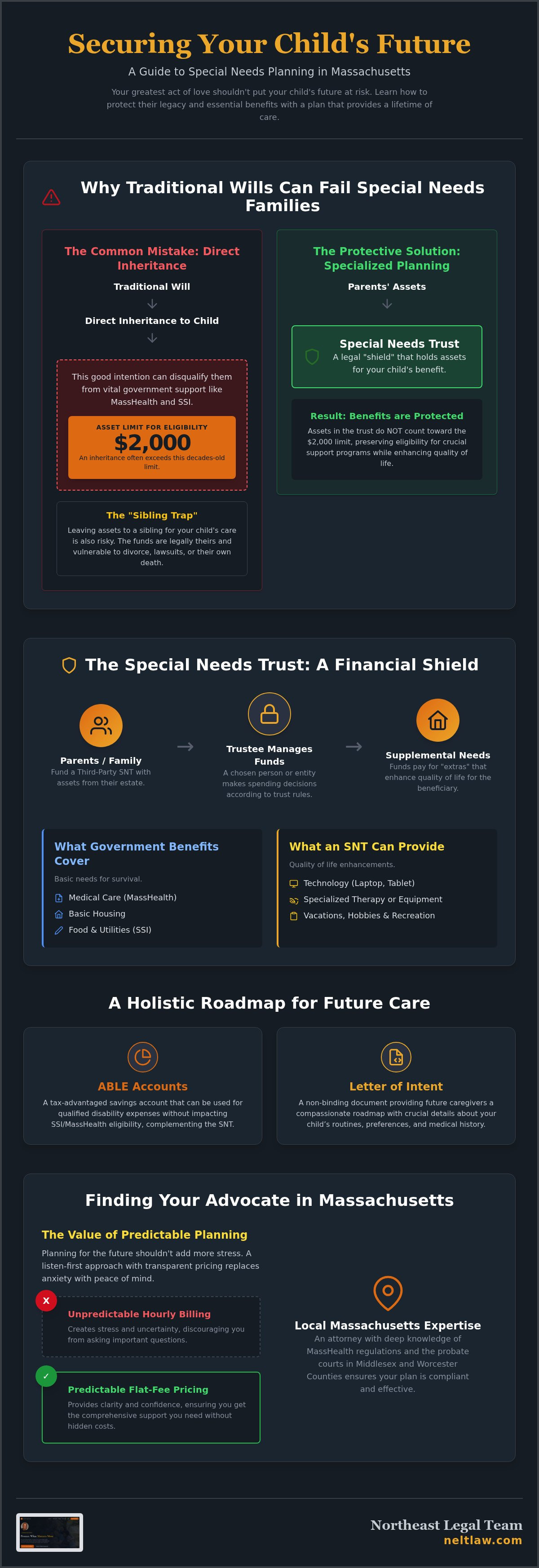
Some parents try to avoid this by leaving money to a sibling with the "understanding" that the funds will care for their disabled brother or sister. This is often called the sibling trap. Even with the best intentions, those funds are legally owned by that sibling. If they face a divorce, a lawsuit, or pass away unexpectedly, the money meant for your child's care could vanish. Proper planning creates a custom-built shield, often centered around a Special Needs Trust, ensuring funds are used exactly as you intended without risk of loss.
The Asset Limit Reality for SSI and MassHealth
To qualify for Supplemental Security Income (SSI), an individual's countable assets can't exceed $2,000. This limit hasn't changed for decades, failing to keep up with the actual cost of living in Massachusetts. If a well-meaning relative leaves your child a modest inheritance in a standard will, that gift triggers a "spend-down" crisis. Your loved one must spend that money quickly on basic needs until they're "poor" enough to qualify for benefits again. This process is emotionally draining and strips away the financial security you worked hard to provide.
The Role of a Special Needs Planning Attorney
Choosing a special needs planning attorney Massachusetts means finding an advocate who looks beyond the paperwork. This process isn't just about drafting a trust; it's about holistic family advocacy. Local expertise is vital because our state has specific regulations regarding MassHealth and probate courts in Middlesex and Worcester Counties. A compassionate attorney uses a listen-first approach to understand your family’s unique dynamics. They help you build a proactive plan that adapts to your child’s evolving needs, ensuring their dignity is protected through every stage of life.
The Special Needs Trust: Your Loved One’s Financial Shield
Imagine a protective vault that keeps your child's future secure while allowing them to enjoy the extras in life. A Special Needs Trust (SNT) is exactly that. It's a legal tool designed to hold assets for a person with a disability without those assets counting against their $2,000 limit for benefits like SSI or MassHealth. By using an SNT, you ensure that your loved one doesn't have to choose between a modest inheritance and the medical care they need to thrive. It's a way to provide for them without causing a "spend-down" crisis.
This trust functions through a bit of legal "magic" that separates ownership from benefit. Because the funds are held by the trust and managed by a trustee, the government doesn't view them as the individual's personal income. This allows the money to pay for things that government benefits won't cover. You might use trust funds for specialized therapy, a new laptop, or even a family vacation. It can also cover home modifications that make daily life easier. For many families, coordinating these funds with services from the Department of Developmental Services creates a comprehensive support system that covers both basic needs and quality of life.
Choosing the right trustee is the most critical part of this process. This person or entity will decide how and when to spend the money. They need to understand the complex rules of MassHealth to avoid accidentally triggering a loss of benefits. If you're feeling unsure about how to structure this, a special needs planning attorney Massachusetts can help you weigh the pros and cons of family members versus professional trustees.
Third-Party SNTs: The Gold Standard for Parents
Most parents choose a Third-Party SNT. This trust is funded by your assets, not your child's own money. It offers the best protection because there's no "Medicaid payback" requirement. When your child eventually passes away, any remaining funds can go to other family members or charities you choose. Many families find it helpful to include this as part of an estate planning attorney flat fee package, providing clarity on costs from day one.
First-Party SNTs: Managing Personal Windfalls
Sometimes, a person with a disability receives money directly, perhaps from a personal injury settlement or a back payment from Social Security. In these cases, a First-Party SNT is required to protect their benefit eligibility. While these trusts must include a provision to reimburse the state for Medicaid expenses after the individual's death, they are still a vital tool for preserving a sudden windfall. To clarify the distinction, a third-party trust is funded by family assets to provide for a loved one, while a first-party trust is funded by the disabled individual's own money to maintain their own benefit eligibility. If you need help deciding which path is right for your family, you can reach out to our team for guidance.
Comparing Planning Options: Predictable Costs and Protective Strategies
Deciding how to fund your child's future is a deeply personal process. Once you understand the protective power of a trust, the next step involves choosing the right legal vehicle and a payment structure that fits your family's budget. Many families feel paralyzed by the traditional legal model of hourly billing. When every phone call or question results in a new invoice, it creates a barrier to the very communication you need to feel secure. Working with an experienced special needs planning attorney Massachusetts allows you to bypass this stress through transparent, flat-fee arrangements.
This clarity is essential because special needs planning isn't an isolated task. It's a vital component of your broader asset protection strategies. By integrating your child’s trust with your overall estate plan, you ensure that every dollar you've worked for is shielded from unnecessary taxes or government recovery. This holistic approach moves you from a state of worry to a state of order, where every piece of your financial life works together to support your family continuity.
Third-Party SNT vs. Pooled Trust
You have two primary options when setting up a trust: a standalone Third-Party SNT or a Pooled Trust. A standalone trust offers maximum control, allowing you to choose your own trustee and dictate exactly how funds are used. This is often the preferred choice for larger estates. A pooled trust, managed by a non-profit organization, combines the assets of many individuals for investment purposes while maintaining separate accounts for each beneficiary. Enrollment fees for pooled trusts in Massachusetts typically range from $0 to $600, making them a cost-effective alternative for smaller estates or families who prefer professional, non-profit management over a family member serving as trustee.
The Northeast Legal Team Flat-Fee Advantage
We believe that planning for a loved one's care should be a calm, methodical journey. To support this, we've eliminated "billable hour anxiety" by offering comprehensive special needs planning packages at a predictable flat fee. This means you can ask the important questions, share your family stories, and review your documents without watching the clock. Our packages include more than just a trust document; they provide a complete roadmap for the future. With over 14 years of experience serving Middlesex and Worcester Counties, we focus on building the trust and transparency necessary to handle these sensitive topics with the dignity they deserve.
Beyond the Trust: A Holistic Roadmap for Care in MA
While a trust provides the financial framework, a complete plan covers the human side of care. Transitioning into adulthood is a major hurdle for families in Massachusetts. At 18, your child becomes a legal adult, which may require you to seek guardianship or conservatorship to continue making medical or financial decisions. A special needs planning attorney Massachusetts can help you determine the least restrictive path to protect their autonomy while ensuring their safety. This proactive stewardship is the best way to prevent a crisis before it starts, ensuring your child always has a steady hand guiding them.
Planning for the future also means preparing for the day you can no longer provide daily care yourself. This involves more than just legal documents; it requires a clear set of instructions for those who will step into your shoes. By addressing these practical needs now, you transform a potentially chaotic transition into a manageable and safe process for your loved one. If you're ready to build a complete plan for your family, contact Northeast Legal Team to begin your flat-fee consultation.
Crafting Your Letter of Intent
The Letter of Intent is your "instruction manual" for future caregivers. It's where you record the details only a parent knows. You should include a full medical history, daily routines, favorite foods, and even specific fears or triggers. While this isn't a legally binding contract, it gives future trustees and guardians the wisdom they need to maintain your child's quality of life. It's perhaps the most important non-legal document you'll ever write, as it preserves the human story behind the legal file. Keep this letter in an accessible place and update it regularly as your child’s preferences evolve.
ABLE Accounts and Special Needs Trusts
ABLE accounts (529A) are a flexible tool that works in harmony with your trust to maximize financial independence. For 2026, the annual contribution limit for an ABLE account is $20,000. These accounts are ideal for managing day-to-day expenses because the funds are easily accessible via a debit card. As of January 2026, the eligibility age for disability onset was raised from 26 to 46, which allows many more individuals to benefit from this tax-advantaged savings tool. It's vital to remember that while ABLE funds are protected, any balance over $100,000 will suspend SSI benefits. A special needs planning attorney Massachusetts can help you balance these two tools to ensure your loved one never loses their safety net.
Finding Your Special Needs Advocate in Middlesex and Worcester Counties
Selecting a partner to protect your family's future is a decision that requires both trust and technical expertise. While many firms offer generic templates, a local special needs planning attorney Massachusetts provides a level of insight that only comes from years of working within the state's specific legal framework. In Middlesex and Worcester Counties, our probate courts have their own unique procedures and expectations. Having a guide who understands these local nuances ensures your documents aren't just legally sound, but also practically effective when they are needed most. This local connection transforms a complex legal requirement into a supportive community partnership.
It's about more than just filing papers. It's about ensuring your child’s continuity of care remains uninterrupted. When you work with someone who knows the local landscape, you gain a partner who understands how Massachusetts disability services actually function on the ground. This knowledge allows us to build a plan that is truly resilient, moving your family from a state of constant worry toward one of order and tranquility. By focusing on proactive stewardship today, you prevent the crises of tomorrow.
Serving Worcester and Middlesex County Families
Our deep roots in Central and Eastern Massachusetts mean we don't just know the law; we know the community. Choosing the best estate attorney near me involves finding someone who understands how state-specific benefits like CommonHealth or local DDS offices impact your planning. We are committed to fostering family continuity for our neighbors in Worcester and Middlesex Counties. We’ve spent over 14 years helping families navigate these waters, ensuring that every plan we create reflects the human story behind the legal file. This commitment to our local community ensures that your family has a steady hand to rely on for years to come.
Your Next Steps Toward Peace of Mind
Taking the first step often feels like the hardest part, but we’ve designed our process to be as low-pressure and supportive as possible. During your initial assessment, we’ll listen first to understand your specific concerns and goals. You don't need to have all the answers or every document ready on day one. We take an unhurried, methodical approach that allows you to absorb information at your own pace. This ensures you feel in control of every decision, rather than feeling rushed through a cold, clinical process.
We believe that every family deserves a clear roadmap for the future without the anxiety of unpredictable costs. By choosing a firm that offers a flat-fee model, you can focus on what matters most: your loved one’s well-being. If you’re ready to replace uncertainty with a sense of relief, schedule your free special needs planning assessment today. Let’s work together to build a legacy of protection and care that lasts a lifetime.
Building a Legacy of Protection and Peace
You've taken a brave first step today by learning how to safeguard your loved one's future. By choosing specialized tools like Third-Party Special Needs Trusts and ABLE accounts, you ensure your child's quality of life is enhanced without risking their essential benefits. A dedicated special needs planning attorney Massachusetts can help you transform these complex legal concepts into a clear, manageable roadmap. This proactive stewardship is the greatest gift you can provide for your family's long-term security.
Our firm is here to serve as your compassionate mentor, drawing on over 14 years of dedicated experience in Middlesex and Worcester Counties. We believe you should feel certain about your child's future and your legal costs. That's why we offer predictable, flat-fee pricing for all our special needs packages, allowing you to focus on your family's continuity rather than billable hours. You don't have to navigate this journey alone.
Secure your loved one’s future with a free special needs planning assessment.
Take comfort in knowing that with the right plan in place, your child will always have the protection and care they deserve. We look forward to helping you find true peace of mind.
Frequently Asked Questions
Does a special needs trust affect my child’s eligibility for MassHealth?
A properly drafted trust won't disqualify your child from MassHealth benefits. Because the assets are owned by the trust rather than the individual, they don't count toward the strict $2,000 asset limit. This allows your loved one to maintain their safety net while the trust funds provide for extras like specialized equipment or recreation. Consulting a special needs planning attorney Massachusetts ensures your trust meets all current state and federal regulations for benefit protection.
What is the difference between a first-party and a third-party special needs trust?
The primary difference lies in whose money funds the trust. A third-party trust is created with your assets to provide for your child, and it doesn't require any Medicaid reimbursement after their death. A first-party trust is funded with the child's own money, such as a personal injury settlement. While it protects benefit eligibility, it must include a provision to pay back MassHealth for medical expenses provided during the child's life.
How much does a special needs planning attorney in Massachusetts cost?
Legal costs vary based on the complexity of your family's needs and the types of trusts required. Many families feel anxious about hourly billing, which can lead to unpredictable invoices. We address this by providing transparent, flat-fee pricing for all our special needs planning packages. This approach allows you to focus on building a comprehensive roadmap for your child's care without worrying about the cost of every phone call or question.
Can I name a sibling as the trustee of a special needs trust?
Yes, you can name a sibling as a trustee, but it requires careful thought. While a sibling knows your child best, they also face their own life challenges like career changes or personal legal issues. If a sibling is sued or goes through a divorce, trust assets could be at risk if not shielded properly. We often suggest naming a professional co-trustee or providing the sibling with a clear instruction manual to ease their burden.
What happens to the money in a special needs trust when the beneficiary passes away?
What happens to the remaining funds depends entirely on the type of trust you've created. In a third-party trust, you decide exactly where the money goes next, whether that's to other children or a favorite charity. In a first-party trust, the law requires that the state of Massachusetts is reimbursed for any Medicaid benefits paid out during the beneficiary's lifetime. Only after this debt is settled can the remaining funds be distributed to other heirs.
Is an ABLE account better than a special needs trust?
Neither tool is better than the other; instead, they are most effective when used together. An ABLE account is a flexible way to manage up to $20,000 in annual contributions for day-to-day expenses via a debit card. A special needs trust is better suited for holding larger assets, like a home or a significant inheritance. Combining these tools provides your child with both immediate financial independence and long-term security for their lifetime.
When should I start the special needs planning process for my child?
It's never too early to begin the planning process, but the most critical window is before your child turns 18. Starting early allows you to build a methodical plan that evolves with your child's needs. Proactive stewardship prevents the spend-down crises that occur when a well-meaning relative leaves an unexpected gift. A special needs planning attorney Massachusetts can help you establish these protections now to ensure your child's transition to adulthood is manageable and safe.
Do I need guardianship if my child with special needs is turning 18?
Guardianship isn't always necessary, but it's a decision you must face before your child's 18th birthday. In Massachusetts, all individuals are presumed to have the capacity to make their own decisions once they reach adulthood. If your child's disability prevents them from making safe medical or financial choices, you may need to petition the probate court for guardianship. We help families explore the least restrictive options, such as supported decision-making, to protect their child’s dignity.


