

What if your family had to guess your most private medical choices during a crisis because your legal paperwork didn't say what you thought it did? It's a heavy thought, and it's exactly why so many people in Middlesex and Worcester Counties feel a sense of unease when they look at generic estate planning forms. You want to be a source of peace for your family, not the center of a difficult debate. If you've felt confused about the living will vs power of attorney for healthcare massachusetts requirements, you're certainly not alone.
In our state, the law treats these two documents very differently. While the Health Care Proxy acts as your legal voice, a living will serves as a guiding whisper for your doctors. This 2026 guide will help you understand the critical legal distinctions so you can create a plan that prevents family conflict and ensures your wishes are honored. We'll walk through the specific requirements of Massachusetts law and show you how to build a strategy that provides true certainty for you and your loved ones. By the end of this article, you'll have a clear path toward the peace of mind you deserve.
Key Takeaways
- Understand the legal distinction of a living will vs power of attorney for healthcare massachusetts, ensuring you know which document grants authority and which provides specific medical instructions.
- Learn why the Health Care Proxy is the essential "legal voice" recognized by Massachusetts law and how to choose a trusted agent to speak for you when you cannot.
- Discover how a living will provides the "clear and convincing evidence" medical providers need to follow your treatment preferences, even though it isn't a binding statute in our state.
- Gain clarity on how these two documents work in tandem to protect your family from the emotional burden of making difficult medical decisions without a roadmap.
- Find out how local expertise and flat-fee planning in Middlesex and Worcester Counties can help you secure your medical legacy with total cost certainty and peace of mind.
Understanding Healthcare Directives in Massachusetts
Thinking about a future medical crisis is never easy. It's a topic many of us push to the back of our minds, yet addressing it now is one of the most compassionate things you can do for the people you love. An Advance healthcare directive is a broad term that covers the various legal tools we use to plan for these moments. In our state, this process is specifically governed by Massachusetts General Law Chapter 201D. This statute isn't just a set of rules; it's a shield that protects your autonomy when you can't speak for yourself. The ultimate goal of these documents is to provide you with peace of mind. When you have a clear plan, you replace the "what-ifs" with a sense of calm and certainty.
The Legal Landscape in the Bay State
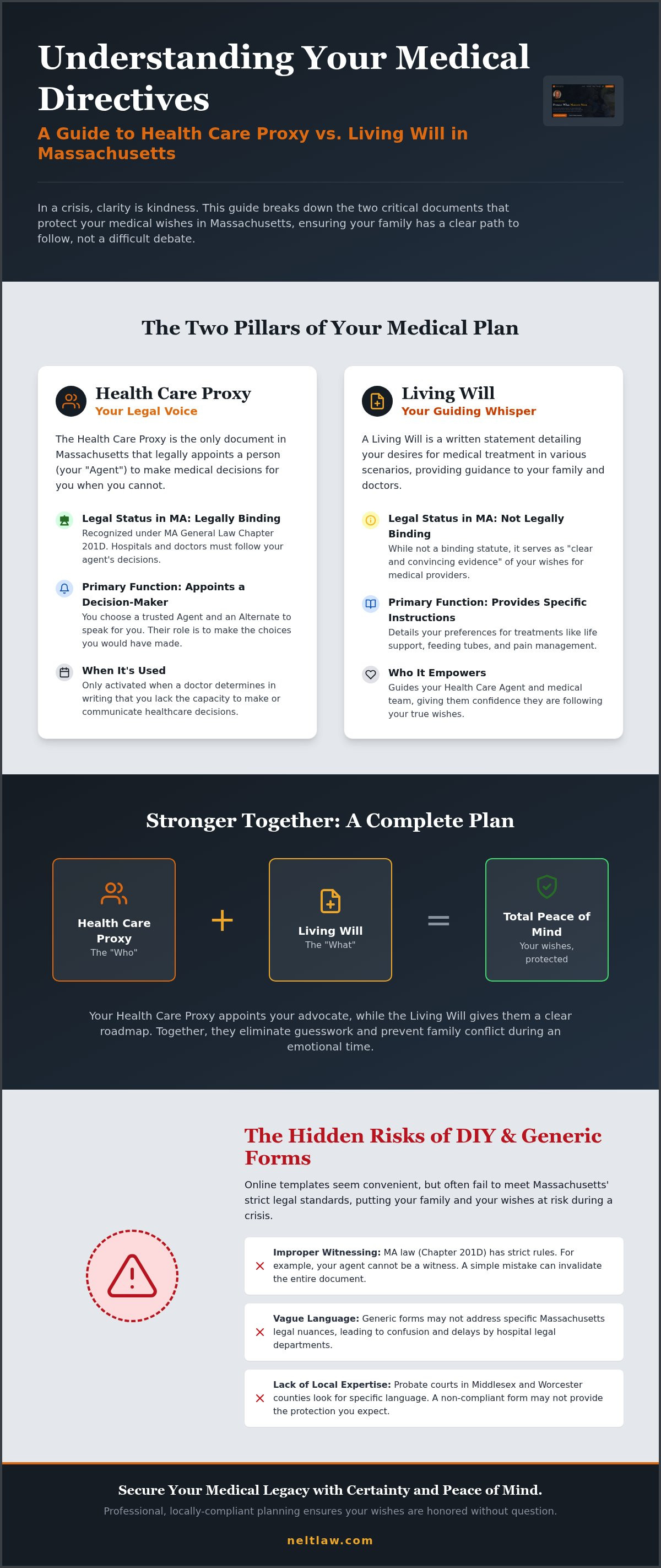
Massachusetts handles healthcare wishes differently than many other states. If you've lived elsewhere, you might be used to different terminology or legal standards. Here, the focus is heavily on the Health Care Proxy. Understanding the nuances of a living will vs power of attorney for healthcare massachusetts is vital because our local probate courts in Middlesex and Worcester Counties look for very specific language. If your documents don't meet these local standards, they might not provide the protection you expect during a crisis. It's helpful to remember one core fact: in Massachusetts, a Health Care Proxy is the only legally binding document used to appoint a specific person to make medical decisions on your behalf.
Why "DIY" Forms Often Fail Massachusetts Families
It's tempting to use a generic online form to save time, but these "one-size-fits-all" templates often ignore the strict witness requirements found in Chapter 201D. For example, your appointed agent or alternate agent cannot serve as a witness to your signature. If this rule is broken, the entire document could be challenged. We often see families face unnecessary stress when hospital legal departments block an agent because the paperwork is vague or technically flawed. This hesitation usually happens during the most critical moments, adding chaos to an already emotional situation. Professional planning removes these hurdles. By opting for a flat-fee approach, you can ensure your directives are airtight and locally compliant without worrying about unpredictable legal bills. This proactive step ensures your medical providers will honor your wishes exactly as you intended.
The Massachusetts Health Care Proxy: Choosing Your Medical Voice
In Massachusetts, we often hear people ask about a "Power of Attorney for Healthcare." While that's a common term used across the country, our state uses a specific legal instrument called a Health Care Proxy. Understanding the nuances of a living will vs power of attorney for healthcare massachusetts starts with recognizing that the Proxy is your legally designated voice. It doesn't take power away from you while you're healthy or capable of making your own choices. Instead, it sits quietly in the background until a physician determines in writing that you lack the capacity to make or communicate your own medical decisions.
Once this clinical trigger occurs, your "Agent" steps in to advocate for you. Their job isn't to decide what they would want for themselves, but to stand in your shoes and make the choices you would make if you could speak. Because life is unpredictable, naming an "Alternate Agent" is a vital safety net. If your primary agent is unavailable, unwell, or unable to serve during a crisis, your alternate ensures there is never a gap in your advocacy. This structure prevents your care from being delayed by hospital ethics committees or court interventions.
Selecting the Right Health Care Agent
Choosing an agent is more than just picking a close relative. You need someone with the emotional resilience to handle high-pressure medical environments and the willingness to follow your values, even if they personally disagree with a specific treatment. A common mistake is naming someone out of a sense of family obligation. If your eldest child struggles with medical settings or avoids difficult conversations, they might not be the best fit for this specific role. Before finalizing your plan, have an open conversation with your chosen person. Ask them directly if they feel comfortable carrying out your wishes; this simple step prevents future conflict and provides your family with a sense of calm.
Legal Requirements for a Valid Proxy in MA
To ensure your document is honored by hospitals in Middlesex or Worcester Counties, it must meet strict standards. According to Massachusetts law on health care proxies, you must sign the document in front of two competent adult witnesses who are not your named agents. While you don't strictly need a notary, professional guidance ensures your document won't be rejected by a hospital's legal department due to a technicality. Once your Proxy is signed, don't hide it in a safe deposit box. Give copies to your agents and your medical team so it's available the moment it's needed. If you're feeling overwhelmed by these choices, reaching out for a free initial assessment can help you move forward with confidence.
The Role of a Living Will: Providing Clarity in Uncertain Times
While it's true that Massachusetts doesn't have a specific statute that makes a living will legally binding, calling it "useless" is a significant mistake. When you're evaluating the living will vs power of attorney for healthcare massachusetts, think of the living will as your personal instruction manual. It provides what courts and hospitals call "clear and convincing evidence" of your wishes. If a medical situation becomes complicated, having your preferences in writing gives your doctors and your Health Care Proxy agent a definitive path to follow. Without this document, your medical team is left to interpret your silence, which can lead to delays in the very care you would have wanted.
One of the kindest things you can do for your family is to remove the burden of guessing. When a crisis hits, your agent often feels an immense weight of responsibility. If they have to decide on life-sustaining treatments like intubation or artificial nutrition without your written guidance, they may struggle with guilt for years. A living will replaces that doubt with clarity. It addresses specific scenarios, such as end-of-life care and the use of ventilators, ensuring your loved ones don't have to carry the emotional scars of an impossible choice. As the Massachusetts Medical Society explains the differences, these documents work together to provide a complete picture of your intent.
Why We Still Recommend Living Wills to MA Clients
In complex cases, hospital ethics committees often look for any documentation that sheds light on a patient's values. Your living will acts as a roadmap for your Health Care Proxy agent, giving them the confidence to speak with authority to medical staff. By putting your specific wishes in writing, you significantly reduce the chance of family conflict. If siblings or spouses disagree on a course of treatment, your written word serves as the final, calming authority that settles the debate and keeps the focus on your comfort.
What to Include in Your Massachusetts Living Will
Your document should define "quality of life" in your own terms. For some, this means being able to recognize family members; for others, it's the ability to live without permanent machines. Be specific about your preferences for palliative care and pain management, ensuring you'll be kept comfortable even if you decline curative treatments. You should also include any religious or spiritual considerations that guide your medical treatment. These personal details transform a standard legal form into a compassionate legacy of care that reflects who you truly are.
Key Differences: Living Will vs. Healthcare Power of Attorney
To truly understand the choice between a living will vs power of attorney for healthcare massachusetts, it's helpful to view them as two halves of a whole. One identifies the "Who" while the other details the "What." Your Health Care Proxy (the Massachusetts version of a medical power of attorney) names the person you trust to speak for you. Your living will provides the specific instructions that guide their words. Both documents remain active as long as you are living but unable to make decisions; however, their legal authority ends the moment you pass away. At that point, your Last Will or Trust takes over to manage your final legacy.
These documents work in tandem to create a safety net that generic forms often miss. While the Proxy gives your agent the legal standing to talk to doctors, the living will gives them the confidence to make the right choice. If a medical emergency arises, your agent won't have to wonder what you would want because you've already provided the roadmap. This coordination ensures that your care is consistent with your values from the moment of incapacity until the very end.
Healthcare Proxy vs. Durable Power of Attorney
A common point of confusion for families in Middlesex and Worcester Counties is the difference between a medical agent and a financial agent. While a Durable Power of Attorney allows someone to manage your bank accounts and pay your mortgage, it doesn't give them the legal right to make surgical or end-of-life decisions. Conversely, your Health Care Proxy agent cannot access your retirement funds to pay for your medical bills. If you only have one of these documents, you leave a dangerous gap in your protection. If you name a financial agent but forget a medical one, your family might have the money to pay for a hospital stay but no legal authority to choose the treatment you receive. We focus on coordinating these roles so your transition from health to care is seamless and free of legal friction.
When Does Each Document Take the Lead?
The "Incapacity Trigger" is what activates your Health Care Proxy. This happens anytime a doctor determines you can't make your own choices, such as during a temporary coma or after a stroke. In contrast, the "End-of-Life Trigger" is when the most specific provisions of your living will come into play. You need both to cover the full spectrum of medical possibilities. Having both ensures that whether you're facing a temporary setback or a permanent transition, your wishes are clear. This dual approach is exactly why working with a Living Will Attorney in Massachusetts: Protecting Your Healthcare Wishes is so valuable; it ensures your specific values are woven into every legal safeguard. If you're ready to close the gaps in your own plan, we invite you to reach out for a free initial assessment to see how we can help.
Navigating the legalities of a living will vs power of attorney for healthcare massachusetts doesn't have to be a source of stress. When you're planning for your future in Middlesex or Worcester County, local expertise makes a world of difference. Every probate court and hospital system has its own rhythms. By working with a team that understands Central and Eastern Massachusetts, you ensure your documents are more than just valid; they're actionable. We've spent over 14 years helping families create plans that reflect their unique stories. This experience ensures that medical providers in our local communities honor every wish without hesitation.
The Northeast Legal Team Flat-Fee Advantage
Many people hesitate to call an attorney because they fear the "billable hour" and unpredictable costs. We've removed that barrier by offering a clear Estate Planning Attorney Flat Fee model. This means you'll know exactly what your investment is before we even begin. Our standard healthcare directive package typically includes your Health Care Proxy, a detailed Living Will, and the necessary HIPAA authorizations. These documents ensure your agents can actually talk to your doctors and access your records during a crisis. When you clarify the details of a living will vs power of attorney for healthcare massachusetts with a professional, you're choosing order over chaos. This transparent pricing fosters a relationship built on trust rather than a ticking clock.
Next Steps: Protecting Your Legacy Today
Taking the first step is often the hardest part, but we've made it as gentle as possible. You can start by scheduling a free initial assessment with our compassionate team. During this conversation, we'll listen first. We want to understand your fears and your goals before we ever talk about paperwork. To prepare, simply think about who you trust to be your voice and what "quality of life" means to you. Most families find that their healthcare directives can be completed from start to finish in just a few weeks. It's a simple process that yields a massive amount of relief.
You deserve to feel a sense of tranquility when you think about the future. By documenting your choices now, you're giving your family a roadmap and yourself the gift of certainty. We're here to act as your steady hand, guiding you through every decision with empathy and professional wisdom. Reach out to us today to begin your journey toward a more secure and peaceful tomorrow.
Securing Your Future with Confidence and Calm
Taking the time to document your medical wishes is one of the most selfless acts you can perform for your family. By clearly defining your Health Care Proxy and your Living Will, you ensure that your loved ones never have to carry the heavy burden of uncertainty during a crisis. You've learned that while the Proxy serves as your legal voice, the Living Will provides the essential evidence of your values that medical teams need to see. Understanding the differences in a living will vs power of attorney for healthcare massachusetts is the first step toward a plan that truly protects your autonomy and your legacy.
At Northeast Legal Team, we believe legal planning should feel supportive rather than clinical. Our flat-fee pricing ensures total transparency, while our deep roots in the Middlesex and Worcester County Probate Courts provide the local expertise your plan requires. You don't have to navigate these sensitive choices alone. We invite you to Schedule Your Free Healthcare Directive Assessment today. Let us act as your compassionate guide, transforming your concerns into a legacy of protection and tranquility. You've done the hard work of thinking about the future; now let us handle the details to ensure your wishes are always honored.
Frequently Asked Questions
Is a living will legally binding in Massachusetts?
In Massachusetts, a living will isn't legally binding in the same way a Health Care Proxy is. While the state doesn't have a specific law making it mandatory for doctors to follow a living will, these documents are incredibly valuable. They serve as "clear and convincing evidence" of your wishes. This provides your medical team and family with a roadmap to follow during difficult times, ensuring your preferences are respected even without a formal statute.
Who can I name as my Health Care Proxy agent in MA?
You can name any competent adult as your agent, but there are important exceptions to keep in mind. Massachusetts law generally prohibits employees or administrators of a healthcare facility where you're receiving care from serving as your agent unless they're related to you. It's best to choose someone who understands your values and can remain calm under pressure. Naming an alternate agent is also a wise step to ensure someone is always available to help.
Do I need a lawyer to create these documents in Worcester County?
You aren't legally required to hire a lawyer to create your healthcare directives in Worcester County, but professional guidance provides significant peace of mind. Local expertise ensures your documents meet the specific witness requirements of Massachusetts General Law Chapter 201D. Using a professional helps you avoid technical errors that might lead a hospital's legal department to reject your paperwork during a crisis. Our flat-fee approach makes this level of protection accessible and predictable for local families.
What happens if I don’t have a Health Care Proxy in Massachusetts?
If you don't have a Health Care Proxy and become unable to make decisions, your family may face a stressful legal hurdle. Without a designated agent, your loved ones might need to petition the probate court in Middlesex or Worcester County for guardianship. This process is often time-consuming and expensive. Having a proxy in place prevents this delay, allowing your chosen advocate to step in immediately to ensure your medical care aligns with your personal wishes.
Can I change my Health Care Proxy after it is signed?
You can absolutely change or revoke your Health Care Proxy at any time as long as you have the mental capacity to do so. Life changes like marriage, divorce, or moving might prompt you to update your choice of agent. To make a change, you simply need to execute a new document that meets the state's signing and witness requirements. It's important to distribute the updated version to your medical providers and agents to ensure everyone has the correct information.
How is a Healthcare Proxy different from a Durable Power of Attorney?
A Health Care Proxy only gives someone the authority to make medical decisions when you can't speak for yourself. In contrast, a Durable Power of Attorney is used for financial matters, like paying bills or managing bank accounts. When comparing a living will vs power of attorney for healthcare massachusetts, it's vital to recognize that these roles are separate. You need both to ensure your physical well-being and your financial legacy are fully protected during a period of incapacity.
Does a Living Will cover my funeral arrangements?
A living will focuses on the medical treatment you receive while you're still alive, so it typically doesn't cover funeral arrangements. In Massachusetts, instructions for your final rest are usually handled through a separate document or within your Last Will and Testament. While you can mention your preferences in a living will to guide your family, it's better to create a specific plan for your remains to ensure your legacy is honored exactly as you envisioned.
Should I give a copy of my Proxy to my primary care physician?
Yes, giving a copy of your Health Care Proxy to your primary care physician is a critical step in your planning process. Doctors often store these documents in your electronic medical record, making them instantly accessible if you're ever rushed to the hospital. You should also provide copies to your named agents and keep one in an easy-to-find spot at home. Sharing this information ahead of time ensures there's no confusion when every second counts during a medical emergency.


