

What if the family home you worked decades to pay off was suddenly at risk because of a single health crisis? In Massachusetts, where the average cost of a semi-private nursing home room is now approximately $14,448 per month, this fear is a reality for many families. You might feel overwhelmed by the strict $2,000 asset limit or anxious about the 5-year lookback period. Learning how to protect assets from nursing home in Massachusetts isn't about hiding your hard-earned savings. It's about using established legal tools to ensure your dignity and your family's future.
We know it's frustrating to feel like you're being penalized for a lifetime of hard work and careful saving. You shouldn't have to choose between receiving quality care and leaving a legacy for your children. This 2026 guide will show you how to safeguard your home and savings through proven legal strategies. We will explore the latest MassHealth requirements, explain how to navigate the lookback window safely, and provide a clear path toward qualifying for benefits without losing everything you've built.
Key Takeaways
- Understand the financial impact of nursing home costs and why traditional insurance often leaves families responsible for the bill.
- Learn how to protect assets from nursing home in Massachusetts by distinguishing between countable and protected property under 2026 MassHealth rules.
- Explore how a Medicaid Asset Protection Trust works to safeguard your home while ensuring you qualify for the care you need.
- Gain clarity on the 5-year look-back period and the proactive steps you can take to keep your family's legacy intact.
- Discover how flat-fee estate planning removes the anxiety of hourly billing and provides a clear, fixed-cost path to peace of mind.
The Reality of Nursing Home Costs in Massachusetts
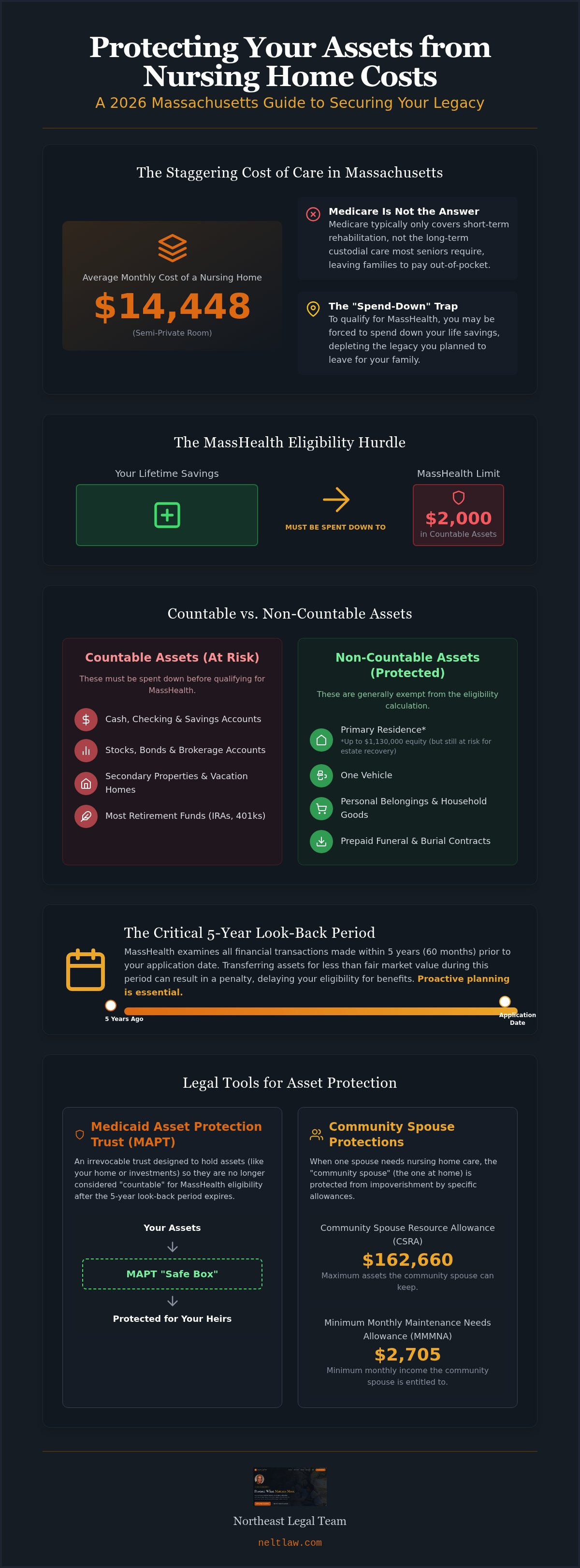
The financial reality of aging in the Commonwealth can feel daunting. In 2026, the average cost for a semi-private nursing home room in Massachusetts has reached approximately $14,448 per month. This isn't just a statistic; it's a monthly bill that can quickly consume a family's legacy. Many people believe their traditional health insurance or Medicare will cover these costs. In reality, Medicare is designed for short-term rehabilitation, not the long-term custodial care that most seniors eventually need. This gap often leaves families paying out of pocket until their life savings are gone.
This "spend-down" trap is where the emotional toll truly hits. It's painful to watch decades of hard work vanish in a matter of months. When you realize that qualifying for MassHealth requires having no more than $2,000 in countable assets, the weight of the situation becomes clear. You aren't just losing money; you're losing the ability to pass something meaningful down to your children. We believe you deserve a path that honors your hard work rather than depleting it.
Why Massachusetts Families Face Unique Challenges
Residents in Middlesex and Worcester Counties face specific hurdles due to high property values. If you're wondering how to protect assets from nursing home in Massachusetts, you're likely concerned about how your home value impacts your eligibility. While the state provides some protections for a "community spouse" staying at home, the limits are strict. A spouse can typically keep up to $162,660 in assets, but in our high-cost area, that amount may not provide long-term security. The stress of unplanned care can leave a surviving spouse feeling financially stranded in the very home they spent a lifetime building.
Identifying Your At-Risk Assets
To plan effectively, you must first understand which of your assets are vulnerable. Your assets generally fall into two categories: countable and non-countable. While your primary residence is often exempt from the initial eligibility calculation if your equity is under $1,130,000, it remains vulnerable to state liens or estate recovery after you pass away. Other items like liquid savings, stocks, and secondary properties are all considered "on the table" for the spend-down process.
One common way to manage these risks is through an Asset-protection trust. By moving your countable resources into a specifically designed legal structure, you can shield your family's inheritance while still qualifying for the care you deserve. Learning how to protect assets from nursing home in Massachusetts starts with this distinction. When you know exactly what is at risk, you can take the methodical steps needed to move from a state of worry to a state of resolution.
MassHealth Eligibility: What Assets Are Actually Protected?
Qualifying for help with long-term care doesn't have to mean losing everything you've spent a lifetime building. To qualify for benefits, you must meet strict MassHealth eligibility rules regarding your finances. Many people feel a sense of panic when they hear that an individual can only have $2,000 in countable assets to qualify. However, understanding the nuance of these rules is the first step in learning how to protect assets from nursing home in Massachusetts. While the limits are low, the law provides specific pathways to keep certain resources safe for your family.
Countable vs. Non-Countable Assets in MA
MassHealth divides your property into two categories. Countable assets are resources that the state expects you to use for your care, including cash, savings, brokerage accounts, and most retirement funds. It's a common mistake to assume that joint bank accounts are only half-counted; in reality, the state often presumes 100% of the funds belong to the applicant unless you can prove otherwise. On the other hand, non-countable assets include items like your personal belongings, one vehicle, and certain prepaid funeral contracts. Understanding this distinction is vital because it helps you identify exactly what needs to be shielded before you apply for benefits.
The Role of the Community Spouse
If you're married and only one spouse needs care, the state provides "spousal impoverishment" protections. The spouse remaining in the home, known as the community spouse, is allowed to keep a specific amount of assets called the Community Spouse Resource Allowance (CSRA). In 2026, this limit is $162,660. Additionally, the state allows for a Minimum Monthly Maintenance Needs Allowance (MMMNA), which ensures the healthy spouse has enough income to live on. As of July 1, 2026, this minimum is $2,705 per month. These rules are designed to prevent a spouse from being left in poverty, but they require careful navigation to maximize the available protections.
One of the most significant misunderstandings involves the family home. While your primary residence is generally exempt from the eligibility calculation if your equity is below $1,130,000, it isn't necessarily safe from "estate recovery." This means the state can place a lien on the property after you pass away to reimburse itself for the cost of your care. This is why simply being "exempt" isn't enough to secure a legacy for your children. If you're feeling overwhelmed by these numbers, reaching out for professional asset protection can help clarify your specific situation. Knowing how to protect assets from nursing home in Massachusetts requires looking beyond the initial application to ensure your home remains in the family for generations to come.
The Medicaid Asset Protection Trust (MAPT)
If you're looking for a way to move beyond the $2,000 asset limit mentioned earlier, the Medicaid Asset Protection Trust is often the most effective tool available. Think of this trust as a protective legal bucket. When you place your home or savings inside it, you're effectively telling the state that these assets no longer belong to you personally. This is a vital step in learning how to protect assets from nursing home in Massachusetts because it allows you to qualify for care while keeping your family's inheritance out of the "spend-down" cycle. While the term "irrevocable" might sound intimidating, it's the very thing that provides the shield you need. Because you don't have direct control over the principal, MassHealth cannot count those assets against you.
Choosing a trustee is a deeply personal decision, but most families select a trusted child or sibling to manage the trust. This person acts as a steward for your legacy, ensuring that the rules of the trust are followed while keeping the assets safe for the next generation. It's a partnership that provides a profound sense of relief, knowing that your hard-earned property is in the hands of someone who cares about your family's future as much as you do.
How the MAPT Safeguards Your Home
For many of our neighbors in Worcester and Middlesex Counties, the family home is their most precious asset. When you transfer your home's deed into a MAPT, you aren't moving out. You retain the legal right to live in the property for the rest of your life. This arrangement provides the best of both worlds: you stay in the comfort of your own home, but the house itself is no longer vulnerable to state liens. Additionally, assets held in this trust avoid the long and often expensive probate process. This means that when the time comes, your home can pass directly to your children without the delays or costs typically associated with settling an estate.
Pros and Cons of the Irrevocable Trust
The primary benefit of an irrevocable trust is the absolute protection it offers against long-term care costs and even potential creditors. Beyond protection, there's a significant tax advantage known as a "step-up in basis." If your children inherit the home through the trust, they may avoid paying heavy capital gains taxes if they decide to sell it later. This can save your family tens of thousands of dollars. The trade-off is that you cannot simply reach into the trust and take back the principal once it's been moved. You can still receive income generated by trust assets, but the core funds must remain protected to satisfy MassHealth rules. If you're planning for the long term, this limited access is a small price to pay for the certainty that your legacy will remain intact. Understanding how to protect assets from nursing home in Massachusetts is about finding this balance between your needs today and your family's security tomorrow.
Life Estates and the 5-Year Look-Back Rule
The 5-year look-back period is often the source of greatest anxiety for families. It is easy to view it as a trap, but it's actually a predictable timeline that we can use to our advantage. Essentially, MassHealth reviews your financial history for the 60 months prior to your application. They look for any transfer of assets for less than fair market value. If you've given away money or property during this time, it could trigger a penalty period. Many people mistakenly believe they can give away $19,000 per person each year because of the 2026 federal gift tax exclusion. While the IRS might be fine with that, MassHealth is not. Learning how to protect assets from nursing home in Massachusetts involves understanding that gift tax rules and MassHealth rules are not the same.
Gifting is often the most dangerous strategy a family can attempt without professional guidance. A simple gift to a child can create a "disqualification period" where you're forced to pay for care out of pocket, even if you've run out of money. We prefer to use validated legal frameworks that provide protection without the risk of disqualification. This methodical approach replaces the chaos of guesswork with the tranquility of a clear plan.
Understanding the Life Estate Deed
A Life Estate is a simpler alternative to a trust for protecting the family home. In this arrangement, you transfer the "remainder interest" of your home to your children while keeping the "life interest" for yourself. You maintain the absolute right to live in the home and continue to pay the taxes and insurance. This keeps your property tax exemptions intact, such as the Section 121 capital gains exclusion. The primary risk is that because your children are now partial owners, their creditors or a potential divorce could impact your home. It's a balance of control and simplicity that works well for many families in Middlesex County.
Planning Within the 5-Year Window
If you need care before the five years are up, don't lose hope. It is a common myth that you've "missed the boat" if you didn't plan years ago. We can often "cure" previous gifts by having the assets returned to the applicant, which can reset or eliminate a penalty. Additionally, we use Medicaid-compliant annuities to turn countable cash into a protected stream of income for a community spouse. This strategy can immediately lower your countable assets to the required $2,000 limit while providing for your family. Even in a crisis, it's never too late to protect at least a portion of your estate. If you're worried about an upcoming application, reaching out for expert asset protection planning can provide the sigh of relief your family needs.
Securing Your Legacy with Flat-Fee Asset Protection
Many people hesitate to start planning because they fear the "billable hour." They worry that every question or phone call will lead to a new charge, making an already stressful situation feel even more out of control. At Northeast Legal Team, we've replaced that anxiety with a transparent, flat-fee approach. This allows us to focus entirely on your family's story rather than the clock. When you know the costs upfront, you can breathe easier and participate fully in the process of learning how to protect assets from nursing home in Massachusetts. We believe that legal guidance should feel like a supportive mentorship, not a clinical transaction.
A truly protective plan goes beyond just a trust. It must include documents that safeguard your dignity while you're still living. Durable Powers of Attorney and Healthcare Proxies are vital tools that ensure your wishes are followed if you ever find yourself unable to speak for yourself. By including these in a fixed-cost plan, we ensure there are no gaps in your protection. This holistic approach is designed to move you from a state of worry to a state of order. It's the path that leads to that elusive "sigh of relief" families feel once their plan is finally in place.
The Advantage of a Flat-Fee Asset Protection Trust
Creating a Medicaid asset protection trust massachusetts involves complex legal drafting, but your experience shouldn't feel complicated. Our flat-fee model covers the initial design, the drafting of the trust, and the transfer of your home's deed. You'll receive a clear, comprehensive package that includes everything needed to start the five-year look-back clock. If you have questions about how the trust interacts with your specific savings or property, you can ask them freely. We want you to feel empowered and informed, knowing that the price we agreed upon is the price you'll pay.
Your Local Partner in Middlesex and Worcester
We are proud to serve families throughout Middlesex and Worcester Counties. We understand the local court systems and the specific ways MassHealth offices in our region review long-term care applications. This local knowledge is invaluable when you're trying to figure out how to protect assets from nursing home in Massachusetts. We don't work in a vacuum; we often coordinate with your existing financial advisors to ensure your legal plan aligns with your overall financial goals. This proactive stewardship helps prevent crises before they happen, giving your family a steady hand to rely on.
Taking the first step is often the hardest part, but it's also the most rewarding. You've worked hard for your home and your savings. You deserve a partner who respects that legacy and offers a clear, unhurried path forward. We invite you to schedule your free assessment with Northeast Legal Team today and begin the journey toward a more secure, tranquil future.
Taking Control of Your Family's Future
Planning for the future doesn't have to be a source of constant anxiety. By understanding the distinction between countable assets and protected property, you've already taken the first step toward security. Whether you choose a Medicaid Asset Protection Trust or a Life Estate, these tools provide a methodical way to safeguard your home while ensuring you qualify for the care you need. Learning how to protect assets from nursing home in Massachusetts is ultimately about proactive stewardship and honoring the legacy you've built over a lifetime.
At Northeast Legal Team, we bring over 14 years of local experience to every consultation. We offer flat-fee pricing for total transparency and provide supportive, non-judgmental guidance that treats you like a person, not a case file. You deserve the peace of mind that comes with a clear, fixed-cost plan. Secure your home and legacy with a free asset protection assessment today. It's never too late to start the conversation and find the sigh of relief your family deserves.
Frequently Asked Questions
Can MassHealth take my house if I go into a nursing home?
MassHealth won't take your house immediately, but they can place a lien on it to recover costs after you pass away. While your home is exempt during your lifetime if your equity interest is below $1,130,000, it remains vulnerable to estate recovery later. Learning how to protect assets from nursing home in Massachusetts involves using legal tools like trusts to ensure the property passes to your heirs instead of being used to reimburse the state.
What is the 5-year look-back rule in Massachusetts?
The 5-year look-back rule is a 60-month window where MassHealth reviews all financial transactions prior to your application. If you transferred assets for less than fair market value during this time, you may face a penalty period of ineligibility. This rule emphasizes why proactive planning is so important for families in Middlesex and Worcester Counties. It's a timeline that requires careful navigation to ensure your legacy remains intact while you receive the care you need.
Does a revocable living trust protect assets from a nursing home?
No, a revocable living trust does not protect your assets from nursing home costs. Because you maintain control and can revoke the trust at any time, MassHealth views those assets as fully countable toward the $2,000 limit. To achieve true protection, you typically need an irrevocable Medicaid Asset Protection Trust. This structure effectively removes the assets from your name, which is a key strategy for those wondering how to protect assets from nursing home in Massachusetts.
How much money can a spouse keep when the other enters a nursing home in MA?
In 2026, the spouse remaining in the home can keep up to $162,660 in countable assets, known as the Community Spouse Resource Allowance. Additionally, the state allows for a Minimum Monthly Maintenance Needs Allowance of at least $2,705 per month. These rules prevent spousal impoverishment, ensuring the healthy spouse can maintain their quality of life. We help families maximize these allowances to provide long-term financial security for the spouse staying in the community.
Is it too late to protect my assets if I'm already 80 years old?
It's never too late to begin planning, regardless of your age. Even if you're 80 and facing an immediate health crisis, we can use strategies like Medicaid-compliant annuities or curing previous gifts to protect a portion of your estate. While earlier planning is ideal for the 5-year look-back, crisis planning can still save significant assets for your family. We focus on providing a sigh of relief by finding the best possible path forward for your unique situation.
What are 'exempt assets' for MassHealth eligibility in 2026?
Exempt assets are resources that MassHealth doesn't count when determining your eligibility. In 2026, these include:
- Your primary home (if equity is below $1,130,000)
- One vehicle used for transportation
- Personal belongings and household goods
- Certain prepaid funeral and burial contracts
How does an irrevocable trust protect my home from estate recovery?
An irrevocable trust protects your home by moving the property out of your individual name and into the trust's ownership. Because the home is no longer part of your probate estate, MassHealth cannot place a lien on it through the estate recovery process after you pass away. This ensures that your home stays in the family. It's a methodical way to transform a vulnerable asset into a protected legacy for your children and grandchildren.
What is the difference between a life estate and a Medicaid trust?
A life estate is a simplified deed change that gives you the right to live in your home while transferring the remainder to your heirs. A Medicaid trust is a more comprehensive legal structure that can protect not just your home, but also cash, stocks, and other investments. While a life estate is often easier to set up, a trust offers superior protection against creditors and provides more flexibility for families with diverse assets in Massachusetts.


