

Imagine you've spent years carefully managing your child's care, only to realize a well-meaning inheritance could suddenly disqualify them from the MassHealth benefits they rely on every day. It's a heavy thought that keeps many parents in Middlesex and Worcester counties awake at night. You want to provide a safety net, but the fear of losing essential support or getting buried under confusing legal jargon feels paralyzing. You might also worry about the actual cost of setting up a special needs trust in Massachusetts, especially when hourly legal fees can feel like a bottomless pit.
We understand that your primary goal is protection, not paperwork. You deserve a plan that offers your loved one a comfortable life without risking their government aid. This 2026 guide provides a transparent look at the steps required to secure your family's future while keeping your legal expenses predictable and manageable. We will walk you through the different trust options available today, explain how to stay compliant with the latest MassHealth regulations, and show you how a clear roadmap can replace your anxiety with lasting peace of mind.
Key Takeaways
- Safeguard your loved one's eligibility for essential programs like MassHealth and SSI by understanding how a Special Needs Trust acts as a protective shield for their assets.
- Learn how the cost of setting up a special needs trust in Massachusetts is influenced by the complexity of your family's needs and the specific type of trust you choose to implement.
- Identify the hidden risks of using generic "do-it-yourself" legal templates, which often fail to meet strict state regulations and can lead to the loss of vital government aid.
- Discover how a flat-fee pricing model provides financial certainty, allowing you to focus on your family's long-term care plan rather than worrying about a ticking clock.
- Gain a clear understanding of the essential steps required to move from a state of legal uncertainty to a secure, documented plan for your beneficiary's future.
What is a Special Needs Trust and Why is it Essential in MA?
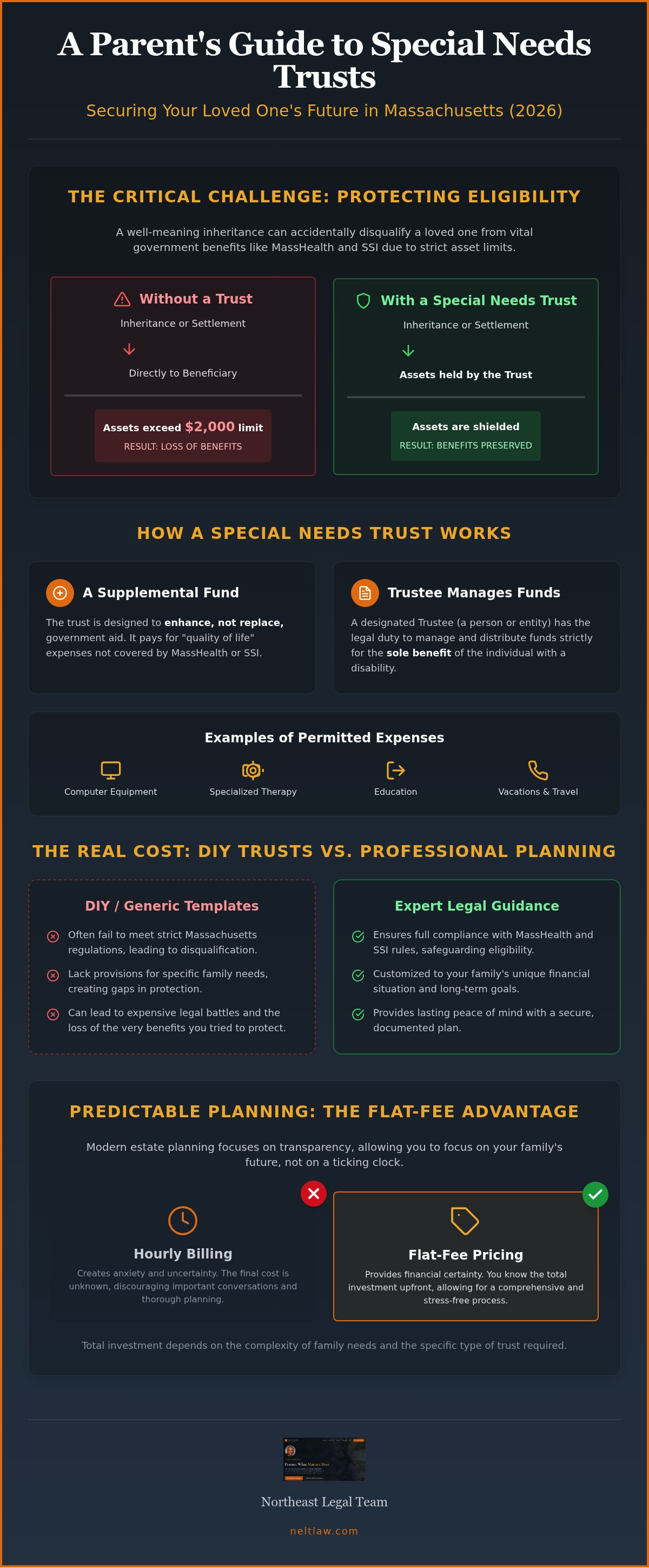
A Special Needs Trust (SNT) is a legal tool designed to protect the quality of life for a person with a disability. In Massachusetts, many families rely on programs like MassHealth and Supplemental Security Income (SSI) to cover basic medical care and housing. However, these programs are means-tested, meaning the beneficiary cannot own more than $2,000 in countable assets. If a well-meaning relative leaves a direct inheritance of $5,000, that individual could lose their health coverage and monthly income overnight. Understanding What is a Special Needs Trust? is the first step toward preventing this scenario. This trust holds assets for the beneficiary's benefit without those funds counting toward that strict asset limit. While families often worry about the initial cost of setting up a special needs trust in Massachusetts, the long-term protection it provides often far outweighs the legal fees.
Think of the trust as a supplemental fund. It isn't meant to replace government aid, but rather to enhance the beneficiary's life. The money can be used for things the government doesn't cover, such as specialized physical therapy, computer equipment, or even a much-needed vacation. Without this structure, an inheritance or a personal injury settlement would have to be spent down until the person is nearly impoverished again before benefits could resume.
The Role of the Trustee in Massachusetts
Choosing a trustee is a significant decision for families in Middlesex County. This person or entity holds the legal responsibility of managing the trust's assets and making distributions according to state law. A trustee must ensure that every dollar spent is for the sole benefit of the individual with a disability. While many parents initially want to name a sibling or close relative, they often realize the burden of reporting to state agencies can be heavy. Professional trustees are often preferred because they understand the complex reporting requirements and don't let personal emotions cloud financial decisions. They ensure the trust remains compliant so the beneficiary stays protected.
Preserving MassHealth and SSI Eligibility
In 2026, the financial rules for government aid remain strict. MassHealth and SSI look at two different buckets: what you earn (income) and what you own (assets). Even a small life insurance payout or a modest savings account can trigger a disqualification notice if it pushes the beneficiary over the $2,000 asset threshold. By holding assets in a specifically drafted trust, the funds are legally considered unavailable to the beneficiary, which effectively shields these resources from being counted by MassHealth or the Social Security Administration. This ensures that the cost of setting up a special needs trust in Massachusetts becomes an investment in the beneficiary's long-term stability and happiness.
Estimated Costs for Setting Up a Special Needs Trust in 2026
When you start researching the cost of setting up a special needs trust in Massachusetts, you'll find that the legal industry is moving away from unpredictable hourly billing. Families in Worcester and Middlesex counties are increasingly seeking the clarity of flat-fee models. This approach allows you to understand your total investment from the very first meeting, removing the anxiety of a ticking clock during sensitive family discussions. A comprehensive setup typically involves more than just a single document; it usually includes a coordinated plan with a pour-over will and power of attorney to ensure no gaps exist in your loved one's protection.
The total investment depends largely on the type of trust required and the complexity of your family's financial situation. A well-structured trust also considers broader tax implications, such as the $2 million Massachusetts estate tax threshold, ensuring your family's legacy is preserved for the long term. If you are unsure which path is right for your family, starting with a free initial assessment can help clarify the specific steps needed for your situation.
Third-Party SNTs: The Most Common Choice for Parents
Third-party trusts are the most frequent choice for parents and grandparents who wish to leave a legacy for a child or grandchild. These trusts are funded with assets that never belonged to the beneficiary. Because these don't require court intervention or the complex "Medicaid payback" provisions found in other structures, they are generally more straightforward and affordable to establish. To remain effective, these documents must strictly adhere to Social Security Administration rules on trusts to ensure that SSI benefits remain uninterrupted.
First-Party (Self-Settled) SNTs: Complexity and Costs
First-party trusts, also known as self-settled trusts, are necessary when the person with a disability receives their own funds. This often happens after a personal injury settlement or an unexpected inheritance. These trusts are subject to much higher levels of legal oversight. They must include specific language to comply with the Special Needs Fairness Act and often involve court filing fees and formal approval processes. Because of these additional layers of state and federal compliance, the legal work required is more intensive. This complexity naturally influences the cost of setting up a special needs trust in Massachusetts, but it remains a vital step to prevent the total loss of essential benefits.
Factors That Influence Legal Fees in Massachusetts
Every family has a unique story, and the legal plan protecting that story should reflect its specific needs. While we have discussed general fee ranges, several factors can shift the total cost of setting up a special needs trust in Massachusetts. For instance, a blended family with children from different marriages often requires more complex "if-then" instructions than a smaller, single-beneficiary household. If your plan requires detailed care instructions for a trustee to follow, the additional time spent customizing these directives will naturally influence the final investment.
The types of assets you choose to protect also play a significant role. Transferring a primary residence in Middlesex County into a trust involves more detailed legal work, such as deed preparation and title review, than simply funding an account with cash. Many families find that the most cost-effective way to handle these complexities is by choosing an estate planning attorney flat fee structure. This model ensures that you aren't penalized for asking the questions necessary to get your plan exactly right.
Middlesex and Worcester County Probate Nuances
Probate courts in Worcester and Middlesex counties have their own administrative rhythms and fee structures. In 2026, staying current with local filing fees and specific court requirements is essential for a smooth process. While some national services offer "one size fits all" templates, they often miss these local nuances that can cause delays or extra expenses. Choosing a local expert who understands the specific preferences of Massachusetts probate judges ensures your trust is built on a solid foundation. This regional knowledge is often the difference between a plan that works and one that gets stalled in administrative paperwork.
Coordination with Other Estate Planning Documents
A Special Needs Trust doesn't exist in a vacuum. It works best when it's part of a larger, cohesive strategy designed to protect the entire family legacy. If you're also looking to protect your own home or retirement savings from future long-term care expenses, you might consider how the Medicaid asset protection trust cost fits into your overall budget. Many families find that bundling their SNT with a broader asset protection plan is more efficient. This holistic approach ensures that your power of attorney, healthcare directives, and trusts all speak the same language. It also typically reduces the per-document price compared to drafting each piece of the puzzle separately over several years.
The Real Cost of Inaction: Why DIY Trusts Can Be Expensive
It's natural to look for ways to save money, especially when you're already managing the high costs of daily care. However, using an online template for such a sensitive document often creates a false sense of security. These generic forms frequently fail to meet strict Massachusetts-specific trust laws, which are some of the most complex in the country. While the initial cost of setting up a special needs trust in Massachusetts might seem like an extra expense, it's actually a protective shield against future disaster. A single "wrong" word or a missing clause can disqualify a beneficiary from thousands of dollars in monthly aid, leaving them without the support they need most.
Some families try the "Sibling Strategy," where they leave an inheritance to a brother or sister with the verbal understanding that they will care for their sibling with a disability. This is incredibly risky. if that sibling faces a divorce, a lawsuit, or a bankruptcy, those funds are legally theirs and can be seized by creditors. Correcting these mistakes after you're gone is a heart-wrenching and expensive process. Legal fees to fix an invalid trust after the grantor passes away often end up being triple what the original setup would have cost. It's much simpler and safer to get it right the first time.
The 'Medicaid Payback' Trap
A poorly drafted trust can accidentally trigger a "Medicaid payback" requirement that wasn't necessary. While Third-Party trusts allow you to name other family members to receive remaining funds after the beneficiary passes away, First-Party trusts require the state to be reimbursed for every dollar spent on medical care. If your document lacks specific "discretionary" language, state agencies may argue the funds are actually available to the beneficiary. This simple oversight can lead to an immediate loss of aid and the eventual seizure of the trust's remaining balance by the state. Ensuring your trust has the correct legal language is the only way to prevent this outcome.
Lost Benefits vs. Legal Fees
When you compare a one-time legal fee to the lifetime value of MassHealth coverage, the math becomes very clear. Losing just one year of benefits could cost your family tens of thousands of dollars in out-of-pocket medical expenses and therapy costs. A professional review ensures your trust is bulletproof against state audits, providing a level of certainty that no software can offer. This peace of mind allows you to focus on your family's daily happiness rather than worrying about the next letter from a government agency. If you're ready to build a plan that truly lasts, you can start by scheduling a free initial assessment with our team today.
Transparent Planning: The Northeast Legal Team Advantage
We believe that planning for your loved one's future should be a source of relief, not a source of financial stress. By offering a predictable flat-fee model, we remove the worry of a ticking clock. When families ask about the cost of setting up a special needs trust in Massachusetts, they are often looking for more than just a number; they are looking for a partner who understands the stakes. Our firm has spent over 14 years serving families in Middlesex and Worcester counties, focusing specifically on the delicate balance of protecting assets while maintaining eligibility for vital state programs.
Choosing a legal partner is about finding a steady hand to guide you through life's most uncertain moments. We've seen how the right trust structure can transform a family's outlook, replacing anxiety with a sense of order and tranquility. Because we focus on flat-fee pricing, you can feel comfortable taking the time to ask every question and explore every detail without fear of an unexpected bill. This transparency is the foundation of the trust we build with every client we serve.
Our Compassionate Consultation Process
Our approach is rooted in a "listen-first" philosophy. We know that no two families are the same, so we begin by understanding the unique care needs and goals for your loved one. We take pride in stripping away the dense legalese that often makes special needs planning feel inaccessible. Instead, we provide plain English explanations that empower you to make informed decisions. We also understand that a trust is just one part of a larger care ecosystem. That's why we coordinate closely with your financial advisors and care providers to ensure your legal plan supports your financial strategy and your loved one's daily requirements.
Taking the Next Step for Your Family
Moving from a state of worry to a state of resolution starts with a single conversation. We invite you to schedule a free initial assessment where we can discuss your specific situation and provide a personalized quote. To help you prepare, we also offer a comprehensive checklist for special needs planning in Massachusetts. This resource helps you organize your thoughts and gather the information needed to build a robust protection plan. Don't let the fear of complex laws or hidden fees prevent you from securing the life your loved one deserves.
Secure your loved one's future with a free special needs assessment today.
Securing Your Family's Peace of Mind
You now have a clearer understanding of how a Special Needs Trust serves as a vital shield for your loved one's independence. By choosing a structured path, you ensure that essential benefits like MassHealth and SSI remain intact while providing for the extras that make life meaningful. We've explored how the cost of setting up a special needs trust in Massachusetts is a manageable investment when compared to the devastating financial impact of lost government aid or a failed DIY plan.
At Northeast Legal Team, we bring over 14 years of local experience to every conversation. Our flat-fee pricing model ensures you'll never face a surprise bill, allowing you to focus on what truly matters: your family's long-term happiness. We are here to act as your compassionate guide, turning complex legal requirements into a simple, effective plan that provides lasting certainty.
Ready to take the next step? Schedule Your Free Special Needs Planning Assessment today. You don't have to carry this weight alone; we're here to help you build a legacy of care and security.
Frequently Asked Questions
Is a Special Needs Trust worth it if my child only has a small inheritance?
Yes, a Special Needs Trust is absolutely worth it even for a small inheritance because even $2,001 can disqualify your child from MassHealth. The value of maintaining health coverage and monthly income is almost always higher than the inheritance itself. By placing these funds in a trust, you provide your loved one with extra support for quality-of-life needs without risking the essential government aid they rely on for survival.
Can I set up a Special Needs Trust without a lawyer in Massachusetts?
You can technically use an online template, but doing so is very risky because Massachusetts has unique and strict trust laws. A single error in the trust's language can lead to an immediate loss of government aid. When you consider the lifetime value of benefits, the cost of setting up a special needs trust in Massachusetts with a professional is a small price for the certainty that your loved one stays protected.
What happens to the money in an SNT when the beneficiary passes away?
What happens to the remaining funds depends entirely on the type of trust you create. With a Third-Party trust, you can designate other family members or charities to receive the leftover money. However, a First-Party trust funded with the beneficiary's own assets usually requires a "Medicaid payback" provision. This means the state must be reimbursed for medical expenses before any other heirs can receive a distribution from the remaining balance.
How much does it cost to maintain a Special Needs Trust annually?
Annual costs typically include tax preparation and potentially management fees if you use a professional trustee. While families often focus on the initial cost of setting up a special needs trust in Massachusetts, it's helpful to plan for these modest yearly expenses. If a family member manages the trust, the costs remain quite low. Professional trustees usually charge a small percentage of the assets to ensure everything stays compliant with state and federal laws.
Can an SNT pay for things like a car or a vacation?
Yes, a Special Needs Trust can pay for supplemental items like a car, a vacation, or specialized therapy. These funds are designed to enhance your child's life beyond the basic food and shelter provided by the government. The key is that the trustee must pay the vendor directly. Giving cash to the beneficiary could count as income, which might reduce their monthly SSI check or disqualify them from other programs.
Does MassHealth have to be notified when I create an SNT?
Yes, you must notify MassHealth and provide them with a copy of the trust document for their review. They need to verify that the trust is drafted correctly and that the assets are truly "non-countable" toward the $2,000 limit. Working with a local expert ensures the trust contains the specific language MassHealth agents look for, which helps prevent delays or benefit interruptions during the state's mandatory approval process.
What is the difference between an ABLE account and a Special Needs Trust?
The main difference is that ABLE accounts have annual contribution limits, while Special Needs Trusts can hold unlimited assets. In 2026, the Massachusetts ABLE contribution limit is $20,000. An ABLE account is often easier to manage for small daily expenses, but an SNT provides much more robust protection for larger inheritances. Using both tools together often creates the most flexible and secure long-term plan for your family's needs.
How do I choose the right trustee for my child's trust in MA?
You should choose a trustee who is financially responsible, organized, and deeply committed to your child's well-being. Many families in Middlesex and Worcester counties name a sibling as a co-trustee alongside a professional. This pairs personal knowledge of the child's life with professional expertise in complex state reporting. It's a significant responsibility, so choosing someone reliable ensures the trust remains in good standing and your child's future stays secure.


